
By maxaeo.ai · Updated August 20, 2026
AI SEO tools are not one product category. The best ones help you write content, optimize pages, or measure whether AI systems actually mention and cite your brand. For SaaS teams, that last layer matters because discovery now happens across Google’s AI features as well as assistants like ChatGPT, Perplexity, Gemini, and Copilot.
What are AI SEO tools?
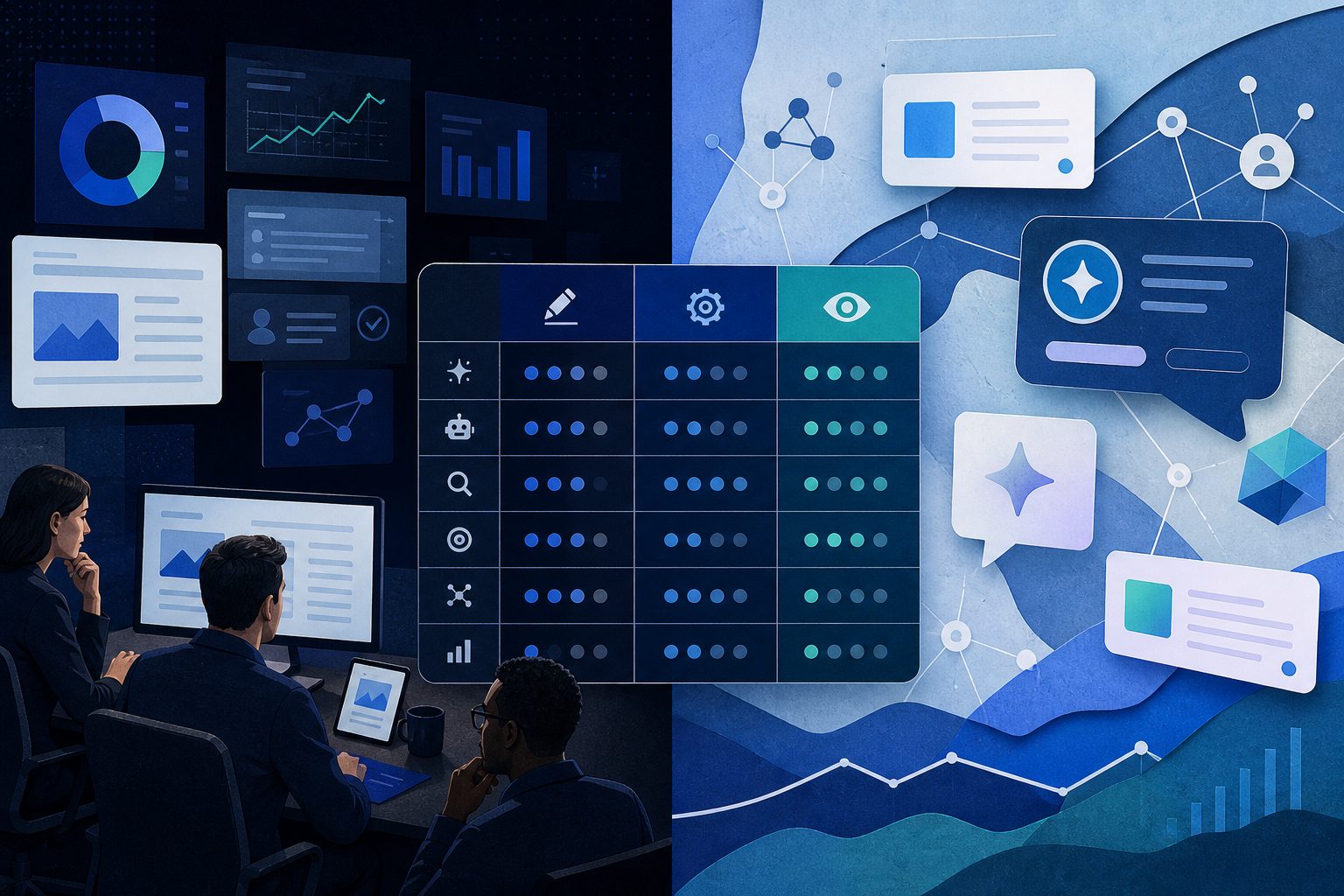
AI SEO tools are software products that use AI to support search work such as keyword research, content briefs, on-page optimization, technical analysis, and AI-answer visibility tracking. In practice, they fall into three jobs: create, improve, and measure.
That distinction matters because the wrong tool can still feel productive while missing the real problem. Google Search Central notes that its AI features follow the same foundational SEO best practices, with no special technical requirements beyond being indexable and eligible for snippets. See Google Search Central’s guidance on AI features. For page titles, Google also recommends concise, descriptive titles and warns against stuffing; its title link guidance is still a useful benchmark for tool selection.
What current ranking pages cover—and what they usually miss
Current top pages for ai seo tools do a solid job listing popular products, comparing entry prices, and splitting tools into content, optimization, and all-in-one SEO suites. Some also acknowledge AI visibility or GEO. That part is useful, but it is usually not enough.
What is commonly missing is the decision layer: which job you are actually buying, how much source-level visibility you need, and whether the tool can trace AI answers back to citations. Most roundups stop at “best tools” and do not answer “best for what?” or “what gets measured next?”
| What most roundups cover | What they often miss | Why that matters |
|---|---|---|
| Tool lists, pricing, and feature checklists | A job-based buying framework | A content generator does not solve a visibility problem |
| Hands-on impressions and editorial scores | Citation tracing and source attribution | You need to know why AI mentioned a competitor |
| Some AI visibility mentions | Actionable workflow and follow-up steps | Monitoring without remediation creates reporting, not progress |

How to choose AI SEO tools without buying the wrong layer
The best way to choose ai seo tools is to separate the workflow into three layers. Most teams need all three eventually, but not all at once.
| Layer | Primary job | Best for | Typical tool examples |
|---|---|---|---|
| Content creation | Draft briefs, outlines, and first-pass copy | Content teams and solo marketers | Jasper, Frase, MarketMuse-style workflows |
| Content optimization | Improve existing pages and briefs | SEO managers and editors | Surfer, Clearscope, Semrush, Ahrefs |
| AI visibility tracking | Measure mentions, citations, and recommendation patterns in AI answers | SaaS, DTC, and brand teams | MaxAEO, Peec AI, Otterly-style monitoring |
The practical rule is simple: if your issue is quality, buy optimization; if your issue is production, buy creation; if your issue is being surfaced by AI systems, buy visibility tracking. A stack built around one of those jobs is usually cheaper and easier to operate than a single oversized platform that tries to do everything at once.
For a broader selection framework, see AI tool for SEO: how to choose the right stack.
A better buying scorecard for SaaS teams
A useful scorecard for ai seo tools should weigh six signals, not just price:
- Job fit — Does the tool solve the task you actually need done?
- Data depth — Does it rely on thin suggestions or real search data?
- AI-engine coverage — Does it track only one assistant, or the platforms your buyers use?
- Citation traceability — Can it show where the AI answer got its source?
- Actionability — Does it tell you what to change next?
- Reporting fit — Can your team share the output with content, SEO, and leadership?
If a tool cannot answer who cited you, what source they used, and what changed after the citation moved, it is not a full AI visibility solution. That is especially relevant for SaaS buyers who need to compare branded and non-branded prompts over time. For a deeper strategy view, the AI search strategy framework is the right next read.
Where MaxAEO fits in the stack
MaxAEO fits the visibility layer, not the content-generation layer. It monitors brand visibility across 8 AI engines, including ChatGPT, Perplexity, Gemini, DeepSeek, Copilot, Grok, Google AI Mode, and Google AI Overview. It also tracks brand mentions, citations, recommendations, sentiment, competitor comparisons, and daily trends.
That matters when your question is not “What should I write?” but “How often does AI recommend us, cite us, or prefer a competitor instead?” MaxAEO’s free AI visibility diagnostic can generate a report from a brand name, website, and competitor set without internal documents. For teams that want a practical visibility workflow, the right companion reading is Generative Engine Optimization tools: selection criteria and buying guide and Best rated answer engine optimization tools.
The point is not to replace your SEO stack. It is to close the gap that most traditional tools leave open: what AI engines say about your brand, where they got it, and how that changes over time.
What to prioritize by team type
Different teams should buy different parts of the stack first.
- Content-led teams should start with drafting and briefing tools.
- SEO teams should start with content optimization and technical analysis.
- Brand, growth, and SaaS teams should add AI visibility monitoring early, because the audience may already be discovering alternatives inside AI answers.
- Agencies usually need reporting, competitor benchmarking, and multi-brand monitoring more than a pure writing assistant.
A good litmus test: if a tool helps you publish faster but cannot tell you whether AI systems are citing the right sources, it is only solving half the job. If a tool tracks visibility but does not help you fix what the AI is seeing, it is also incomplete.
The simplest way to think about the category
Here is the short version: ai seo tools are most useful when they are matched to the layer of work you are trying to improve. Content tools help you create. Optimization tools help you refine. Visibility tools help you understand how AI systems represent your brand.
That is why buying decisions should start with the question, “What failure do we need to remove first?” For many SaaS teams, the answer is no longer just rankings. It is also mentions, citations, sentiment, and recommendation share inside AI answers.
Frequently asked questions
Are AI SEO tools the same as AI visibility tools?
No. AI SEO tools is the broader category. It can include writing assistants, page optimizers, technical SEO software, and AI visibility platforms. AI visibility tools are the subset focused on how your brand appears in AI answers, citations, and recommendations.
Do I still need traditional SEO software?
Yes. Google’s guidance says AI features still depend on foundational SEO best practices, so classic SEO work remains relevant. Keyword research, technical audits, internal linking, and page quality still matter even when you are also tracking AI mentions.
What should a SaaS team buy first?
If your content team is weak, start with drafting and optimization. If your pages are strong but your brand does not appear in AI answers, start with visibility monitoring. Many SaaS teams need a traditional SEO suite plus an AI visibility layer.
How often should AI visibility be checked?
For competitive SaaS categories, daily or near-daily tracking is more useful than monthly snapshots because AI answers can shift quickly. If you are monitoring a small site with low volatility, weekly checks may be enough for early-stage learning.
Can one tool cover everything?
Rarely well. A single platform may cover multiple jobs, but most tools are strongest in one layer. The better strategy is to choose a core SEO suite, then add a content optimizer or AI visibility tracker where the gap is real.