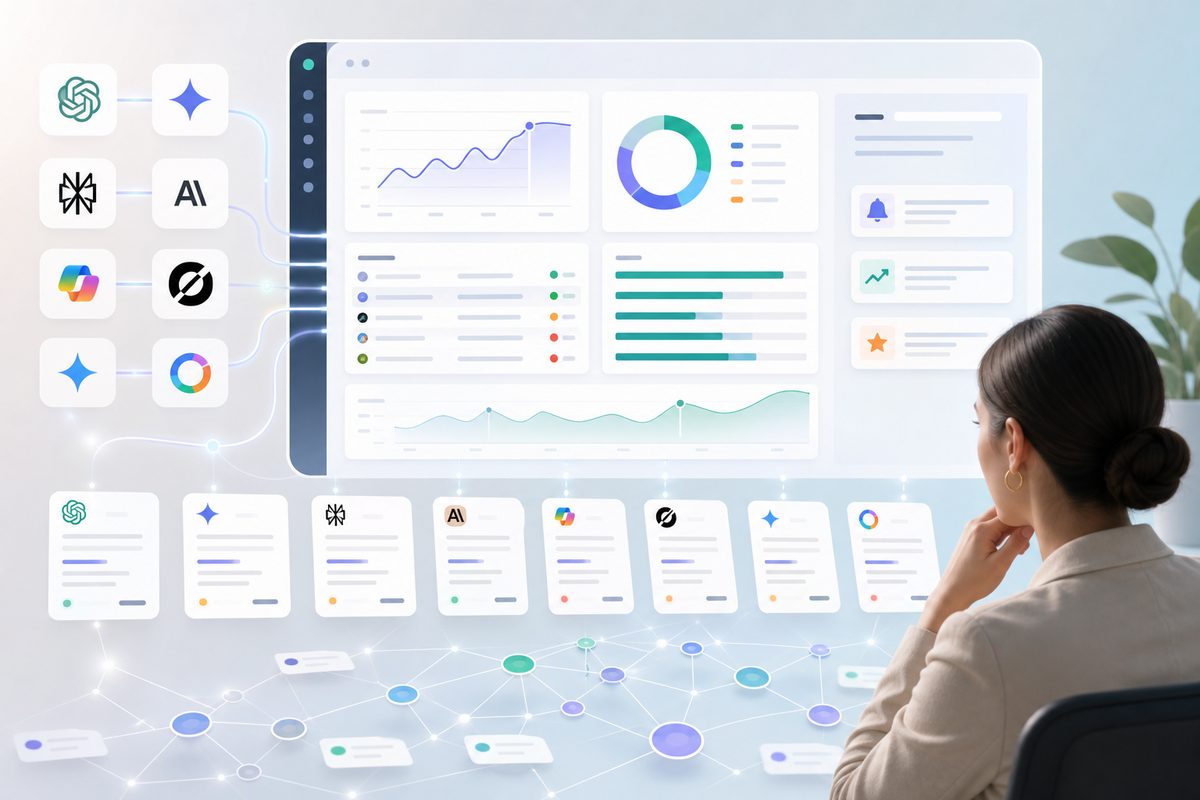
AI search visibility software helps marketing teams measure whether AI answer engines mention, recommend, rank, cite, and accurately describe their brand when buyers ask commercial questions. The right platform does not just show a visibility score. It preserves answer evidence, compares competitors, traces citations, and turns findings into fixes your SEO, content, PR, and product marketing teams can actually ship.
This buying guide is for teams evaluating AI search monitoring, answer engine optimization, generative engine optimization, LLM brand tracking, and AI reputation management platforms. It gives you a practical scorecard, vendor test plan, feature checklist, pricing questions, and decision framework for choosing software that can support real budget decisions.
What is AI search visibility software?
AI search visibility software is a platform that tracks how often AI engines mention, recommend, cite, rank, and describe a brand across monitored prompts, competitors, markets, and time. It replaces one-off manual checks with repeatable measurement, raw answer evidence, source analysis, sentiment review, and optimization workflows.
A useful platform should answer six questions:
- Presence: Does AI mention our brand for buyer-intent prompts?
- Position: Are we recommended before or after competitors?
- Citation: Which sources, pages, reviews, docs, and directories support the answer?
- Accuracy: Is our product described correctly?
- Movement: Did visibility change after we shipped fixes?
- Ownership: What should SEO, PR, content, product marketing, or partnerships do next?
This is different from classic rank tracking. SEO rank trackers follow URL positions in traditional search results. AI search visibility software follows generated answers, brand mentions, recommendation order, citations, answer wording, factual accuracy, and AI share of voice.
What buyers usually miss when comparing tools
Most commercial pages for AI visibility tools cover the obvious features: engine coverage, prompt tracking, competitor reports, citation tracking, sentiment, and dashboards. Those matter, but they are not enough to choose a platform.
For this guide, MaxAEO reviewed 12 English-language pages targeting “AI search visibility software,” “AI visibility tools,” and related buying queries in June 2026. The pattern was consistent: many pages explain the category, but fewer show buyers how to test measurement quality before purchase.
| Buying area | Commonly covered | Often missing | What to require |
|---|---|---|---|
| Engine coverage | Lists of ChatGPT, Perplexity, Gemini, Claude, Copilot, and Google surfaces | Country, language, surface, citation availability, and run frequency | Engine-by-engine evidence, not one blended score |
| Prompt tracking | Prompt volume and keyword imports | Prompt ownership, versioning, intent tags, and change history | Governed prompt sets mapped to buyer journeys |
| Metrics | Visibility score, mentions, sentiment | Confidence, repeated runs, raw answers, and time-series movement | Exportable evidence with timestamps |
| Citations | Source URLs | Owned vs earned vs community citations | Source-level prioritization and fix ownership |
| Competitors | Share-of-voice charts | Why AI prefers one competitor | Prompt-level reasoning and cited proof points |
| Workflows | Dashboards | Ticketable fixes and post-fix validation | Clear next actions for SEO, PR, content, and brand teams |
The practical takeaway: do not buy the tool that looks best in a demo. Buy the tool that can prove what changed, why it changed, and what to do next.
How AI search visibility software differs from SEO software
AI search visibility software and SEO platforms overlap, but they measure different discovery surfaces.
| Capability | SEO rank tracking | AI search visibility software |
|---|---|---|
| Primary unit tracked | URL ranking position | Generated answer and brand presence |
| Query format | Keywords | Buyer prompts and natural-language questions |
| Output measured | SERP position, clicks, impressions | Mentions, recommendation rank, citations, sentiment, accuracy |
| Competitor view | Competing URLs and domains | Competing brands, products, sources, and claims |
| Evidence needed | Ranking snapshots and Search Console data | Raw answer text, cited URLs, engine, prompt, date, and run history |
| Main action | Improve pages for search rankings | Improve entity clarity, source coverage, citations, and answer accuracy |
Google’s guidance for AI features says AI Overviews and AI Mode may use different models and techniques, and that links can vary because of query fan-out. Google also states there are no additional technical requirements or special schema required to appear in these features beyond normal Search eligibility and SEO fundamentals. That makes measurement, source quality, and content usefulness more important than chasing a special “AI markup” shortcut.
Which engines should the platform cover?
Good engine coverage means tracking the AI surfaces your buyers actually use, not collecting logos. A B2B SaaS team should usually evaluate ChatGPT, Gemini, Perplexity, Claude, Copilot, Grok, Google AI Mode, and Google AI Overviews when those surfaces are available in the target market.
Coverage should include:
- Engine and surface: ChatGPT search, Perplexity, Gemini, Claude, Copilot, Grok, AI Overviews, AI Mode, or another relevant assistant.
- Market and language: Country, region, language, and localization settings.
- Run frequency: Daily, weekly, repeated samples, or on-demand checks.
- Citation availability: Whether the engine provides source links for the answer.
- Raw evidence: Prompt, answer, cited URLs, timestamp, engine, model or surface when available, and screenshots where useful.
A single “AI visibility score” is not enough. A brand may appear strongly in Perplexity because it earns citations, underperform in ChatGPT because its entity signals are unclear, and fail to trigger in Google AI Overviews because its best content is not indexed or eligible for snippets.
Why prompt governance matters more than prompt volume
Prompt governance matters because AI visibility is measured against buyer questions, not keyword strings. A platform with 5,000 weak prompts can be less useful than one with 150 well-managed prompts mapped to commercial intent, category language, competitor alternatives, objections, and regions.
A strong prompt set includes five groups:
- Category shortlist prompts: “Best customer onboarding software for enterprise SaaS.”
- Alternative prompts: “Best alternatives to [competitor] for mid-market teams.”
- Use-case prompts: “Tools to reduce churn in product-led SaaS.”
- Problem prompts: “How can a B2B SaaS team improve expansion revenue?”
- Reputation prompts: “Is [brand] a reliable vendor for regulated companies?”
The platform should support prompt owners, tags, versions, markets, languages, history, and change notes. Without versioning, you cannot tell whether visibility improved because your brand earned more authority or because someone rewrote the test.
For a practical build process, use MaxAEO’s guide to turning SEO keywords into AI search prompts or the deeper workflow for building an AI search prompt set for brand monitoring.
What metrics should the software report?
The right platform reports visibility as a diagnostic set, not a single vanity number.
| Metric | What it tells you | Why it matters |
|---|---|---|
| Mention rate | How often your brand appears | Shows whether AI includes you in the category |
| Recommendation rank | Where your brand appears in lists | Shows whether you are first, buried, or absent |
| AI share of voice | Your presence versus competitors | Shows who owns the answer space |
| Citation rate | How often your owned or earned sources are cited | Shows whether AI has evidence it can use |
| Owned citation share | How often your site, docs, blog, or help center is cited | Shows whether your own content is influencing answers |
| Earned citation share | How often third-party sources cite or support you | Shows PR, review, directory, analyst, and partner opportunities |
| Sentiment | Whether descriptions are positive, neutral, negative, or uncertain | Shows brand perception risk |
| Accuracy | Whether claims about your company are correct | Shows product, pricing, positioning, and reputation risk |
| Competitor delta | Where rivals outperform you | Shows which gaps matter commercially |
| Prompt-level movement | Which buyer questions improved or declined | Shows where to act next |
Two 2026 research papers support a cautious measurement approach. “Don’t Measure Once: Measuring Visibility in AI Search” argues that AI search visibility should be measured repeatedly because answers vary across prompts, runs, and time. “Quantifying Uncertainty in AI Visibility” makes a similar point for citation visibility: single-run measurements can look more precise than they really are.
That does not mean AI visibility is impossible to measure. It means your software should show repeated observations, raw answers, and trend direction rather than pretending one run is a permanent truth.
For KPI definitions, compare your reporting plan with MaxAEO’s guide to AI search visibility metrics.
How should citation tracking work?
Citation tracking matters because a brand mention and an AI citation are not the same thing. A mention shows that the AI included your company. A citation shows which page, publication, review, directory, documentation, or community source may have supported the answer.
A serious platform should separate:
- Brand mentions: The answer names your company.
- Product mentions: The answer names a specific product, feature, or integration.
- Owned citations: The answer cites your website, docs, blog, changelog, or help center.
- Earned citations: The answer cites analyst, media, review, marketplace, partner, or directory pages.
- Community citations: The answer cites Reddit, GitHub, YouTube, forums, or comparison threads.
- Competitor citations: The answer cites sources that support a rival’s positioning.
Citation work is where SEO, PR, content, partnerships, and product marketing meet. If an AI engine recommends a competitor and cites a third-party comparison page, the fix may not be another blog post. It may be review profile cleanup, partner-page updates, analyst outreach, clearer documentation, or correcting outdated information on high-trust sources.
Use citation reports to answer three commercial questions:
- Which sources influence buyer-facing answers?
- Which of those sources can we improve, update, or earn?
- Did answer wording change after the source changed?
For a deeper evaluation framework, see MaxAEO’s buyer guide to AI visibility tools with citation tracking.
How should competitor benchmarking work?
Competitor benchmarking should explain why AI recommends one brand over another. A leaderboard is useful, but the real value is prompt-level evidence: cited sources, feature language, positioning, proof points, and missing claims.
Benchmark at three levels:
| Level | Example prompt | What to compare |
|---|---|---|
| Category | “Best product analytics tools” | Inclusion, recommendation rank, cited sources |
| Segment | “Best product analytics tools for enterprise SaaS” | Enterprise fit, security claims, integrations, compliance proof |
| Alternative | “Best alternatives to [competitor]” | Differentiators, objections, migration language, outdated claims |
| Use case | “Tools to reduce churn in PLG SaaS” | Problem framing, feature relevance, customer proof |
| Reputation | “Is [brand] reliable for regulated companies?” | Accuracy, sentiment, risk language, cited evidence |
Do not benchmark only direct competitors. AI answers often include adjacent tools, open-source projects, large suites, agencies, marketplaces, and category leaders from neighboring segments. Those unexpected co-mentions can explain why your AI share of voice is weaker than your traditional SEO position.
A good platform should let you freeze a competitor set for recurring reports while also surfacing new brands that appear repeatedly. For the workflow, use MaxAEO’s guide to AI search competitor analysis.
What should the optimization workflow include?
A dashboard shows what happened. An optimization workflow tells the right owner what to fix, where to fix it, and how to confirm whether the answer changed after the next measurement cycle.
Look for issue types that can become work tickets:
- Missing brand in category prompts
- Competitor outranking your brand
- Wrong company, product, pricing, or market description
- Missing owned citations
- Weak third-party citations
- Outdated review, directory, or marketplace profiles
- Inconsistent naming across product pages and external sources
- Unclear category positioning
- Negative or uncertain sentiment
- Unsupported claims in AI answers
The fix path should be specific. “Improve AI visibility” is not a task. “Update the comparison page to address SOC 2, SSO, enterprise pricing, and migration support because Claude and Perplexity cite competitors for those proof points” is a task.
Google’s helpful content guidance is a useful quality guardrail: content should provide original information, complete coverage, clear sourcing, and value beyond rewriting other pages. AI search visibility software should help teams find evidence gaps, not encourage shallow pages written only to target AI systems.
How should you run a 14-day vendor test?
Run a vendor test with your own prompts, competitors, and engines before buying. A polished demo using vendor-selected data does not prove the platform can handle your category, naming issues, source gaps, or executive reporting needs.
Use this 14-day test:
- Pick one commercial topic cluster. Choose a category that sales already cares about.
- Create 30 prompts. Include shortlist, alternative, use-case, problem, and reputation prompts.
- Add five to eight competitors. Include direct competitors, suites, and emerging alternatives.
- Track at least four engines. Include one citation-heavy engine and one broad assistant.
- Run daily checks. Avoid relying on a single snapshot.
- Export raw evidence. Require prompt, answer, source URL, engine, date, rank, sentiment, and screenshot where available.
- Tag issues. Separate visibility gaps, citation gaps, factual errors, and positioning gaps.
- Ship three fixes. Update one owned page, one third-party profile, and one internal link path.
- Measure again. Look for directional movement, not instant certainty.
- Review reporting. Ask whether an executive, PR lead, SEO lead, and content owner can each use the output.
The pass/fail question is simple: after 14 days, can the software show what changed, why it matters commercially, and what your team should do next?
A 100-point scorecard for buying
Use this scorecard to compare vendors without over-weighting a single feature such as engine count or a proprietary score.
| Category | Weight | What “good” looks like |
|---|---|---|
| Engine coverage | 15 | Tracks the AI surfaces your buyers use, with market, language, citation, and surface context |
| Prompt governance | 15 | Supports prompt sets, tags, versions, owners, regions, languages, and history |
| Measurement reliability | 15 | Runs repeated checks, preserves raw answers, and shows time-series movement |
| Citation traceability | 15 | Separates mentions from citations and maps source URLs clearly |
| Competitor benchmarking | 10 | Compares ranks, share, citations, and reasons across competitors |
| Sentiment and accuracy | 10 | Flags wrong, outdated, negative, or ambiguous brand descriptions |
| Reporting and exports | 10 | Provides CSV/API exports, screenshots, client-ready reports, and evidence trails |
| Optimization workflow | 10 | Converts findings into prioritized fixes for SEO, PR, content, and brand teams |
Scoring guide:
| Score | Meaning | Buying recommendation |
|---|---|---|
| 0-69 | Monitoring experiment | Use only for limited audits or early learning |
| 70-84 | Operational tool | Good for focused GEO or AEO programs |
| 85-100 | Decision-grade platform | Suitable for recurring reporting, multi-team ownership, and agency or executive use |
Which platform type fits your team?
The best AI search visibility software depends on your operating model, not just your company size.
| Buyer | Best fit | Watch out for |
|---|---|---|
| B2B SaaS SEO lead | AI-native monitoring with prompt, citation, and competitor workflows | Tools that only add AI scores to keyword tracking |
| Brand or PR manager | Reputation, sentiment, factual accuracy, and source monitoring | Dashboards without raw-answer evidence |
| Startup founder | Focused prompt set, core competitors, and citation gap tracking | Overbuying enterprise reporting too early |
| Digital agency | Multi-brand workspaces, exports, white-label reporting, and API access | Pricing that scales badly by client, prompt, or engine |
| Enterprise SEO team | AEO-native platform or SEO-suite add-on tested against real prompts | Assuming classic rankings predict AI recommendations |
| Product marketing team | Competitor language, use-case prompts, and positioning gap analysis | Tools that cannot show why rivals are recommended |
If your team is choosing between a classic SEO suite and an AEO-native platform, compare the tradeoffs in MaxAEO’s breakdown of MaxAEO vs Semrush AI Visibility Toolkit.
What pricing questions should you ask?
Pricing can vary widely because vendors meter different things. Before signing, ask what changes the bill.
Key pricing dimensions:
- Number of brands or workspaces
- Number of prompts
- Number of engines and markets
- Run frequency
- Historical data retention
- Seats and permission levels
- Competitor count
- Raw answer exports
- API access
- White-label reporting
- Screenshots and evidence storage
- Agency or multi-client usage
The most important question is not “How many prompts do we get?” It is “How many commercially important prompts can we monitor often enough to make reliable decisions?”
A cheaper plan that checks too few engines or stores no raw evidence can cost more later because your team cannot defend the findings. An expensive plan is also wasteful if you do not yet have owners ready to fix citations, content, profiles, and positioning gaps.
What red flags should buyers avoid?
Most failed evaluations happen because teams buy a score instead of a workflow.
Avoid these red flags:
- ChatGPT-only monitoring: Buyers use multiple AI engines, and engines use different sources.
- No raw answer export: If you cannot inspect the answer, you cannot trust the metric.
- No citation separation: Mentions and citations should not be blended.
- No prompt versioning: You need to know whether the test changed.
- No competitor explanation: Share of voice without reasons is hard to act on.
- No data retention: AI visibility is a trend problem, not a one-day snapshot.
- No owner workflow: Findings should become SEO, PR, content, partnership, or product marketing tasks.
- Guarantees of AI recommendations: No credible vendor can guarantee that ChatGPT, Gemini, Perplexity, Claude, Copilot, Grok, AI Mode, or AI Overviews will recommend your brand.
- Special markup promises: Google states that no special schema.org structured data is required for AI Overviews or AI Mode.
The strongest buying process starts with real prompts and ends with a fix queue, not a logo slide.
Where MaxAEO fits
MaxAEO is built for teams that need AI-native visibility tracking across major answer engines and Google AI search surfaces. It monitors how AI systems mention, rank, cite, and describe a brand, then translates findings into specific fixes.
MaxAEO is a strong fit when your team needs to:
- Track brand mentions in ChatGPT and other AI engines
- Measure AI share of voice against competitors
- Detect citation gaps and source opportunities
- Find inaccurate AI descriptions before they spread
- Compare owned, earned, and community citations
- Report AI search monitoring results across brands or clients
- Prioritize actions that help the brand become more likely to appear in buyer-facing answers
MaxAEO may be less urgent if you only need a one-time curiosity report, have no owner for content or PR fixes, or are not yet tracking a defined commercial prompt set. In that case, start with a small prompt audit, identify the questions that matter to pipeline, then move into ongoing monitoring once stakeholders are ready to act.
Final recommendation
Choose AI search visibility software the way you would choose a revenue-facing analytics system: test it with your data, require raw evidence, compare competitors, inspect citations, and confirm that the output changes what your team does next.
The terminology will keep shifting between AEO, GEO, AI SEO, LLM brand tracking, and AI search monitoring. The buying principle is stable: the right platform should show where AI recommends you, where it ignores you, where it cites weak sources, where it misstates your brand, and which fixes are most likely to improve future answers.
Common questions
What is the difference between AI search visibility software and SEO rank tracking?
AI search visibility software tracks generated answers, brand mentions, rankings inside AI responses, citations, sentiment, accuracy, and competitor share across AI engines. SEO rank tracking follows URL positions in traditional search results. Both matter, but they measure different discovery surfaces.
How many prompts should a B2B SaaS team track?
Start with 30 to 50 commercial prompts per major product line or category. Include shortlist, alternative, use-case, problem, and reputation prompts. Expand after you know which prompts map to sales conversations, competitor displacement, and source gaps.
Can software guarantee that we get recommended by ChatGPT?
No credible platform can guarantee recommendations in ChatGPT or any other AI engine. Software can monitor visibility, identify missing evidence, show citation gaps, flag inaccurate descriptions, benchmark competitors, and prioritize fixes that improve recommendation likelihood over time.
What features matter most in AI search visibility software?
The most important features are multi-engine tracking, prompt governance, repeated measurement, raw answer exports, citation tracking, competitor benchmarking, sentiment and accuracy checks, reporting, and workflows that turn findings into specific fixes.
Should agencies use the same setup for every client?
No. Agencies need a shared reporting framework, but each client needs its own prompt set, competitors, markets, source map, and fix workflow. A cybersecurity SaaS client and a developer tooling client may use the same engines but very different buyer questions.
What should be included in an executive AI visibility report?
Include AI share of voice, top prompt gains and losses, competitor movement, citation changes, inaccurate answer risks, priority fixes, screenshots or raw answer evidence, and a short explanation of business impact. Avoid reporting only a blended visibility score.