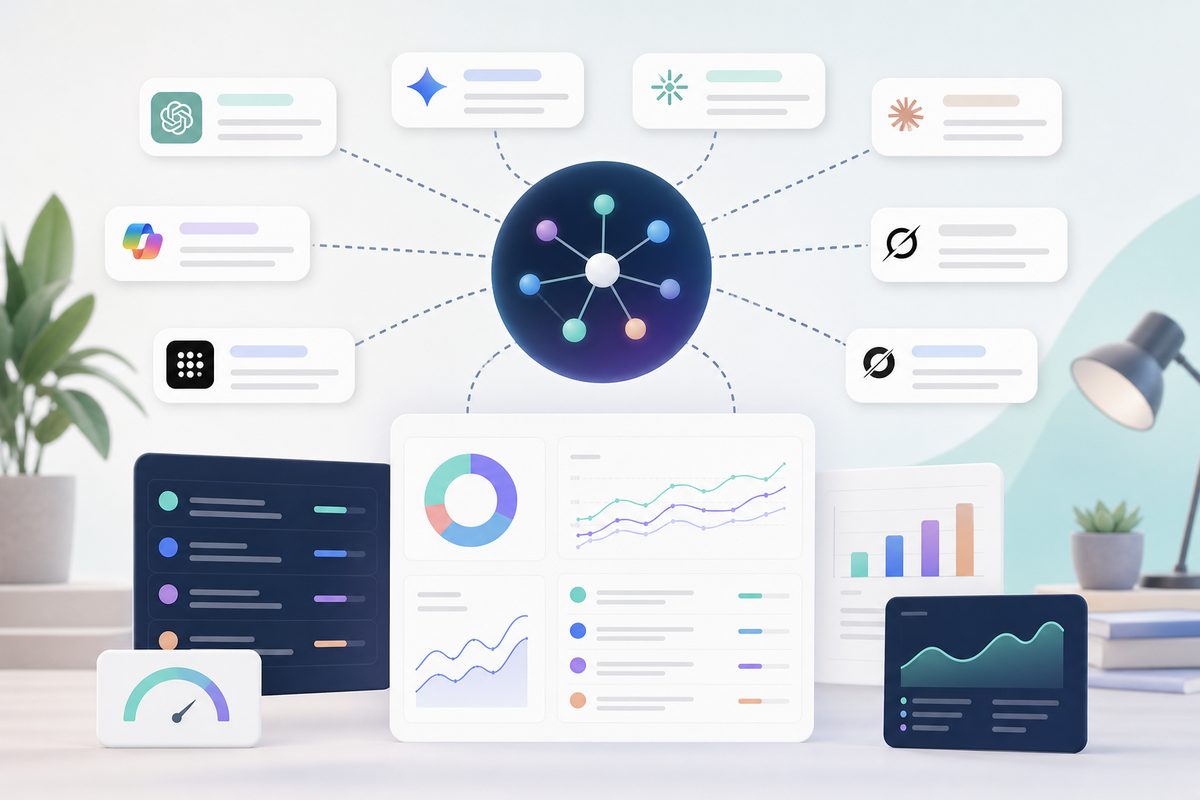
AI search share of voice is the percentage of relevant AI-generated answers where your brand appears versus competitors across a defined prompt set, answer engine set, and scoring method. It helps marketers answer a practical question: when buyers ask ChatGPT, Gemini, Perplexity, Claude, Copilot, Grok, Google AI Mode, or AI Overviews for category recommendations, does your brand make the shortlist?
That definition has one important constraint: AI search share of voice should be measured on non-branded discovery prompts, not only prompts that include your company name. A brand mention after someone searches for you is useful for AI reputation management. It is not the same as being recommended in a shortlist such as “best customer onboarding platforms for enterprise SaaS” or “top data observability tools for Snowflake teams.”
A useful benchmark combines four views:
- Mention share: how often your brand appears.
- Answer rank: where your brand appears when it is named.
- Category ownership: which buyer questions and use cases you win.
- Citation support: which sources AI systems use when describing you.
Quick Answer: How Do You Calculate AI Search Share of Voice?
Use this formula for the basic metric:
AI search share of voice = your brand mentions in tracked AI answers / total tracked mentions for all tracked brands
Example: if 200 AI answers contain 500 total brand mentions across your category, and your brand receives 75 mentions, your raw AI search share of voice is 15%.
For executive reporting, raw share is not enough. Use a weighted version:
Weighted AI search share of voice = your brand’s weighted points / total weighted points for all tracked brands
Weighted scoring should include mention presence, answer position, prompt importance, citation quality, category fit, and description accuracy. A first-position recommendation in ChatGPT for a high-intent comparison prompt should count more than a sixth-position mention in a vague educational answer.
What AI Search Share of Voice Measures
AI search share of voice measures competitive visibility inside answer engines. Instead of asking “Where does our URL rank?”, it asks:
- Are we included in AI-generated answers for relevant buyer questions?
- Are we recommended before or after competitors?
- Are we described accurately and specifically?
- Are we cited by sources the answer engine appears to trust?
- Do we show up for commercial discovery prompts, or only branded prompts?
This is why AI search monitoring is different from traditional rank tracking. SEO ranks documents. AI search often ranks, summarizes, and compares entities, claims, products, categories, and sources.
What Current Search Results Cover and What They Miss
A live review of Google results on June 12, 2026 for variants of “AI search share of voice,” “AI share of voice,” and “AI search visibility share of voice” showed a thin exact-match landscape. Ranking pages commonly explain generative engine optimization, AI visibility tools, or brand monitoring, but they rarely show how to build a defensible competitor benchmark.
| SERP theme | What ranking pages usually explain | What they often miss |
|---|---|---|
| GEO definitions | What generative engine optimization means | How to calculate prompt-cluster ownership |
| AI visibility tools | Which platforms track mentions or citations | How to separate vanity mentions from recommendation quality |
| AI search trends | Why answer engines change search behavior | How teams should build a repeatable benchmark |
| Share-of-voice analogies | How SOV works in SEO, PR, or paid media | How answer rank, prompt intent, and citations change the metric |
The information gain in this guide is the maxaeo AI SOV stack: a benchmark model that separates raw mentions, weighted recommendation value, source influence, and category ownership. It is built for teams that need to defend GEO and AEO investment with a repeatable measurement system, not screenshots.
The need is practical. A Semrush study reported by Business Insider found that only 22% of surveyed US marketers had a fully integrated AI search and SEO strategy. In the same survey, 37% said competitors were mentioned more often in AI results, 30% reported inaccurate brand descriptions, and 29% said their positioning appeared unclear or generic. The survey included 481 US marketers, business owners, and SEO professionals in April 2026 (Business Insider).
Why AI Search Share of Voice Matters
AI answers compress competition. A traditional Google results page can show organic links, ads, videos, shopping results, forums, and “People also ask.” A chatbot or AI answer often gives three to seven named options and presents them as a synthesized recommendation set.
That changes the marketing question from “Do we rank?” to “Are we included in the answer buyers trust?”
Pew Research Center found that when Google users encountered an AI summary, they clicked a traditional search result in 8% of visits, compared with 15% when no AI summary appeared. Users clicked a link inside the AI summary in only 1% of visits. The study analyzed 68,879 Google searches from 900 US adults in April 2025 (Pew Research Center).
For brands, visibility can now happen before the click, and sometimes without a click. A buyer may accept an AI shortlist, ask follow-up questions, and only visit vendors that survive that filtering process.
AI Search Share of Voice vs. SEO Share of Voice
SEO share of voice estimates visibility from rankings, search volume, and expected click-through rate. AI search share of voice measures how often a brand is mentioned, ranked, cited, and described inside generated answers.
| Metric | Traditional SEO share of voice | AI search share of voice |
|---|---|---|
| Unit measured | URL or domain | Brand, product, entity, source, or claim |
| Result format | Ranked links | Synthesized answer, shortlist, comparison, citation set |
| Main question | “Do we rank?” | “Are we recommended?” |
| Competitive field | Usually top 10 or top 20 results | Brands named in the generated answer |
| Evidence layer | Ranking position and traffic | Mentions, order, descriptions, citations, sentiment |
| Volatility source | Algorithm updates and SERP features | Model updates, retrieval changes, prompt wording, answer variation |
Google’s AI Mode shows why this matters. Google says AI Mode uses a query fan-out approach that breaks a question into subtopics and runs multiple searches before synthesizing the answer (Google Search blog). A brand can therefore lose AI visibility because it lacks coverage for one expanded subtopic, even if it ranks for the original head term.
For the deeper prompt-building process, see how to build an AI search prompt set from your SEO keywords.
The maxaeo AI SOV Stack
A defensible benchmark needs four layers. Do not collapse them into one unexplained score.
| Layer | Question answered | Best metric |
|---|---|---|
| Inclusion | Does the brand appear? | Raw mention share |
| Recommendation value | Is the brand prominent and relevant? | Weighted share |
| Category ownership | Where does the brand win or lose? | Prompt-cluster share |
| Source influence | What evidence shapes the answer? | Citation rate and cited-domain mix |
This stack prevents two common reporting errors:
- Overstating visibility: a brand appears often but low in answers, without citations, or mostly in branded prompts.
- Missing source problems: a brand has strong owned content, but AI systems rely on competitor pages, publishers, review sites, documentation hubs, forums, or communities.
Which Prompts Should Be Included?
A benchmark prompt set should represent the questions buyers ask before they choose a vendor. Include category, comparison, problem, use-case, integration, pricing-risk, and alternative prompts.
For a first benchmark, use 40 to 100 prompts per category. Larger brands, agencies, and enterprise categories may need more because prompts vary by role, region, segment, maturity level, and buying committee.
| Prompt type | Example | What it reveals |
|---|---|---|
| Category shortlist | “Best AI search monitoring tools for B2B SaaS” | Whether the brand gets recommended by ChatGPT and other engines |
| Problem-led | “How do I track whether AI tools mention my brand accurately?” | Whether the brand owns pain-point language |
| Competitor alternative | “Alternatives to [competitor] for AI visibility tracking” | Whether the brand appears in displacement paths |
| Use-case specific | “Tools for agencies reporting AI visibility across clients” | Whether engines understand ideal customer fit |
| Integration or workflow | “How should SEO teams report AI citations and brand mentions?” | Whether the brand is tied to operational workflows |
| Reputation risk | “Why does ChatGPT describe our company incorrectly?” | Whether descriptions are accurate or generic |
| Buying committee | “What should a CMO measure before investing in GEO?” | Whether the brand appears in budget-defense conversations |
A practical split:
| Prompt group | Share of prompt set | Purpose |
|---|---|---|
| Unbranded category prompts | 70% | Measures market discovery |
| Competitor or alternative prompts | 20% | Measures displacement opportunity |
| Branded accuracy prompts | 10% | Measures reputation and entity clarity |
Do not build the benchmark from only branded prompts. That measures recognition, not competitive discovery.
Which AI Engines Should You Track?
Track the engines your buyers use, not every model that exists. For most B2B SaaS, ecommerce, and technology categories, the minimum useful set includes ChatGPT, Gemini, Perplexity, Claude, Copilot, Grok, Google AI Mode, and Google AI Overviews.
| Engine | Why it matters | What to inspect |
|---|---|---|
| ChatGPT | Broad buyer research and shortlist generation | Brand mentions in ChatGPT, ordering, follow-up persistence |
| Gemini | Google ecosystem and workplace research | Category associations, current source use, Google-connected context |
| Perplexity | Citation-heavy research | AI citations, source quality, freshness |
| Claude | Enterprise and technical research | Nuance, comparison quality, positioning accuracy |
| Copilot | Microsoft workplace distribution | Procurement-style and productivity-context answers |
| Grok | Real-time and social-context answers | Public conversation influence and brand sentiment |
| Google AI Mode | Multi-step AI search behavior | Subtopic coverage and source retrieval |
| Google AI Overviews | Mainstream search exposure | Citation inclusion and zero-click answer presence |
Report total AI search share of voice, but also break it down by engine. A 25% share in Perplexity does not mean the same thing as 25% in Google AI Overviews because the interfaces, users, citation behavior, and answer formats differ.
For a broader measurement framework, see how to measure AI search visibility across ChatGPT, Gemini, Perplexity, and Google AI Overviews.
How to Score AI Search Share of Voice
Score each answer on three levels: whether the brand appears, where it appears, and whether the answer positions the brand as a credible fit for the prompt.
| Signal | Raw measurement | Suggested score |
|---|---|---|
| Mention presence | Brand appears in the answer | 1 |
| Recommendation position | First mention = 5, second = 4, third = 3, fourth = 2, fifth or lower = 1 | 1-5 |
| Category fit | Answer describes the brand as relevant to the prompt | 0-3 |
| Citation support | Brand site or credible third-party source is cited near the claim | 0-3 |
| Description accuracy | Description is accurate, specific, and non-negative | -2 to +2 |
| Prompt value | Prompt is high-intent or strategically important | 1-3 multiplier |
Then calculate:
Weighted AI search share of voice = brand weighted points / total weighted points for all tracked brands
This avoids treating all mentions equally. If your brand appears frequently but is buried, uncited, or described generically, raw mention share will overstate performance.
Worked Example: Competitor Benchmark
The table below is an illustrative B2B SaaS benchmark using 80 prompts, 8 engines, and 2 runs per prompt, producing 1,280 answer checks. Replace the sample numbers with your own tracked data.
| Brand | Raw mention share | Weighted share | First-mention rate | Citation rate | Strongest cluster | Weakest cluster |
|---|---|---|---|---|---|---|
| Brand A | 31% | 38% | 42% | 28% | Enterprise shortlist | Agency workflows |
| Brand B | 27% | 24% | 19% | 36% | Technical comparisons | Founder-led buying |
| Brand C | 18% | 15% | 11% | 14% | Pricing alternatives | Category definitions |
| Brand D | 14% | 16% | 20% | 9% | Startup recommendations | Compliance questions |
| Your brand | 10% | 7% | 4% | 6% | Branded accuracy | Unbranded discovery |
The important insight is not “your brand is at 10%.” The insight is that your branded accuracy is acceptable, but your unbranded discovery is weak. You are known when named, but not recommended when buyers ask for the category.
That diagnosis points to specific work: stronger category pages, third-party validation, comparison content, use-case pages, review coverage, and source cleanup for the clusters competitors own.
How to Measure Category Ownership
Category ownership measures which brand AI systems associate with a topic, use case, or buying situation. It is the cluster-level version of AI search share of voice and is often more actionable than the total score.
A company can have low overall AI visibility but dominate “SOC 2 automation for startups.” Another company can lead the broad category but lose “enterprise procurement workflow” prompts.
Use a matrix like this:
| Prompt cluster | Your share | Leading competitor | Gap | Recommended action |
|---|---|---|---|---|
| Category shortlist | 12% | Brand A | -26 pts | Publish evidence-backed category comparison |
| Competitor alternatives | 8% | Brand B | -19 pts | Build alternative pages and third-party proof |
| Integration workflows | 22% | Brand A | -5 pts | Add integration-specific examples and schema |
| Agency reporting | 4% | Brand D | -21 pts | Create agency use-case page and client proof |
| Branded accuracy | 86% | N/A | N/A | Fix inaccurate descriptors |
This view helps executives connect AI visibility to positioning. It also prevents teams from chasing a broad “AI visibility score” when the growth opportunity sits in one commercial cluster.
If you already use an AI visibility score, treat category ownership as the diagnostic layer underneath it. For more on what to include and ignore, see AI Visibility Score: what it should include and what it should ignore.
Why Answer Position Matters
Position matters because answer engines frame early recommendations as safer or more relevant choices. A brand that appears first in 20 high-intent answers may have more commercial visibility than a brand that appears fifth in 40 low-intent answers.
Track four position metrics:
- First-mention rate: percentage of answers where the brand is named first.
- Average mention position: mean rank among answers where the brand appears.
- Top-three inclusion: percentage of answers where the brand appears in the first three named options.
- Follow-up persistence: whether the brand remains recommended after narrower follow-up prompts.
Follow-up persistence is especially useful. A brand may appear in a broad answer, then disappear when the buyer asks, “Which is best for a 200-person SaaS company with a small SEO team?” That drop-off usually signals weak fit evidence.
How to Measure Citations
Citations should be measured separately from mentions because they answer a different question. Mentions show whether an AI system recommends or describes you. Citations show which sources it relies on.
| Citation signal | Why it matters |
|---|---|
| Cited domain | Shows whether AI systems rely on your site, competitors, publishers, communities, review sites, or documentation |
| Cited URL type | Reveals whether source preference favors homepages, comparison pages, docs, blogs, reports, or third-party lists |
| Citation proximity | Shows whether the citation supports your brand mention or appears elsewhere in the answer |
| Citation freshness | Identifies outdated sources shaping brand reputation |
| Citation consistency | Shows whether the same sources appear across engines and prompt variants |
The foundational GEO paper by Aggarwal et al. introduced generative engine optimization and reported that optimization methods could increase visibility by up to 40% in generative engine responses, with effects varying by domain (arXiv). Recent research has also focused on citation failures because being used in an AI answer is not the same as being cited by it.
For marketers, the operational takeaway is: AI citations are a source strategy, not just a content formatting issue. If answer engines cite competitor comparison pages, analyst lists, Reddit discussions, documentation hubs, or review sites, owned content alone may not be enough.
For a deeper citation playbook, see how answer engines choose sources and what brands can influence.
How Often Should You Run Benchmarks?
Run AI search share of voice benchmarks daily for active categories and weekly for slower categories. AI answers are variable, and engines can change model versions, retrieval behavior, source preferences, and answer formats without giving marketers a stable ranking report.
A single manual check is not a benchmark. It is a screenshot.
Use repeated runs because answers vary by:
- Prompt wording.
- User location.
- Conversation context.
- Model version.
- Retrieval freshness.
- Source availability.
- Follow-up question path.
For an early benchmark, use two to three runs per prompt per engine. For executive reporting, use daily tracking and show rolling averages over 7, 14, or 30 days.
Rolling averages reduce noise. If one engine drops your brand for a day, do not rebuild your website. If three engines drop your brand across the same cluster for two weeks, investigate.
How to Diagnose a Competitor Lead
When competitors lead, identify the prompt clusters where they win, inspect the answers that recommend them, and map the missing evidence in your own digital footprint.
Use this workflow:
- Find the gap. Compare raw share, weighted share, rank position, and citations by cluster.
- Read the winning answers. Extract the phrases AI systems use to describe competitors.
- Trace the sources. Identify whether answers rely on vendor pages, media, review sites, documentation, communities, YouTube, or forums.
- Classify the failure. Decide whether you have a content gap, source gap, entity gap, reputation gap, or positioning gap.
- Ship the fix. Update owned pages, publish comparison content, add structured proof, improve third-party source coverage, or correct inconsistent brand descriptions.
- Re-measure. Compare the next 7- or 14-day rolling average against the baseline.
| Failure type | Symptom | Fix |
|---|---|---|
| Content gap | Your site lacks a direct answer to the prompt | Publish a focused page with specific claims and proof |
| Source gap | Competitors are cited from credible third-party sources | Build PR, partner listings, analyst mentions, review coverage, and community proof |
| Entity gap | AI systems confuse your brand with another company | Standardize naming, schema, descriptions, and knowledge sources |
| Reputation gap | Answers mention old weaknesses or negative public chatter | Address public sources and correct outdated information |
| Positioning gap | You appear, but as a generic vendor | Add category-specific use cases, proof, and differentiated language |
This is the difference between answer engine optimization as a workflow and “write more blog posts” as a reflex.
What Should an Executive Report Include?
An executive report should show competitive movement, category ownership, reputation risk, source gaps, and recommended action. It should not drown leaders in raw prompt exports.
Use this one-page structure:
| Report section | What to show |
|---|---|
| Executive scorecard | Total AI search share of voice, weighted share, top-three inclusion, citation rate |
| Competitive trend | 30-day movement for your brand and top competitors |
| Category ownership | Prompt clusters won, lost, and newly contested |
| Reputation risks | Inaccurate, outdated, or generic AI descriptions |
| Source opportunities | URLs and domains most often cited for competitors |
| Next actions | 3 to 5 fixes with owner, expected impact, and review date |
Budget owners usually care about three questions:
- Are we getting recommended more often?
- Are we being described correctly?
- What should we fix next?
If the report cannot answer those questions, the metric is not operational yet.
Common Mistakes
The most common mistake is treating AI search share of voice as a vanity score. A high number can hide weak commercial visibility if the brand appears mostly in branded prompts, low-intent prompts, or uncited answers.
| Mistake | Why it misleads |
|---|---|
| Tracking only branded prompts | It measures recognition, not discovery |
| Counting every mention equally | It ignores rank position and recommendation strength |
| Ignoring citations | It misses the sources shaping AI descriptions |
| Combining all engines into one unexplained score | It hides engine-specific strengths and weaknesses |
| Using one run per prompt | It overreacts to normal answer variation |
| Ignoring inaccurate descriptions | Visibility without accuracy can damage trust |
| Reporting without actions | Executives cannot fund a metric that does not guide work |
| Optimizing only owned pages | Many answer engines rely on third-party sources and public conversation |
Also avoid overclaiming. No team can guarantee that a brand will get recommended by ChatGPT, Gemini, Perplexity, Claude, Copilot, Grok, AI Mode, or AI Overviews for every desired prompt. The defensible promise is measurement, diagnosis, and systematic improvement.
A Practical 30-Day Benchmark Plan
A 30-day plan should establish the baseline, identify the biggest competitive gaps, ship fixes for the highest-value clusters, and measure whether AI answers begin to change.
- Days 1-3: Define the market. Select 5 to 10 competitors, 40 to 100 prompts, and the engines that matter to your buyers.
- Days 4-7: Run the baseline. Capture at least two runs per prompt per engine. Score mentions, rank position, citations, and description accuracy.
- Days 8-10: Diagnose gaps. Group losses by prompt cluster and failure type.
- Days 11-20: Ship fixes. Update pages, publish missing comparison or use-case content, improve entity clarity, and address third-party source gaps.
- Days 21-27: Re-run tracking. Compare rolling averages rather than one-off answers.
- Days 28-30: Report decisions. Show movement, unresolved risks, and next-cycle priorities.
The first month should not aim to “win AI search.” It should create a benchmark the organization trusts.
Frequently Asked Questions
What is a good AI search share of voice?
A good AI search share of voice depends on category maturity, competitor count, prompt intent, and engine mix. In a five-brand category, 20% raw share may be average, but 20% weighted share with strong first-position rates can be commercially valuable.
The better benchmark is relative movement. If your weighted share rises from 7% to 14% in high-intent prompts while competitor share falls, that is meaningful even if the absolute number still looks small.
Is AI share of voice the same as AI visibility?
No. AI visibility is the broader concept. It can include mentions, citations, sentiment, accuracy, referral traffic, and source presence. AI share of voice is the competitive portion of AI visibility, focused on how your brand performs against other brands in the same answer space.
Use both. AI visibility tells you whether you appear. Share of voice tells you whether you are winning the category.
Can traditional SEO improve AI search visibility?
Yes, but it is not enough by itself. Technical accessibility, strong content, authority, and clear site structure still matter because many AI systems retrieve information from the web. But AI answers also depend on entity clarity, third-party sources, answer structure, citation likelihood, and how well content maps to multi-step buyer prompts.
The safest view is that generative engine optimization extends SEO rather than replacing it.
How many competitors should I track?
Track the competitors that appear in AI answers, not only the competitors named in your sales deck. Start with 5 to 10 known competitors, then add brands that repeatedly appear in generated shortlists.
AI systems may surface adjacent vendors, marketplaces, open-source tools, or legacy platforms that your team does not consider direct competitors. If buyers see them in the same answer, they belong in the benchmark.
How many prompts do I need for a reliable benchmark?
Use 40 to 100 prompts for a focused category baseline. Use more when your market has multiple buyer personas, geographies, product lines, or compliance requirements. The prompt set should cover unbranded discovery, competitor alternatives, use cases, integrations, pricing risk, and branded accuracy.
Reliability comes from prompt coverage and repeated runs, not from one large prompt export.
How do agencies report AI visibility for multiple clients?
Agencies should standardize the scoring model but customize prompt sets by client category. A shared framework makes reporting consistent, while category-specific prompts prevent generic benchmarks.
For each client, report total share, weighted share, top competitors, won and lost clusters, citation gaps, inaccurate descriptions, and the next set of fixes. The value is not the dashboard alone. It is the diagnosis behind the movement.
Final Takeaway
AI search share of voice is the most useful competitive metric for teams adding GEO and AEO to their search strategy because it turns AI recommendations into measurable market visibility. The strongest benchmark does not stop at “mentioned or not mentioned.” It shows whether your brand is recommended often, ranked high, cited by trusted sources, and associated with the buying topics you need to own.
Treat the metric as a decision system. If competitors lead, find the cluster, inspect the answer, trace the sources, classify the failure, ship the fix, and re-measure. That is how AI search monitoring becomes a growth workflow instead of another reporting tab.
This article was created with AI assistance and reviewed by a human editor.