
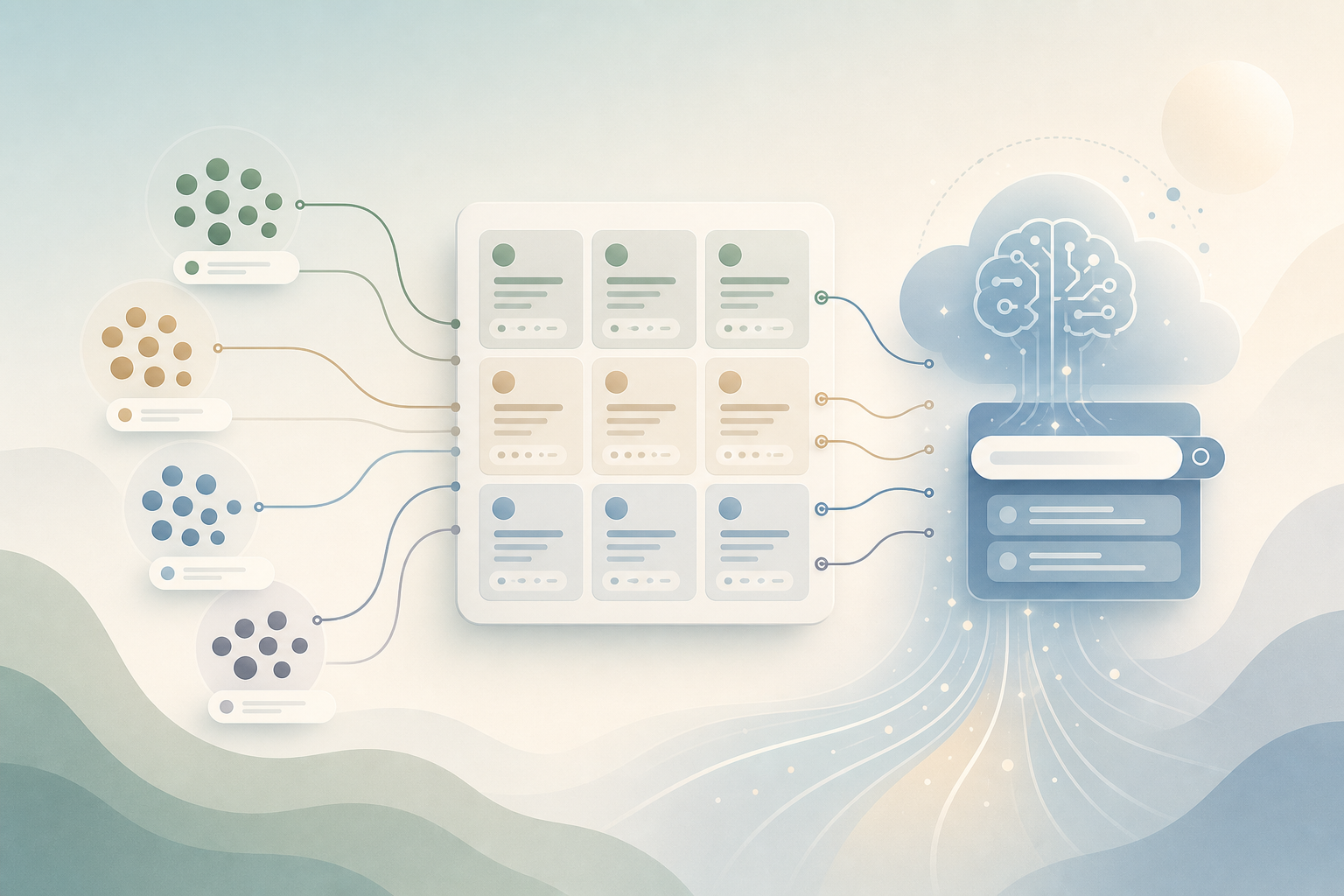
AI search prompts are neutral, buyer-style questions used to test how answer engines mention, rank, cite, and describe brands. The practical way to build them is to translate SEO keywords into realistic prompts grouped by audience, scenario, category, and purchase intent.
That translation matters because AI search is not a blue-link ranking report. A keyword such as "best customer onboarding software" shows demand. A prompt such as "What customer onboarding software should a 200-person B2B SaaS company compare if we need Salesforce integration and implementation in under 60 days?" tests whether an AI answer engine can place vendors in a real buying context.
This guide gives you a complete workflow for building AI search prompts from keyword research, Google Search Console queries, PPC terms, sales calls, and competitor topics. It also includes a reusable prompt matrix, neutrality checks, scoring rules, examples, and a 90-minute workflow for your first AI search monitoring set.
What People Mean by "AI Search Prompts"
AI search prompts are structured questions or tasks that simulate how users ask AI systems for research, recommendations, comparisons, and validation. In answer engine optimization, they replace single keyword positions with measurable outcomes: brand mentions, citation frequency, recommendation rank, sentiment, and message accuracy.
A keyword is usually compressed. A prompt adds the missing context:
| Element | SEO keyword | AI search prompt |
|---|---|---|
| User context | Usually missing | Role, company type, problem, constraints |
| Task | Implied | Explicit: explain, compare, shortlist, diagnose, validate |
| Measurement | Ranking position | Mention, rank, citation, sentiment, narrative accuracy |
| Example | "ai visibility tool" | "What AI visibility tools should a B2B SaaS marketing team compare to track brand mentions in ChatGPT, Gemini, Perplexity, and AI Overviews?" |
A useful prompt should be realistic enough that a buyer could ask it without knowing your company exists. That is the difference between measurement and self-confirmation.
Why AI Search Prompts Matter for SEO
AI search prompts matter because answer engines often synthesize a recommendation instead of sending users through a list of links. If your brand is absent, miscategorized, or described inaccurately in those answers, traditional rankings may not tell the full visibility story.
Google says its generative AI features in Search rely on familiar SEO foundations, including crawlable content and quality systems, while also using techniques such as retrieval-augmented generation and query fan-out (Google Search Central). That means classic SEO inputs still matter, but the output you measure is different.
Recent research also shows why prompt-level measurement is necessary. A 2026 study of Google Search, Gemini, and AI Overviews found that AI-generated search surfaces retrieve sources differently from traditional results, with low overlap between source sets and visible inconsistency across repeated or slightly edited queries (arXiv, 2026). Another 2026 AI Overviews study found that nearly 30% of cited pages did not appear in co-displayed first-page organic results, and 11.0% of analyzed atomic claims were unsupported by the cited pages (arXiv, 2026).
The SEO implication is clear: ranking well is helpful, but it is not the same as being recommended, cited, or accurately summarized by AI systems.
AI Search Prompt vs SEO Keyword vs Search Query
Use these terms separately. Mixing them leads to weak audits.
| Term | Definition | Example | Best use |
|---|---|---|---|
| SEO keyword | A target phrase used to represent search demand | "ai search monitoring" | Topic planning, page targeting, demand sizing |
| Search query | The actual phrase a user typed or spoke | "how to monitor brand mentions in chatgpt" | Language mining, intent validation |
| AI search prompt | A full question or task given to an AI answer engine | "How should a B2B SaaS team monitor whether ChatGPT recommends its brand for category-level buying questions?" | AI visibility testing, citation analysis, brand narrative auditing |
The keyword is the raw material. The prompt is the test instrument. The query is evidence of how people actually phrase the problem.
Start With SEO Keywords, But Do Not Copy Them
SEO keywords are the best starting point because they already encode market demand, topic clusters, commercial language, and intent. They should be translated, not pasted.
If you already have an SEO program, use these inputs:
| Existing asset | What it contributes to AI prompt design |
|---|---|
| Keyword clusters | Product categories, pain points, modifiers, related entities |
| Search intent labels | Learn, compare, shortlist, validate, switch, buy |
| Google Search Console queries | Real phrasing from searchers who already found you |
| PPC search terms | High-intent wording, objections, budget language |
| Sales and demo notes | Buyer roles, constraints, integrations, procurement triggers |
| Win/loss notes | Competitor set, reasons for switching, deal blockers |
| Support tickets | Reputation risks, confusing terminology, product gaps |
A team that skips this step usually creates prompts like "best CRM tools" or "why is our CRM the best." The first is too generic to diagnose. The second is biased. Neither gives leadership a reliable view of brand mentions in ChatGPT, Gemini, Perplexity, Claude, Copilot, Google AI Mode, or AI Overviews.
For the broader measurement layer, see how to measure AI search visibility across ChatGPT, Gemini, Perplexity, and Google AI Overviews.
The Four Dimensions of a Strong Prompt Set
A strong AI search prompt set is grouped by audience, scenario, category, and intent. These four dimensions keep the audit defensible and prevent it from becoming a random list of questions.
| Dimension | What it answers | Example values |
|---|---|---|
| Audience | Who is asking? | SEO lead, VP marketing, founder, agency strategist, PR manager |
| Scenario | Why are they asking now? | New category launch, competitor displacement, executive reporting, inaccurate AI descriptions |
| Product category | What market should the answer evaluate? | AI visibility platform, AEO software, LLM brand tracking tool, AI citation monitoring |
| Purchase intent | How close is the user to action? | Learn, diagnose, compare, shortlist, validate, switch |
Use this rule: one prompt should test one buyer job, not one keyword. If five keywords express the same job, merge them into one prompt and keep the keyword variants as supporting language.
Original Worksheet Test: 240 Keywords Became 42 Prompts
To make the framework concrete, maxaeo tested it on an anonymized B2B SaaS keyword worksheet. The file included 240 SEO keywords across 12 topic clusters, with fields for keyword, monthly search volume band, intent, funnel stage, target page, and competitor overlap.
This was not meant to be a universal benchmark. It was a practical editing test: how much cleanup is required before ordinary SEO data becomes a reliable AI search prompt set?
| Conversion step | Count remaining | Editorial decision |
|---|---|---|
| Raw SEO keywords | 240 | Exported from keyword research and paid search terms |
| Remove duplicates and near duplicates | 179 | Merged plural, word-order, and modifier variants |
| Remove navigational/support-only terms | 142 | Dropped login, docs, help, support, and branded troubleshooting terms |
| Group by buyer job | 68 | Merged keywords that expressed the same task |
| Draft neutral prompts | 52 | Added audience, scenario, category, and intent |
| Pilot across four answer engines | 42 | Removed prompts that produced ambiguous or unscorable answers |
The useful keyword-to-prompt ratio was 5.7:1. In other words, 240 keywords did not produce 240 useful AI search prompts. They produced 42 prompts that could be measured without drowning the audit in noise.
The failed prompts had three patterns:
| Failure pattern | Example problem | Fix |
|---|---|---|
| Too broad | "What are the best marketing tools?" | Narrow by category and task |
| Mixed intent | "Explain, compare, price, and implement AI visibility tools" | Split into separate prompts |
| Vendor jargon | "How do I optimize omnichannel LLM salience?" | Rewrite in buyer language |
How to Convert SEO Keywords Into AI Search Prompts
To convert SEO keywords into AI search prompts, cluster keywords by buyer job, assign audience and intent, rewrite each cluster as a neutral question, remove brand seeding, define the expected answer type, and pilot the prompts before using them for ongoing AI search monitoring.
Follow this workflow:
- Export your keyword universe. Include organic keywords, GSC queries, PPC search terms, internal site search, competitor terms, and sales-call phrases.
- Remove terms that cannot produce useful AI answers. Drop login, support, documentation-only, irrelevant informational, and purely navigational queries.
- Cluster by buyer job. Group terms by the problem behind the search, not by exact phrase.
- Assign intent. Use labels such as learn, diagnose, compare, shortlist, validate, switch, and buy.
- Add audience only when it changes the answer. "PR manager" and "SEO lead" may need different advice; "marketing person" may not.
- Add scenario constraints. Include company size, stack, region, risk, urgency, or budget only when they are realistic.
- Write one neutral buyer question. Avoid your brand name in non-branded prompts.
- Define the expected output. Recommendation list, comparison table, source list, explanation, checklist, or implementation plan.
- Pilot 10-15 prompts. Run them across the answer engines your buyers use.
- Keep only measurable prompts. A prompt should produce scorable mentions, rank, citations, sentiment, source patterns, or narrative accuracy.
- Version the set. Store prompt ID, text, cluster, audience, scenario, intent, owner, date added, and reason for inclusion.
A prompt is ready when a human buyer could plausibly ask it and the answer gives you something concrete to score.
The Prompt Matrix Template
A prompt matrix is a structured table that turns keyword clusters into testable AI search questions. It keeps audits consistent across engines, dates, countries, clients, and reporting periods.
| Field | Purpose | Example |
|---|---|---|
| Prompt ID | Stable tracking | AEO-COMP-001 |
| Source keyword cluster | SEO lineage | "ai visibility tool", "ai search monitoring", "LLM tracking" |
| Audience | Buyer role | SEO lead at a B2B SaaS company |
| Scenario | Business situation | Adding GEO reporting to a quarterly marketing dashboard |
| Category | Market being tested | AI visibility platform |
| Intent | Buyer stage | Shortlist |
| Prompt | Exact text to run | "What AI visibility platforms should a B2B SaaS SEO lead compare for tracking brand mentions, citations, and share of voice across ChatGPT, Gemini, Perplexity, and Google AI Overviews?" |
| Expected output | What the answer should contain | Vendor list with reasons and citations |
| Success metric | Audit outcome | Mentioned, ranked top 3, cited, described accurately |
| Source review | Citation analysis | Owned site, third-party review, publisher, community, documentation |
| Notes | Change log | Rewritten to remove brand seed |
For sizing the audit, use how many prompts you need for an AI visibility audit as the next planning step.
Prompt Examples by Audience
Audience-specific prompts are useful when different roles would reasonably receive different recommendations. Do not personalize every prompt; add the role only when it changes the answer.
| Audience | SEO keyword source | Better AI search prompt |
|---|---|---|
| SEO lead | answer engine optimization tools | "What tools should an SEO lead use to measure whether a B2B SaaS brand appears in answer engine recommendations for non-branded category prompts?" |
| VP marketing | ai share of voice | "How can a B2B marketing leader report AI share of voice against competitors across ChatGPT, Gemini, Perplexity, and AI Overviews?" |
| PR manager | ai reputation management | "How should a PR team monitor and correct inaccurate AI-generated descriptions of a technology company?" |
| Founder | get recommended by ChatGPT | "What practical steps help a startup become more likely to be recommended by ChatGPT when buyers ask for software shortlists?" |
| Agency strategist | ai search monitoring | "What should an agency include in a monthly AI search monitoring report for multiple B2B SaaS clients?" |
The best audience prompts reveal whether AI systems understand who your product is for. If an answer recommends enterprise tools to a startup buyer, the issue may be category fit, source quality, or prompt ambiguity.
Prompt Examples by Scenario
Scenario prompts capture the business situation behind the search. They often produce more useful answers than generic "best tools" prompts because they force the model to reason through constraints.
| Scenario | Prompt |
|---|---|
| New category entry | "Which AI visibility tools should a B2B SaaS company evaluate before adding GEO reporting to its SEO program?" |
| Competitive displacement | "If our competitor is mentioned more often by AI answer engines, how should we diagnose whether the gap comes from content, citations, reviews, or third-party mentions?" |
| Board reporting | "What metrics should a marketing team use to report AI search visibility and brand mentions in ChatGPT to executives?" |
| PR risk | "How can a communications team find and fix outdated or inaccurate descriptions of its company in AI-generated answers?" |
| Content planning | "How should an SEO team prioritize pages to improve AI citations for high-intent software comparison queries?" |
| Budget validation | "Is an AI visibility tool worth testing for a B2B SaaS company that already pays for Semrush, Ahrefs, or Similarweb?" |
Scenario prompts are where you often find the strongest information gain. They show not only whether your brand appears, but whether AI systems understand your use case, positioning, and evidence.
Prompt Examples by Product Category
Category prompts test whether answer engines understand where your brand belongs. For maxaeo, category language may include AI visibility tool, AI search monitoring, LLM brand tracking, answer engine optimization, generative engine optimization, AI citations, and AI share of voice.
| Category | Prompt |
|---|---|
| AI visibility platform | "What AI visibility platforms help marketing teams monitor brand mentions, rankings, citations, and sentiment across major answer engines?" |
| LLM brand tracking | "Which tools track how LLMs describe a brand and whether competitors are recommended more often?" |
| AI citation monitoring | "How can a SaaS company identify which sources AI answer engines cite when recommending vendors in its category?" |
| AI reputation management | "What workflow should a brand team use when AI assistants describe its company inaccurately or omit key positioning?" |
| GEO reporting | "What should be included in a generative engine optimization report for a B2B SaaS leadership team?" |
Watch for category drift. If AI systems place your product in the wrong market, you may not have a prompt problem. You may have an entity clarity problem across your site, third-party profiles, reviews, comparison pages, and citations.
Prompt Examples by Purchase Intent
Purchase-intent prompts show where your brand appears or disappears as buyers move from learning to vendor selection.
| Intent | Prompt pattern | Example |
|---|---|---|
| Learn | "What is…" | "What is AI search monitoring, and how is it different from traditional rank tracking?" |
| Diagnose | "How do I know if…" | "How do I know if my brand is being overlooked in ChatGPT recommendations for my software category?" |
| Compare | "How does X differ from Y…" | "How do AI visibility platforms differ from SEO rank trackers and social listening tools?" |
| Shortlist | "What are the best tools for…" | "What are the best tools for tracking AI citations and brand mentions across multiple answer engines?" |
| Validate | "Is this category useful for…" | "Is an AI visibility tool useful for a B2B SaaS company that already uses Semrush or Ahrefs?" |
| Switch | "What alternatives should I consider…" | "What should a team compare when switching from manual AI prompt checks to automated LLM brand tracking?" |
Shortlist prompts are tempting because they feel closest to revenue. They are not enough. If you only test "best tools" prompts, you miss earlier answers that shape how buyers understand the category.
For prompt neutrality, compare this workflow with branded vs non-branded prompts for auditing AI recommendations.
What Makes an AI Search Prompt Neutral?
A neutral AI search prompt does not lead the model toward your brand, your claims, or your preferred competitor set. It describes the buyer's problem in normal market language and lets the answer engine decide which vendors, sources, and arguments to include.
Use this checklist before adding any prompt to your set:
| Check | Pass | Fail |
|---|---|---|
| Brand seeding | No vendor named unless testing branded visibility | "Why is maxaeo the best AI visibility tool?" |
| Loaded adjectives | Uses evidence-based criteria | "leading", "most advanced", "top-rated" without proof |
| Realistic constraints | Matches actual buyer situations | Artificial requirements only your product satisfies |
| Single task | One answer job | "Explain, compare, rank, price, and implement…" |
| Measurable output | Mentions, rank, sentiment, or citations can be scored | Vague brainstorming with no decision output |
| Normal language | Buyer wording | Internal product jargon or campaign slogans |
Google's guidance for generative AI search warns against creating many variations primarily to manipulate rankings or AI responses, and emphasizes original, useful, people-first content (Google Search Central). Prompt testing should be measurement, not recommendation poisoning.
Good and Bad AI Search Prompts
The easiest way to improve prompt quality is to compare weak prompts with usable ones.
| Source keyword | Weak prompt | Why it fails | Better prompt |
|---|---|---|---|
| ai visibility tool | "Is maxaeo the best ai visibility tool?" | Branded and leading | "What AI visibility tools should a B2B SaaS marketing team compare to track brand mentions in ChatGPT, Gemini, Perplexity, and AI Overviews?" |
| llm brand tracking | "Tell me about maxaeo LLM tracking." | Tests branded recall, not market visibility | "How should a tech company track whether LLMs recommend its brand versus competitors for category-level buying questions?" |
| ai citations | "How do I get AI citations?" | Too broad and tactical | "What sources do AI answer engines tend to cite when recommending software vendors, and what can a brand influence?" |
| answer engine optimization | "How do I win AEO?" | Vague and unscorable | "What should a B2B SaaS SEO team change on its website to improve visibility in answer engine recommendations?" |
| ai share of voice | "Calculate our AI share of voice." | Missing competitors and surfaces | "How should a marketing team measure AI share of voice against three competitors across ChatGPT, Perplexity, Gemini, and Google AI Overviews?" |
A strong prompt does not have to be long. It only needs enough context to produce a useful, repeatable answer.
How Many AI Search Prompts Do You Need?
Most B2B SaaS teams should start with 30-60 AI search prompts, not hundreds. That is usually enough to cover core category, competitor, pain-point, citation, and purchase-intent questions while keeping results interpretable.
A practical starter mix:
| Prompt type | Count | Why it matters |
|---|---|---|
| Category education | 6-10 | Tests whether AI understands the market |
| Problem diagnosis | 6-10 | Finds pain-point visibility gaps |
| Vendor comparison | 8-12 | Measures shortlist inclusion |
| Competitor alternatives | 5-8 | Shows displacement opportunities |
| Citation/source discovery | 5-8 | Finds pages and publishers influencing answers |
| Reputation accuracy | 3-6 | Detects outdated or wrong descriptions |
Do not expand until you can explain what each prompt is supposed to prove. More prompts create more charts, not necessarily better decisions.
How to Score AI Search Prompt Results
Score prompt results across visibility, rank, citations, and narrative quality. A brand mention is useful, but it is not the same as being recommended first with a strong rationale and accurate description.
| Metric | Definition | Suggested scoring |
|---|---|---|
| Mention rate | Share of runs where your brand appears | 0 = absent, 1 = mentioned |
| Recommendation rank | Position in a vendor list | 5 = #1, 4 = top 3, 3 = top 5, 1 = mentioned outside list, 0 = absent |
| Citation presence | Whether your site or third-party sources are cited | 1 = cited, 0 = not cited |
| Citation quality | Authority and relevance of cited pages | 3 = strong source, 2 = relevant but weak, 1 = low relevance |
| Sentiment | Tone of brand description | 2 = positive, 1 = neutral, 0 = mixed/negative |
| Message accuracy | Whether the answer describes your product correctly | 2 = accurate, 1 = incomplete, 0 = wrong |
| Competitor co-mentions | Competitors appearing beside you | Track names and rank positions |
| Source pattern | Types of cited sources | Owned, review site, publisher, community, documentation |
For executive reporting, separate two numbers:
| Report metric | Formula | What it tells you |
|---|---|---|
| AI mention share | Brand mentions / total prompt runs | Whether the brand appears at all |
| AI recommendation share | Top-3 placements / commercial prompt runs | Whether the brand is being shortlisted |
This is where an ai visibility tool becomes useful. Manual checks are fine for a pilot, but ongoing llm brand tracking needs stable prompts, engines, locations, run history, and exportable evidence. Otherwise, teams argue over screenshots instead of trends.
The maxaeo Prompt Quality Score
Before running a prompt at scale, score it from 0 to 10. This lightweight editorial check catches most bad prompts before they pollute reporting.
| Criterion | Points | What to check |
|---|---|---|
| Buyer realism | 0-2 | Would a real buyer ask this? |
| Neutrality | 0-2 | Does it avoid brand seeding and loaded language? |
| Single intent | 0-2 | Does it ask for one clear task? |
| Measurability | 0-2 | Can the answer be scored for mention, rank, citation, or accuracy? |
| SEO lineage | 0-2 | Is it traceable to a keyword cluster, query, sales note, or competitor topic? |
Use the score this way:
| Score | Decision |
|---|---|
| 8-10 | Add to the core prompt set |
| 6-7 | Pilot, then revise if answers are ambiguous |
| 0-5 | Rewrite or archive |
This score is not meant to be scientific. It is meant to prevent common editorial failure: adding prompts because they sound interesting rather than because they measure a real buyer job.
How Prompt Results Turn Into SEO and Brand Fixes
Prompt results should create a fix queue, not just a dashboard. Each weak answer should map to a content, technical, citation, or reputation action.
| Finding | Likely cause | Fix |
|---|---|---|
| Brand never appears for category prompts | Weak category association | Strengthen category pages, comparison content, and third-party mentions |
| Brand appears but is described incorrectly | Entity confusion or outdated sources | Update About pages, schema, profiles, PR boilerplate, review listings, and key directories |
| Competitors are cited but you are not | Missing source influence | Analyze cited pages and earn inclusion or create stronger evidence |
| Your page ranks in Google but is not cited by AI | Content is not extractable or not trusted for the prompt | Add direct answers, sourced data, examples, definitions, and clear section structure |
| Brand appears only for branded prompts | Low non-branded visibility | Build non-branded category authority and comparison coverage |
| Answer lists the wrong competitors | Category positioning is unclear | Clarify use cases, alternatives, integrations, and audience fit |
| AI answer omits a key feature | Feature not stated in crawlable, quotable language | Add concise feature sections, FAQs, docs, and proof points |
AI search visibility work often crosses SEO, content, PR, brand, and product marketing. Prompt metadata matters because it tells you who owns the fix. A citation gap may belong to PR. A crawlability issue belongs to SEO. A message accuracy problem may belong to brand or product marketing.
For a deeper source strategy, read how AI search citations are chosen and what brands can influence.
What Content Helps AI Answers Use Your Brand Correctly?
Prompt testing only diagnoses the gap. Content and source work close it.
Useful pages usually share five traits:
- They answer the exact buyer question early. Put a direct definition, comparison, or recommendation framework near the top of the page.
- They use entity-clear language. State what the product is, who it is for, what category it belongs to, and how it differs from alternatives.
- They include evidence. Add first-party data, customer examples, benchmarks, screenshots, workflows, and sourced statistics.
- They are easy to extract. Use descriptive headings, concise paragraphs, tables, lists, schema, and crawlable HTML.
- They are corroborated elsewhere. Third-party profiles, reviews, partner pages, interviews, and earned media help reinforce the entity story.
Google's helpful content guidance asks whether content provides original information, reporting, research, or analysis, and whether it gives substantial value compared with other pages in search results (Google Search Central). That standard is also the right bar for AI search prompts: if the page only repeats generic advice, it gives answer engines little reason to cite or trust it.
Common Mistakes When Building AI Search Prompt Sets
The biggest mistake is treating prompts as keywords with punctuation. AI systems respond to context, constraints, and task framing, so prompt design needs editorial judgment.
Avoid these patterns:
- Prompt stuffing. Do not cram every keyword variant into one question.
- Brand-first wording. Do not name your brand in non-branded audits.
- Only testing bottom-funnel prompts. Include education and diagnosis, not only "best tools."
- Ignoring audience differences. A PR manager and SEO lead may receive different useful answers.
- Changing prompts too often. Version prompts so trend data remains comparable.
- Using one engine as truth. ChatGPT, Gemini, Perplexity, Claude, Copilot, Grok, Google AI Mode, and AI Overviews can produce different source sets.
- Skipping citation review. The cited sources often explain why the answer looks the way it does.
- Treating every answer as stable. Run important prompts repeatedly before making major decisions.
- Creating pages for every prompt variant. Consolidate around useful buyer jobs instead of publishing thin query variations.
A 90-Minute Workflow for Your First Prompt Set
You can build a useful first version in 90 minutes if you keep the scope tight. The goal is not perfection. The goal is a clean, neutral prompt set that can be tested and improved.
- Minutes 0-15: Export and filter. Pull 100-300 keywords from your highest-priority product category. Remove support, login, and irrelevant informational terms.
- Minutes 15-30: Cluster by buyer job. Group keywords by the job behind the search, not by exact phrase.
- Minutes 30-45: Add dimensions. Assign audience, scenario, category, and intent to each cluster.
- Minutes 45-65: Draft prompts. Write one neutral buyer question per cluster.
- Minutes 65-80: Bias review. Remove brand names, loaded adjectives, and artificial constraints.
- Minutes 80-90: Pilot selection. Choose 10 prompts across intents and run them manually or in your monitoring platform.
After the pilot, keep only prompts that produce measurable answers. Rewrite prompts that are too vague. Split prompts that ask for more than one task. Archive prompts that do not map to a decision.
Frequently Asked Questions
What are AI search prompts?
AI search prompts are neutral questions or tasks used to test how AI answer engines respond to real user needs. They help teams measure brand mentions, recommendation rank, citations, sentiment, competitor visibility, and message accuracy across tools such as ChatGPT, Gemini, Perplexity, Claude, Copilot, and Google AI Overviews.
Are AI search prompts the same as SEO keywords?
AI search prompts are not the same as SEO keywords. Keywords capture demand in compressed form, while prompts simulate full buyer questions with context, constraints, and intent. The keyword is the input; the prompt is the measurement instrument.
Should AI search prompts include my brand name?
Use brand names only for branded audits. Non-branded prompts should not include your company because the goal is to see whether AI systems recommend you without being asked directly. Branded prompts are still useful for checking description accuracy, sentiment, and ai reputation management.
How often should I update a prompt set?
Review the prompt set monthly and update it when your product category, competitors, positioning, or buyer language changes. Do not rewrite core prompts every week because you will lose trend continuity. Add new prompts with new IDs instead of silently replacing old ones.
Which AI engines should I test?
Test the engines your buyers actually use. For many B2B SaaS teams, that means ChatGPT, Gemini, Perplexity, Claude, Copilot, Google AI Mode, and AI Overviews. If your category has a developer, finance, legal, or enterprise IT audience, validate usage with customer interviews and analytics.
What is the best prompt format for AI visibility reporting?
The best format is a neutral buyer question with a defined expected output. A reliable pattern is: "What [category] tools should [audience] compare for [scenario]?" This format produces answers that are easier to score for mentions, rank, citations, sentiment, and competitor share.
How many prompts do I need for AI search monitoring?
Start with 30-60 prompts for one core category. Use fewer if you are piloting manually and more only when each prompt maps to a real buyer job. A small, stable set is better for trend analysis than a large set full of overlapping questions.
Final Takeaway
AI search prompts should be built from SEO keywords, but not copied from them. Start with keyword clusters, translate them into neutral buyer questions, group them by audience, scenario, category, and purchase intent, then score the answers for mentions, rank, citations, sentiment, and message accuracy.
The winning prompt set is not the longest one. It is the one your team can defend: every prompt maps to a real buyer job, every result maps to a fix, and every trend can be explained without hype.
This article was created with AI assistance and reviewed by a human editor.