AI search citations are the source links, references, or supporting pages that answer engines use when generating AI responses. They may appear as clickable source cards, inline links, footnotes, or supporting URLs. For brands, they show which evidence shapes how AI systems describe, compare, and recommend companies.
That matters because ChatGPT, Gemini, Perplexity, Claude, Copilot, Grok, Google AI Mode, and Google AI Overviews can influence a buyer before the buyer reaches a website. A prospect may ask “best AI visibility tools,” “is Brand X reliable,” or “Brand X vs Competitor Y” and treat the AI answer as a shortlist.
The practical question is no longer only “Do we rank in Google?” It is:
- Are we mentioned?
- Are we recommended?
- Are we cited?
- Are the cited sources accurate, current, and favorable?
This guide explains how AI search citations work, why visible citations are only part of the source-selection system, and how B2B teams can audit and improve the evidence layer around their brand.
What Are AI Search Citations?
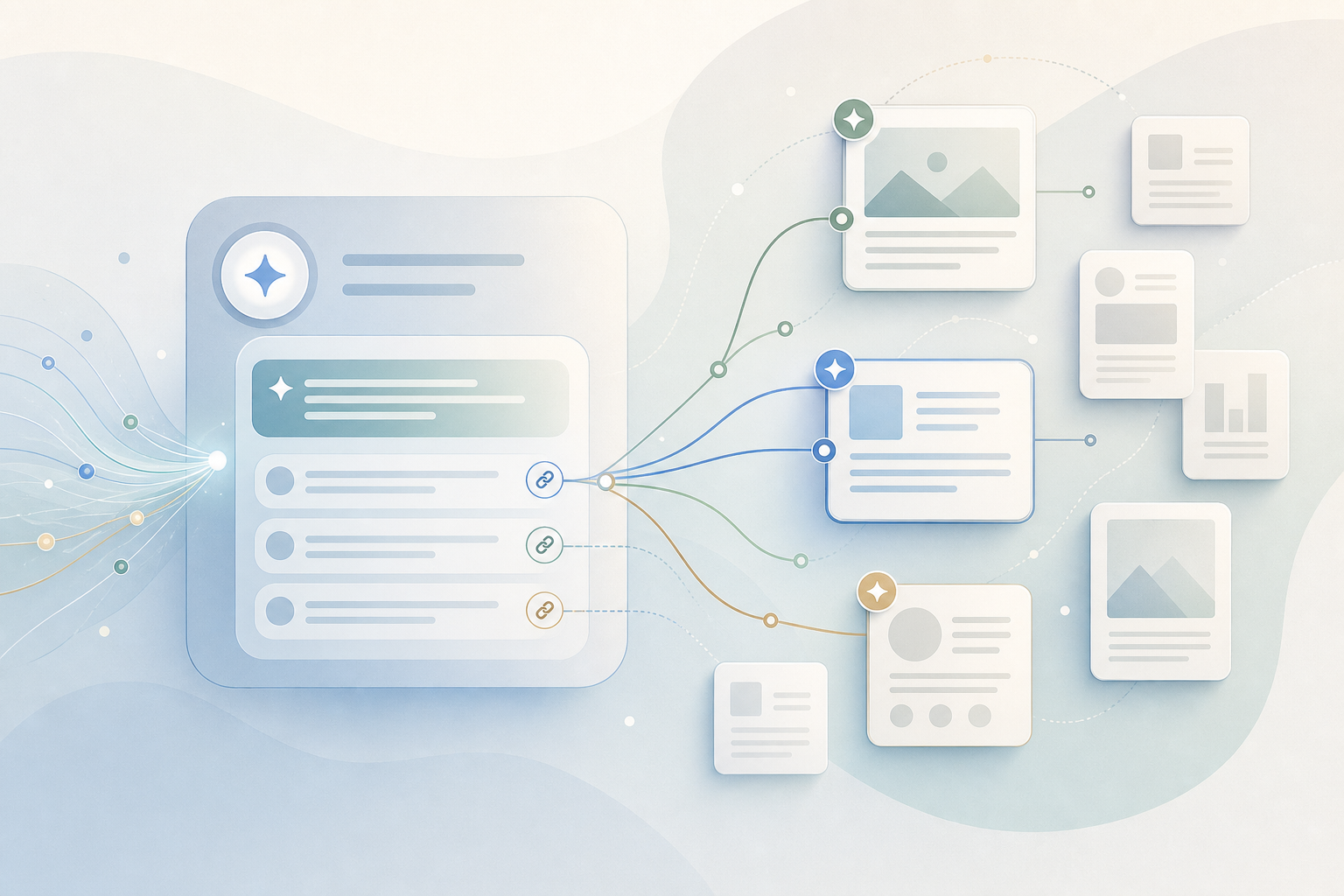
AI search citations are user-visible source references attached to AI-generated answers. They help users inspect where an answer came from, but they do not always reveal every source that influenced the response. A model may draw on retrieved pages, search results, product databases, review sites, knowledge graph data, or prior web snapshots.
A simple distinction helps:
| Term | Meaning | Example |
|---|---|---|
| AI mention | The answer names a brand | “maxaeo is an AI visibility platform.” |
| AI recommendation | The answer suggests a brand for a task | “Consider maxaeo for AI search monitoring.” |
| AI citation | The interface shows a source link or reference | A link to a maxaeo guide, review page, or comparison article |
| Citation influence | A source appears to shape the answer, even if not visibly cited | A review profile changes how the model describes strengths and weaknesses |
For measurement, track these separately. A brand can be mentioned without being cited, cited without being recommended, or recommended because third-party sources explain the category better than the brand’s own site.
Google says AI Overviews and AI Mode can surface supporting links and may use “query fan-out,” where the system issues multiple related searches across subtopics and data sources before composing a response. Google also says pages must be indexed and eligible for snippets to appear as supporting links in these features, and that standard SEO practices still apply (Google Search Central).
Why AI Search Citations Matter
AI search citations matter because answer engines compress discovery, evaluation, and recommendation into one response. In classic SEO, a buyer could scan ten blue links. In AI search, the system may summarize the market, list vendors, frame trade-offs, and attach a few sources.
For B2B SaaS, that creates direct commercial risk:
| Buyer question | Citation risk | Business impact |
|---|---|---|
| “What does Brand X do?” | Old profile or vague homepage gets used | Wrong positioning spreads |
| “Best tools for [category]” | Competitor listicles dominate | Brand is excluded from shortlist |
| “Brand X vs Competitor Y” | Only competitor-owned pages exist | Comparison frame is biased |
| “Is Brand X secure?” | Stale forum thread or unsupported claim appears | Procurement confidence drops |
| “Alternatives to [competitor]” | Brand has no category evidence | Demand is captured elsewhere |
Research supports the need to measure AI visibility separately from rankings. A 2026 study comparing Google Search, Gemini, and AI Overviews found that AI Overviews appeared for 51.5% of representative real-user queries in its dataset, and that overlap between traditional Google results and generative search sources was low, with average Jaccard similarity below 0.2 (Grossman et al., 2026).
The implication: organic rankings still matter, but they do not fully explain AI search citations or AI share of voice.
That is why measuring AI search visibility across major answer engines needs its own workflow.
The SERP Gap: What Most AI Citation Guides Miss
Most pages about AI search citations explain the basics: get indexed, publish helpful content, build authority, and monitor mentions. Those points are useful, but too broad for a team that needs to fix a specific citation problem.
The missing piece is an operational map of which source type affects which prompt type.
During a June 12, 2026 review of results for “AI search citations,” “AI citations AI search SEO,” and “how AI search engines cite sources,” the visible content clustered around four themes:
| SERP theme | What it covers well | What it often misses |
|---|---|---|
| Google guidance | Indexability, snippets, AI Overviews, AI Mode | Non-Google source behavior across reviews, communities, and listicles |
| Academic studies | Citation selection, source quality, source overlap | Brand-level remediation steps |
| Industry commentary | GEO tactics and reputation risk | How to separate ethical source improvement from manipulation |
| Vendor pages | Dashboards and monitoring concepts | Which source layer to fix first |
The useful framework is not “write better content.” It is: trace every important AI answer back to the evidence layer that shaped it.
How Answer Engines Choose Sources
Answer engines choose sources by matching the prompt to evidence that is retrievable, relevant, clear, current, trusted, and easy to synthesize. The exact system differs by engine, but most citation behavior can be understood as a five-step process:
- Prompt interpretation: The system identifies entities, intent, constraints, and comparison targets.
- Retrieval: It gathers candidate sources from search indexes, browsing systems, internal databases, or tool-connected sources.
- Source filtering: It narrows sources by relevance, accessibility, freshness, authority, and duplication.
- Answer synthesis: It extracts facts, comparisons, examples, and summaries from selected material.
- Citation display: It attaches visible links if the product interface supports citations.
A controlled 2026 GEO study ran 252,000 trials across six LLMs and found that topical relevance and list position were the strongest drivers of first-citation selection. Explicit price information and recent timestamps also helped consistently, while formatting-only edits had limited effect (Vishwakarma, Kumar, and Jamidar, 2026).
That does not mean every page should add artificial dates or pricing tables. It means pages become more citable when they directly help the model resolve the user’s task.
| Prompt type | Evidence answer engines often need | Page that tends to help |
|---|---|---|
| Definition | Clear entity and category facts | Homepage, About page, product overview |
| Pricing | Current plan and packaging details | Pricing page, pricing FAQ |
| Comparison | Feature differences and trade-offs | Comparison page, integration docs, reviews |
| “Best tools” | Category fit and third-party validation | Review profiles, listicles, analyst pages |
| Reputation | User experience and public record | Reviews, community threads, support docs |
| “Latest” | Recent updates and dates | Changelog, release notes, news page |
This is why a structured AI search prompt set built from SEO keywords is essential. A team that only tracks branded prompts will miss the unbranded category prompts where competitors are being cited.
Visible Citations vs. Hidden Influence
A visible citation is not always the same as the source that shaped the answer.
Some systems show many links, some show few, and some provide no citations in certain modes. Even when citations are visible, the answer may also be influenced by training data, search snippets, product feeds, knowledge graph records, prior crawl data, or other retrieved pages not shown to the user.
Use this working model:
| Layer | What you can observe | What may be hidden |
|---|---|---|
| Visible citation | Source card, inline link, footnote, URL | Whether the cited passage actually influenced the answer |
| Retrieved evidence | Pages surfaced through browsing or search | Candidate pages that were considered but not cited |
| Entity memory | Stable facts about brand, people, products | Source of the stored entity fact |
| Reputation layer | Reviews, forums, news, social discussions | How sentiment is weighted |
| Interface policy | Number and placement of links shown | Why one source was omitted |
A 2026 measurement framework distinguishes citation selection from citation absorption: a page can be cited without strongly shaping the final answer, and a page can influence language, facts, or structure beyond a simple citation count (Kai, Xinyue, and Jingang, 2026).
For marketers, the takeaway is straightforward: count citations, but also read the answer and judge whether the source changed the narrative.
The Five Evidence Layers Behind AI Search Citations
From maxaeo’s citation-tracing perspective, most B2B brand citations come from five evidence layers:
| Evidence layer | Typical sources | Prompts influenced | Brand control |
|---|---|---|---|
| Owned content | Homepage, product pages, docs, pricing, comparison pages, changelog | “What does Brand X do?” “Brand X pricing” | High |
| Review and marketplace pages | G2, Capterra, Product Hunt, app marketplaces, partner directories | “Is Brand X good?” “Best tools for…” | Medium |
| Editorial and affiliate pages | Buyer guides, roundups, “best software” articles, alternatives pages | Category shortlists and vendor comparisons | Low to medium |
| Communities | Reddit, Hacker News, Quora, forums, Slack exports, YouTube comments | “Real user opinions” “Common complaints” | Low |
| Authority sources | Analyst reports, news, Wikipedia-style pages, public docs, standards bodies | Definitions, reputation, market context | Low to medium |
Different prompts pull from different layers.
For example:
| Prompt | Likely citation pattern | Best fix if answer is weak |
|---|---|---|
| “What is maxaeo?” | Owned site, product page, profile pages | Align entity facts and page copy |
| “Best AI visibility tools for agencies” | Listicles, reviews, category guides | Improve category proof and credible third-party coverage |
| “maxaeo vs [competitor]” | Comparison pages, reviews, competitor pages | Publish evidence-based comparison content |
| “Is maxaeo reliable?” | Reviews, communities, support pages | Address recurring issues and publish verifiable evidence |
| “Does maxaeo monitor ChatGPT citations?” | Product pages, docs, feature pages | Create crawlable feature documentation |
An ai visibility tool should therefore show more than brand mentions in ChatGPT. It should show the source path behind each mention, citation, competitor recommendation, and inaccurate claim.
What Makes a Page More Citable?
A page becomes more citable when it gives a direct answer, uses visible text, provides verifiable facts, stays current, and aligns with other trusted sources. Clarity beats decorative content.
A 2026 benchmark called SourceBench evaluated 3,996 cited sources across AI search tools using source-quality metrics such as relevance, factual accuracy, objectivity, freshness, authority, accountability, and clarity (Jin et al., 2026).
Use this checklist for owned content:
| Citable trait | Strong example | Weak example |
|---|---|---|
| Direct answer | “maxaeo monitors how AI engines mention, rank, cite, and describe brands.” | “We transform the future of discovery.” |
| Entity clarity | Category, audience, use cases, integrations, company facts | Ambiguous positioning |
| Evidence | Screenshots, methodology, customer examples, update dates | Unsupported superlatives |
| Crawlable text | Key facts in HTML | Product facts locked inside images |
| Freshness | Visible update date on pages where timing matters | Old “latest” posts with no maintenance |
| Corroboration | Same facts across site, profiles, docs, and reviews | Conflicting descriptions across sources |
| Internal links | Relevant pages linked from guides, docs, and product pages | Orphaned page |
| Structured data alignment | Schema matches visible content | Schema claims facts not shown on page |
Google’s guidance for AI Overviews and AI Mode is consistent with this: there are no special schema requirements, but pages should be crawlable, internally linked, textually accessible, and structured data should match visible page content (Google Search Central).
How to Audit AI Search Citations
To audit AI search citations, build a prompt set, run it across answer engines, record mentions and citations, classify source types, compare competitors, and prioritize fixes by business value and source controllability.
Start with 40 to 80 prompts across five clusters:
- Brand definition: “What is [brand]?” “What does [brand] do?”
- Trust and reputation: “Is [brand] reliable?” “Is [brand] legitimate?”
- Category discovery: “Best [category] tools for [audience].”
- Comparison: “[brand] vs [competitor].” “Alternatives to [competitor].”
- Problem and use case: “How to solve [pain point] for [audience].”
Record these fields for every run:
| Field | Why it matters |
|---|---|
| Engine | ChatGPT, Gemini, Perplexity, Claude, Copilot, Grok, Google AI Mode, AI Overviews |
| Prompt | Small wording changes can change retrieval |
| Brand mentioned | Baseline visibility |
| Brand position | Placement affects AI share of voice |
| Recommendation strength | Separates mention from endorsement |
| Description accuracy | Shows whether positioning is correct |
| Visible citations | Shows user-facing evidence |
| Citation type | Owned, review, editorial, community, authority |
| Competitors cited | Shows who owns the evidence layer |
| Source freshness | Identifies stale evidence |
| Fix owner | SEO, content, PR, product marketing, support, partnerships |
A first audit can be done manually in a spreadsheet. A repeatable program should use AI search monitoring so the same prompts, engines, and fields are tracked over time.
A Citation Influence Map for Marketing Teams
A citation influence map connects each high-value prompt to the sources that appear in, support, or distort the AI answer. It turns AI search monitoring from a screenshot exercise into a fix list.
| Prompt cluster | Example prompt | Desired answer behavior | Current source pattern | Fix priority |
|---|---|---|---|---|
| Category discovery | “Best tools to monitor AI brand visibility” | Include brand in shortlist | Listicles cite competitors only | Build category page, improve third-party coverage |
| Brand definition | “What is maxaeo?” | Accurate product description | Owned page cited, old profile conflicts | Update profiles and entity facts |
| Comparison | “maxaeo vs alternative” | Balanced pros and cons | No neutral comparison evidence | Publish comparison page with proof |
| Reputation | “Is Brand X reliable?” | Current, balanced answer | Old complaint thread dominates | Address issue and publish support evidence |
| Integration | “Does Brand X work with HubSpot?” | Direct yes/no answer | Docs unclear or uncrawlable | Create indexed integration page |
Score each prompt with four factors:
| Factor | Score 1 | Score 3 | Score 5 |
|---|---|---|---|
| Business value | Informational only | Influences evaluation | Directly affects pipeline or procurement |
| Answer accuracy | Mostly correct | Partly wrong | Materially wrong |
| Source controllability | Low control | Some influence | Owned or profile source |
| Reputation risk | Low | Moderate | High trust or legal impact |
Fix the prompts with the highest combined score first. This keeps AI citation work tied to business outcomes instead of vanity metrics.
How Reviews, Listicles, and Communities Affect Citations
Reviews, listicles, and communities affect AI search citations because they answer questions that owned content cannot answer credibly by itself. Buyers want alternatives, drawbacks, user experience, and category shortlists. Answer engines often look for third-party evidence for those tasks.
That does not mean brands should spam communities or manufacture reviews. It means the public reputation layer must be accurate enough that answer engines are not forced to rely on stale or low-quality summaries.
A 2026 audit of generative search citations across ChatGPT, Copilot, Gemini, and Perplexity found evidence of AI-generated sources appearing among citations, about 16% of cited sources in its tested set (Allaham and Diakopoulos, 2026). This raises the bar for source quality: brands should make authoritative, human-verifiable evidence easier to find than synthetic summaries.
Ethical ai reputation management includes:
- Updating official review profiles with correct categories, screenshots, and product descriptions.
- Asking real customers for substantive reviews without scripting the content.
- Creating partner and integration pages that describe real workflows.
- Responding publicly to recurring issues where appropriate.
- Publishing comparison content that names trade-offs honestly.
- Correcting outdated third-party profiles before they become AI source material.
If answers are already wrong, use a remediation workflow for correcting wrong AI answers about your brand.
How to Improve AI Search Citations
You cannot force an answer engine to cite a page. You can make better evidence easier to retrieve, verify, and reuse.
Prioritize these actions:
- Align entity facts. Your homepage, About page, schema, LinkedIn profile, review profiles, marketplace listings, and docs should agree on name, category, audience, product description, headquarters, founders, and key use cases.
- Create answer-ready pages. Publish pages for pricing, alternatives, integrations, security, migration, use cases, comparisons, and category definitions.
- Lead with the answer. Put the direct answer in the first 40 to 60 words of each section, then support it with detail.
- Show dates where freshness matters. Use visible update dates on changelogs, benchmarks, pricing explainers, release posts, and integration docs.
- Make claims verifiable. Replace “best-in-class” language with methodology, examples, screenshots, customer outcomes, or public documentation.
- Add comparison evidence. Help answer engines understand when your product is a fit and when it is not.
- Strengthen third-party coverage. Earn credible reviews, partner pages, marketplace listings, and editorial mentions.
- Fix contradictions. If a review site calls you “SMB CRM” and your site says “enterprise RevOps platform,” the simpler third-party label may win.
Avoid hidden prompt injections, doorway listicles, fake reviews, or mass-produced “best tools” pages. Those tactics may create search, legal, and reputation risk. A durable answer engine optimization program looks more like source governance than manipulation.
How to Measure AI Share of Voice From Citations
AI share of voice measures how often and how prominently a brand appears in AI answers compared with competitors. Citation-aware share of voice adds source evidence: which pages caused, supported, or accompanied the mention.
A practical scoring model:
| Dimension | Suggested scoring |
|---|---|
| Mention presence | 1 if mentioned, 0 if absent |
| Position | 3 for first mention, 2 for shortlist, 1 for later mention |
| Recommendation strength | 0 to 3 based on neutrality, shortlist inclusion, or explicit recommendation |
| Citation quality | 0 to 3 based on relevance, authority, freshness, and accuracy |
| Description accuracy | 0 to 3 based on match to approved positioning |
| Competitor displacement | 1 if competitor is cited where brand is absent |
Example:
| Brand | Mentioned prompts | Strong recommendations | High-quality citations | Interpretation |
|---|---|---|---|---|
| Your brand | 18 / 60 | 6 | 5 | Visibility exists, but evidence is weak |
| Competitor A | 42 / 60 | 24 | 21 | Competitor owns the category evidence |
| Competitor B | 25 / 60 | 9 | 18 | Fewer mentions, stronger source quality |
If your brand appears but citations are stale, the fix is source cleanup. If competitors are recommended and you are absent, the fix may be category evidence, third-party coverage, or clearer use-case pages.
This is where choosing an AI visibility tool with citation tracking matters. Basic llm brand tracking tells you whether your brand was mentioned. Citation tracking shows which source layer to improve.
What to Prioritize First
Prioritize AI search citation work by business value, source controllability, and risk.
Use this order:
- Wrong brand facts: outdated descriptions, old pricing, discontinued features, wrong categories, old executive names.
- High-value missing mentions: category prompts where competitors are recommended and your brand is absent.
- Weak comparison evidence: prompts where competitor pages define the frame.
- Stale review profiles: outdated screenshots, categories, descriptions, and integrations.
- Reputation-sensitive prompts: security, reliability, privacy, compliance, and customer complaints.
- Uncited owned pages: useful content that is not indexed, internally linked, or answer-ready.
Avoid treating all citations equally. A citation on a low-value definition query may not matter. A citation on “best enterprise [category] platforms” can influence pipeline. A citation on “is [brand] secure?” can influence procurement.
Common Mistakes That Reduce Citability
The most common mistakes are vague positioning, inaccessible facts, conflicting public profiles, stale pages, unsupported claims, and measuring AI visibility only once.
| Mistake | Why it hurts | Better approach |
|---|---|---|
| Vague homepage copy | Models cannot extract category or use case | State product, audience, and use case plainly |
| Product facts inside images only | Retrieval systems may miss key evidence | Put important facts in HTML text |
| Old review profiles | Third-party pages may override owned content | Maintain profiles quarterly |
| Thin “best tools” pages | Low information gain and trust risk | Publish original criteria, examples, and trade-offs |
| No comparison content | Competitors define the narrative | Create fair, evidence-based comparisons |
| Unsupported superlatives | Hard to cite and easy to ignore | Use proof, methodology, and examples |
| No monitoring cadence | Teams discover bad answers after prospects do | Track priority prompts on a schedule |
The strongest teams treat AI search citations as a shared workflow across SEO, content, PR, product marketing, support, and customer marketing.
Frequently Asked Questions
What is the difference between AI citations and AI mentions?
An AI mention is when an answer engine names your brand. An AI citation is a visible source link or reference attached to an answer. A brand can be mentioned without being cited, cited without being recommended, or recommended because of third-party evidence.
Track mentions, recommendations, and citations separately.
Can brands control whether ChatGPT or Gemini cites them?
No. Brands cannot directly control whether ChatGPT, Gemini, Perplexity, Claude, Copilot, Grok, Google AI Mode, or AI Overviews cite them. They can influence the evidence environment by improving accurate, accessible, current, and corroborated sources.
That means better owned pages, cleaner third-party profiles, stronger reviews, clearer documentation, and credible external references.
Do traditional SEO rankings still matter for AI search citations?
Yes. Traditional SEO still matters because crawlability, indexability, internal links, textual content, page quality, and structured data alignment help answer engines find and understand pages.
But rankings are not deterministic. Studies show generative search sources can differ substantially from classic Google results. Treat SEO as the foundation, not the full measurement model.
How do I get cited in AI Overviews?
To be eligible as a supporting link in Google AI Overviews or AI Mode, Google says a page must be indexed and eligible to appear in Search with a snippet. There are no special schema requirements. Focus on crawlable pages, useful content, internal links, visible text, and structured data that matches the page.
Eligibility does not guarantee citation.
Should we create pages only for AI systems?
No. Pages created only to manipulate AI systems can create search and reputation risk. The better approach is to publish useful pages that answer real buyer questions clearly enough for both humans and machines.
If a page would be thin or unhelpful to a human buyer, it is probably a weak AI citation asset too.
How often should we monitor AI search citations?
For active B2B categories, monitor priority prompts weekly or daily. For stable brand-definition prompts, monthly may be enough. Increase frequency during launches, pricing changes, funding announcements, incidents, category repositioning, or competitor campaigns.
Consistency matters because AI answers can vary by wording, engine, location, account state, and time.
What should I do if an AI answer cites a wrong or outdated source?
First, identify whether the wrong source is owned, third-party, community, or editorial. Then update the controllable source, correct conflicting profiles, publish stronger evidence, request page updates where possible, and remeasure the same prompt over time.
Do not assume rewriting one homepage paragraph will fix every answer.
The Practical Takeaway
AI search citations are not a magic ranking factor. They are the visible edge of a larger source-selection system.
To improve them, trace which sources shape your most valuable prompts, classify those sources by evidence layer, fix inaccurate or stale information, and publish pages that answer real buyer questions with verifiable detail.
The brands that win AI visibility will not be the ones that publish the most content. They will be the ones whose public evidence is clear, current, corroborated, and easy for answer engines to trust.
本文在 AI 协助下创作并经人工审校。