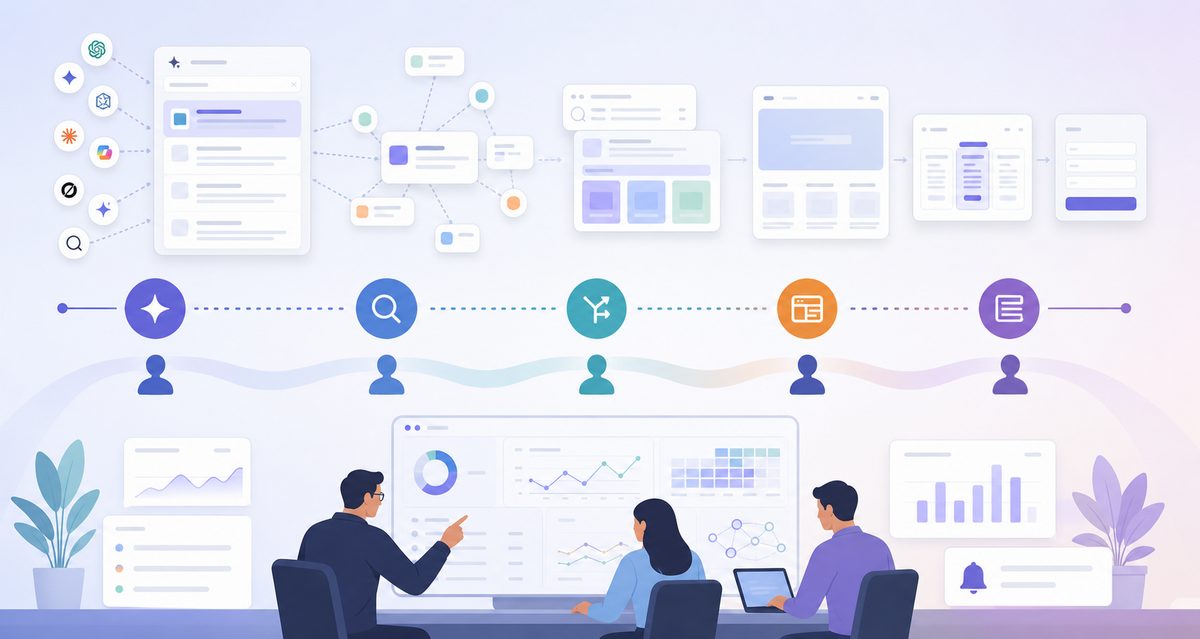
The AI recommendation buyer journey is the path a buyer takes after an answer engine recommends, compares, cites or omits a brand. It starts with the prompt and answer, then continues through branded search, validation pages, pricing or demo checks, review lookups and CRM evidence from sales conversations.
The important change is that the first influence event is often invisible to normal analytics. A buyer may see a ChatGPT, Perplexity, Gemini, Claude, Copilot, Grok, Google AI Mode or AI Overview answer, then leave and search your brand name directly. GA4 may call that traffic organic, direct or paid brand. Sales may call it demo sourced. Neither view explains why the buyer entered the market with your brand already in mind.
A useful AI recommendation buyer journey map answers six questions:
- Which buyer prompts produce recommendations?
- Which brands are included, ranked, cited or excluded?
- What claims does the AI answer attach to each brand?
- What does the buyer do next: search, compare, price, review or book?
- Where does the journey leak?
- What proof is strong enough to defend budget?
Why This Journey Exists
AI recommendations create upper-funnel influence without a clean referral click. A buyer can read an AI-generated shortlist, remember two vendors, ignore the citations, search one brand by name, compare it against a competitor and arrive on pricing already carrying assumptions from the answer.
That behavior is visible in emerging research. A June 2026 arXiv preprint, From Prompt to Purchase, studied opt-in clickstream data joined to ChatGPT, Claude and Gemini conversations. When an assistant recommended a brand to users with no recent observed engagement, same-name Google search rose by 4.3 percentage points, brand-site visits rose by 2.4 percentage points and brand-specific retailer-page visits rose by 1.0 percentage point over matched backward placebos. The authors note that the study is observational and does not observe transactions, so it is evidence of downstream navigation rather than final purchase causality.
Pew Research Center found a related click issue in Google Search. In a March 2025 dataset of 68,879 Google searches, users clicked a traditional search result on 8% of visits with an AI summary, compared with 15% of visits without one. They clicked links inside the AI summary itself on only 1% of visits with a summary. See Pew's analysis of how users click when Google AI summaries appear.
The takeaway for marketers is practical: AI can move demand into normal search and site behavior while analytics credits the last visible channel.
How AI Recommendation Journeys Differ From SEO Funnels
A classic SEO funnel begins with a query, a ranked result and a click. The AI-driven funnel often begins with a prompt, a synthesized answer and a recommendation set. The click may happen later, elsewhere or not at all.
| Dimension | Traditional SEO funnel | AI recommendation buyer journey |
|---|---|---|
| Starting point | Search query | Prompt or AI-assisted research task |
| Main visibility event | Ranking and snippet | Recommendation, comparison, citation or omission |
| Common next action | Organic click | Branded search, follow-up prompt, comparison, review or direct visit |
| Attribution problem | Keyword-to-click visibility | Prompt-to-demand visibility |
| Core evidence | Rankings, CTR, sessions | Answer text, rank, citations, branded search, page sequence, CRM notes |
| Main risk | Ranking loss | Misdescription, omission, weak citation, competitor framing |
Google's own guidance reinforces that this is not a separate shortcut from SEO. In its guide to optimizing for generative AI features on Google Search, Google says generative AI features rely on core Search ranking and quality systems, and that AEO and GEO are terms for AI search visibility work within the broader search experience. That means crawlable, useful, specific content still matters.
The difference is measurement. SEO tells you whether people clicked. The AI recommendation buyer journey tells you what shaped the buyer before the click.
The Six-Stage AI Recommendation Buyer Journey
The journey has six measurable stages: prompt, answer, recall, validation, commercial intent and sales proof. Each stage needs its own signal because no single dashboard captures the whole path.
| Stage | What happens | What to measure | What to improve |
|---|---|---|---|
| 1. Prompt | Buyer asks an AI system for help | Prompt coverage by persona, use case, market and funnel stage | Prompt research and monitoring set |
| 2. Answer | AI names, ranks, compares, cites or omits brands | Mention rate, rank, stance, citations, claim accuracy | Entity facts, product pages, third-party proof |
| 3. Recall | Buyer remembers a brand and searches it | Branded search lift, brand-plus-modifier queries, paid brand clicks | Brand SERP, homepage, category positioning |
| 4. Validation | Buyer checks whether the answer is fair | Comparison, alternatives, reviews, security and integration visits | Comparison, trust and proof pages |
| 5. Commercial intent | Buyer checks price, fit, ROI or demo path | Pricing visits, demo starts, ROI page visits, plan-fit behavior | Pricing, demo, ROI and routing flows |
| 6. Sales proof | Buyer references the AI answer in conversation | CRM fields, call transcript tags, objection notes | Sales enablement and reporting |
Use this model as a layer above SEO, paid search and sales attribution. It does not replace those systems. It explains why their downstream numbers move.
Stage 1: Build Buyer Prompt Coverage Before Tracking Mentions
Prompt coverage is the percentage of buyer-relevant questions your AI monitoring set actually tests. If the prompt set is weak, AI share of voice looks precise while missing the situations that influence revenue.
Start with five prompt families:
- Category prompts: "best [software category] for [company type]"
- Problem prompts: "how to solve [pain] without [constraint]"
- Comparison prompts: "[Brand] vs [Competitor] for [use case]"
- Risk prompts: "[Brand] limitations, complaints, security or pricing concerns"
- Implementation prompts: "how to evaluate [category] before rollout"
Then add persona and context modifiers. A founder, procurement lead, technical evaluator, agency strategist and CFO will not ask the same question. They may also receive different shortlists.
A 2026 arXiv audit on persona conditioning of brand recommendations tested brand recommendations across personas, prompts and model configurations. It found that changing only the persona reduced recommendation-set similarity by 0.12 to 0.20 Jaccard points, while mid-market brands could see up to 75% of the recommendation set swap as the persona changed.
That is why one "best tools" prompt is not a strategy. Build prompt clusters by buyer job, not by keyword alone. For a practical setup, use a process like AI prompt research for SEO: start from sales calls, Search Console queries, comparison searches, review-site language, community threads and customer objections.
Stage 2: Classify the Answer, Not Just the Mention
A brand mention is only the entry point. The business impact depends on how the answer frames the brand.
Track these answer fields for every priority prompt:
| Field | What to capture | Why it matters |
|---|---|---|
| Presence | Included, excluded or only cited | Shows whether the brand entered the consideration set |
| Rank or order | First, top three, lower list, paragraph mention | Higher placement is easier to remember |
| Stance | Recommended, neutral, cautious, negative | A mention can create demand or create objections |
| Competitive context | Which brands appear nearby | Reveals shortlist pressure |
| Citation source | Owned page, third-party page, review site, no citation | Shows what may be shaping the answer |
| Claim accuracy | Correct, outdated, incomplete, misleading | Identifies fixes for pages and profiles |
| Buyer-fit language | Segment, use case, industry, company size | Shows whether the answer matches target ICP |
This is the core of AI search monitoring and LLM brand tracking. Do not stop at an aggregate visibility score. A useful report preserves the answer text, citation, rank, prompt and model so teams can see exactly what buyers may be seeing.
Example: if an answer says "Vendor A is strong for enterprise governance but expensive for smaller teams," that single sentence can affect pricing-page behavior, sales objections and comparison-page visits. The fix may involve pricing clarity, use-case proof, third-party review updates and an honest comparison page, not just another top-of-funnel article.
Stage 3: Connect AI Answers to Branded Search
Branded search is often the first measurable footprint after an AI recommendation. The buyer sees a shortlist, leaves the answer engine and searches a brand name because that is faster than clicking a citation.
Measure branded search as a recall signal, not as complete attribution.
| Signal | Healthy pattern | Weak pattern |
|---|---|---|
| AI mention rate | Rises for priority buyer prompts | Rises only for low-intent prompts |
| AI rank | Moves into top three | Appears below entrenched competitors |
| Branded search | Increases after visibility gains | Moves without prompt visibility change |
| Query modifiers | "pricing," "reviews," "vs," "demo," "security" rise | Generic brand searches rise alone |
| Paid brand clicks | Capture incremental demand | Spend rises without new demand evidence |
The timing matters. If the brand starts appearing in "best for enterprise compliance" prompts and, two weeks later, Search Console shows more brand queries with "enterprise," "security" or "pricing," that is stronger evidence than a raw month-over-month increase.
Control for obvious confounders before claiming AI influence: product launches, PR, events, paid campaigns, partner announcements, competitor outages and seasonal demand.
Stage 4: Build Validation Pages for AI-Shaped Buyers
After an AI recommendation, buyers usually try to validate four things:
- Was the recommendation current?
- Does the product fit my company size and use case?
- What are the tradeoffs against the other vendors named?
- Can I trust the claims before I talk to sales?
That makes comparison, alternatives, reviews, security, integrations and customer-proof pages more important. They are no longer just SEO landing pages. They are post-answer validation surfaces.
A strong comparison page should include:
- A clear "best for" summary for each product.
- Decision criteria buyers actually use.
- Evidence for claims: features, integrations, reporting examples, security documentation, review patterns or customer proof.
- Honest tradeoffs instead of attack-copy.
- Paths to pricing, demo, implementation and migration information.
For maxaeo's category, one frequent validation question is whether a team needs a one-time audit or ongoing monitoring. A page such as Free AI Visibility Reports vs Ongoing Monitoring helps buyers understand that tradeoff before they compare vendors.
Stage 5: Treat Pricing and Demo Pages as AI-Influenced Pages
Pricing and demo pages are now validation pages for buyers who may already have an AI-generated opinion. They arrive with sharper questions than a generic lead.
| Buyer question after an AI answer | Page element that should answer it |
|---|---|
| "Is this built for my company size?" | Plan-fit guidance by segment and use case |
| "Why was this vendor recommended?" | Differentiators tied to evidence |
| "Which AI platforms are monitored?" | Clear platform coverage and update frequency |
| "Can I prove ROI?" | Reporting examples, executive metrics and workflow outcomes |
| "How does this compare with the other shortlist vendors?" | Comparison paths and decision criteria |
| "Will sales understand my AI visibility issue?" | Demo form fields and routing logic |
Keep the demo form short, but add one or two AI-specific fields where useful:
- "Which AI platforms are you tracking or worried about?"
- "Have prospects mentioned ChatGPT, Perplexity, Gemini, AI Overviews or another AI answer in sales conversations?"
These fields preserve attribution that would otherwise disappear. If a buyer found the brand through an AI answer but arrived through branded search, the form can still capture the influence.
For teams evaluating platforms, a category comparison such as The 10 Best AI Search and LLM Monitoring Tools in 2026 can help buyers understand monitoring depth, pricing models and workflow differences before they request a demo.
Stage 6: Capture AI Influence in CRM and Sales Notes
Sales conversations are where invisible AI influence often becomes explicit. Buyers may say:
- "ChatGPT recommended you."
- "Perplexity said your competitor is better for enterprise teams."
- "Gemini listed you but said pricing was unclear."
- "Google AI Overview cited an older article about your category."
If those statements stay only in call recordings, marketing cannot defend budget or fix the answer source.
Add lightweight CRM fields:
| CRM field | Example values |
|---|---|
| AI platform mentioned | ChatGPT, Perplexity, Gemini, Claude, Copilot, Grok, Google AI Mode, AI Overviews |
| Buyer prompt type | Shortlist, comparison, pricing, risk, implementation |
| Brand stance in answer | Recommended, mentioned, omitted, criticized, misdescribed |
| Competitors named | Vendor A, Vendor B, none |
| Claim to fix | Wrong pricing, missing feature, outdated positioning, weak category fit |
| Sales impact | Created demand, accelerated deal, created objection, no clear impact |
| Evidence location | Demo form, call transcript, sales note, email, chat |
This is the bridge between AI reputation management and revenue operations. It turns scattered anecdotes into a dataset.
The Post-Answer Evidence Ladder
Not all evidence deserves the same confidence. Use an evidence ladder to avoid over-attribution.
| Level | Evidence | Confidence |
|---|---|---|
| 0 | Brand appears in an AI answer, no downstream signal | Weak |
| 1 | Brand appears in priority prompts with positive rank or stance | Directional |
| 2 | Branded search or brand-plus-modifier searches rise after visibility gains | Moderate |
| 3 | Buyers visit validation pages after brand search | Stronger |
| 4 | Demo forms or sales calls mention AI platforms, prompts or answer claims | Strong |
| 5 | CRM-confirmed opportunities show AI influence and revenue stage movement | Budget-grade |
The most defensible reporting combines levels 2 through 5. An AI mention alone is useful for diagnosis, but it is not enough for revenue claims.
A simple attribution rule works well:
| Question | Use it to decide |
|---|---|
| Did the brand appear for the relevant prompt cluster? | Whether AI exposure was plausible |
| Did rank, stance or citation quality improve? | Whether exposure became more memorable |
| Did branded demand move after the answer change? | Whether recall likely increased |
| Did validation-page behavior match the answer topic? | Whether buyers acted on the recommendation |
| Did sales capture buyer language about AI? | Whether influence was explicit |
| Were campaigns or events active at the same time? | Whether attribution should be discounted |
Worked Example: From AI Shortlist to Demo Request
Assume a B2B SaaS buyer asks: "What are the best AI search monitoring tools for a 200-person SaaS company?"
The AI answer names three vendors. maxaeo appears second, with a correct description of daily monitoring across major AI search and answer platforms. The citation points to a current comparison page, but the answer omits agency reporting.
A clean journey map would look like this:
| Timeline | Buyer action | Observable signal | Team action |
|---|---|---|---|
| Day 0 | AI answer recommends maxaeo | Prompt rank = 2, positive stance | Save answer, citation and model |
| Day 0 | Buyer searches "maxaeo pricing" | Branded search with pricing modifier | Check pricing-page clarity |
| Day 1 | Buyer visits comparison content | Competitor comparison session | Add missing proof or decision criteria |
| Day 2 | Buyer checks reviews and security | Trust-page sequence | Strengthen risk-reduction content |
| Day 3 | Buyer requests demo | Demo form includes AI platform field | Route to AI visibility specialist |
| Day 7 | Sales call mentions ChatGPT shortlist | CRM field confirms AI influence | Include in weekly AI visibility report |
This does not claim that AI closed the deal. It shows a defensible influence path: prompt evidence, branded recall, validation behavior, demo intent and buyer language.
What to Fix When the Journey Breaks
A broken AI recommendation buyer journey usually falls into one of these patterns.
| Failure pattern | Symptom | Likely cause | Fix |
|---|---|---|---|
| Brand absent | Competitors appear, brand is omitted | Weak entity signals, thin category footprint, low third-party proof | Strengthen product facts, category pages, comparisons, reviews and earned mentions |
| Brand misdescribed | AI uses wrong pricing, category or feature claims | Inconsistent web facts or outdated pages | Update product pages, pricing pages, docs and third-party profiles |
| Mentioned but not remembered | AI mentions rise, branded search stays flat | Low rank, neutral stance or weak prompt intent | Improve answer prominence and test higher-intent prompt clusters |
| Searched but not validated | Branded search rises, comparison visits are shallow | Comparison pages are vague or biased | Add decision criteria, proof, tradeoffs and paths to demo |
| Validated but not converting | Pricing or demo visits rise, demo requests do not | Pricing ambiguity, weak ROI proof, poor routing | Clarify plan fit, add proof and shorten demo path |
| Sales objections rise | Buyers repeat AI-framed competitor claims | AI answer highlights a competitor advantage | Build honest objection pages and sales enablement |
| Influence disappears | Reps hear AI mentions but reports show none | No CRM field or transcript tag | Add lightweight AI-source capture |
The fix should match the leak. Do not publish more top-of-funnel content when the problem is pricing clarity. Do not blame sales when the answer engine is repeating outdated product facts.
Minimum Measurement Stack
You can map the journey with a lightweight stack before investing in a full program.
| System | What to collect | Review cadence |
|---|---|---|
| AI monitoring | Prompt, answer, rank, stance, citation, model, date | Daily for priority prompts, weekly for long tail |
| Search Console | Branded queries, brand-plus-modifier queries, comparison queries | Weekly |
| Web analytics | Sessions to homepage, comparison, pricing, demo, reviews, security and integrations | Weekly |
| CRM | AI platform mentioned, buyer prompt type, competitors named, sales impact | Weekly |
| Call intelligence | Transcripts containing ChatGPT, Perplexity, Gemini, AI Overview, "AI said" and competitor phrases | Weekly |
| Content workflow | Page fixes, citation targets, claim corrections, owner, due date | Weekly |
A one-time audit can find the first set of issues. Ongoing monitoring is needed when competitors, models, citations and buyer prompts change frequently. The distinction matters for budget, which is why many teams compare free AI visibility reports with ongoing monitoring before choosing a workflow.
How to Report the Journey to Executives
Executives do not need hundreds of screenshots. They need a concise readout of demand, risk and action.
A useful monthly report includes:
| Section | Question it answers |
|---|---|
| AI share of voice | Are we recommended more or less often than competitors? |
| Priority prompt coverage | Are we testing the prompts buyers actually use? |
| Answer quality | Are claims, positioning and citations accurate? |
| Post-answer demand | Are branded search, comparison visits and pricing visits moving? |
| Sales evidence | Are demo forms, calls or CRM notes confirming AI influence? |
| Revenue context | Which opportunities show AI-influenced behavior? |
| Fix list | Which pages, profiles, citations or sales assets need work next? |
The best report connects AI visibility to business motion without overstating causality. Use the format in this AI visibility report template to keep executives focused on what changed, why it matters and what the team will fix next.
Where maxaeo Fits
maxaeo is built for teams that need to monitor how AI systems mention, rank, cite and describe their brand over time. The workflow is simple:
- Build prompt sets by persona, funnel stage, market and buyer job.
- Track AI share of voice, rank, stance, sentiment and citations.
- Flag inaccurate, weak or outdated descriptions.
- Map answer changes to branded search, validation pages, pricing behavior and demo quality.
- Feed sales objections and buyer language back into monitoring.
- Report the journey weekly so SEO, brand, PR, product marketing, growth and sales work from the same evidence.
For deeper context on how answer engines decide which brands to cite, read AI Search Engine Ranking: How ChatGPT, Perplexity and Gemini Decide Which Brands to Cite.
Common Questions
What is the AI recommendation buyer journey?
The AI recommendation buyer journey is the measurable path from an AI-generated recommendation to the buyer's next actions. It includes the prompt, answer, cited evidence, branded search behavior, comparison and pricing checks, demo activity, review lookups and CRM proof that AI influenced the conversation.
How is it different from a normal SEO funnel?
A normal SEO funnel usually starts with a query and a click. The AI recommendation buyer journey starts with an answer that may not produce a referral click. The buyer can still remember the brand, search it later, compare vendors, check pricing or mention the AI answer in sales.
Which metric matters most?
No single metric is enough. Track AI share of voice, answer rank, stance, citation quality, branded search lift, validation-page visits, pricing or demo behavior and CRM-confirmed AI influence together. The chain is more useful than one dashboard number.
How often should teams measure it?
Measure priority prompts daily or weekly in competitive B2B categories. Review branded search, validation pages and CRM evidence weekly. Quarterly audits are useful for snapshots, but they miss prompt, model, citation and competitor movement.
What should you fix first after an AI visibility audit?
Fix the largest post-answer leak. If the brand is absent, strengthen entity facts and third-party proof. If the brand is misdescribed, update source pages and profiles. If buyers search but do not convert, improve comparison, pricing, demo and trust pages.
Do AEO, GEO and SEO need separate strategies?
They need separate measurement, not separate fundamentals. SEO still provides the crawlable, useful and authoritative content base. AEO and GEO add answer-level monitoring: prompts, recommendations, citations, claims, omissions and post-answer buyer behavior.
The Practical Takeaway
AI recommendations do not end the buyer journey. They move the entrance.
The measurable path now runs from prompt visibility to branded search, validation pages, pricing checks, demo behavior and sales conversations. Teams that only track AI mentions miss business impact. Teams that only track last-click analytics misattribute the influence.
The defensible approach is to monitor AI answers, classify recommendation quality, map downstream behavior and capture buyer language in CRM. That is how marketing leaders turn AI visibility from a trend into a budget line they can defend.