Your dashboard flags it at 8 a.m.: mention rate down 27 points overnight, your AI citations gone, a competitor sitting in the shortlist slot you held for months. A brand visibility drop after an AI model update is now a routine operating risk, not a freak event — and the first 48 hours largely decide whether you recover in weeks or watch the new answer mix harden around your absence.
This playbook is an incident-response runbook, hour by hour: confirm the cause, root-cause it with citation diffs, brief your stakeholders, and sequence recovery actions by how fast each one can actually move the needle. It is built on what MaxAEO's model-update alerts and daily AI search monitoring data show across the GPT-5, GPT-5.1, GPT-5.2, Gemini 3 and early-2026 ChatGPT update cycles.
The playbook at a glance:
| Window | Objective | Output |
|---|---|---|
| Hour 0–6 | Confirm the drop is real and platform-side (the 15/3 rule) | Severity grade P1–P3 |
| Hour 6–12 | Root-cause with a before/after citation diff | One of five diff patterns |
| Hour 12–24 | Ship fixes that take effect in days; brief stakeholders | Quick wins live + one-page brief |
| Hour 24–48 | Sequence slower recovery work by lead time | Prioritized recovery plan |
What Is an AI Model Update Brand Visibility Drop?
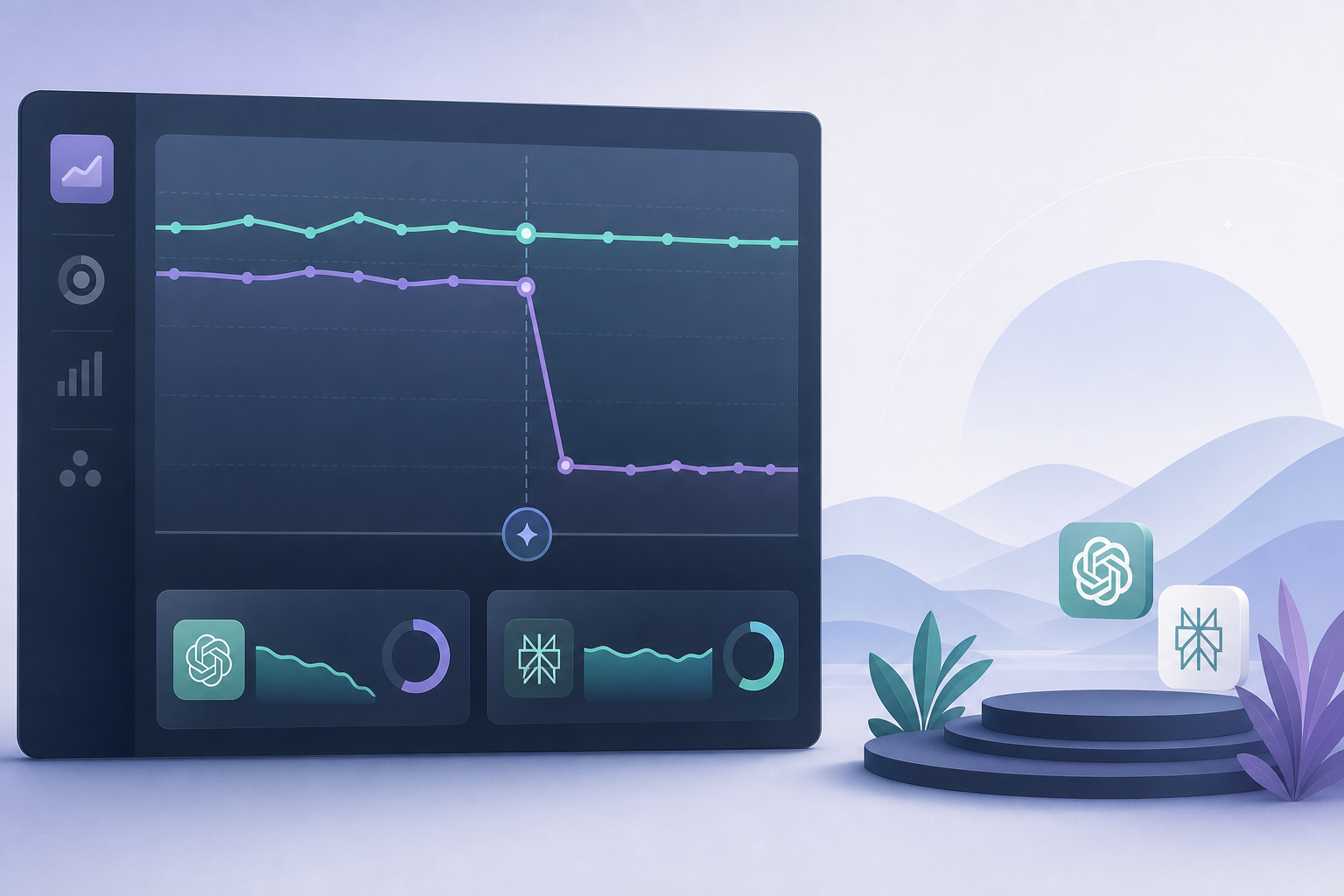
An AI model update visibility drop is a sudden, sustained decline in how often AI assistants mention, recommend or cite a brand, triggered by the platform shipping a new model or changing retrieval behavior — not by anything the brand itself changed. It usually appears as a step change on one platform within a day or two, while other platforms hold steady.
These step changes are well documented, and they cluster tightly around release dates:
| Update | Date | Documented visibility impact |
|---|---|---|
| GPT-5 | Aug 2025 | Mention-rate inflections within 72 hours across MaxAEO-tracked brands |
| GPT-5.1 | Nov 2025 | Source-type reshuffles on brand queries (see the worked incident below) |
| Gemini 3 in Search | Nov 18, 2025 | 46.3% of previously cited domains dropped out of AI Overview sources; "sourceless" AI Overviews jumped from 0.11% to 10.63% after Google's fastest-ever deployment into AI Overviews and AI Mode, per Fortune |
| GPT-5.2 | Dec 11, 2025 | Tracking inflections within 24–72 hours of the December 11 release |
| ChatGPT early-2026 update | Jan–Feb 2026 | Citations per answer on brand queries fell from 4.95 to 2.96 — a 41% decline in five weeks, per Built In; mentions persisted while links dropped |
Why does a model swap move brand visibility? Four mechanisms, often stacked:
- New training data and weights. Sources the old model leaned on get re-weighted; what counted as the "consensus answer" about your category shifts.
- Retrieval and re-ranking changes. The model fetches and trusts different live sources, so your AI citations can vanish even when your content is unchanged.
- Answer-style changes. Updates often alter how many sources get linked at all — the early-2026 ChatGPT update kept mentioning brands while linking far less.
- Guardrail and system-prompt changes. New instructions about recommendations, sentiment and hedging change which brands get named, and how.
Knowing the mechanisms matters because each one calls for a different fix. But before you fix anything, you need to be sure a model update is actually what hit you.
Hour 0–6: Confirm It's the Model, Not Noise
The first job is separating a real regime change from ordinary volatility. AI answers are noisy by default: AirOps' analysis found only about 30% of brands remain visible in back-to-back AI responses to the same query. If you panic over every fluctuation, you will burn credibility and budget chasing ghosts.
MaxAEO tracking observation: across brands we monitor daily on stable 100+ prompt sets, normal day-to-day swing in mention rate is roughly ±8–12 points. We codify the triage threshold as the 15/3 rule: a move greater than 15 points that holds for three consecutive days almost always traces back to a model, retrieval or system-prompt change on the platform side. Magnitude plus persistence — that combination is the single most useful triage filter we have found.
Run this checklist before you touch anything else:
- Re-run your prompt set multiple times. One run is an anecdote. Three to five runs across the day give you a distribution; a true drop survives re-sampling.
- Segment by platform. In MaxAEO's cross-platform data, citation overlap between any two engines averages only about 11%, so a genuine model-update drop is usually platform-specific. ChatGPT down while Gemini, Perplexity and Copilot hold steady points at OpenAI, not at you.
- Check the changelogs. OpenAI, Google and Anthropic publish release notes; every major 2025–2026 update in the table above showed up as an inflection in tracking data within 24–72 hours.
- Rule out your own side. Recent deploys, robots.txt edits, CDN or bot-blocking changes, expired pages — confirm AI crawlers (GPTBot, Google-Extended, PerplexityBot) can still fetch you.
- Check whether competitors moved. If your slots went to specific rivals while the platform's overall behavior looks unchanged, you may be looking at displacement, not a model effect.
| Signal | Most likely cause | First move |
|---|---|---|
| Drop on one platform, same day as a release note | Model update | Proceed to citation diff (next section) |
| Drop across all platforms at once | Your site or measurement setup | Audit crawl access, deploys, prompt set |
| Mentions hold, links disappear | Answer-style / citation policy change | Track mentions and citations separately |
| Your slots filled by one competitor | Displacement | Run a competitor citation comparison |
| Wild swings, no persistence | Normal volatility | Wait out the 3-day persistence test |
Grade severity before escalating:
- P1: sustained drop of more than 20 points on revenue-relevant prompts (pricing, "best X for Y", comparison queries) — run the full 48-hour response.
- P2: sustained drop on informational prompts — fix within the week.
- P3: movement inside normal volatility — a note in next week's report.
Your baseline only works if you already track the right numbers — the six AI visibility metrics that define your baseline are the prerequisite for everything in this section.
Once the drop is confirmed and graded, the question becomes what exactly changed — and that answer lives in the citations.
Hour 6–12: Root-Cause the Drop With Citation Diffs
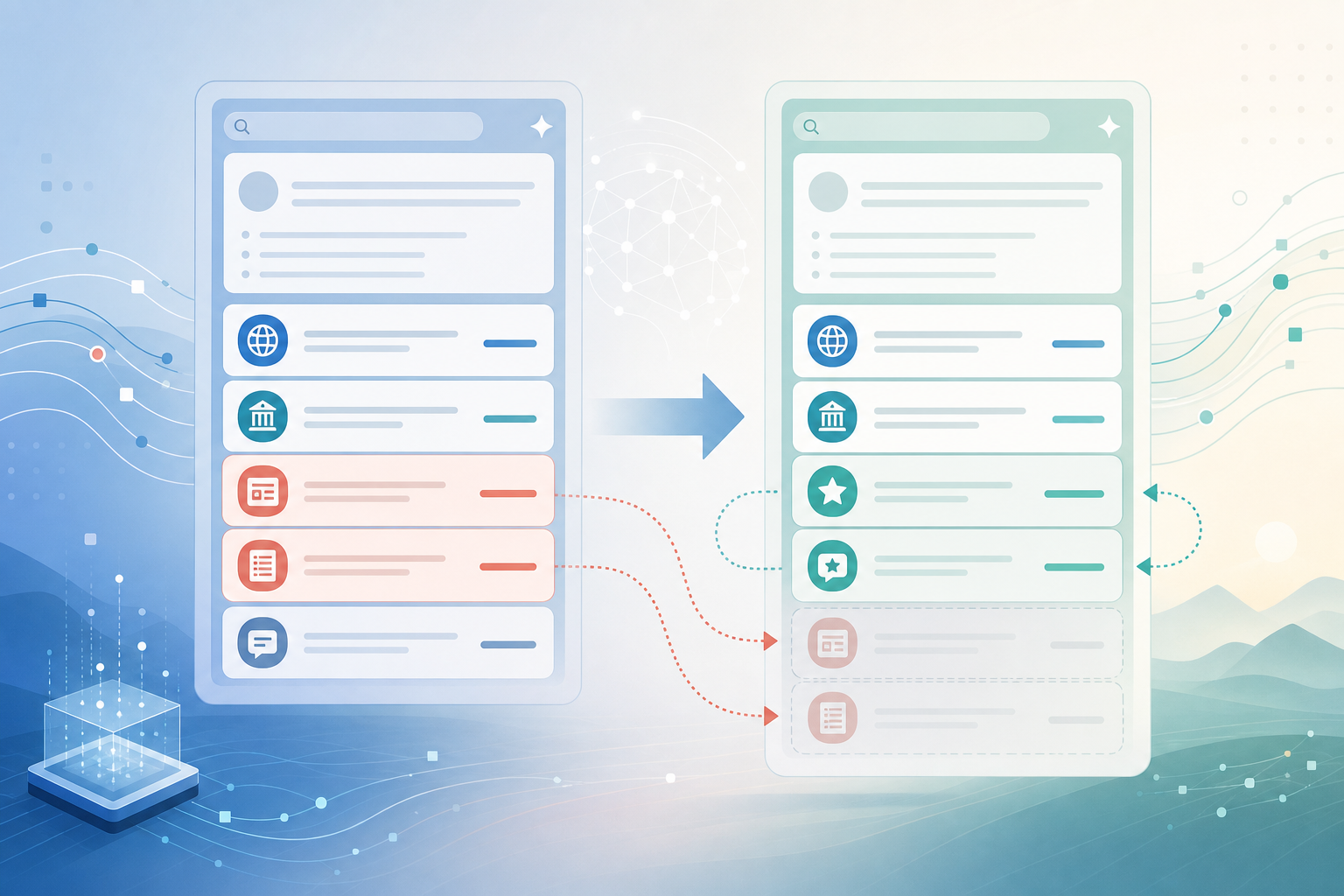
A citation diff — comparing which sources the AI cited for your prompt set before versus after the update — is the fastest way to turn "we dropped" into "here is why." Export the cited domains and URLs from your last stable week, export the same for the post-update runs, and diff them at both domain and URL level.
In MaxAEO incident reviews, virtually every model-update drop resolves into one of five diff patterns — and the first two account for roughly two-thirds of the incidents we see:
- Source-type swap. The new model prefers different categories of sources. After the early-2026 ChatGPT update, educational domains fell from 14% to under 10% of brand-query citations while review platforms like G2 and Capterra grew from 5% to about 7%. If the listicles that carried you lost favor, your visibility goes with them. Understanding which source types ChatGPT, Perplexity and Gemini cite most tells you where to rebuild.
- You-specific removal. Competitors' citations survived; yours didn't. Usual suspects: stale content (AI engines show strong recency bias), crawlability problems, or thin coverage of the way the new model now frames the question.
- Full reshuffle. Nearly all old sources gone — the model is interpreting the intent differently and effectively answering a different question. Your content needs to match the new framing, not the old one.
- Link suppression. Brand mentions persist but citations drop across the board. This is a platform-level style change; measure AI share of voice by mentions, not links, and don't misread it as a brand problem.
- Fact regression. The new model reintroduces outdated pricing, dead features or outright errors. This is an accuracy incident, not just a visibility one — escalate it through the workflow for correcting AI hallucinations about your company.
A worked incident from MaxAEO tracking
A representative case from our data (B2B SaaS customer, anonymized): during the GPT-5.1 rollout week in November 2025, their ChatGPT mention rate on a 120-prompt set fell from 58% to 31% overnight, while Gemini and Perplexity were flat. The citation diff showed two third-party aggregator listicles — previously their most-cited sources — had dropped out of answers entirely, while G2 and vendor docs pages rose. Root cause: pattern 1, source-type swap. They refreshed their comparison page, completed their G2 profile, and updated two partner listings. Mention rate recovered to 54% by day 19. The diff turned a vague crisis into a three-item task list.
With a root cause in hand, the next 12 hours are about stabilizing — both the answers and the people asking you about them.
Hour 12–24: Quick Wins and the Stakeholder Brief
By hour 24 you should have shipped the fixes that can take effect within days, and put a one-page incident brief in front of stakeholders. Both matter: AI visibility incidents get noticed internally, and marketers who show a controlled response defend their answer engine optimization budget far better than those who shrug at "AI is just random."
Quick wins, in order of typical impact:
- Refresh the pages the engines re-crawl most. Recency bias is measurable — in MaxAEO citation data, pages updated within the last 90 days are cited at roughly twice the rate of pages older than a year. Update statistics, dates and examples on your most-cited URLs first.
- Fix what you control among the newly favored sources. If the diff shows review platforms or docs rising, complete those profiles and pages today, not next sprint.
- Verify and restore crawler access. Confirm GPTBot, Google-Extended, PerplexityBot and ClaudeBot get 200s on your key URLs; an old bot-blocking rule plus a new retrieval pipeline is a silent killer.
- Log fact errors with each platform's feedback channel if you found pattern 5 — and publish a correct, crawlable source for every wrong claim.
Then write the brief. Five lines is enough:
- What happened: ChatGPT mention rate −27 pts on [date], aligned with [model release]; other platforms stable.
- Scope: which prompt categories and funnel stages are affected, and which are not.
- Root cause: the diff pattern, in one sentence.
- Actions: what shipped today, what ships this week.
- Recovery outlook: expected timeline with an honest range, and the next report date.
This is AI reputation management in practice: the brief converts an alarming chart into a managed incident. With stabilization done, the remaining 24 hours are for sequencing the slower, compounding work.
Hour 24–48: Sequence Recovery Actions by Lead Time
Sequence recovery by time-to-effect, not by ease. The most common failure mode we see is teams spending week one rewriting their own blog — the action they control most — when the diff clearly shows the new model trusts third-party sources they haven't touched.
| Lead time | Action | When it's the priority |
|---|---|---|
| Days | Refresh owned, already-cited pages; fix crawl access; update docs and pricing pages | Pattern 2 (you-specific removal), pattern 5 (fact regression) |
| 1–3 weeks | Build or complete presence on newly favored source types: review platforms, comparison sites, community threads | Pattern 1 (source-type swap) |
| 3+ weeks | Publish content matching the new answer framing; PR and expert commentary for authority mentions | Pattern 3 (full reshuffle) |
Three rules keep the sequence honest:
- Match effort to the diff, not to habit. If G2 rose and listicles fell, a G2 profile completed this week beats three new blog posts.
- Treat displacement as competitive intelligence. When specific rivals took your slots, study what sources now carry them — mapping every brand AI recommends before yours shows you the exact gap to close, and whether their gain is durable or one model-version lucky.
- Don't over-correct. Resist rewriting everything. Around 57% of pages that disappear from AI citations resurface in later collection waves, per a 481-site volatility study — bulk rewrites can churn pages that were about to come back on their own.
What you should not do is equally important: no mass-produced "optimized for AI" pages, no keyword-stuffed FAQ farms, no fake review velocity. Every post-update winner we have tracked won on source alignment and freshness, not on volume. The remaining question is what recovery realistically looks like once the work ships.
What Does Recovery Actually Look Like?
Visibility usually comes back — but the mix of winners rarely returns to the old one. After the early-2026 ChatGPT citation crash, brand-query citations recovered to roughly 90% of their December baseline within about ten weeks — yet the source mix had permanently shifted toward review platforms and product sites. Recovery is real; restoration is rare.
Set expectations with the platform's own churn rate. The 481-site study found 28-day citation retention averaged just 33% across five AI platforms — Gemini lowest at 11%, AI Overviews 27%, ChatGPT 31%, Copilot 34%, Perplexity highest at 44%. On a high-churn platform, fixes surface faster; on a stickier one, both losses and gains take longer to register.
MaxAEO tracking observation: in the incidents we have monitored end-to-end, brands that shipped diff-driven fixes within the first week recovered to within 5 points of baseline in a median of about three weeks. Brands that waited a month or longer frequently found the new answer set had stabilized around competitors — at that point they were not recovering a position, they were contesting one. Speed is the variable you control.

The cheapest 48-hour response is the one you prepared before the update shipped.
How to Be Ready Before the Next Model Update
Preparation is four assets: a stable prompt set, an archived baseline, an alert threshold, and a pre-agreed runbook. Model releases are accelerating — GPT-5, GPT-5.1, Gemini 3 and GPT-5.2 shipped within five months of each other — so "the next one" is a quarter away at most.
- Keep a fixed, versioned prompt set (100+ prompts spanning your funnel) and run it daily. LLM brand tracking without a stable instrument produces noise you can't diff.
- Archive weekly citation snapshots. A citation diff is only possible if you stored the "before." This is the single highest-use habit in generative engine optimization incident response.
- Set alert thresholds that respect noise. Use the 15/3 rule calibrated to your platforms' normal swing, not single-day blips. An AI visibility tool like MaxAEO ships model-update alerts that correlate visibility inflections with platform release timelines automatically, plus the before/after citation diffs this playbook runs on — but the methodology works even if you assemble it from scripts and spreadsheets.
- Diversify your source footprint in advance. With citation overlap between any two engines averaging only ~11% in our cross-platform data, and source preferences shifting every release, depending on one listicle or one platform is concentration risk. Spread across owned pages, review platforms, communities and press so no single re-weighting can erase your brand mentions in ChatGPT — or anywhere else.
- Pre-agree the runbook. Decide now who owns triage, who writes the brief, and what P1 means, so hour zero is execution rather than negotiation. Getting recommended by ChatGPT consistently is less about any single optimization and more about being the brand whose evidence survives every model's re-evaluation.
Frequently Asked Questions
How do I know a visibility drop came from a model update and not my own site?
Check three signals: scope, timing and persistence. A model-update drop is platform-specific (one engine falls, others hold), aligns with a published release within 24–72 hours, and passes the 15/3 rule — a move beyond 15 points that persists across three days of repeated runs. A drop across all platforms at once points to your site: crawl access, deploys or content removal.
What should I do first when my brand's AI visibility drops?
Re-run your prompt set three to five times across the day and segment results by platform before changing anything. A real drop survives re-sampling and stays platform-specific. Then grade severity: a sustained 20+ point fall on revenue-relevant prompts is a P1 that justifies the full 48-hour playbook; volatility within normal range justifies a line in next week's report.
How long does it take to recover from an AI model update visibility drop?
In MaxAEO's incident data, brands that shipped diff-driven fixes within the first week recovered to near-baseline in a median of about three weeks; ecosystem-wide, the early-2026 ChatGPT citation crash took roughly ten weeks to climb back to ~90% of baseline. Expect weeks, not days — and expect the recovered answer mix to differ from the old one.
Do model updates affect all AI platforms at the same time?
No. Each platform ships on its own cycle, and citation overlap between any two engines averages only about 11% in MaxAEO's tracking, so updates land as platform-specific shocks — Gemini 3 reshuffled AI Overviews in November 2025 while ChatGPT was unaffected, and the early-2026 ChatGPT update did the reverse. That independence is diagnostic: it is how you isolate the cause in triage.
Should I rewrite my content after every model update?
No. Rewrite only what the citation diff implicates: stale already-cited pages, content that no longer matches the new answer framing, or sources with factual errors. Roughly 57% of pages that drop out of AI citations resurface on their own in later waves, so reflexive bulk rewrites waste effort and can churn pages that were about to return.
This article was created with AI assistance and reviewed by a human editor.