
An AI citation audit identifies which pages AI engines cite, quote, summarize, or appear to rely on when they answer category, comparison, and vendor recommendation prompts. The deliverable is not a screenshot folder. It is a prioritized action plan for content, SEO, digital PR, profile cleanup, partnerships, and reputation monitoring.
For B2B SaaS teams, this matters because buyers now ask ChatGPT, Gemini, Perplexity, Claude, Copilot, Grok, Google AI Mode, and Google AI Overviews questions such as "best AI search monitoring tools for B2B SaaS" before they visit a vendor site. The answer may include a ranked shortlist, cited URLs, uncited claims, and competitor-framed category language.
Traditional SEO tells you which page ranks. An AI citation audit tells you which sources influence the answer.
Quick Answer: What Is an AI Citation Audit?
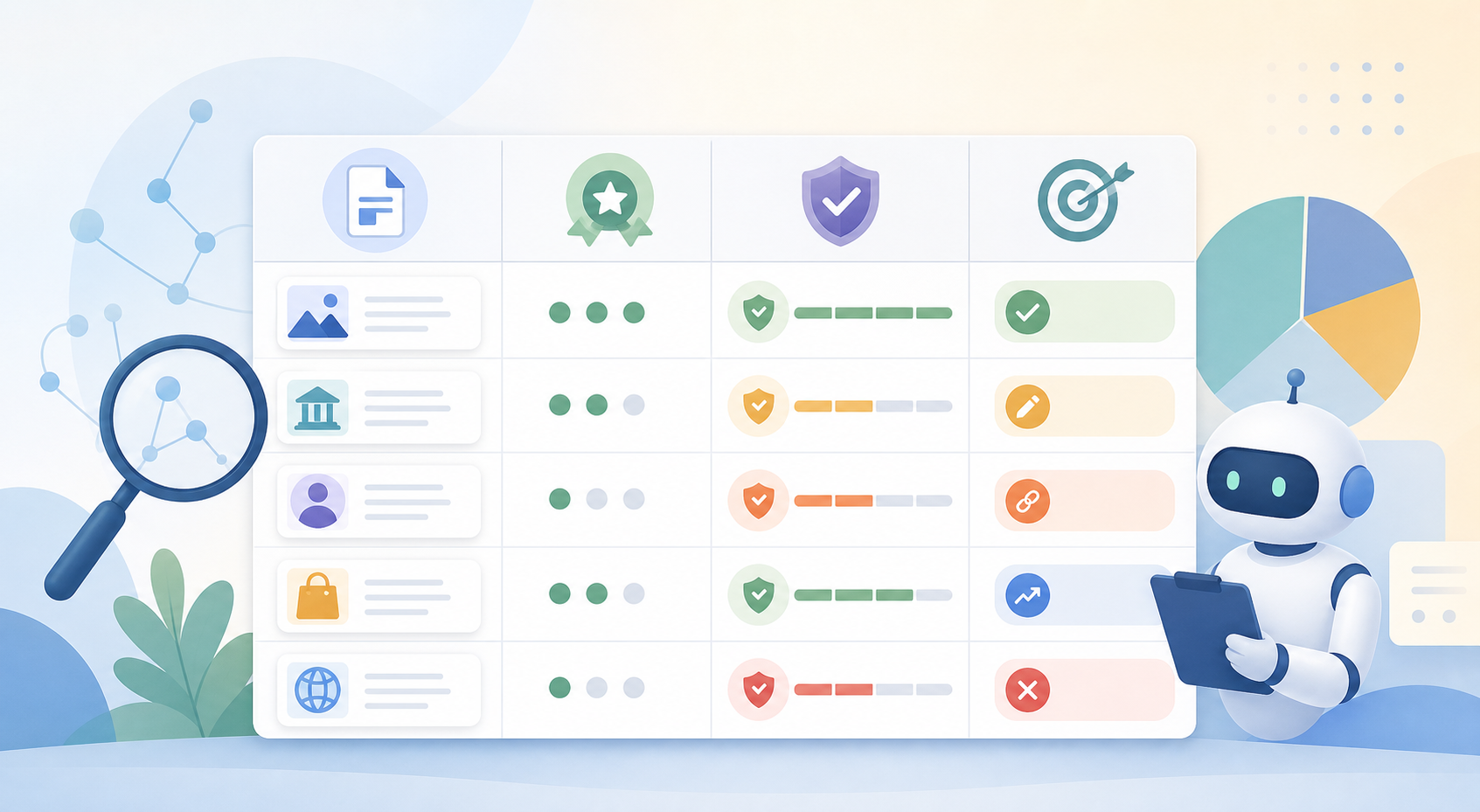
An AI citation audit is a source-by-source review of the URLs, domains, and claims AI engines cite or rely on when answering buyer questions. It shows which sources influence brand recommendations, whether those sources are accurate, and what content, PR, profile, or technical action should happen next.
A useful audit answers seven questions:
- Which brands are mentioned, ranked, cited, or omitted?
- Which URLs and domains appear as citations?
- Which uncited claims repeat across answers?
- Which sources influence wording, ranking rationale, or trust signals?
- Which cited facts are stale, incomplete, or wrong?
- Which sources can your team fix, influence, or outrank with better evidence?
- Which actions should be assigned to content, SEO, PR, product marketing, customer marketing, or legal?
If you only need to find cited URLs, start with AI citation tracking. If you need to decide what to change next, run the audit process below.
AI Citation Audit vs. Citation Tracking vs. SEO Audit
These workflows overlap, but they are not the same.
| Workflow | Primary question | Main output | Typical owner |
|---|---|---|---|
| AI citation tracking | Which sources appear in AI answers? | Citation list, domain list, screenshots | SEO, GEO, analytics |
| AI citation audit | Which cited or implied sources help, hurt, or misrepresent us? | Source Influence Matrix and action queue | SEO, content, PR, product marketing |
| SEO content audit | Are our own pages strong enough to rank and convert? | On-page fixes, content roadmap | SEO, content |
| Reputation audit | Are public claims about us accurate and fair? | Risk log, correction plan | Comms, legal, customer marketing |
The mistake is treating every citation as a win. A citation can be low-value, stale, competitor-controlled, or even harmful. The audit separates citation presence from source influence.
Why AI Citation Audits Matter
AI recommendation answers compress days of buyer research into one response. If the engine cites stale directory profiles, outdated pricing pages, weak listicles, Reddit threads, or competitor-owned comparisons, those sources can shape who gets recommended and why.
Google’s own guidance says generative AI features in Search are rooted in Search ranking and quality systems, and may use techniques such as retrieval-augmented generation and query fan-out to retrieve supporting pages from the Search index. See Google Search Central’s guide to optimizing for generative AI features.
That does not mean AI answers mirror the classic top 10 results. It means source quality, crawlability, specificity, freshness, and evidence still matter, while the visible source set may differ by engine, prompt, location, and time.
Research also supports auditing beyond raw citation counts. The 2026 arXiv preprint From Citation Selection to Citation Absorption analyzed 602 controlled prompts and 21,143 valid search-layer citations, finding that citation breadth and answer influence can diverge across AI search platforms. In practical terms: a page can be cited often but barely shape the answer, while another source can appear less often but provide the language that defines the category.
What Most AI Citation Reports Miss
Many reports stop at "these domains were cited." That is useful, but incomplete.
The maxaeo audit model adds four layers:
| Missing layer | Why it matters | How to audit it |
|---|---|---|
| Answer absorption | A citation is not always influential | Compare answer wording, ranking rationale, and claims against the source |
| Fixability | Some sources can be changed; others cannot | Classify ownership and assign realistic actions |
| Freshness risk | AI answers may repeat old product facts | Check pricing, features, positioning, screenshots, dates, and profiles |
| Business impact | Not every prompt or source deserves the same priority | Score by prompt intent, shortlist position, accuracy risk, and revenue relevance |
The central question is not "How many AI citations did we get?" It is: Which sources are shaping buyer-facing AI answers, and what can we do about them?
What Counts as an AI Citation?
For audit purposes, count more than visible footnotes.
| Source signal | Include in the audit? | How to label it |
|---|---|---|
| Visible citation link in an AI answer | Yes | cited |
| Source card in Perplexity, Copilot, Gemini, or AI Overview | Yes | cited |
| Link shown below or beside an AI-generated answer | Yes | cited |
| Brand mentioned without a source | Yes | uncited mention |
| Repeated claim with no visible citation | Yes, if material | uncited claim |
| Wording that closely matches a known page | Yes, but mark uncertainty | inferred source |
| Classic organic result with no AI answer influence | No, unless also cited or reflected | SEO only |
Do not overstate certainty. If the engine does not show a source, label the source as inferred, not proven.
Build the Prompt Set Before Pulling Sources
An AI citation audit is only as good as the prompts. Use prompts that match real buyer research, not only exact-match keywords.
Start with four prompt types:
- Category shortlist prompts: "What are the best AI search monitoring tools for B2B SaaS?"
- Use-case prompts: "Which platforms help marketing teams track brand mentions in ChatGPT?"
- Comparison prompts: "What are the best alternatives to [competitor] for AI visibility tracking?"
- Validation prompts: "Which tools are trusted for generative engine optimization reporting?"
For a first audit, use at least 8 prompts across 5 engines with 3 repeated runs each. That creates 120 answer captures. Repeated runs matter because AI answers vary by prompt wording, run, time, and platform. The 2026 arXiv preprint Don't Measure Once argues that AI search visibility should be measured as a distribution rather than a single observation.
Record these fields for every capture:
| Field | Why it matters |
|---|---|
| Engine and model, if visible | Different systems cite and summarize differently |
| Date, country, and language | AI answers can vary by market |
| Prompt text | Small wording changes can change sources |
| Brand mentions | Shows whether the brand entered the answer |
| Shortlist position | Shows recommendation strength |
| Cited URLs | Shows visible source set |
| Uncited claims | Finds hidden reputation and accuracy risks |
| Brand descriptors | Reveals how the engine frames positioning |
| Screenshot or export | Preserves evidence for remeasurement |
For agencies, segment prompts by country, category, buying stage, and competitor set. "Best customer onboarding software for startups" and "enterprise customer success platforms" may cite different sources even when the same vendor appears.
Create the Citation Inventory
The citation inventory is the working table for the audit. Include every cited URL, every cited domain, and every answer where the source appeared.
Do not collapse URLs too early. A homepage, pricing page, review profile, integration page, help doc, and comparison article may all require different actions.
Use this inventory structure:
| Column | What to record | Why it matters |
|---|---|---|
| Source URL | Exact cited or inferred page | Keeps fixes page-specific |
| Source domain | Root domain | Shows concentration by publisher |
| Source type | Owned, earned, third-party, community, partner, competitor | Determines action path |
| Engine | ChatGPT, Gemini, Perplexity, Claude, Copilot, Grok, AI Overview, AI Mode | Citation behavior varies |
| Prompt cluster | Category, comparison, use case, validation | Connects source to buyer intent |
| Brand outcome | Mentioned, ranked, cited, omitted, misdescribed | Turns source data into visibility impact |
| Citation frequency | Number of captures where the source appears | Finds recurring sources |
| Answer absorption | Low, medium, high | Estimates how much the source shaped the answer |
| Freshness | Current, stale, unknown | Finds outdated product facts |
| Accuracy risk | None, minor, material, severe | Supports reputation triage |
| Action owner | Content, SEO, PR, partnerships, customer marketing, legal | Prevents stalled follow-up |
| Next action | Update, create, correct, pitch, clean profile, monitor, escalate | Turns the audit into work |
When citations are missing or incomplete, use language matching and source discovery methods from How to Find the Sources Behind AI Answers About Your Brand. Keep inferred sources separate from visible citations.
Score Sources With the Source Influence Matrix
The Source Influence Matrix ranks each cited or inferred source by business impact and fixability. It prevents teams from wasting time on sources that appear often but cannot realistically change the answer.
Score each source from 1 to 5 across six factors:
| Factor | 1 means… | 5 means… |
|---|---|---|
| Citation recurrence | Appears once | Appears across prompts, engines, or weeks |
| Answer absorption | Merely listed | Supplies key claims, ranking rationale, comparisons, or wording |
| Brand impact | Neutral or irrelevant | Affects inclusion, position, sentiment, trust, or objection handling |
| Freshness risk | Current facts | Old pricing, old positioning, missing new features, outdated screenshots |
| Fixability | No realistic path | Owned page, editable profile, partner page, responsive publisher |
| Strategic value | Low-intent query | High-intent category, alternative, or competitor shortlist query |
Add the scores and prioritize:
| Total score | Priority | Treatment |
|---|---|---|
| 24-30 | Critical | Fix or influence in the next sprint |
| 18-23 | High | Add to content, PR, or profile roadmap |
| 12-17 | Medium | Improve when adjacent work exists |
| 6-11 | Low | Monitor unless accuracy risk is severe |
How to Judge Answer Absorption
Answer absorption is the most important judgment call in the audit.
| Absorption level | Signal |
|---|---|
| Low | The page is cited, but the answer does not use its facts, structure, or language |
| Medium | The answer uses one or two facts, feature claims, or examples from the page |
| High | The answer's ranking rationale, pros and cons, category framing, or wording closely follows the page |
A high-absorption source deserves attention even if it appears only once. A low-absorption source may not deserve urgent work even if it is frequently cited.
Classify Sources by Ownership
Source ownership determines the fix.
| Source class | Examples | Best action |
|---|---|---|
| Owned source | Homepage, product page, docs, pricing page, blog, comparison page | Rewrite, update, restructure, add evidence, improve internal links |
| Earned source | Analyst article, media coverage, newsletter, podcast recap | Pitch correction, update, or new coverage |
| Third-party marketplace | G2, Capterra, app stores, partner marketplaces, directories | Fix profile data, category tags, screenshots, reviews, descriptions |
| Community or UGC | Reddit, forums, GitHub issues, community Q&A | Add helpful public context where appropriate |
| Partner source | Integration pages, agency pages, reseller pages | Update partner copy, screenshots, use cases, and linking |
| Competitor-controlled source | Competitor comparisons, competitor docs, competitor blog posts | Publish stronger owned evidence and pursue neutral validation |
Use three action paths:
- Fix the source when you control the page or profile.
- Influence the source when a publisher, analyst, partner, customer, or community can update it.
- Outrank the source in evidence quality when you cannot change it directly.
For competitor-heavy citation patterns, use Why Does AI Cite Competitors Instead of Your Website? to separate content gaps from authority gaps.
Audit the Content Inside Each Cited Page
A cited page should be reviewed for the exact information AI engines are likely to extract. Do not audit it only like a standard SEO landing page.
Check each high-priority source for:
- A clear definition of the category or use case
- Current product names, pricing model, integrations, and target audience
- Specific use cases, limitations, and fit criteria
- Comparison points that match buyer prompts
- Evidence such as screenshots, examples, customer proof, benchmarks, or data
- Author or publisher credibility
- Visible publish or update date
- Internal links to deeper proof pages
- Crawlable text, not only images or client-rendered elements
- Structured data that matches visible content
Google’s helpful content guidance asks whether content provides original information, complete coverage, and analysis beyond the obvious in its documentation on creating helpful, reliable, people-first content. That standard applies directly to AI citation readiness. Generic category summaries rarely provide enough information gain to become durable source material.
Also check technical eligibility. Google says pages must be indexed and eligible to show a snippet to appear as supporting links in AI Overviews or AI Mode, and that there are no additional technical requirements, in AI features and your website. It also says structured data should match visible page content; the same point appears in Google’s structured data documentation.
Turn Source Findings Into Content Actions
Content actions should close specific citation gaps. Do not publish generic posts just because an AI answer missed your brand.
Common owned-content actions:
- Update stale facts: Pricing model, plan names, integrations, screenshots, positioning, security claims, supported regions.
- Create missing source pages: Comparison pages, integration pages, security pages, category explainers, customer proof pages, methodology pages.
- Clarify positioning: State who the product is for, who it is not for, and which alternatives it replaces.
- Add quotable evidence blocks: Use concise definitions, criteria tables, data-backed claims, and step-by-step workflows.
- Improve internal links: Connect category pages to docs, pricing, proof, integrations, and comparison content.
- Make claims verifiable: Pair every strong claim with a visible proof point, screenshot, customer example, or public documentation link.
- Refresh source freshness signals: Update the visible modified date only when the content materially changes.
If AI answers repeat old facts about your brand, the issue may not be the AI engine. It may be that stale public pages remain the clearest available sources. Use Source Freshness in AI Answers to prioritize stale pricing, positioning, and product facts.
When owned pages are weak, the fastest win is often not a new article. It is a better source page. A product page that clearly states integrations, audience fit, limitations, proof, and comparison criteria can be more useful than a broad "what is GEO" article.
For page structure, see How to Build AI-Ready Source Pages That Answer Engines Can Quote Accurately.
Turn Source Findings Into PR and Outreach Actions
PR actions are needed when influential sources sit outside your website. In B2B SaaS categories, these often include analyst posts, best-tools lists, integration marketplaces, review profiles, newsletters, podcasts, and niche community discussions.
Do not ask publishers to "help us rank in AI." Ask for factual accuracy, category completeness, or a useful update for readers.
| Finding | Outreach angle | Evidence to include |
|---|---|---|
| Your product is missing from a neutral category list | Category completeness | Differentiators, screenshots, customer examples, public use cases |
| Your product is described with old positioning | Factual correction | Current positioning, launch notes, docs, pricing page |
| A competitor page is the only comparison source | Neutral comparison gap | Side-by-side criteria and public proof |
| A directory profile is thin or miscategorized | Profile cleanup | Correct categories, integrations, screenshots, review prompts |
| AI cites a stale media article | Update request or new story pitch | Product changes, market data, executive commentary |
| Partner page uses old copy | Partner enablement update | Current boilerplate, screenshots, integration details |
The strongest outreach creates useful public evidence. If a source would not help a buyer make a better decision, it is unlikely to become a durable AI search asset.
Find and Fix Citation Gaps
A citation gap exists when AI answers cite sources that do not support your brand, omit stronger available evidence, or rely on pages that are too thin, stale, or biased to represent the category well.
Common citation gaps include:
| Gap | Symptom | Fix |
|---|---|---|
| Owned-source gap | Your brand is mentioned but your site is not cited | Build or improve AI-ready source pages |
| Evidence gap | Competitors are described with proof; your brand gets generic wording | Add public case studies, screenshots, benchmarks, and integration proof |
| Comparison gap | AI cites competitor-controlled comparison pages | Publish neutral comparison criteria and stronger alternative pages |
| Marketplace gap | AI cites a review profile with old categories or screenshots | Update profiles and review prompts |
| Freshness gap | AI repeats old pricing or product facts | Update owned pages and request third-party corrections |
| Authority gap | Neutral publishers cite competitors but not you | Pitch useful category evidence and original data |
For a deeper gap workflow, use How to Find and Fix Citation Gaps in AI Search Results.
Check Accuracy, Sentiment, and Reputation Risk
An AI citation audit should flag incorrect claims even when visibility looks good. Being mentioned is not a win if the answer misstates your audience, pricing, security posture, integrations, or product category.
Create a claim-level risk label:
| Risk level | Definition | Example |
|---|---|---|
| None | Accurate and current | Correct category, feature, and audience |
| Minor | Incomplete but unlikely to change buying decisions | Missing one integration or use case |
| Material | Could affect evaluation | Wrong target market, missing core feature, outdated pricing model |
| Severe | Legal, compliance, or trust risk | False security claim, incorrect contract terms, unsupported compliance claim |
Citations do not guarantee that every claim is supported. The 2026 arXiv preprint Measuring Google AI Overviews decomposed 98,020 atomic claims and reported that 11.0% were unsupported by cited pages. Treat that as a reason to audit both the source and the answer text.
For every material or severe claim, record:
- Exact AI answer claim
- Cited URL, if visible
- Likely source, if inferred
- Correct fact
- Public proof URL
- Risk level
- Owner
- Remediation action
- Date fixed
- Remeasurement date
Measure Citation Patterns Over Time
A single answer capture can reveal a problem, but it cannot prove a stable trend. Measure repeatedly.
Track these metrics:
| Metric | Formula | What it tells you |
|---|---|---|
| Brand mention rate | Captures mentioning brand / total captures | Whether the brand enters relevant answers |
| Average shortlist position | Sum of positions / captures where ranked | Whether recommendation strength improves |
| Owned citation rate | Captures citing owned URLs / total captures | Whether your pages are becoming sources |
| Influenced-source rate | Captures citing owned, partner, or corrected sources / total captures | Whether controllable sources are gaining ground |
| Source diversity | Unique cited domains / total cited domains | Whether answers rely on a narrow source set |
| Source concentration | Top 3 domains' citation share | Whether a few publishers dominate the narrative |
| AI share of voice | Brand mentions vs. competitor mentions | Competitive visibility |
| Descriptor consistency | Repeated brand phrases across answers | Whether positioning is stable |
| Citation freshness | Current cited sources / total cited sources | Whether answers reflect current facts |
| Fix-to-impact lag | Days between fix and measurable answer change | How long remediation takes |
Pew Research Center’s March 2025 analysis found that Google users who encountered an AI summary clicked a traditional search result link in 8% of visits, compared with 15% when no AI summary appeared, and clicked a link inside the AI summary in only 1% of visits. See Pew’s report on Google AI summaries and link clicks. That makes in-answer visibility and accurate source representation important even when referral traffic is hard to attribute.
A Practical 10-Step AI Citation Audit Workflow
Use this sequence to turn AI search monitoring into an executable work queue:
- Define the category: Choose the buyer category, region, language, and competitor set.
- Build prompt clusters: Include category, comparison, use-case, and validation prompts.
- Capture repeated answers: Run each prompt across priority engines at least three times.
- Extract citations and claims: Record cited URLs, domains, rankings, brand mentions, and answer wording.
- Separate visible and inferred sources: Do not mix confirmed citations with likely source matches.
- Classify source ownership: Owned, earned, third-party, community, partner, or competitor.
- Score with the Source Influence Matrix: Rate recurrence, absorption, brand impact, freshness, fixability, and strategic value.
- Audit high-priority pages: Check facts, structure, evidence, freshness, schema, crawlability, and internal links.
- Assign action codes: Update, create, correct, pitch, profile cleanup, partner update, community response, monitor, or escalate.
- Remeasure after fixes: Compare mention rate, citation rate, shortlist position, source mix, sentiment, and claim accuracy.
The output should be a prioritized queue, not a long report with no owner.
Example Source Action Map
A source action map is the core deliverable of an AI citation audit.
| Source | Finding | Score | Owner | Action |
|---|---|---|---|---|
| Product page | Cited once, but answer omits enterprise use case | 21 | Product marketing and SEO | Add enterprise fit section, proof points, internal links |
| Competitor comparison page | Cited in three engines and frames category around competitor strengths | 24 | Content | Publish neutral comparison page with clearer evaluation criteria |
| Review directory profile | Appears often, but category tags and screenshots are outdated | 20 | Customer marketing | Update categories, screenshots, descriptions, and review prompts |
| Analyst blog post | Mentions old pricing and missing feature set | 19 | PR | Request correction with public product evidence |
| Partner integration page | Cited for use-case prompt but uses old boilerplate | 18 | Partnerships | Send updated copy, screenshots, and integration details |
| Reddit thread | Answer language reflects thread but no citation appears | 14 | Community | Add helpful non-promotional context if appropriate |
| Old launch article | Low recurrence and low-intent prompt | 9 | Monitor | No immediate action |
This table gives every team a specific job. It also makes the next measurement cycle easier because each fix has a source, owner, and expected impact.
Manual Audit or AI Visibility Tool?
Manual audits are enough for the first pass if you are testing a narrow prompt set. Use a spreadsheet, screenshots, and clear scoring rules.
Use an AI visibility tool or LLM brand tracking platform when you need:
- Weekly or daily monitoring
- Multiple countries or languages
- Large competitor sets
- Share-of-voice reporting
- Source history over time
- Screenshot archives
- Team workflows and action ownership
- Alerts for reputation-sensitive changes
Even with software, keep the Source Influence Matrix. Tools can collect answers and citations, but editorial judgment is still needed to decide which sources deserve content work, outreach, or escalation.
Common Mistakes in AI Citation Audits
Avoid these errors:
- Counting only citations: A citation that does not influence the answer may not deserve urgent work.
- Ignoring uncited claims: Some engines summarize source language without showing every source.
- Testing once: AI answers vary by run, prompt wording, time, engine, and location.
- Collapsing URLs too early: Different pages on the same domain may require different fixes.
- Updating owned content only: Some gaps require PR, partner updates, profile cleanup, or third-party corrections.
- Treating GEO as separate from SEO: Google says foundational SEO remains relevant for AI features.
- Adding schema that does not match the page: Structured data should reflect visible content.
- Forgetting reputation risk: A wrong answer with high visibility is worse than no mention.
- Publishing generic content: AI engines need extractable evidence, not recycled category summaries.
The best audits stay direct: what did the AI answer say, which source shaped it, is the source accurate, and what action can improve future answers?
Common Questions
How often should a team run an AI citation audit?
Run a full AI citation audit monthly for strategic categories. Run weekly monitoring for high-value launch, competitor, or reputation-sensitive prompts. Daily monitoring is useful when pricing, positioning, product facts, or public controversy are changing quickly.
Is an AI citation audit the same as SEO content auditing?
No. SEO content auditing usually reviews your own pages for search performance. An AI citation audit reviews all sources that influence AI answers, including third-party profiles, review sites, media coverage, community discussions, partner pages, and competitor-controlled sources.
Can we force AI engines to cite our website?
No. You can improve the probability by publishing crawlable, useful, current, evidence-rich pages and by improving third-party sources that AI engines already use. Indexing, retrieval, and citation are never guaranteed.
What should agencies include in client reports?
Include prompt coverage, engines tested, capture dates, brand mention rate, shortlist position, cited sources by type, harmful or stale sources, completed fixes, recommended next actions, and before-and-after measurements. Screenshots support the report, but the action map is more important.
What is the fastest way to get recommended by ChatGPT or other AI engines?
The fastest defensible path is to fix high-influence sources already shaping the answer. Update owned source pages, correct stale third-party profiles, publish missing proof pages, and pursue neutral coverage where AI engines already cite competitor-friendly sources.
What should be audited when an AI answer has no citations?
Audit the answer text itself. Extract repeated claims, compare wording against likely source pages, check whether those sources are current, and label the source as inferred. Uncited claims can still affect brand perception and buyer shortlists.
Which teams should own AI citation audit fixes?
SEO usually owns measurement and source inventory. Content owns owned-page fixes. PR owns publisher outreach. Customer marketing owns review profiles. Partnerships owns partner pages. Product marketing owns positioning and proof. Legal or security should review severe risk claims.