
When ChatGPT tells a buyer your product has "frequent billing complaints," you don't get a notification. The answer just ships — to that buyer, and to everyone else asking similar questions that week. AI brand sentiment monitoring exists to close that blind spot: it catches negative phrasing the day it appears, traces it to the citations that caused it, and tells you what to fix.
This guide goes beyond the usual "run some prompts monthly" advice. You'll get the alert thresholds and scoring formulas we use at MaxAEO, a manual protocol you can run this week without buying anything, and three anonymized, fully traced cases from our tracking data: which source triggered the negative sentiment, how citation analysis found it, and which remediation actually cleared it — with real timelines.
What Is AI Brand Sentiment Monitoring?
AI brand sentiment monitoring is the practice of tracking the tone — positive, neutral, cautious, or negative — that AI assistants like ChatGPT, Gemini, and Perplexity use when they mention your brand, identifying which cited sources drive that tone, and alerting your team when it changes.
It is not the same as social listening. Social listening measures what humans post about you. AI sentiment tracking measures what the machine itself says when it answers a buyer's question — a synthesized verdict, delivered with the authority of an assistant the user already trusts. With ChatGPT alone serving roughly 800 million weekly users as of late 2025 (per OpenAI's DevDay announcement), that verdict has distribution no single review or tweet ever had.
In practice, LLM brand tracking classifies each answer into a four-tier spectrum:
- Endorsement — "a leading option for mid-market teams"
- Neutral mention — listed factually, no positioning
- Cautious mention — "worth considering, though some users report…"
- Negative framing — "users complain about support response times"
The cautious tier matters more than most teams expect. It rarely shows up in casual spot checks, but it quietly removes you from AI-generated shortlists. Sentiment monitoring is one pillar of a broader discipline — see our complete guide to AI reputation management for how it fits alongside accuracy and visibility work.
Why Negative Sentiment in AI Answers Is Easy to Miss
Negative AI sentiment hides because it is rare, concentrated, and unstable — three properties that defeat casual spot-checking.
Our tracking data shows all three at once. Across MaxAEO-monitored brands from April 2025 through March 2026, with daily runs across eight platforms, negative or cautious phrasing appeared in under 6% of tracked answers — rare enough that teams stop looking. But 71% of those instances clustered in just three prompt families: pricing questions, "is it worth it / reviews" questions, and alternatives-or-comparison questions. If your monthly spot check doesn't hit those exact phrasings, you'll see a clean bill of health while the prompts buyers actually use turn against you.
Two more factors compound the blind spot:
- Run-to-run variance. The same prompt can produce different answers on different runs. A single clean response proves nothing; a single negative one may not persist. You need repeated daily runs to separate signal from noise.
- Per-platform divergence. In one case below, Perplexity went negative while Gemini stayed neutral for weeks — different retrieval pipelines, different citations, different tone.
The cost of a slow find is linear with time: a monthly check means up to 30 days of buyers hearing the negative version before you even start fixing it. That's the budget argument for continuous AI search monitoring over quarterly audits.
Where Negative AI Sentiment Comes From: The Citation Chain
AI assistants don't form opinions; they assemble them. When ChatGPT search, Perplexity, Google AI Overviews, or Gemini answer a brand question, they retrieve a handful of web sources and synthesize the tone those sources carry. OtterlyAI's research found that about 95% of AI citations point to third-party sources rather than brand-owned pages — your sentiment is mostly written by people who don't work for you.
The practical consequence is the single most useful fact in this article: in 9 of the 11 negative-sentiment incidents we traced in the past year, the tone was set by one to three specific citations — not by broad consensus. Negative AI sentiment is usually a sourcing problem with a short list of suspects, which means it's fixable.
The usual suspects, with their frequency as the primary source across our 11 traced incidents:
- Review-platform profiles (G2, Capterra, Trustpilot) — AI quotes the "cons" patterns directly (4 of 11)
- Forum and Reddit threads — often years old, quoted as if current (3 of 11)
- News articles and aggregator blogs — including misattributed stories about similarly named companies (2 of 11)
- Comparison and affiliate posts — "weaknesses" sections written to rank (1 of 11)
- Your own outdated pages — stale docs and pricing quoted faithfully (1 of 11)
For a deeper breakdown of which domains each engine pulls from, see the source types ChatGPT, Perplexity, and Gemini cite most. Knowing the citation landscape ahead of time makes the tracing step below dramatically faster.
How to Detect Negative AI Sentiment Early: The Alert-Driven Workflow
Early detection means alerting on changes, not reading dashboards. The workflow that has worked across our accounts:
- Build a prompt set buyers actually use. 30–80 prompts spanning direct brand queries, "is [brand] worth it," "[brand] pricing," "[brand] alternatives," "[category] tools," and problem-framing queries ("[brand] complaints"). A workable 40-prompt starter: 10 pricing, 10 reviews/worth-it, 10 alternatives and comparisons, 5 direct brand lookups, 5 category "best tools" prompts — deliberately weighted toward the three high-risk families above.
- Run them daily, multiple times, on every platform that matters. ChatGPT, Gemini, Perplexity, Copilot, Claude, Grok, AI Overviews, and Google AI Mode diverge; one platform is not a proxy for the rest. Run each prompt more than once to control for variance.
- Score sentiment per answer and store the citations. The citation list is what turns an alarm into a to-do list.
- Alert on flips, drift, and new sources (thresholds below).
- Confirm persistence before escalating. Require the change on 2 of 3 runs, or two consecutive days, before declaring an incident. This single rule eliminated most false positives in our data.
- Trace, fix, and re-test on a schedule — covered in the cases and playbook below.
The Metrics Behind the Alerts
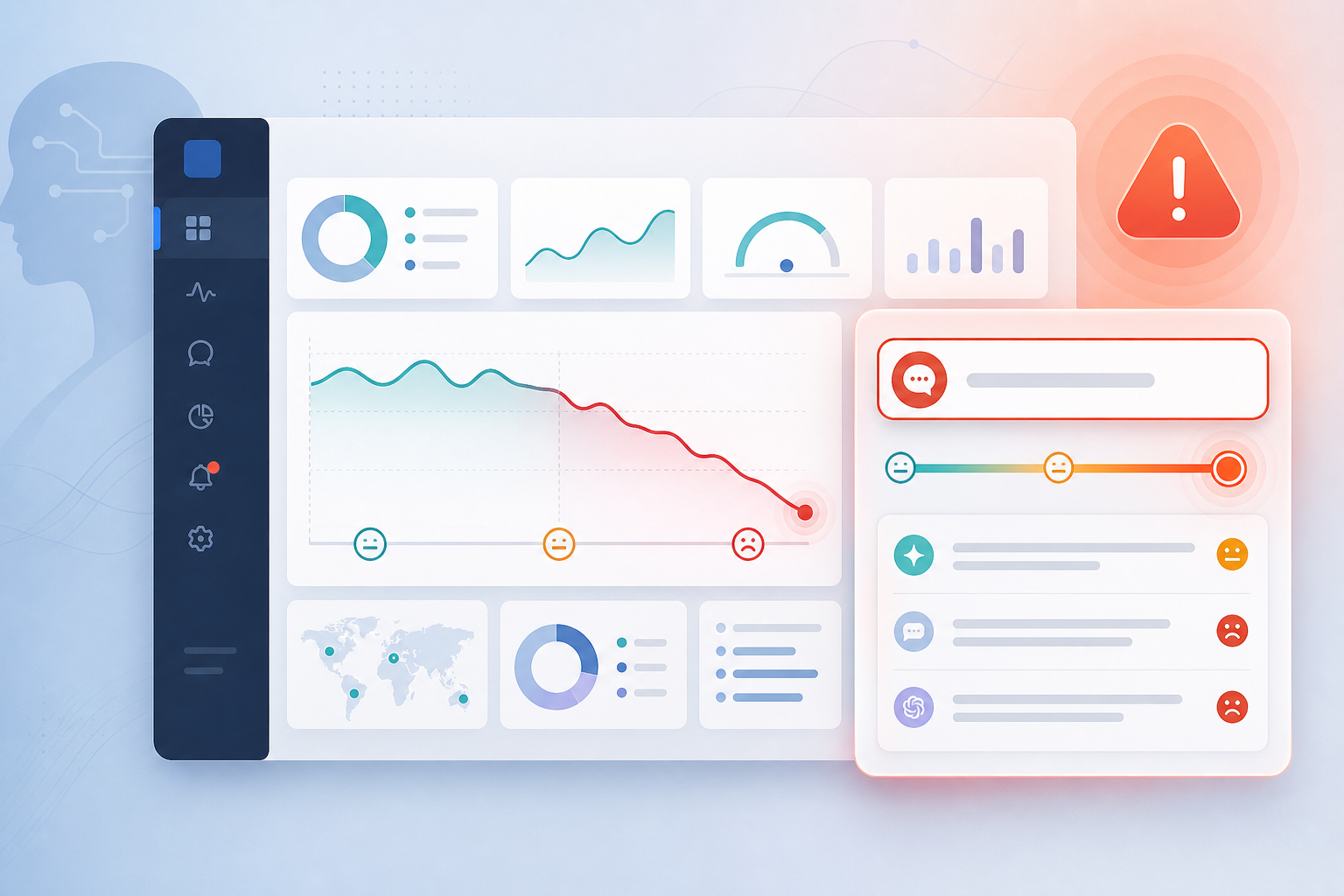
Net sentiment score = the share of positive answers minus the share of negative and cautious answers, computed per platform over the trailing seven days of runs. It ranges from −100 to +100, and computing it per platform — never blended — is what lets you see Perplexity slide while Gemini holds steady.
Two companion metrics complete the picture:
- AI share of voice — the percentage of category prompts ("best [category] tools") where your brand appears at all, tracked against named competitors. Sentiment only matters on answers you're actually in; track both, because a "fix" that drops you from answers entirely is a different failure, not a win.
- Citation concentration — the count of distinct domains cited across answers that mention you. Our incident data shows tone is usually set by 1–3 domains, so a brand whose answers rest on a handful of sources is one bad thread away from a flip. Low concentration is an early-warning condition, not just a descriptive stat.
The Four Alerts Worth Firing
Score and store everything, but page a human only on these events:
| Alert | Trigger | Priority |
|---|---|---|
| Sentiment flip | Any tracked prompt changes class (e.g., neutral → cautious) | P1 if a commercial prompt (pricing, reviews, alternatives); P2 otherwise |
| Description drift | Risk words enter your brand descriptor vs. its 30-day baseline: "concerns," "complaints," "lawsuit," "breach" | P1 always |
| New citation domain | A domain never seen before appears in citations for your brand prompts | Same-day review |
| Net sentiment trend | Net sentiment score drops more than 10 points over 7 days on any platform | P2, escalate if two platforms |
P1 means trace the citations within 24 hours. P2 means watch for persistence for 2–3 days. The discipline here is what separates an alert-driven program from a dashboard nobody opens — and it's what makes the response timelines in the cases below possible.
Do You Need a Tool, or Can You Track This Manually?
Start manually: one analyst, a spreadsheet, and 20 prompts will catch major sentiment flips on a weekly cadence. Automate when you need daily runs, variance control, or more than three platforms — the volume math defeats manual tracking quickly.
The manual protocol we recommend for week one:
- Pick 20 prompts from the high-risk families (pricing, worth-it/reviews, alternatives) plus direct brand queries.
- Run each on ChatGPT (search mode), Perplexity, and Gemini, twice per platform across two different days.
- Log four fields per answer: sentiment class, the exact descriptor phrase used, cited domains, and date.
- Re-run weekly; flag any class change or never-before-seen domain.
That's 120 answers and roughly 3–4 hours per week — viable for one brand, and enough to establish your baseline and surface any existing negative framing.
The breaking point is cadence. Persistence-based alerting requires daily runs with repeats: 30 prompts × 3 runs × 6 platforms is 540 scored answers per day, which no spreadsheet workflow survives. When you reach that point, require four things from any AI visibility tool before paying for it: citation-level data per answer (tone without sources isn't actionable), per-platform sentiment classes rather than one blended score, change-based alerts of the four types above rather than dashboards alone, and multiple daily runs so variance doesn't trigger false alarms.
Three Traced Cases: From Negative Answer to Clean Answer
The following cases come from MaxAEO tracking data between 2025 and early 2026, anonymized with each client's permission. Numbers and timelines are as observed; identifying details are altered.
Case 1: The Four-Year-Old Reddit Thread (B2B SaaS)
Detection. A daily run flagged a sentiment flip on "[Company A] pricing" in Perplexity: neutral the previous day, now "users report opaque pricing and surprise overage fees." A P1 alert fired because pricing is a commercial prompt.
Trace. The citation panel showed two sources: a 2021 Reddit thread complaining about an overage-billing model the company had retired in 2023, and a stale aggregator post paraphrasing that thread. The current pricing page — which contained no overage language at all — wasn't cited.
Remediation. Three moves in week one: the pricing page was rewritten with an explicit fee table and a dated "pricing changelog" section; a founder posted a date-stamped correction in the Reddit thread itself; and the company published a transparent pricing-breakdown post that picked up two organic citations. One thing that did not work: a takedown request to subreddit moderators — the thread was legitimate, and it stayed up.
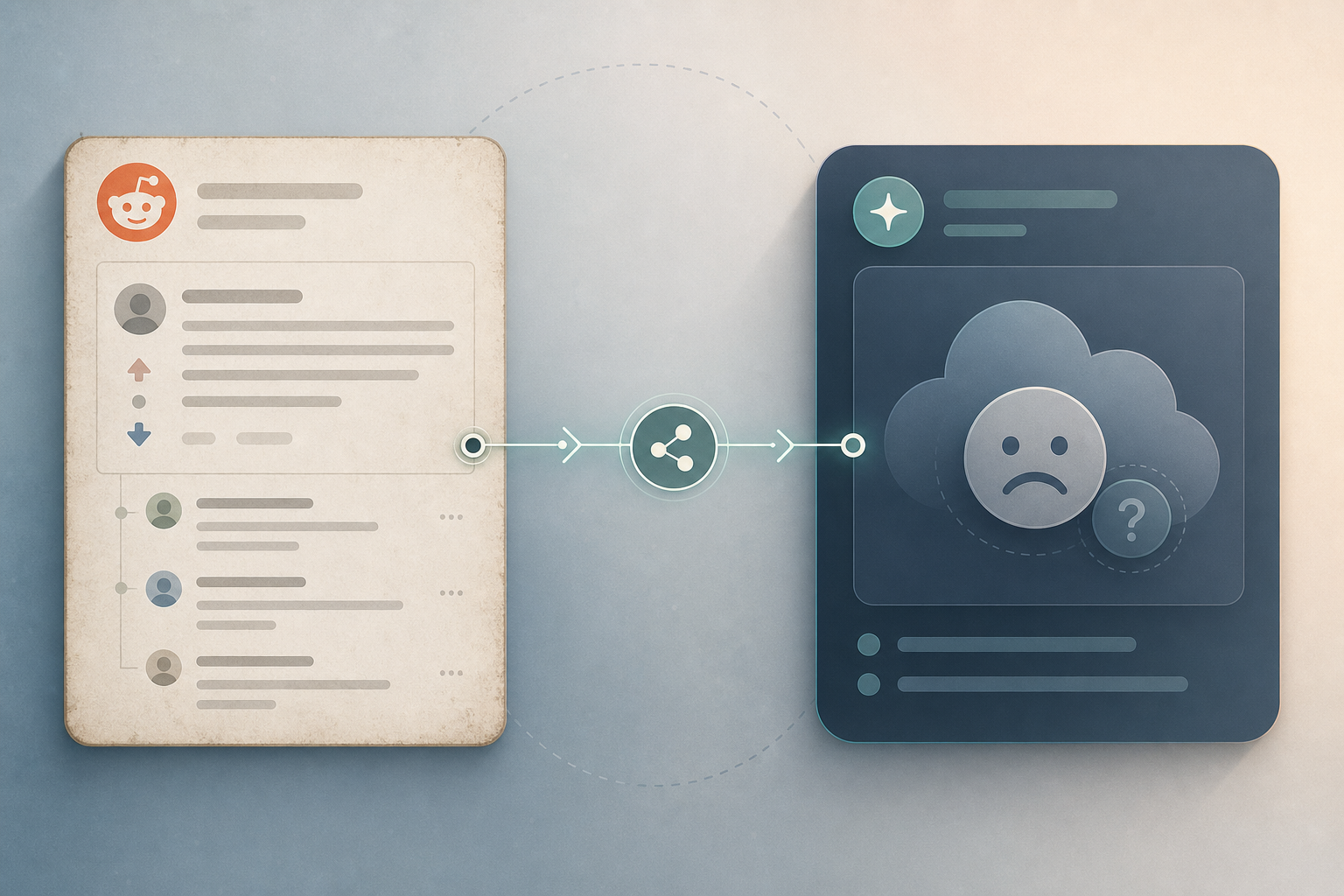
Outcome. Perplexity dropped the Reddit thread from its citations 19 days after the changes and reverted to neutral pricing language. ChatGPT search followed at roughly 5 weeks. Gemini never surfaced the thread at all — a clean illustration of why per-platform monitoring matters.
Case 2: The Churned-Cohort Review Cluster (HR Tech)
Detection. "Is [Company B] worth it" in ChatGPT shifted from cautious to negative: "frequent complaints about support response times during onboarding." The flip persisted across runs on two consecutive days — a confirmed incident.
Trace. ChatGPT's citations pointed at the company's G2 profile. Drilling into the profile showed the driver: four one-star reviews posted within six weeks, all from one enterprise cohort affected by a botched data-migration window. A handful of recent reviews had rewritten the aggregate "cons" narrative the AI was quoting.
Remediation. The company responded to every review with specifics and a remediation commitment, published a post-incident write-up, and fixed the actual support-SLA gap. Then the dilution play: in-app review prompts triggered by high NPS scores produced 23 fresh reviews in 8 weeks. What didn't work: a removal request to G2 (reviews were genuine — declined), and a burst of positive blog posts (irrelevant, because the cited source was the G2 profile itself, not the blog ecosystem).
Outcome. At about 6 weeks, ChatGPT's phrasing softened to "mixed reviews, with recent improvements in support." Gemini's cautious phrasing lingered to roughly 9 weeks. The lesson: when the citation is a review platform, remediation runs through that platform — nothing else moves the answer.
Case 3: The Misattributed Security Incident (Fintech API)
Detection. A description-drift alert fired in Gemini: the brand summary for Company C gained the phrase "has faced security concerns." No tracked prompt had flipped — only the descriptor changed, which is exactly what this alert type exists to catch.
Trace. Citations led to a regional news story about a data breach at a similarly named consumer app ("[Company C] Pay" — no relation), plus one fintech aggregator blog that had conflated the two companies in a roundup. A classic entity-confusion failure, sitting one step away from a full-blown AI hallucination about the company.
Remediation. A correction request to the aggregator, sent with side-by-side evidence of the two distinct entities, got the post amended in 8 days. In parallel: entity disambiguation work — Organization schema with sameAs links, a sharpened About page, cleaned-up Wikidata and Crunchbase entries — plus a public security trust page documenting SOC 2 status.
Outcome. Gemini's "security concerns" phrasing disappeared about 4 weeks after the correction published. The stubborn tail: ChatGPT in non-search mode kept a faint association in model weights, which no edit could touch; it faded only with a later model refresh. Grounded (search-mode) answers, however, cleaned up on the same cycle as Gemini.
The Remediation Playbook: Match the Fix to the Source
The fix is determined by the source type, not by how bad the answer sounds. Generic "publish more positive content" advice fails because it ignores the citation chain. What worked across our traced cases:
| Source of negative sentiment | Fix that actually cleared it | Median time-to-clear (observed) |
|---|---|---|
| Old forum / Reddit thread | Update the canonical page it contradicts + dated correction in-thread + fresh citable content | ~3 weeks (Perplexity), ~5 weeks (ChatGPT search) |
| Review-platform profile | Respond to reviews + fix the root cause + review-velocity program to refresh the aggregate | 6–9 weeks |
| News / aggregator misattribution | Correction request with evidence + entity-disambiguation schema | 1–2 weeks after the correction publishes |
| Your own outdated pages | Update content, surface change dates, keep facts consistent everywhere | 1–4 weeks |
| Comparison / affiliate posts | Outreach with updated facts + publish your own substantive comparison | 4–8 weeks |
| Model weights (no citations shown) | Can't be edited directly: build a consistent positive corpus and wait for a model refresh; prioritize grounded platforms meanwhile | Model release cycle (months) |
Two patterns deserve emphasis. First, search-augmented answers heal much faster than model-weight answers — Perplexity was consistently the fastest to update in our cases, because its index refreshes aggressively. Second, removal almost never works; replacement and correction do. Legitimate negative content stayed up in all three cases above. What changed the AI's tone was newer, more authoritative, more consistent information winning the retrieval.
This is the same mechanism that answer engine optimization and generative engine optimization teams use offensively: the work that gets you recommended by ChatGPT — fresh, specific, well-structured pages that engines prefer to cite — is the same work that crowds out stale negatives.
How to Confirm the Fix Worked
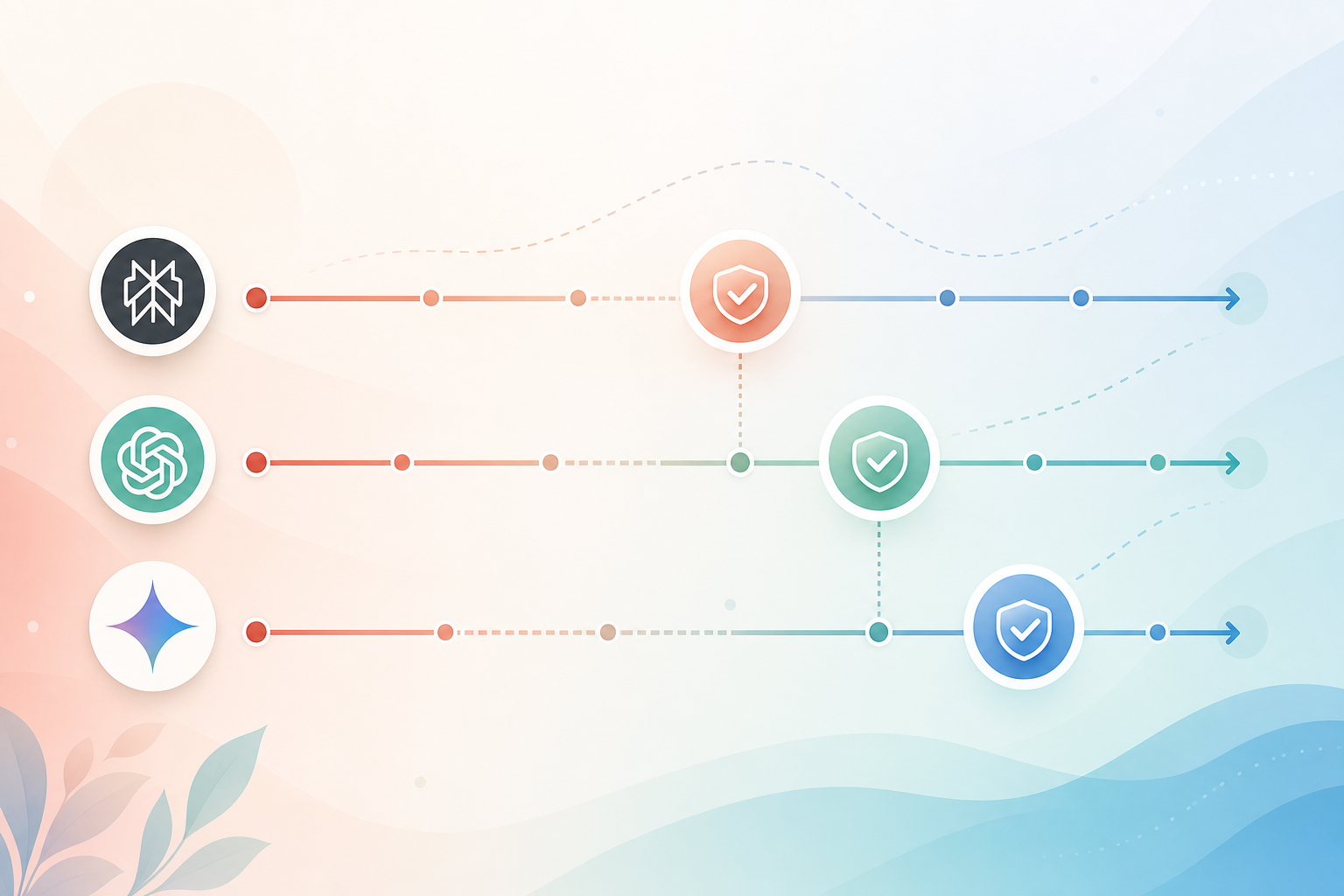
A fix is confirmed when the tracked prompts stay clean for two consecutive weeks and the offending citation is gone — not when the content ships. Declaring victory at publication is the most common failure we see.
The verification loop:
- Re-run the full affected prompt set daily, not just the prompt that fired the alert. Negative framing often migrates to adjacent phrasings before it dies.
- Check the citation list, not just the tone. If the bad source is still cited but paraphrased gently, the issue isn't resolved — it's dormant.
- Watch the trend metrics: net sentiment score per platform, and your AI share of voice against competitors on category prompts. A cleared negative that coincides with a visibility drop means the engine solved the problem by dropping you — which is its own incident.
- Set a 30-day recheck. In one of our cases, an old thread resurfaced in citations after a model-side retrieval change. Closure isn't permanent; monitoring is.
For which numbers belong on the recovery dashboard and how to baseline them, see the six AI visibility metrics that tell you if AI recommends your brand.
Frequently Asked Questions
How often should you check your brand's sentiment in AI answers?
Run automated checks daily and review them weekly. Daily runs are what make persistence-based alerting possible — single weekly or monthly runs can't distinguish a real sentiment flip from run-to-run variance, and they leave negative answers live for up to 30 days before anyone notices.
How do you check brand mentions in ChatGPT?
Ask the questions your buyers ask — pricing, "is it worth it," alternatives — in both search-enabled and default modes, then record the tone, the exact descriptor phrase, and the cited sources for each answer. Search mode shows fixable citations; default mode reveals what's baked into model weights. Repeat runs, because single answers vary.
Can you get negative content removed from AI answers?
Rarely, and only when it's factually wrong. In our traced cases, takedown requests for legitimate content failed every time; corrections for misattributed content succeeded. The reliable path is replacement: update canonical pages, add fresh authoritative sources, and let retrieval favor newer, more consistent information.
How long does it take to turn around negative AI sentiment?
In MaxAEO's traced incidents, search-augmented platforms cleared in roughly 3–9 weeks depending on source type — Perplexity fastest, review-driven cases slowest. Negative framing baked into model weights, with no citations to fix, only changed at a model refresh, which is why grounded platforms should be remediated first.
Is AI sentiment monitoring different from social listening?
Yes. Social listening tracks what people post about your brand; AI sentiment monitoring tracks what AI assistants generate about it — a synthesized verdict shaped by a small set of AI citations. A brand can have healthy social sentiment while ChatGPT quotes a four-year-old complaint thread to every prospect who asks about pricing.
Which platforms should you monitor first?
Start where your buyers ask: for B2B, that's typically ChatGPT, Google AI Overviews and AI Mode, Perplexity, and Copilot, with Gemini, Claude, and Grok close behind. Our cases show platforms diverging for weeks on the same incident, so a single-platform check systematically under-reports risk.
This article was created with AI assistance and reviewed by a human editor.