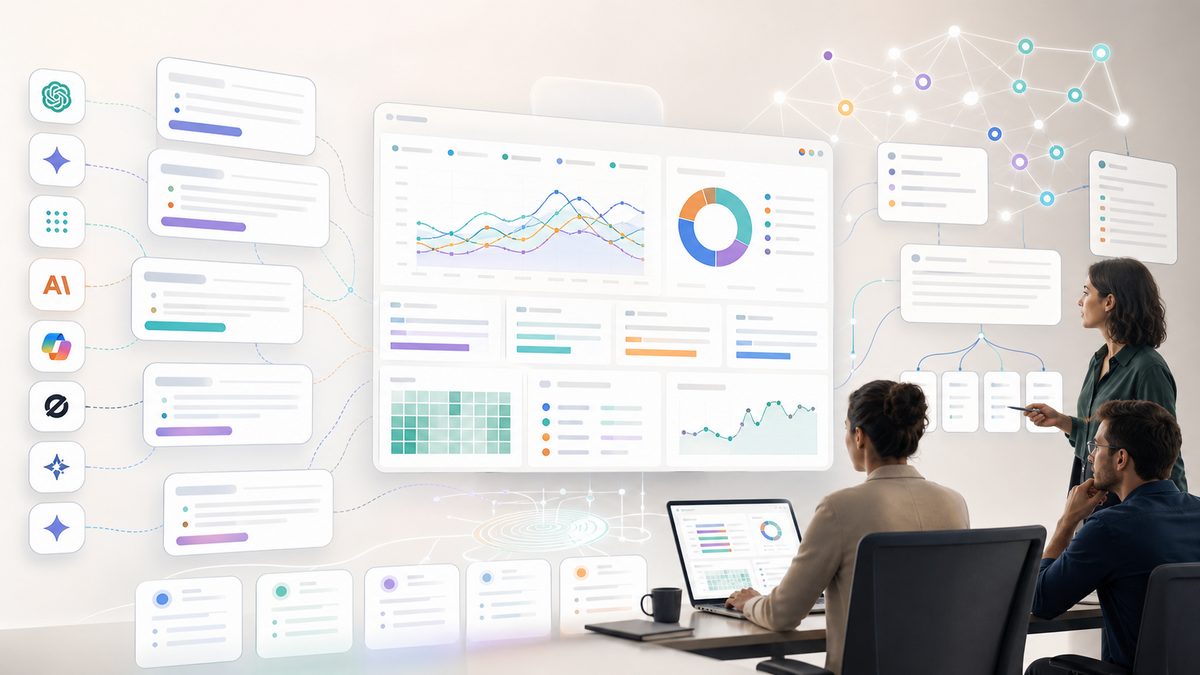
An AI brand monitoring tool should show whether AI systems mention, cite, rank, recommend, misdescribe, or ignore your brand when buyers ask commercial questions. The best tools do not stop at a visibility score. They connect each AI answer to the prompt, engine, competitor, cited source, business risk, and next fix.
That matters because AI search is not one search box. A buyer may ask ChatGPT for a shortlist, use Perplexity to verify sources, see Google AI Overviews during category research, and ask Claude or Copilot for comparison help. Your brand can be visible in one surface and absent in another.
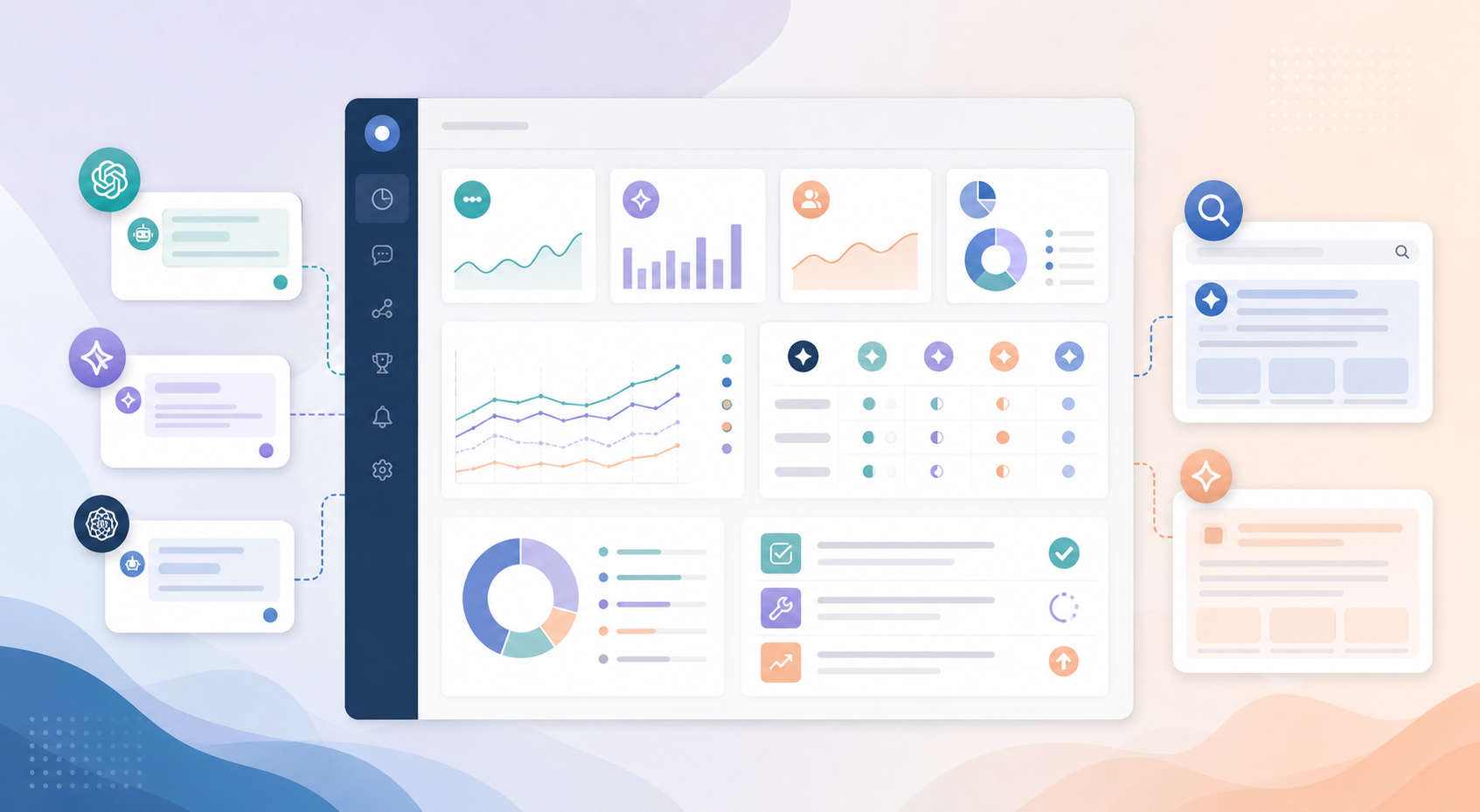
Quick Answer: How to Choose an AI Brand Monitoring Tool
Choose an AI brand monitoring tool that can prove what happened, why it happened, and what to do next. A serious platform should:
- Track buyer-like prompts across ChatGPT, Gemini, Perplexity, Claude, Copilot, Grok, Google AI Mode, and Google AI Overviews.
- Separate mentions, recommendations, answer position, citations, sentiment, and incorrect claims.
- Preserve raw answers with prompt, engine, timestamp, cited URLs, and competitors.
- Measure repeatability over time instead of relying on one-off screenshots.
- Show citation gaps and source opportunities, not just cited URLs.
- Prioritize fixes by commercial intent, competitor impact, and remediation effort.
- Support exports, agency reporting, permissions, and executive-ready evidence.
If a vendor cannot open the raw AI answer behind a score, treat the score as a presentation layer, not evidence.
What Is an AI Brand Monitoring Tool?
An AI brand monitoring tool is software that repeatedly tests buyer-like prompts across AI answer engines to measure whether a brand is mentioned, recommended, cited, ranked, or misdescribed. It turns volatile AI answers into prompt-level evidence marketers can use to improve visibility, reputation, content, PR, and competitive positioning.
This category is different from classic social listening. Social listening tracks what people publish. AI brand monitoring tracks what answer engines synthesize. AI systems may recommend a competitor without linking to them, cite a third-party list instead of your website, or repeat outdated facts from old web sources.
For commercial teams, the core question is not “Did our brand appear?” It is “Are we being recommended for the prompts that influence pipeline?”
AI Brand Monitoring vs. Social Listening vs. SEO Rank Tracking
| Tool category | What it monitors | Best for | Where it falls short |
|---|---|---|---|
| Social listening | Public mentions across social, news, forums, and reviews | Reputation, campaigns, customer voice | Does not show how AI answer engines summarize your category |
| Media monitoring | Press coverage, journalists, publication volume | PR coverage and earned media | Usually misses prompt-level AI recommendations and citations |
| SEO rank tracking | Keyword rankings in search results | Organic search performance | Does not capture generated answers, AI shortlists, or cited-source behavior |
| AI brand monitoring | AI-generated answers, citations, recommendations, and brand descriptions | Answer engine optimization, AI visibility, competitive shortlists | Requires disciplined prompt design and repeated measurement |
A strong AI monitoring workflow often uses all four. The AI layer is the missing surface for teams that already track search rankings, brand sentiment, and press coverage.
The MaxAEO Evidence Ladder
The biggest buying mistake is choosing the dashboard with the cleanest visibility score. Visibility scores can be useful, but only when they are built from inspectable evidence.
Use this five-layer evidence ladder during evaluation:
| Evidence layer | What the tool must show | Why it matters |
|---|---|---|
| Prompt intent | Prompt text, persona, funnel stage, topic, geography, and competitor set | Prevents strategy from being built on vague or irrelevant prompts |
| Raw answer | Full AI answer, engine, timestamp, citations, and settings | Lets stakeholders verify the claim |
| Parsed signals | Mention, answer position, recommendation language, sentiment, and citation status | Separates awareness from authority and preference |
| Source cause | Owned pages, third-party domains, competitor pages, reviews, docs, and media cited | Shows where remediation should happen |
| Fix owner | Prioritized action for SEO, PR, content, product marketing, or partnerships | Turns monitoring into work that can be assigned |
Weak tools fail between layers three and five: they count mentions but cannot explain the source pattern or recommend a defensible fix.
The Feature Checklist That Actually Matters
Use this checklist before buying, renewing, or expanding an AI visibility platform.
| Feature | Why it matters | Buyer test |
|---|---|---|
| Multi-engine tracking | Buyers use different AI systems | Can it compare ChatGPT, Gemini, Perplexity, Claude, Copilot, Grok, Google AI Mode, and AI Overviews? |
| Prompt-set governance | Bad prompts create bad strategy | Can you edit, tag, version, and group prompts by intent, persona, topic, and region? |
| Mention vs. citation separation | Being named is not the same as being used as evidence | Does the tool report mentions and citations separately? |
| Recommendation tracking | AI shortlists influence commercial consideration | Can it detect whether the brand is recommended, merely named, or excluded? |
| Answer position | First-mentioned brands often receive more attention | Can it show order, co-mentions, and competitor displacement? |
| Repeat measurement | AI answers vary across runs and time | Does it show daily history, variance, and raw answer archives? |
| Source analysis | Fixes happen at source level | Does it group cited sources by owned, third-party, competitor, review, media, docs, and community pages? |
| Reputation alerts | AI can repeat stale or wrong claims | Does it flag inaccurate, negative, outdated, or off-position descriptions? |
| Raw evidence | Executives and clients need proof | Can you inspect transcripts, screenshots, cited URLs, and prompt settings? |
| Prioritized recommendations | Dashboards do not fix visibility | Does it produce a ranked remediation list by business impact? |
| Reporting and export | Teams need budget proof | Does it support CSV, API, QBR decks, client reports, and permissions? |
Engine Coverage: Track Where Buyers Actually Ask
Do not buy engine coverage by logo count alone. Buy it by buyer behavior and measurement quality.
For B2B SaaS and tech categories, a useful setup usually includes ChatGPT, Gemini, Perplexity, Claude, Copilot, Grok, Google AI Mode, and Google AI Overviews. For ecommerce, consumer products, healthcare, finance, or local services, the right mix may differ.
Ask vendors three questions:
- Is each engine monitored daily, or only on demand?
- Are answers stored historically, or overwritten by the latest result?
- Does the tool distinguish web-grounded answers from model-native answers?
This distinction matters because AI systems do not retrieve the same sources. Google’s own guidance says generative AI features in Search can use retrieval-augmented generation and query fan-out from Search systems, which means visibility depends on more than one exact keyword or page. See Google Search Central’s guide to optimizing for generative AI features on Google Search.
Research supports the same practical point. A 2026 study of Google Search, Gemini, and AI Overviews using 11,500 queries found that retrieved sources were substantially different across systems, with less than 0.2 average Jaccard similarity. One engine is not a market view.
Prompt Governance: The Methodology Should Survive Scrutiny
Prompt methodology is the backbone of AI brand monitoring. A tool should let you create prompt sets by category, persona, use case, funnel stage, geography, and competitor group. It should also preserve prompt history when the team edits a test.
Do not track only obvious brand prompts such as “What is Acme?” Those measure recognition, not buyer discovery.
A commercial prompt set should include:
- Category prompts: “Best SOC 2 automation platforms for startups”
- Problem prompts: “How should a startup prepare for SOC 2 without hiring a consultant?”
- Alternative prompts: “Vanta alternatives for small security teams”
- Comparison prompts: “Compare Drata, Vanta, and newer compliance tools”
- Integration prompts: “SOC 2 tools that integrate with AWS and GitHub”
- Persona prompts: “Compliance software for first-time founders”
- Risk prompts: “Which SOC 2 tools are easiest to implement without slowing engineering?”
A reliable platform should tag these prompts by intent. A broad informational prompt should not carry the same weight as a high-intent shortlist prompt.
For a complete prompt-building workflow, use MaxAEO’s guide to building an AI search prompt set for brand monitoring.
Metrics: Separate Mentions, Rankings, Recommendations, and Citations
An AI brand monitoring tool should separate at least six signals. Blending them into one score hides the diagnosis.
| Signal | What it tells you | Common fix |
|---|---|---|
| Mention rate | Whether AI systems recognize the brand | Entity clarity, broader source footprint, category pages |
| Recommendation rate | Whether the brand is actively suggested | Comparison proof, use-case pages, third-party validation |
| Answer position | Where the brand appears in shortlists | Authority building, differentiated positioning, stronger category relevance |
| Citation rate | Whether AI systems use your domain or related sources as evidence | Citation-worthy pages, docs, research, reviews, and source outreach |
| Source quality | Whether citations come from trustworthy, current, relevant pages | PR, analyst pages, review sites, partner pages, content updates |
| Claim accuracy | Whether the answer describes the brand correctly | Entity cleanup, profile updates, clearer product messaging |
Example: a cybersecurity company may appear in 38% of broad category prompts but receive citations in only 6% of answers. That means awareness exists, but source authority is weak. The fix is not more homepage copy. The fix is better citation targets, credible third-party proof, comparison pages, and clearer entity data.
For KPI definitions, see MaxAEO’s guide to AI search visibility metrics.
Data Reliability: Measure Distributions, Not Screenshots
AI answers vary across runs, prompts, engines, and time. A single screenshot can start an investigation, but it should not drive budget decisions.
A serious platform should show repeated measurements and historical movement. For high-value prompt groups, ask whether the tool reports variance or confidence ranges. At minimum, it should make day-by-day raw answers inspectable.
A 2026 arXiv paper, Don’t Measure Once, argues that AI search visibility should be characterized as a distribution rather than a single-point outcome. Another 2026 paper on uncertainty in AI visibility found that single-run citation metrics can look more precise than they are.
In a demo, ask the vendor to show the same prompt over multiple days. If your visibility moves from 8% to 22%, the tool should help explain whether that is a real trend, a sampling artifact, a source change, or a model update.
Citation Intelligence: Turn Source Lists Into Fixes
Citation tracking should answer one question: what sources does AI trust when it talks about this category?
A weak tool lists cited URLs. A strong tool groups them, compares them, and turns them into a fix list.
| Citation pattern | Likely diagnosis | Action |
|---|---|---|
| AI cites third-party lists that omit your brand | Category sources do not include you | PR outreach, review updates, partner mentions, analyst inclusion |
| AI cites your old pages | Current product proof is not clear or discoverable | Update pages, add concise proof blocks, improve internal links |
| AI cites competitor docs but not yours | Competitor documentation answers buyer questions better | Publish stronger docs, integration pages, and comparison content |
| AI mentions you but cites no owned source | Entity awareness exists, but owned authority is weak | Build source-worthy pages with facts, use cases, and structured content |
| AI cites low-quality or outdated pages | Source quality risk | Create better canonical explanations and correct stale profiles |
Citation work is where SEO, PR, and product marketing meet. If Perplexity repeatedly cites “best compliance tools” articles that exclude you, outreach may matter more than another blog post. If Google AI Overviews cite your docs but misstate a feature, the page may need clearer, extractable language.
For a buyer-focused evaluation model, see MaxAEO’s guide to AI visibility tools with citation tracking.
Reputation Monitoring: Catch Wrong Claims Early
AI reputation management is not only about negative sentiment. It is also about stale facts, wrong categories, missing differentiators, outdated pricing, old leadership details, unsupported claims, and confusing product names.
A useful platform should flag when an AI answer says your company:
- Serves only enterprises when you now sell to startups.
- Lacks an integration you already support.
- Uses an old product name.
- Describes you with competitor language.
- Cites a retired page or outdated profile.
- Makes a pricing claim that is no longer accurate.
Every alert should include the exact answer, engine, prompt, timestamp, cited sources, and likely origin of the claim. Without that evidence, PR cannot correct the source, SEO cannot update the page, and product marketing cannot tighten the positioning.
AI Share of Voice: Segment by Topic, Not Just Global Score
AI share of voice measures how often your brand appears relative to competitors inside a defined prompt set. It is useful only when the prompt set matches a real market segment.
A single global score is too blunt. You need share of voice by topic, persona, use case, funnel stage, and geography.
Example: a B2B analytics company may dominate “enterprise BI platform” prompts but lose “embedded analytics for SaaS products” prompts. Those gaps require different content, different proof, and different competitive positioning.
Ask the vendor to show:
- Which competitor beats you by topic.
- Which prompts create the gap.
- Whether the competitor is mentioned, recommended, or cited.
- Which sources support the competitor’s advantage.
- Which fixes would likely move the segment.
If the platform cannot move from score to cause, it is an awareness dashboard.
Workflow and Reporting: Make the Data Usable
AI brand monitoring becomes valuable when teams can act on it. The tool should support different workflows for in-house teams, agencies, founders, and executives.
| Team | What they need from the tool |
|---|---|
| SEO | Prompt groups, cited URLs, source gaps, page-level recommendations |
| PR and comms | Incorrect claims, reputational risks, third-party source opportunities |
| Product marketing | Positioning gaps, comparison prompts, buyer-language patterns |
| Growth | High-intent prompt movement, competitor displacement, pilot results |
| Executives | Trend summaries, raw proof, risk level, and business impact |
| Agencies | Multi-client workspaces, repeatable templates, white-label reports, permissions |
For agencies, the buying question is not “Can we add more projects?” It is “Can we produce credible monthly reports without rebuilding the same analysis by hand?”
Red Flags in Vendor Demos
Watch for these warning signs:
- The vendor shows polished charts but will not open raw answers.
- The main metric is a proprietary score with unclear inputs.
- Prompt sets cannot be tagged, versioned, or mapped to funnel stage.
- The tool counts mentions but does not distinguish recommendations or citations.
- Screenshots are used as proof without timestamps or prompt settings.
- There is no explanation of sampling frequency or answer variance.
- Source analysis stops at a URL list.
- Competitor tracking is global, not topic-specific.
- Reporting requires manual screenshot assembly.
- The platform cannot separate owned, third-party, competitor, and review sources.
A good demo should use your real category, your competitors, and your prompts. A generic sample dashboard is not enough.
100-Point Demo Scorecard
Use this scorecard during evaluation. Ask the vendor to run a small sample with your category before the demo.
| Category | Points | What to inspect |
|---|---|---|
| Engine coverage | 15 | Daily tracking across the engines your buyers use |
| Prompt governance | 15 | Tags, versions, segments, funnel mapping, and prompt history |
| Data reliability | 15 | Repeated runs, historical trendlines, variance, raw answer access |
| Citation intelligence | 15 | Source grouping, citation gaps, owned vs. third-party analysis |
| Competitive analysis | 10 | Topic-level share of voice and competitor displacement |
| Reputation monitoring | 10 | Incorrect claims, outdated descriptions, sentiment, alerts |
| Recommendations | 10 | Prioritized fixes tied to pages, sources, and team owners |
| Reporting | 10 | Executive exports, agency reports, CSV/API access, permissions |
Scoring guide:
| Score | Interpretation |
|---|---|
| 85-100 | Strong candidate for operational AI visibility tracking |
| 70-84 | Usable, but validate weak areas before annual commitment |
| 50-69 | Good for lightweight monitoring, weak for decision-making |
| Below 50 | Likely a vanity dashboard |
What a 30-Day Pilot Should Prove
A 30-day pilot should prove that the platform can find material gaps, explain causes, and guide fixes. It does not need to prove that every AI engine will recommend your brand more often immediately.
A clean pilot plan:
- Track 80-150 prompts across category, problem, comparison, alternative, integration, persona, and brand intent.
- Include 5-10 direct competitors and category alternatives.
- Monitor at least five relevant engines daily.
- Separate mentions, recommendations, answer position, citations, sentiment, and claim accuracy.
- Produce one weekly fix list with owner, source, and priority.
- Publish or update selected pages and source profiles.
- Re-check the same prompt set after changes are live.
A useful pilot result sounds like this: “We appear in 31% of broad category answers but only 9% of startup-specific shortlist prompts. Competitors win because AI systems cite three third-party buyer guides that omit us. Priority fixes: startup use-case page, review-site updates, outreach to two cited category pages, and a clearer comparison page.”
That is better than: “Our AI visibility score is 42.”
What Happens After Monitoring: The Fix Playbook
Monitoring is only the first step. The right tool should help your team improve the source footprint that AI systems use.
A practical remediation workflow:
- Clean entity facts across your website, product pages, knowledge panels, company profiles, docs, and review platforms.
- Create prompt-mapped pages for the buyer questions where competitors replace you.
- Add concise proof blocks: use cases, integrations, pricing qualifiers, implementation details, customer segments, and limitations.
- Strengthen third-party sources that AI systems already cite in your category.
- Build comparison content that is specific, fair, and easy to extract.
- Update stale pages that still shape AI descriptions.
- Re-measure the same prompt group before declaring progress.
For source-level tactics, see MaxAEO’s playbook on how to get cited by AI.
Pricing Questions to Ask Before You Buy
AI brand monitoring pricing can vary by prompt volume, engine coverage, seats, projects, reporting, historical storage, and API access. Before comparing plans, clarify what is actually included.
Ask:
- Are prompt runs charged by prompt, engine, project, or seat?
- Is historical data included, and for how long?
- Are Google AI Overviews and AI Mode included or priced separately?
- Are exports, API access, and white-label reports included?
- Can agencies separate client workspaces and permissions?
- What happens when the model or engine changes?
- Is onboarding included for prompt design and competitor setup?
The cheapest plan is not always cheaper if it caps the exact prompt and engine coverage you need.
Who Should Buy an AI Brand Monitoring Tool?
You are likely ready for an AI brand monitoring tool if:
- Buyers compare you against named competitors.
- Your category appears in AI-generated shortlists.
- You depend on organic search, content, PR, analysts, or review sites for demand.
- Sales teams hear prospects reference ChatGPT, Perplexity, Gemini, or Google AI answers.
- Incorrect AI descriptions could create reputational or conversion risk.
- You manage multiple brands, products, regions, or clients.
You may not need a paid platform yet if your category has little AI-search demand, you have no clear competitor set, or your website lacks basic product and positioning clarity. In that case, fix the foundation first.
For vendor comparison context, see MaxAEO’s tested guide to the best AI search and LLM monitoring tools.
How This Connects to SEO and AEO
Google’s helpful content guidance emphasizes original, useful, people-first content that provides substantial value. That standard applies to AI visibility too. If your pages are thin, generic, or hard to verify, AI systems have fewer strong sources to retrieve, summarize, or cite. See Google Search Central’s guidance on creating helpful, reliable, people-first content.
Answer engine optimization does not replace SEO. It adds a new measurement layer: prompt-level visibility, answer-level claims, and source-level citations.
The foundation still matters: crawlable pages, clear entities, useful content, strong internal links, structured data where appropriate, credible third-party mentions, and up-to-date product information. The difference is that AI brand monitoring shows whether those assets are actually shaping generated answers.
Final Recommendation
Buy an AI brand monitoring tool only if it improves decisions. The right platform should show where your brand appears, where competitors replace you, which sources AI systems cite, what claims are wrong, and which fixes should come first.
For B2B SaaS, tech brands, startups, and agencies, the winning capability is not the prettiest AI visibility score. It is a repeatable operating system for answer engine optimization: track the right prompts, preserve the evidence, diagnose citation and reputation gaps, prioritize fixes, and prove movement over time.
If a platform can do that across the engines your buyers use, it is worth serious consideration. If it cannot, you are probably buying another dashboard.
FAQ
What is the most important feature in an AI brand monitoring tool?
The most important feature is prompt-level evidence. Every score should connect back to the exact prompt, answer, engine, date, competitors, and citations. Without that evidence, you cannot diagnose the issue or prove progress.
Is AI brand monitoring the same as social listening?
No. Social listening tracks what people publish across social, news, forums, and review sites. AI brand monitoring tracks what answer engines synthesize from many sources. Both can support reputation work, but they measure different surfaces.
How many prompts should a B2B SaaS brand track?
Most B2B SaaS teams should start with 80-150 prompts. Include category, problem, comparison, alternative, integration, persona, and brand prompts. More prompts are useful only when they are grouped by clear commercial intent.
Which AI engines should a brand monitor?
Monitor the engines your buyers use. For many B2B and tech categories, that means ChatGPT, Gemini, Perplexity, Claude, Copilot, Grok, Google AI Mode, and Google AI Overviews. The exact mix should be validated against your market.
Can AI search monitoring prove ROI?
It can support ROI measurement when tied to commercial prompts, competitor displacement, citation gains, sales enablement, and pipeline-influencing pages. Do not measure ROI from a generic visibility score alone. Measure movement in high-intent answer share and recommendation frequency.
How often should brands monitor AI visibility?
Daily monitoring is useful for active categories because AI answers and citations change over time. For high-value prompts, repeated measurements are better than one-off checks. Monthly reporting is usually too slow for competitive or reputation-sensitive categories.
Should agencies use the same setup for every client?
No. Agencies should use reusable templates, but each client needs custom competitors, geographies, product language, prompt sets, and risk thresholds. Standardized reporting is useful. Standardized strategy is usually too shallow.