By maxaeo
AI brand mention tracking accuracy measures whether a monitoring system correctly identifies references to the intended brand—not merely whether it finds a matching string. Reliable measurement requires aliases, entity context, exclusion rules, product-owner relationships, human-labeled test data, and separate reporting of precision, recall, and collection coverage.
This distinction matters because an acronym may identify several companies, a product may appear without its parent brand, and a dictionary-word brand may occur in ordinary prose. Loose matching inflates visibility; strict matching hides genuine discovery.
This guide provides a reproducible testing method, including:
- A three-gate alias decision protocol
- A 60-snippet adversarial benchmark
- Precision, recall, F1, specificity, and coverage formulas
- Rules for acronyms, products, misspellings, and namesakes
- Sampling, labeling, QA, and governance procedures
- Practical thresholds for deciding whether data is report-ready

What Is AI Brand Mention Tracking Accuracy?
AI brand mention tracking accuracy is the proportion of response-brand pairs correctly classified as true mentions or non-mentions after aliases, entity context, exclusions, and product relationships are applied. It should be reported with precision and recall because overall accuracy can look strong when genuine mentions are rare.
The most useful counting unit is usually one brand in one response. If an answer names the same company four times, that is one response-level mention unless the metric explicitly measures repetition.
A mention must also be separated from adjacent signals:
| Signal | Question being answered | Example |
|---|---|---|
| Brand mention | Does the text refer to the intended entity? | “Ramp provides spend-management software.” |
| Citation | Does the answer link to a source associated with the brand? | A citation to ramp.com |
| Recommendation | Is the brand presented as a suitable choice? | “Consider Ramp for corporate cards.” |
| List rank | Where does the brand appear among alternatives? | Second brand in a shortlist |
| Sentiment | How is the entity characterized? | “Strong controls, but limited regional availability.” |
| Product mention | Is a product named without the company? | “Claude can analyze long documents.” |
A citation can exist without a visible brand mention. A brand can be mentioned without being recommended. A product reference may or may not roll up to its owner. Store these as separate fields rather than deriving all of them from one text match.
Matching Accuracy Is Not the Same as Tracking Reliability
A matcher can classify every captured response correctly while the overall monitoring program remains unreliable. End-to-end AI visibility measurement has at least five independent quality layers.
The maxaeo Mention Reliability Stack
| Layer | What can fail | Metric to report |
|---|---|---|
| 1. Collection | Timeouts, refusals, incomplete captures, unsupported locales | Collection coverage |
| 2. Detection | Missed aliases, substring errors, punctuation loss | Precision, recall, F1 |
| 3. Entity resolution | Namesakes, acronyms, wrong company or product owner | Collision error rate |
| 4. Interpretation | Mention confused with recommendation, rank, citation, or sentiment | Field-specific accuracy |
| 5. Aggregation | Duplicate runs, inconsistent denominators, silent product roll-ups | Recalculation agreement |
Use this stack to diagnose a questionable dashboard number. If 12 of 100 scheduled responses failed, a perfect matcher has evaluated only the remaining 88. Those failed runs must be reported as missing—not silently converted into “brand not mentioned.”
A defensible report therefore shows at least:
- Collection coverage: usable responses ÷ scheduled responses
- Mention precision and recall
- Manual-review rate
- Rule-set version
- Prompt, model, locale, and collection date
- Product roll-up policy
For a platform-specific collection design, see the ChatGPT, Gemini, and Claude brand mention tracking guide.
Which Alias Cases Cause the Most Errors?
The highest-risk aliases are short acronyms, product names, common words, punctuation-sensitive names, fuzzy spellings, transliterations, and names shared by multiple entities. Their meaning depends on nearby evidence, so surface-string matching alone is insufficient.
| Edge case | Possible true mention | Possible false match | Evidence required |
|---|---|---|---|
| Acronym | “SAS Viya analytics platform” | “SAS flight to Copenhagen” | Product, category, domain, or company context |
| Product name | “Claude handles long documents” | A person named Claude | Anthropic, AI assistant, model, or LLM context |
| Spelling variant | “Chat GPT” referring to ChatGPT | Unrelated adjacent tokens | Recognized variant plus AI context |
| Common-word brand | “Ramp automates expense controls” | “Traffic moved up the ramp” | Commercial action, category, or official domain |
| Punctuation-sensitive name | “monday.com work management” | “Schedule it for Monday” | Domain form or software-category evidence |
| Company collision | “Mercury provides startup banking tools” | The planet or another company named Mercury | Industry, geography, product, or URL |
| Parent-product relationship | “Photoshop added a new feature” | A literal Adobe-name report | Verified ownership plus an explicit roll-up policy |
| Transliteration | Local-language rendering of a brand | Ordinary word with the same spelling | Locale-specific entity evidence |
Short AI answers are particularly difficult because they often omit domains, legal suffixes, and parent-company names. Long answers create a different problem: more unrelated text means more opportunities for an ordinary word to trigger a substring rule.
When several entities share a name, maintain a collision registry containing their industries, domains, locations, products, and known exclusion terms. The entity-disambiguation playbook explains how to structure that registry.
How Do Matching Errors Distort AI Visibility Metrics?
False positives overstate visibility and can create invented reputation alerts, ranks, and share-of-voice gains. False negatives conceal real discovery and recommendations. One classification error may therefore contaminate several dashboard fields.
Assume manual review finds that a brand appears in 20 of 100 responses. The matcher identifies 18 genuine mentions, misses two, and adds eight unrelated matches.
- True positives: 18
- False positives: 8
- False negatives: 2
- True negatives: 72
- Reported mentions: 26
- Actual mentions: 20
- Reported mention rate: 26%
- Actual mention rate: 20%
- Overstatement of the true count: 30%
Precision is only 69.2%, despite 90% recall:
- Precision: 18 ÷ (18 + 8) = 69.2%
- Recall: 18 ÷ (18 + 2) = 90.0%
- Accuracy: (18 + 72) ÷ 100 = 90.0%
This example also shows why accuracy alone is misleading. A system that labels every response “no mention” would score 95% accuracy in a dataset where only 5% of responses contain the brand, yet its recall would be zero.
Which error matters more?
| Use case | More costly error | Why |
|---|---|---|
| Executive visibility reporting | False positive | Inflates performance and weakens trust |
| Reputation alerting | False positive | Can assign unrelated criticism to the brand |
| Exploratory brand discovery | False negative | Hides new aliases and product references |
| Competitive share of voice | Both | False positives distort every brand’s denominator |
| Recommendation tracking | False positive | A neutral occurrence may be mistaken for endorsement |
| Compliance or risk monitoring | False negative | A relevant mention may go unreviewed |
The correct threshold depends on the decision. Externally shared reporting usually prioritizes precision. Research and discovery workflows can accept lower precision if ambiguous cases enter a review queue.
What Did the 60-Snippet Alias Benchmark Find?
In a maxaeo synthetic benchmark, unrestricted aliases improved recall from 60.0% to 90.0% but reduced precision from 69.2% to 64.3%. Adding exclusions and entity context produced 93.3% precision and recall. The test evaluates alias logic—not the total accuracy of any commercial monitoring platform.
Benchmark design
The fixture contained 60 response-brand pairs divided into six equal buckets:
- Acronyms
- Product-parent references
- Spelling and spacing variants
- Common-word brands
- Punctuation-sensitive names
- Company-name collisions
Each bucket contained five genuine mentions and five non-mentions, for a balanced total of 30 positives and 30 negatives. Gold labels were assigned before testing, and all three methods processed the same snippets.
The methods were:
- Exact or substring matching: case-insensitive canonical-name matching after basic whitespace normalization
- Unrestricted aliases: canonical matching plus approved variants, acronyms, and product names
- Context-aware aliases: the same aliases, followed by entity evidence, exclusions, and review rules
| Matching method | TP | FP | FN | TN | Precision | Recall | F1 | Accuracy |
|---|---|---|---|---|---|---|---|---|
| Exact name or substring | 18 | 8 | 12 | 22 | 69.2% | 60.0% | 64.3% | 66.7% |
| Exact name plus unrestricted aliases | 27 | 15 | 3 | 15 | 64.3% | 90.0% | 75.0% | 70.0% |
| Aliases plus exclusions and entity context | 28 | 2 | 2 | 28 | 93.3% | 93.3% | 93.3% | 93.3% |

Alias expansion recovered nine additional true mentions compared with exact matching. It also accepted seven more false matches. Recall improved, but confidence in each reported mention declined.
The context-aware method made four errors across 60 cases. Its 93.3% accuracy has an approximate 95% Wilson confidence interval of 84.1% to 97.4%. Precision and recall each have wider intervals of approximately 78.7% to 98.2% because their denominators are only 30.
Those intervals are important. A 60-case fixture can identify obvious rule failures, but it cannot establish a universal 93.3% production-performance claim.
What the benchmark does and does not prove
The benchmark supports three conclusions:
- Adding aliases without exclusions can make reported totals less trustworthy.
- Context rules can recover recall without accepting most collision errors.
- Sparse snippets should be routed to review instead of forced into a binary decision.
It does not evaluate:
- Prompt sampling quality
- Model-to-model volatility
- Failed or truncated responses
- Screenshot OCR
- Sentiment classification
- Citation extraction
- Multilingual performance
- Production mention prevalence
These layers require separate tests.
How Do You Build a Testable Alias Protocol?
Define the entity first, type every alias by risk, preserve identity-bearing punctuation, require context for ambiguous forms, document product roll-ups, and retain the evidence behind every decision. The same stored response and rule version should always produce the same outcome.
1. Write an entity measurement contract
Before collecting aliases, document exactly what the report intends to measure.
| Contract field | Example decision |
|---|---|
| Canonical entity | The operating software company, excluding namesakes |
| Counting unit | One binary mention per brand per response |
| Geographic scope | Global company; exclude unrelated regional businesses |
| Product roll-up | Count verified products in corporate-awareness reports |
| Literal-name metric | Count only responses containing the corporate name or approved variant |
| Citation policy | Store citations separately from textual mentions |
| Recommendation policy | Require suitability, selection, or comparison language |
| Ambiguity policy | Send insufficient-context cases to review |
This contract prevents two analysts from assigning different results to the same product reference while both believe they followed the rules.
2. Create a typed alias inventory
Do not store aliases as one undifferentiated list. Give each candidate a type, source, risk level, and approval status.
| Alias type | Typical risk | Example evidence source |
|---|---|---|
| Canonical name | Low to high, depending on collisions | Official website |
| Legal or historical name | Medium | Corporate records or brand materials |
| Official domain or handle | Low | Official website or verified profile |
| Spacing or punctuation variant | Low to medium | Observed model responses |
| Acronym or initialism | High | Official usage plus category context |
| Product name | Medium to high | Verified product documentation |
| Common misspelling | Medium to high | Repeated confirmed examples |
| Localized or transliterated form | High | Market-specific review |
Candidate aliases should come from official materials, real customer language, observed model answers, and the monitored prompt portfolio. A prompt set for AI brand monitoring should cover category, comparison, problem, use-case, and branded prompts so rules are tested in varied contexts.
3. Normalize text without erasing identity
Normalization should create comparison candidates while preserving the raw response.
A safe starting pipeline is:
- Retain the original text unchanged.
- Apply case folding to a comparison copy.
- Normalize Unicode consistently.
- Collapse duplicate whitespace.
- Standardize recognized hyphen and apostrophe variants.
- Preserve punctuation that distinguishes the entity.
- Run fuzzy matching only as candidate generation.
The official Unicode Normalization Forms specification defines standard normalization behavior. Unicode normalization does not justify deleting every symbol.
Names such as monday.com, C++, and C# show why punctuation matters. Removing dots, plus signs, or number signs can transform an identifiable name into a common token. Always retain the raw excerpt for debugging and audit.
4. Require evidence for risky aliases
Evaluate context at the sentence or adjacent-sentence level. Searching the entire response can connect an alias with an unrelated category term several paragraphs away.
| Alias | Positive evidence nearby | Hard or strong exclusion evidence |
|---|---|---|
| SAS | analytics, Viya, statistical software | airline, flight, airport, Copenhagen |
| Ramp | corporate card, expense, spend management, ramp.com |
slope, access ramp, airport ramp |
| monday.com / Monday | CRM, project software, work management | weekday, calendar date, “next Monday” |
| Claude | Anthropic, AI assistant, model, LLM | person, artist, author, unrelated surname |
| MaxAEO / Max AEO | maxaeo.ai, AI visibility, brand monitoring |
“maximum AEO” used as a generic phrase |
A transparent evidence score can support triage:
- Exact official domain:
+4 - Collision-free canonical name:
+3 - Verified product relationship:
+2 - Relevant category term:
+1 - Conflicting named entity:
−4 - Explicit exclusion context:
−3
One workable starting policy is:
- Accept: score of 3 or more and no hard exclusion
- Review: score of 1 or 2, or conflicting evidence
- Reject: score of 0 or lower, or a decisive exclusion
These weights are calibration examples, not industry standards. Tune them against labeled data rather than intuition.
5. Separate product events from parent-brand roll-ups
Product inheritance must be configurable. If “Claude” appears with clear AI-product context, a corporate-awareness report may attribute the event to Anthropic. A report measuring literal recall of the name “Anthropic” should not.
Store at least:
mentioned_entity: what the answer actually namedentity_type: company, product, service, or publicationcanonical_owner: verified parent entityownership_valid_from: when the relationship became effectivereporting_rollup: whether the selected metric inherits the eventrollup_rule_version: the policy used
This structure also prevents acquisitions, divestitures, and discontinued products from being attributed through outdated ownership rules.
6. Record the reason for every decision
For each accepted, rejected, or reviewed candidate, retain:
- Raw response
- Matched excerpt
- Matched alias
- Nearby context
- Positive and negative signals
- Final entity ID
- Decision outcome
- Decision reason
- Rule-set version
- Prompt and prompt-group ID
- Model and locale
- Collection timestamp
- Reviewer and adjudication status
Use three review outcomes: true mention, false match, and insufficient context. Forcing an ambiguous snippet into a binary label hides uncertainty and weakens future regression testing.
How Should You Test AI Brand Mention Tracking Accuracy?
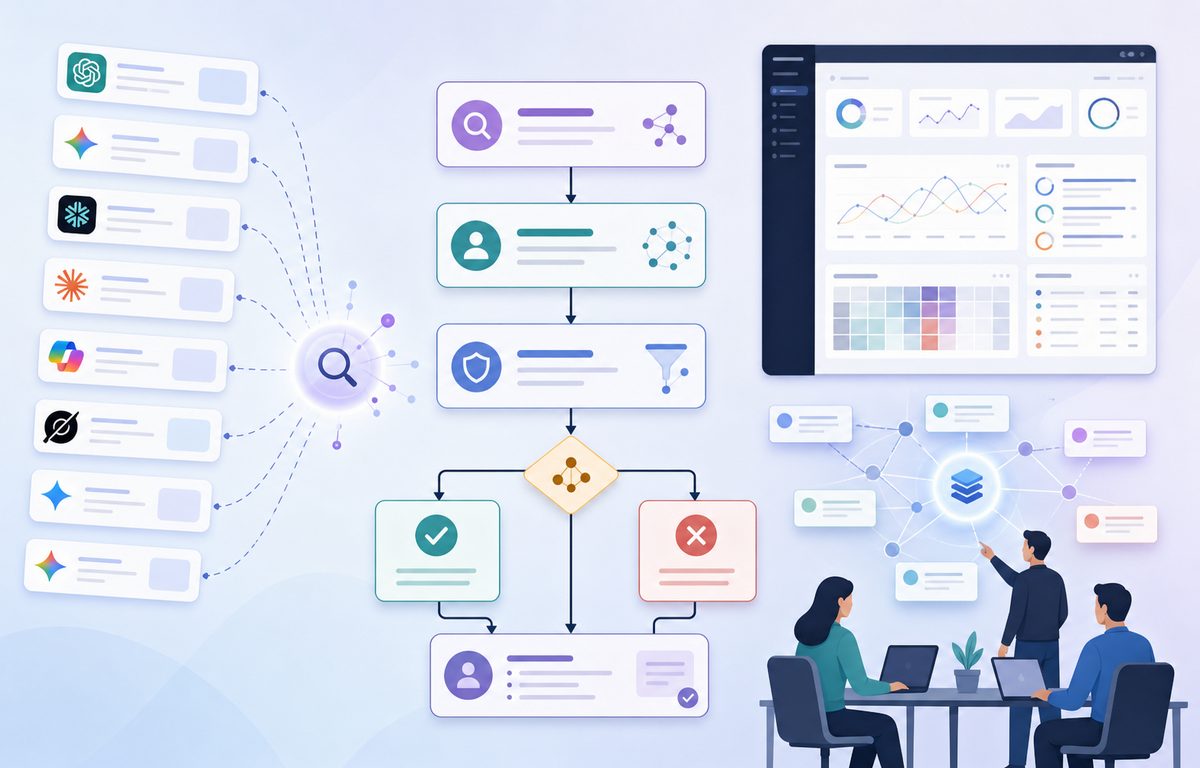
Test against a manually labeled, stratified set of stored responses that deliberately overrepresents risky aliases. Freeze the rules before scoring a holdout set, inspect errors by segment, and convert every confirmed failure into a permanent regression case.
Step-by-step accuracy test
- Choose the counting unit. Use one response-brand pair unless another unit is explicitly required.
- Build a risk inventory. List acronyms, products, namesakes, common words, misspellings, punctuation variants, and localized forms.
- Create a gold set before tuning. Include clear positives, clear negatives, and insufficient-context cases.
- Split development and holdout data. Tune rules on the development set; report final performance on untouched cases.
- Label independently. Have two reviewers label a meaningful subset and adjudicate disagreements.
- Run the frozen matcher. Preserve predicted labels and rule explanations.
- Calculate confusion counts. Report TP, FP, FN, and TN—not percentages alone.
- Score each risk segment. A good aggregate score can conceal a broken acronym or transliteration rule.
- Inspect every error. Separate rule failures from ambiguous gold labels and collection failures.
- Create regression fixtures. Future changes must continue to pass all resolved cases.
How large should the gold set be?
For an initial operational audit, 100–200 response-brand pairs per language or market is a practical starting range, with extra cases for high-risk aliases. This is a QA recommendation, not a statistical guarantee.
Sample size should increase when:
- Genuine mentions are rare
- Several aliases have different collision patterns
- Results will be shared externally
- Small metric changes affect budget or strategy
- Multiple languages or markets are combined
- The acceptable error margin is narrow
A balanced fixture is useful for debugging, but it does not reproduce production prevalence. Maintain both:
- A challenge set balanced across positives, negatives, and edge cases
- A production sample drawn from real monitored responses
Which metrics should be reported?
| Metric | Formula | What it reveals |
|---|---|---|
| Precision | TP ÷ (TP + FP) | How many reported mentions are genuine |
| Recall | TP ÷ (TP + FN) | How many genuine mentions were detected |
| F1 | 2 × precision × recall ÷ (precision + recall) | Balance between precision and recall |
| Specificity | TN ÷ (TN + FP) | Ability to reject non-mentions |
| False discovery rate | FP ÷ (TP + FP) | Share of reported mentions that are wrong |
| Review rate | Reviewed candidates ÷ all candidates | Operational burden from ambiguity |
| Collection coverage | Usable responses ÷ scheduled responses | How much of the intended dataset was captured |
Report confidence intervals for precision, recall, and accuracy when the sample is small. A point estimate without its denominator can create false certainty.
What is a good accuracy threshold?
There is no universal industry threshold. A useful operational starting point is:
| Reporting use | Suggested starting gate |
|---|---|
| Externally shared visibility metrics | At least 95% precision |
| Internal discovery analysis | At least 90% recall |
| High-impact collision aliases | Zero known regression failures |
| Collection coverage | At least 95%, with missing runs disclosed |
| Manual-review rate | Low enough to review consistently |
| Holdout evaluation | Required before production release |
These are governance targets, not published standards. Tighten or relax them based on the financial and reputational cost of each error.
Can an LLM Judge Whether Another AI Mentioned a Brand?
An LLM can triage ambiguous mentions, but it should not be the sole source of gold labels. Model judgments can vary with instructions, context length, model version, and knowledge of company-product relationships.
If an LLM classifier is used:
- Provide the tracked entity, known collisions, aliases, and roll-up policy.
- Require a structured decision: true mention, false match, or insufficient context.
- Require the exact supporting excerpt.
- Record the classifier model and prompt version.
- Validate its decisions against human-labeled holdout data.
- Send low-confidence and conflicting cases to human review.
- Do not use the same model-generated label as both training evidence and independent evaluation.
Human reviewers can also disagree. Track their disagreement rate, adjudicate recurring conflicts, and update the measurement contract when the policy—not the reviewer—is ambiguous.
How Do Prompt, Model, and Language Differences Affect Accuracy?
Matching quality and response-generation variability must be measured separately. Prompt wording, model selection, browsing behavior, locale, refusals, and collection time determine what evidence exists before the matcher sees the response.
A rephrased prompt can change:
- Whether any brands appear
- Which product or parent name is used
- How much disambiguating context is supplied
- Whether the response contains a ranked list
- Whether sources are cited
- Which language or transliteration appears
This is why a tracking run should store the exact prompt rather than only a prompt category. The maxaeo analysis of prompt wording sensitivity covers how rephrasing can alter named brands.
Language-specific aliases need separate approval. A transliteration that is reliable in one country may collide with a common word or unrelated company elsewhere. Do not activate localized aliases globally based on a single market’s results.
Compare performance by:
- Model and model version
- Prompt group
- Branded versus non-branded query
- Language and market
- Browsing or search mode
- Response length
- Alias-risk category
- Collection period
Do not interpret a drop in measured mentions until collection coverage, prompt changes, model mix, and rule versions have been checked.
How Can You Compare the Accuracy of Two Tracking Tools?
Run both tools on the same stored responses and compare their classifications with the same independent gold labels. Dashboard totals are not comparable when the tools use different prompts, models, retries, counting units, or product roll-ups.
A fair comparison requires:
- The same raw response corpus
- The same response-brand counting unit
- The same entity and roll-up contract
- The same human gold labels
- Separate precision, recall, and confusion counts
- Error results by alias-risk category
- Disclosure of manual overrides
- Identical treatment of missing responses
Also inspect the evidence trail. A tool that reports a slightly lower F1 score but exposes every matched excerpt and rule may be more operationally useful than a black box with a higher unverified total.
How Should Alias Rules Be Governed?
Treat alias rules as versioned measurement code, not permanent dashboard settings. Assign an owner, log every change, rerun the full regression suite, and attach the active rule version to every recurring report.
Review rules after:
- A rebrand or legal-name change
- A product launch, rename, or retirement
- An acquisition or divestiture
- Entry into a new language or market
- Discovery of a new namesake
- Repeated manual-review decisions
- A material model-output change
- Expansion into broader prompt categories
Do not silently rewrite historical results after changing a rule. Preserve the original series, then create a clearly labeled restatement when the change materially affects comparisons.
For agencies, isolate rule sets by account and prompt portfolio. An acronym that is unambiguous in a narrow software category may fail when applied across general business prompts.
AI Brand Mention Tracking Accuracy Checklist
A result is report-ready only when someone who did not configure the tracker can inspect the entity definition, collection coverage, matching rules, test results, and supporting excerpts.
- The canonical entity and official domains are documented.
- The response-brand counting unit is explicit.
- Product and parent-brand roll-ups are configurable.
- Aliases are typed by source, market, and risk.
- Acronyms and common words require contextual evidence.
- Known namesakes have collision and exclusion rules.
- Raw text is retained beside normalized text.
- Identity-bearing punctuation is preserved.
- Mentions, citations, recommendations, rank, and sentiment use separate fields.
- A stratified challenge set covers every risky alias class.
- A production sample tests real-world prevalence.
- Development and holdout datasets are separate.
- Precision, recall, F1, and confusion counts are reported.
- Confidence intervals accompany small samples.
- Missing-response rates appear beside visibility metrics.
- Ambiguous cases enter a review queue.
- Every resolved error becomes a regression test.
- Rule versions are stored with historical reports.
Passing this checklist does not guarantee that a brand will be recommended by an answer engine. It ensures that teams can trust the evidence used to prioritize AI visibility optimization.
Frequently Asked Questions
Should every recognized acronym count as a brand mention?
No. Accept an acronym automatically only when it uniquely identifies the tracked entity within the relevant market and prompt portfolio. Otherwise, require nearby product, category, domain, legal-name, or ownership evidence. Short acronyms should normally receive the highest collision-risk rating.
Should fuzzy matching automatically accept misspelled brand names?
Usually not. Fuzzy matching should generate candidates for review because small edit distances can connect unrelated short words and company names. Promote a misspelling to an approved alias only after confirming the intended entity across repeated examples.
Should a product mention count as a parent-brand mention?
Only when the measurement contract permits that roll-up. Store the product as the entity actually mentioned, attach its verified owner, and apply inheritance during reporting. This supports corporate-awareness analysis without claiming that the parent’s name appeared.
Can AI brand mention tracking accuracy be compared across tools?
Yes, but only when both tools classify the same stored responses using the same counting unit, gold labels, entity definitions, and roll-up policy. Comparing dashboard totals is not an accuracy test when collection methods differ.
Is overall accuracy enough to evaluate a brand mention tracker?
No. Overall accuracy can remain high when genuine mentions are rare. Report precision, recall, confusion counts, collection coverage, and performance by alias category. Include confidence intervals when the labeled sample is small.
How often should alias rules be reviewed?
Review them after material brand or product changes and whenever the error queue reveals a recurring pattern. For active programs, monthly inspection plus automatic regression tests after every rule change is a reasonable starting cadence.
Can an LLM replace human labeling?
Not completely. An LLM can triage candidates and provide structured evidence, but a human-labeled holdout set is still needed to measure its errors. Ambiguous or high-impact cases should be adjudicated by reviewers working from a documented policy.
Accurate Tracking Starts With an Entity Decision
AI brand mention tracking accuracy is not primarily a string-search problem. It is an entity-resolution and measurement problem supported by aliases, local context, exclusions, ownership relationships, test data, and auditable evidence.
The 60-snippet benchmark demonstrates why unrestricted alias expansion is insufficient: it recovered genuine variants but also increased false matches. Context-aware rules delivered the strongest result, while the confidence intervals showed why a small fixture should not be mistaken for a production guarantee.
The durable process is straightforward: define what counts, measure collection coverage, preserve raw evidence, test risky cases, report precision and recall, and version every rule. That makes AI visibility reporting explainable when SEO, communications, marketing, and agency teams need to know not only what a dashboard counted, but why the mention belongs to the brand.