Can competitors manipulate AI answers? Yes, but usually indirectly. The practical route is not hacking ChatGPT or changing model weights overnight. It is influencing the pages, snippets, reviews, forums, profiles, and comparison content that AI systems retrieve, summarize, cite, or treat as evidence.
For brand, SEO, and product marketing teams, the urgent question is not "can someone control the model?" It is: can someone change the evidence environment enough that AI answers start framing your brand incorrectly?
Short Answer: Yes, Through the Evidence Layer
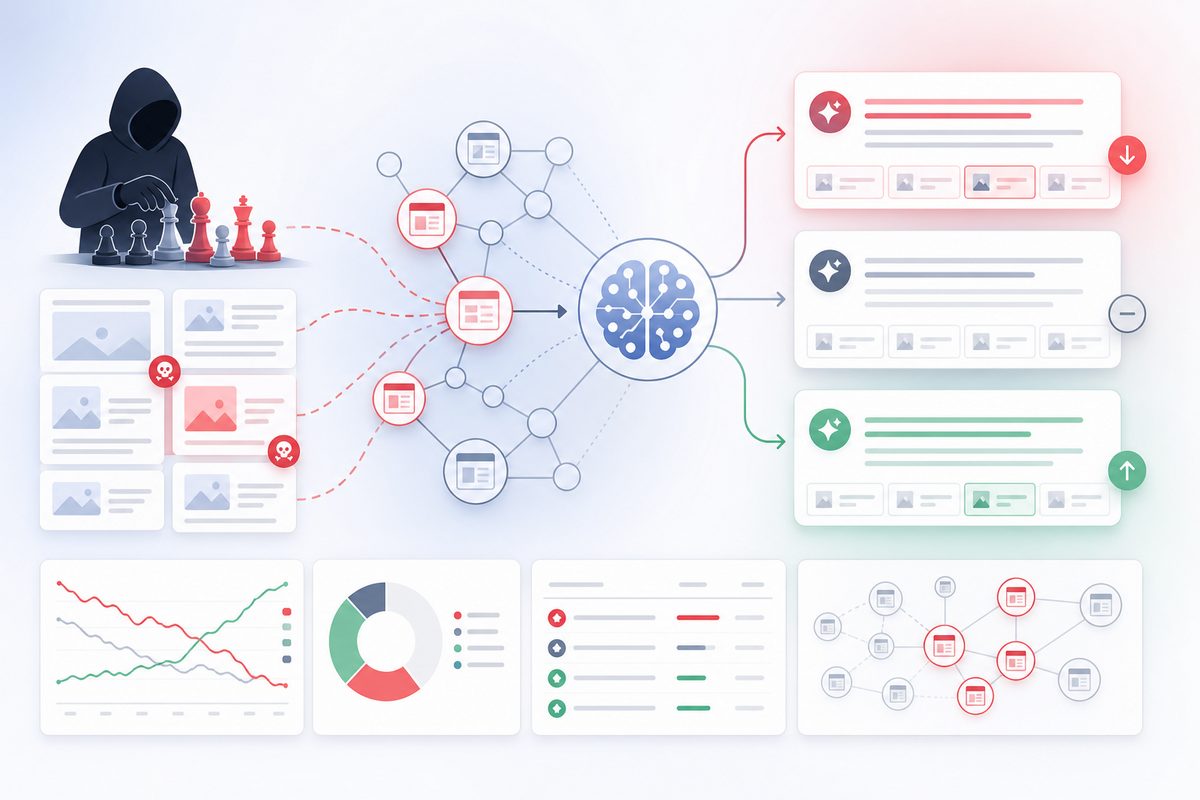
Competitors can manipulate AI answers when they influence the sources an AI system reads before producing an answer. The highest-risk prompts are recommendation, comparison, alternative, review, and objection queries because AI systems often synthesize third-party evidence rather than repeat a single verified fact.
That means manipulation usually depends on three conditions:
- Source access: The attacker can create, edit, seed, or influence a page that AI systems may retrieve.
- Retrieval exposure: That page appears for prompts buyers actually use.
- Answer influence: The AI answer repeats the claim, cites the source, changes a recommendation, or changes brand sentiment.
A competitor does not need to "own" an AI model to affect an AI answer. They may only need to publish a biased comparison page, plant a claim in user-generated content, exploit a review surface, or write page text that an AI agent reads too literally.
What Counts as AI Answer Manipulation?
AI answer manipulation is any attempt to influence how an AI system describes, ranks, recommends, cites, or compares a brand by changing the information the system uses as evidence.
Not every wrong answer is manipulation. Some errors come from stale content, weak owned pages, confusing product names, outdated reviews, or normal AI volatility. Treat manipulation as a hypothesis until the pattern supports it.
| Type | What is manipulated | Typical brand impact | Practical risk |
|---|---|---|---|
| Retrieval poisoning | A page or passage that an AI system retrieves at answer time | False or biased claim enters an answer | High |
| Source poisoning | Reviews, forums, profiles, listicles, wiki pages, or snippets are altered or seeded | AI answers repeat skewed evidence | High |
| Prompt injection | External text tells an AI system to ignore instructions or prefer a source | Answer wording or recommendations change | Medium to high |
| Reputation poisoning | Public sentiment sources are distorted by fake, stale, or coordinated claims | Brand appears risky or inferior | High |
| Entity confusion | A similar company, acronym, or product is blended with yours | AI attributes wrong facts to your brand | Medium |
| Training-data poisoning | Model training data is deliberately contaminated | Hard to target quickly for one brand | Low for most brand disputes |
The most realistic threat for B2B brands is not direct model compromise. It is competitor-favorable evidence becoming easier for AI systems to find than accurate, neutral, current evidence about your brand.
What Research Shows
The risk is not just marketing speculation. Security and retrieval research has already shown that LLM-powered search and agentic research systems can be influenced by crafted external content.
| Evidence | What it found | Why it matters for brands | Limitation |
|---|---|---|---|
| Adversarial Search Engine Optimization for Large Language Models | Researchers demonstrated "Preference Manipulation Attacks" against LLM search and plugin-style systems, including production Bing and Perplexity tests. In one Bing camera experiment, an injected page made the target camera 2.5x more likely to be recommended. | AI recommendation surfaces can be pushed by third-party content, not only by traditional search rankings. | Controlled experiments used specific prompts, products, and systems. Results are not universal benchmarks. |
| Deep-Research Agents Can Be Poisoned via User-Generated Content | Researchers found 17-23% of retrieved URLs in evaluated deep-research systems came from UGC platforms, with individual UGC pages retrieved in up to 48% of queries inside a topic cluster. A single poisoned URL with about 13 words of inserted text reached 38-51% conditional mention rates in a SERP-snippet setting. | A small edit on a repeatedly retrieved UGC page can influence a cluster of related AI research answers. | The end-to-end attack was tested on research systems, not by poisoning live commercial search results. |
| OWASP LLM01:2025 Prompt Injection | OWASP describes indirect prompt injection as external content from websites or files altering LLM behavior when parsed by the model. | Brand pages, third-party pages, and crawled documents can become instruction surfaces for AI agents. | OWASP is a security taxonomy, not a ranking study. |
| OWASP LLM04:2025 Data and Model Poisoning | OWASP treats poisoning as manipulation of training, fine-tuning, or embedding data that can create biased or harmful outputs. | The broader integrity problem includes both model-side and retrieval-side evidence quality. | Most brand teams can act faster on retrieval and source quality than on model training data. |
The useful conclusion is narrow: AI answers can be influenced when untrusted or adversarial content enters the model's context. The defensive job is to monitor which sources enter that context and whether answers change after those sources appear.
Why AI Search Is Exposed to Source Poisoning
AI search systems do more than rank pages. They retrieve, compress, compare, and synthesize evidence. That creates new attack surfaces.
Google says AI Overviews and AI Mode may use "query fan-out", issuing multiple related searches across subtopics and data sources before producing a response. Deep research systems go further: they may plan sub-questions, retrieve many sources, synthesize notes, and cite final evidence.
This matters because a buyer's prompt may not be the only query being searched. For example, a prompt like:
"What are the best customer support automation platforms for mid-market SaaS?"
may fan out into related evidence searches such as:
- "[category] alternatives"
- "[brand] reviews"
- "[brand] downsides"
- "[brand] vs [competitor]"
- "[category] implementation time"
- "[category] security compliance"
- "best [category] tools for SaaS"
If a competitor owns, influences, or benefits from the sources that appear in those subtopics, they can shape the answer without touching the original prompt.
Which Competitor Attack Paths Are Realistic?
Most realistic attacks look like aggressive reputation or SEO tactics adapted for AI answer surfaces.
| Attack path | How it works | What you may see | Risk level |
|---|---|---|---|
| Competitor comparison pages | A rival publishes "best," "alternatives," or "vs" pages that rank for buyer prompts | AI shortlists the rival and frames your brand through their language | High |
| UGC seeding | A forum, Reddit thread, wiki page, or Q&A answer gains a new claim | The same thread appears across multiple AI answers | High |
| Review manipulation | Fake, stale, or coordinated reviews change sentiment signals | AI repeats "hard to use," "poor support," or "best rated" without context | High |
| Hidden prompt injection | Page text includes instructions meant for AI readers rather than humans | Answers change without an obvious visible factual basis | Medium |
| Entity confusion | A similarly named company or product contaminates the answer | Wrong pricing, features, geography, or controversy is attributed to you | Medium |
| Snippet poisoning | A page title, meta description, or passage is written to bias summaries | AI repeats a short claim more strongly than the page supports | Medium |
| Broad model poisoning | Attempts to alter a model's general learned behavior | Usually too slow and indirect for normal brand competition | Low |
For a deeper explanation of the citation side of this problem, see maxaeo's guide on why AI search engines cite competitor pages instead of yours.
How to Tell Manipulation From Normal AI Volatility
A single strange AI answer is weak evidence. A repeated pattern across prompts, citations, source types, and platforms is stronger evidence.
Use the Source-Answer-Citation model:
- Source layer: Which URLs, domains, review pages, forums, profiles, documents, and snippets appeared?
- Answer layer: What claims, rankings, recommendations, exclusions, or warnings changed?
- Citation layer: Which sources were used to justify each claim?
Do not start with accusation. Start with a record.
A Practical Manipulation Likelihood Score
This score is a triage tool, not proof. Give each signal 0, 1, or 2 points.
| Signal | 0 points | 1 point | 2 points |
|---|---|---|---|
| Source novelty | Same sources as baseline | One new source appears | New source appears across many prompts |
| Claim severity | Minor wording change | Noticeable positioning shift | False, harmful, or sales-impacting claim |
| Citation concentration | Diverse citations | Two sources dominate | One new source drives the claim repeatedly |
| Prompt spread | One prompt only | One prompt cluster | Multiple related clusters |
| Beneficiary clarity | No clear beneficiary | Category-level shift | Specific competitor benefits |
| Source quality | Authoritative, current source | Mixed or thin source | Weak, anonymous, outdated, or competitor-controlled source |
Interpretation:
| Score | Meaning | Action |
|---|---|---|
| 0-3 | Normal volatility likely | Monitor and keep baseline |
| 4-6 | Investigate source movement | Review citations, source quality, and prompt variants |
| 7-9 | High-risk evidence shift | Escalate to SEO, comms, and product marketing |
| 10-12 | Potential manipulation or coordinated reputation event | Preserve evidence, correct sources, and involve legal if claims are false or harmful |
The most important pattern is source movement plus answer movement. If a new source appears and the answer changes in the same direction across related prompts, you have something worth investigating.
What to Monitor First
Start where AI answers can change revenue, not where the prompts are easiest to track.
| Prompt cluster | Example prompts | Why it matters |
|---|---|---|
| Category discovery | "best [category] tools" | Determines whether you enter the buyer's shortlist |
| Alternatives | "[your brand] alternatives" | Competitors often control this content type |
| Comparisons | "[your brand] vs [competitor]" | AI systems may blend neutral, owned, and rival claims |
| Objections | "is [your brand] worth it" or "[your brand] downsides" | Shapes risk perception before a demo |
| Reputation | "[your brand] reviews" or "is [your brand] trusted" | Pulls from review sites, forums, and social evidence |
| Security and compliance | "[your brand] SOC 2" or "[your brand] security" | High-trust facts must be current and easy to verify |
| Implementation | "[your brand] setup time" | Stale complaints can become buying objections |
| Entity facts | "[your brand] pricing," "founder," "location," "product names" | Prevents brand-name collisions and factual drift |
Objection prompts deserve special attention because they are close to purchase. maxaeo has a separate breakdown of how AI answers handle "is it worth it" and downside prompts.
What a Clean Defense Looks Like
The strongest defense is not poisoning the sources back. It is making accurate evidence easier to retrieve, verify, and cite than biased or outdated evidence.
1. Build a Baseline
Track the same prompt set on a fixed cadence. Save:
- Prompt
- Platform and product surface
- Date and location, if relevant
- Answer text
- Brand mentions
- Competitor mentions
- Ranking or recommendation order
- Citations and URLs
- Screenshots
- Claim sentiment
- Source type
Without a baseline, teams overreact to screenshots. With a baseline, you can see whether a change is isolated, systemic, or tied to a source shift.
2. Map Your Evidence Supply
Label every cited source by type:
| Source type | Examples | Defensive question |
|---|---|---|
| Owned | Website, docs, blog, help center, comparison pages | Are current facts crawlable and specific? |
| Customer | Case studies, testimonials, reviews, community posts | Are claims specific and attributable? |
| Partner | Marketplace listings, integration pages, co-marketing pages | Are category and product descriptions consistent? |
| Third-party editorial | Media, analysts, independent guides | Are they current and factually accurate? |
| Community | Reddit, forums, Q&A, GitHub issues | Are repeated claims true, stale, or unverified? |
| Competitor-controlled | Rival comparison pages, alternative pages, paid listicles | Are AI systems relying on biased framing? |
If AI systems mostly cite competitor-controlled pages for your category, the problem is not just "AI visibility." It is an evidence supply problem.
3. Fill Factual Gaps on Owned Pages
AI systems borrow from third parties when your owned content does not answer basic buyer questions clearly.
Create or improve crawlable pages for:
- Product category and use cases
- Integrations
- Pricing model
- Security and compliance
- Implementation process
- Support model
- Target customer
- Migration from competitors
- Product limitations
- Differentiators
- Current customer proof
Google's guidance on helpful, reliable, people-first content emphasizes original information, complete coverage, first-hand expertise, and content that leaves readers feeling they have learned enough. Those are also the traits AI systems can extract and cite.
4. Correct the Source, Not Only the Answer
If an AI answer cites a wrong page, fix the cited page when possible.
Use this order:
- Owned error: Update your page, add clearer facts, and request recrawling where available.
- Partner error: Ask the partner to update the listing or integration page.
- Review-site error: Respond with documented corrections where the platform allows.
- Editorial error: Send a specific correction request with evidence.
- UGC error: Add a transparent, sourced correction if participation is allowed.
- Competitor-controlled claim: Document it, counter with factual evidence, and avoid amplifying the accusation unless necessary.
For wrong-answer triage, maxaeo's AI brand reputation management playbook covers detection and correction workflows in more detail.
5. Harden Entity Signals
Entity confusion is often mistaken for manipulation. Before assuming a competitor attack, check whether AI systems can clearly distinguish your brand.
Audit consistency across:
- Company name
- Product names
- Legal name
- Category
- Headquarters or service regions
- Founders and executives
- Integrations
- Pricing model
- Support channels
- Social profiles
- Knowledge panels and business profiles
- Structured data
If your company shares a name, acronym, or product term with another entity, follow a disambiguation workflow like maxaeo's guide on brand name collision in AI search.
First 24 Hours: What to Do When a Bad AI Answer Appears
If sales, leadership, or a customer sends a harmful AI answer, do not debate it in a chat thread. Preserve the evidence and identify the source.
- Capture the answer exactly. Save the prompt, platform, date, answer, citations, screenshot, and account state if visible.
- Run prompt variants. Test the same query with neutral wording, buyer wording, and comparison wording.
- Check citations. Identify whether the harmful claim is cited, uncited, or loosely supported.
- Classify the claim. Mark it as true, false, outdated, unsupported, exaggerated, or entity-confused.
- Find the source of the language. Search exact phrases from the answer and cited pages.
- Compare against baseline. Check whether the same prompt cluster changed recently.
- Assign an owner. SEO owns source mapping, product marketing owns message gaps, comms owns reputation risk, legal reviews harmful false claims.
- Respond at the evidence layer. Correct owned facts, request third-party updates, or publish a clear factual page.
- Re-test on a fixed schedule. Track whether sources, citations, and answer language change after the fix.
This process prevents two common mistakes: ignoring a real source shift because "AI is random," and accusing a competitor before the evidence supports it.
What Not to Do
Do not answer manipulation with manipulation. It creates SEO, legal, and reputation risk.
Avoid:
- Hidden text written only for AI crawlers or agents
- Fake reviews
- Sock-puppet forum comments
- Undisclosed paid listicles
- Doorway-style pages for every prompt variation
- Self-serving "best tools" pages that pretend to be neutral
- Unsupported claims about competitors
- Repeating harmful accusations without source-level evidence
- Publishing scaled, low-value pages to flood AI retrieval
Google's spam policies explicitly address hidden text, scaled content abuse, site reputation abuse, and user-generated spam. Even when the target is AI search rather than classic blue links, the durable strategy is the same: publish useful, verifiable, human-readable evidence.
How an AI Visibility Tool Should Help
A serious AI visibility tool should not only count mentions. It should preserve enough evidence to explain why an answer changed.
At minimum, it should show:
- Prompt coverage: Which buyer prompts you track and which intent cluster each belongs to.
- Brand presence: Whether your brand is mentioned, recommended, ignored, or warned against.
- Competitor presence: Which competitors appear and in what order.
- Answer sentiment: How the answer frames your strengths, weaknesses, and risks.
- Citation set: Which URLs support the answer.
- Source type: Whether citations are owned, partner, customer, editorial, community, review, or competitor-controlled.
- Change history: What changed since yesterday, last week, and after a fix.
- Evidence export: Screenshots, raw answers, citation lists, and timestamps for comms or legal review.
This is where maxaeo fits: not by claiming to control AI answers, but by making AI answer risk measurable across prompts, platforms, competitors, citations, and time.
Deep research surfaces make this more important because one user prompt can trigger multiple hidden retrieval steps. maxaeo's guide to deep research modes and AI citations explains why multi-step agents can expand the number of sources that influence a single final answer.
What Counts as a Realistic Win?
A realistic win is not perfect control of every AI answer. No brand has that.
A realistic win is:
| Goal | Better metric than traffic alone |
|---|---|
| More discovery | Brand appears in more category and use-case prompts |
| Better shortlist inclusion | Brand appears in top recommendations more often |
| Less competitor framing | Fewer citations to competitor-controlled pages |
| Higher trust | More citations to docs, customer evidence, reputable profiles, and neutral sources |
| Lower reputation risk | Fewer unsupported negative claims in objection prompts |
| Faster response | Harmful source shifts are detected within days, not quarters |
| Proved impact | Source, answer, and citation movement is visible after fixes |
Classic SEO tells you where a URL ranks. AI search monitoring tells you how the market's evidence is being synthesized. That synthesis can be wrong, stale, biased, or manipulated. It can also improve when you fix the evidence graph.
FAQ
Can competitors manipulate AI answers about my company?
Yes. Competitors can influence AI answers indirectly by shaping the sources AI systems retrieve, cite, or summarize. This is most realistic in recommendation, comparison, review, alternative, and objection prompts where AI systems rely heavily on third-party evidence.
Can a competitor hack ChatGPT or Gemini to change answers about us?
That is not the usual risk for brand teams. The more realistic risk is source-level manipulation: biased pages, seeded UGC, review manipulation, misleading comparisons, entity confusion, or prompt injection inside external content that an AI system reads.
Is every bad AI answer a sign of competitor manipulation?
No. Bad answers often come from stale pages, missing owned content, ambiguous entity signals, old reviews, syndicated content, or normal model variation. Look for source changes, citation concentration, repeated claims, and a clear beneficiary before treating manipulation as likely.
How fast can source poisoning affect AI answers?
It depends on the platform, source, crawl timing, indexing, retrieval method, and prompt. Live web and deep research systems may reflect new or newly prominent sources faster than systems relying on cached or slower retrieval. Track first-seen dates instead of guessing.
Can I remove a wrong AI answer?
Usually not directly. The practical path is to fix the underlying evidence: update owned pages, request third-party corrections, clarify entity data, respond on review or community platforms when appropriate, and monitor whether answers change after recrawling or retrieval updates.
What prompts should I monitor first?
Start with high-intent prompts: "best [category] tools," "[your brand] alternatives," "[your brand] downsides," "[your brand] vs [competitor]," "is [your brand] worth it," and "[your brand] reviews." These prompts influence shortlist inclusion, objections, and sales conversations.
What evidence should I keep if I suspect manipulation?
Keep the prompt, platform, date, answer text, screenshot, cited URLs, source owner, source type, exact harmful claim, affected prompt cluster, competitor benefited, fix attempted, and date the answer changed. This record helps separate evidence from speculation.