Brand protection AI search is the practice of monitoring, proving, and fixing the ways AI answer engines misstate, omit, confuse, or commercially damage a brand. It covers ChatGPT, Google AI Overviews, AI Mode, Perplexity, Gemini, Copilot, Claude, Grok, and other answer surfaces where buyers may act without clicking through.
The old brand-protection playbook watched domains, ads, social posts, reviews, marketplaces, and search results. AI search adds a different risk: one synthesized answer can compress official pages, stale third-party profiles, reviews, Reddit threads, competitor content, and model assumptions into a confident recommendation.
The practical goal is not to make every AI answer perfect. The goal is to make materially wrong, missing, or damaging answers visible fast enough to respond with evidence.
Quick Answer: How to Protect a Brand in AI Search
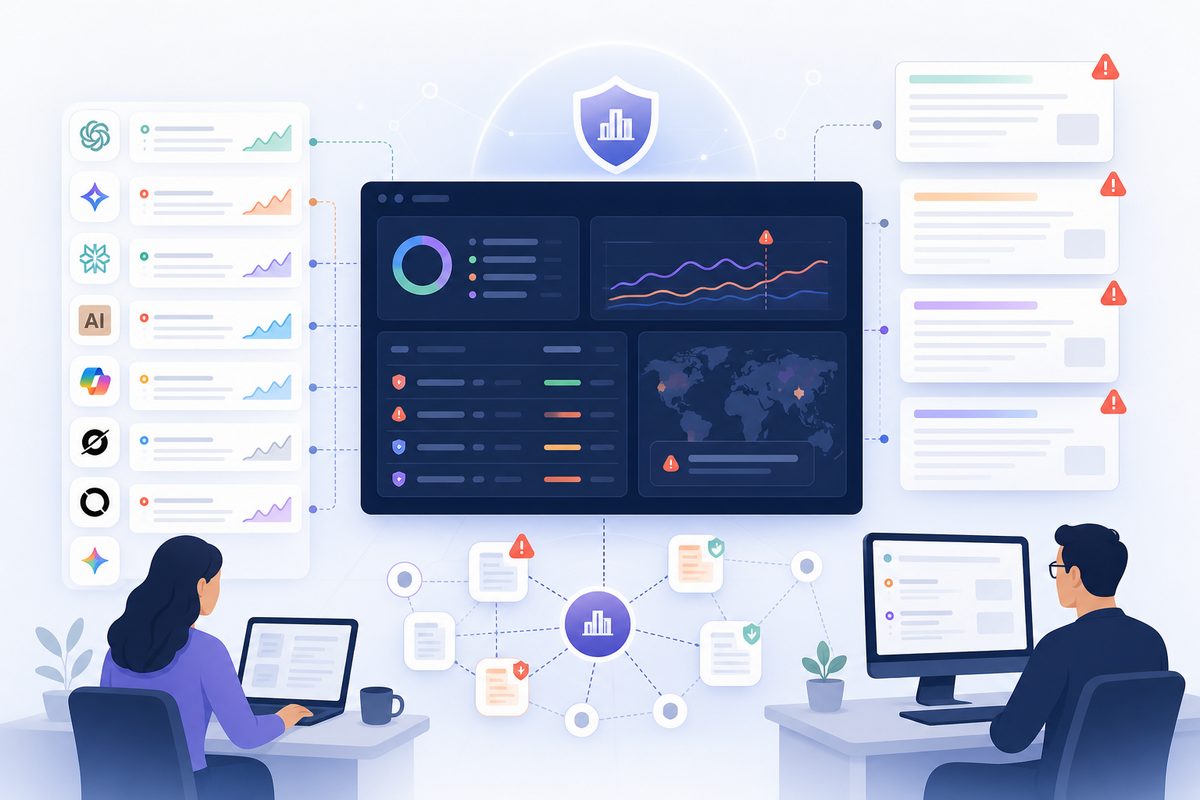
Start with monitoring, not optimization. Build a repeatable prompt set, collect answers and citations across priority AI systems, classify issues by threat type, score severity, repair the source layer, then retest until the answer trend improves.
A working AI brand defense loop has seven parts:
- Define protected assets: brand name, product facts, claims, categories, certifications, executives, pricing, and competitors.
- Track buyer prompts: direct brand, category, comparison, alternatives, reputation, compliance, and problem-led prompts.
- Capture evidence: prompt, answer text, timestamp, model, region, citations, screenshot, source panel, and answer rank.
- Classify threats: hallucination, entity confusion, stale facts, negative framing, source poisoning, prompt injection, citation drift, or competitor displacement.
- Score severity: separate a low-risk wording issue from a material falsehood in a buyer-intent answer.
- Fix sources: update official pages, correct third-party profiles, clarify visible claims, improve internal links, and publish missing proof.
- Retest: measure whether claim accuracy, citation support, AI share of voice, and recommendation rate improved.
Brand Protection vs AI Visibility vs Reputation Management
Brand protection AI search overlaps with AI visibility and reputation management, but it is more defensive. Visibility asks, "Are we mentioned?" Brand protection asks, "Can we prove AI answers are accurate, sourced, and not commercially harmful?"
| Discipline | Primary question | Typical metric | Limitation if used alone |
|---|---|---|---|
| AI visibility monitoring | Are we mentioned or cited? | Mentions, citation count, AI share of voice | May miss false or damaging mentions |
| AI reputation management | Are answers favorable or negative? | Sentiment, negative context rate | May underweight omissions and competitor displacement |
| Brand protection AI search | Are AI answers safe, accurate, and defensible? | Correct claim rate, citation support, severity queue, recovery time | Requires cross-functional ownership |
| Traditional SEO | Do pages rank and earn traffic? | Rankings, clicks, impressions | Does not show how AI systems synthesize the answer |
| Social listening | What are people saying publicly? | Mentions, sentiment, reach | Does not capture generated summaries and recommendations |
For a deeper reputation workflow, see MaxAEO's guide to AI brand reputation management.
Why AI Search Creates New Brand Risk
AI search creates risk because retrieval, summarization, and recommendation happen inside one answer. A buyer may see a shortlist, a risk summary, or a comparison without opening the source pages that shaped it.
Google says its generative AI search features can use retrieval-augmented generation and query fan-out, where related searches are generated to gather more information before an answer is synthesized. See Google Search Central's guide to optimizing for generative AI features.
That changes the operating model for marketing, SEO, PR, legal, and product teams. You are no longer only protecting a ranked result. You are protecting the source graph around the brand.
That source graph can include:
- Official product pages and help docs
- Review sites and marketplace profiles
- News coverage and analyst pages
- Reddit, forums, and community discussions
- Comparison articles and affiliate pages
- YouTube transcripts and podcast pages
- Partner directories and integration listings
- Old press releases, cached profiles, and scraped summaries
Research supports the need for direct measurement. A 2026 arXiv preprint on Google Search, Gemini, and AI Overviews found AI Overviews in 51.5% of representative real-user queries in its dataset, with retrieved sources differing substantially across systems. Another 2026 study of Google AI Overviews reported 13.7% activation overall, 64.7% activation for question-form queries, and 11.0% unsupported claims among decomposed answer claims.
Do not treat those rates as universal for every brand. Treat them as the operational point: AI answers are dynamic, source selection differs from classic rankings, and claim accuracy must be checked directly.
What Counts as an AI Brand Incident?
An AI brand incident is any generated answer that creates material risk for the company. The issue may be factual, reputational, competitive, legal, security-related, or commercial.
Examples include:
- AI says the company lacks a certification it has.
- AI confuses the brand with a similarly named company.
- AI recommends competitors for the brand's core category but omits the brand.
- AI cites a page that does not support the claim in the answer.
- AI repeats discontinued pricing, old positioning, or retired features.
- AI overweights an old controversy without current context.
- AI summarizes a manipulated or low-quality source as if it were authoritative.
The incident test is simple: Would this answer change how a buyer, analyst, journalist, candidate, investor, or regulator evaluates the brand? If yes, it belongs in the monitoring queue.
The Eight Threats to Monitor
A useful threat model separates failure modes. "Bad sentiment" is too broad to manage. Each threat has a different detection signal and a different fix.
| Threat | What it looks like | Detection signal | First response |
|---|---|---|---|
| Hallucinated fact | AI invents pricing, features, customers, certifications, or risks | Unsupported claim; no matching source | Publish or update a clear canonical source |
| Entity confusion | AI mixes your brand with a similarly named company | Wrong logo, industry, founders, locations, or products | Strengthen entity disambiguation and sameAs signals |
| Stale answer | AI repeats old positioning, retired features, or outdated pricing | Old citation dates; mismatch with current docs | Update high-authority pages, profiles, and change logs |
| Negative framing | AI overweights complaints, outages, lawsuits, or controversy | Sentiment shift; repeated negative clauses | Add balanced public context and PR-approved evidence |
| Competitor displacement | AI recommends competitors for your category but omits you | Falling AI share of voice; missing shortlists | Build use-case, comparison, and proof-led category content |
| Source poisoning | Low-quality, copied, adversarial, or misleading pages influence answers | New suspicious citations or repeated false claims | Investigate source, document harm, counter-publish or escalate |
| Prompt injection | Hidden or external instructions alter summaries or recommendations | Strange phrasing; source-level hidden text; unsafe instruction patterns | Escalate to security and remove or isolate the source |
| Citation drift | AI cites a real page that does not support the answer | Cited page mismatch; unsupported extraction | Rewrite the source page for clearer claim support |
Entity confusion is especially common for brands with generic names, acronyms, local subsidiaries, or similarly named competitors. Use a dedicated entity disambiguation playbook when AI systems mix your company with another organization.
For prompt injection risk, OWASP's LLM Top 10 describes both direct and indirect prompt injection, including cases where external sources such as websites or files alter model behavior. That is why source-level inspection belongs in the brand protection workflow, not only the security workflow.
The Evidence Packet: What to Capture Before Fixing
Do not start with "AI said something wrong." Start with a reproducible evidence packet. It should let SEO, PR, legal, product, and security teams evaluate the same incident without relying on memory.
Capture these fields for every material issue:
| Evidence field | Why it matters |
|---|---|
| Prompt text | Small wording changes can change the answer |
| AI surface | ChatGPT, Perplexity, Gemini, AI Overviews, AI Mode, Copilot, Claude, Grok, or another system |
| Date and time | AI answers change; timing matters for incident review |
| Region and language | Brand risk often varies by market |
| Answer text | Needed for claim extraction and legal review |
| Screenshot | Preserves the visible user experience |
| Citation URLs | Shows what source may have influenced the answer |
| Source panel or link cards | Captures what the user could click |
| Mention rank | Shows whether the brand appeared first, later, or not at all |
| Competitors named | Measures displacement and category ownership |
| Claim status | Supported, partially supported, unsupported, or uncited |
| Severity | P0-P3 triage level |
| Owner | SEO, PR, product marketing, legal, support, or security |
| Retest date | Prevents one-time fixes from being mistaken for recovery |
Screenshots are not decoration. They are evidence. Without screenshots, teams debate anecdotes. With screenshots, citations, and timestamps, they can triage incidents.
How Many AI Search Prompts Should a Brand Track?
Most B2B brands should start with 60 to 150 prompts. Use fewer for a narrow product in one market. Use more for multi-product, multi-region, regulated, or enterprise brands.
One prompt is not monitoring. Buyers ask category, comparison, alternatives, risk, pricing, integration, compliance, and problem-led questions. A defensible prompt matrix covers the journey before and after the brand is named.
| Prompt bucket | Example pattern | Risk detected |
|---|---|---|
| Direct brand | "What is [brand] used for?" | Wrong facts, stale positioning, entity confusion |
| Brand reputation | "Is [brand] trustworthy?" | Negative framing, controversy drift |
| Category shortlist | "Best [category] tools for [use case]" | Omission, AI share of voice loss |
| Comparison | "[brand] vs [competitor]" | Feature errors, competitor framing |
| Alternatives | "Alternatives to [competitor]" | Missed displacement opportunities |
| Pain point | "How do I solve [buyer problem]?" | Pre-brand discovery gaps |
| Pricing | "How much does [brand] cost?" | Invented pricing, outdated plans |
| Integration | "Does [brand] work with [tool]?" | Missing or stale integration facts |
| Compliance | "Is [brand] safe for [regulated team]?" | Risk claims, policy confusion |
| Entity clarity | "Who founded [brand]?" | Brand-name collision |
| Regional or language | Same intent in priority markets | Local blind spots |
MaxAEO's 60-prompt framework for AI brand monitoring is a practical starting point. If you need to size the program, use this guide on how many AI search prompts to track.
How to Score AI Answer Severity
Severity scoring turns noisy answer changes into an operational queue. Score each issue by business impact, buyer proximity, answer confidence, source quality, recurrence, and regulatory risk.
| Severity | Definition | Example | Response target |
|---|---|---|---|
| P0 | Material falsehood in a high-intent, high-risk, or regulated answer | AI says the product lacks a security certification it has | Same day |
| P1 | Harmful omission, competitor displacement, or repeated unsupported claim on core prompts | Brand disappears from "best enterprise [category] tools" across models | 2-3 business days |
| P2 | Stale or incomplete fact with moderate buyer impact | AI lists old integrations or retired pricing language | 1 week |
| P3 | Low-risk phrasing issue or isolated unstable answer | One model uses off-brand wording once | Watchlist |
Do not score only by sentiment. A neutral answer can be commercially damaging if it omits the brand from a shortlist. A negative answer may be accurate and should not be "fixed" by burying the truth.
A useful severity note has this format:
| Field | Example |
|---|---|
| Issue | "AI says Acme does not support SOC 2." |
| Prompt | "Is Acme safe for enterprise finance teams?" |
| Surface | Google AI Overview, US, desktop |
| Citation | Old third-party profile from 2023 |
| Claim status | Unsupported by current source |
| Severity | P0 |
| Owner | Product marketing + security + SEO |
| Fix | Update trust page, correct third-party profile, request recrawl, retest prompt set |
Source Poisoning and Citation Drift
Source poisoning means weak, misleading, copied, or adversarial sources influence AI answers. Citation drift means an AI answer cites a real page but the cited page does not support the claim.
Both are hidden risks because cited AI answers look more trustworthy. A citation is useful evidence, but it is not proof.
A study on ChatGPT attribution found correct or partially correct answers in about half of its test cases, while suggested references existed only 14% of the time. Modern AI search systems are more retrieval-oriented than early ungrounded chatbot answers, but the brand defense rule is the same: verify every material claim against the cited source.
Classify citations like this:
| Citation state | Meaning | Fix |
|---|---|---|
| Supports the claim | The cited source clearly backs the answer | Decide whether the underlying fact needs business action |
| Partially supports the claim | The source is ambiguous, old, or incomplete | Rewrite the source and add clearer supporting pages |
| Does not support the claim | The answer overstates or misreads the source | Document mismatch and publish clearer evidence |
| No citation | The answer makes a material uncited claim | Add a canonical source and monitor recurrence |
| Suspicious source | Low-quality, copied, fake, or adversarial page | Escalate to PR, legal, security, or platform reporting |
This is where answer engine optimization becomes defensive. The best fix is often not another blog post. It is a clear, crawlable, well-linked source that states the exact fact a buyer needs.
Fix the Source Layer, Not Just the Answer
The durable fix is to improve the source layer that AI systems can retrieve, compare, and cite. That includes official pages, structured data, third-party profiles, reviews, comparison content, documentation, and earned media.
Google's AI features documentation says there are no special schema.org requirements to appear in AI Overviews or AI Mode, and that structured data should match visible page text. That is the right guardrail: do not hide facts in markup. Put important brand facts where users can read them.
Build a canonical brand fact base:
| Page type | Purpose | Content to include |
|---|---|---|
| About/entity page | Disambiguate the company | Legal name, product names, category, locations, leadership, founding date, sameAs links |
| Product fact page | Prevent feature hallucinations | Current features, limitations, integrations, screenshots, changelog links |
| Security/trust page | Reduce compliance confusion | Certifications, policies, data handling, subprocessors, support contacts |
| Pricing explainer | Reduce invented pricing | Current pricing model, plan names, quote process, update date |
| Comparison pages | Correct competitor framing | Specific use cases, tradeoffs, substantiated differences, source-backed claims |
| Review response hub | Balance complaint-heavy sources | Support themes, fixes shipped, transparent issue handling |
| Press/source kit | Help journalists and AI systems | Boilerplate, approved descriptions, logos, screenshots, spokesperson details |
| Documentation index | Improve technical retrieval | Product docs, integration docs, API references, troubleshooting pages |
For ChatGPT search visibility, crawler choices also matter. OpenAI's crawler documentation distinguishes OAI-SearchBot, which is used for ChatGPT search features, from GPTBot, which relates to training. The settings are independent, so blocking training crawlers is not the same decision as blocking search visibility.
What an AI Search Monitoring Tool Should Do
A brand can start manually with a spreadsheet, but manual checks break down once you need multiple prompts, markets, models, and stakeholders. A serious AI search monitoring setup should collect answers, citations, screenshots, competitors, recurrence, and severity.
Use this checklist when evaluating an AI visibility tool or AI brand monitoring platform:
| Capability | Why it matters for brand protection |
|---|---|
| Multi-surface tracking | ChatGPT alone does not represent AI search |
| Prompt groups | Lets teams separate brand, category, comparison, and risk prompts |
| Citation capture | Shows which sources need repair |
| Screenshots | Creates evidence for PR, legal, and executives |
| Claim extraction | Separates factual risk from general sentiment |
| Competitor tracking | Measures displacement, not just mentions |
| Region and language support | Finds market-specific issues |
| Change detection | Alerts teams when answers drift |
| Severity workflow | Turns monitoring into response |
| Exportable evidence | Supports incident reviews and board reporting |
If you are comparing platforms, start with MaxAEO's list of the best AI brand monitoring tools. For Google-specific tracking, see the guide to Google AI Overviews and AI Mode tracking tools.
Metrics That Prove Brand Risk and Recovery
The right metrics connect AI answer quality to commercial risk. Do not report only total mentions. Track visibility, accuracy, citation support, competitive displacement, volatility, and response time.
| Metric | Definition | Why it matters |
|---|---|---|
| AI share of voice | Brand mentions divided by relevant category mentions | Shows shortlist presence |
| Recommendation rate | Share of prompts where AI actively recommends the brand | Stronger than passive mention count |
| Mention rank | Brand position in an AI-generated list | Measures prominence |
| Correct claim rate | Share of brand claims verified against sources | Measures factual risk |
| Citation support rate | Share of cited claims supported by cited pages | Catches citation drift |
| Source control ratio | Share of citations from official or trusted sources | Shows source-layer health |
| Competitor displacement rate | How often competitors replace the brand in target prompts | Measures commercial threat |
| Negative context rate | Share of mentions framed by risk, controversy, or weakness | Helps PR triage |
| Answer volatility | How often answers materially change across runs | Prevents overreaction to one sample |
| Time to detect | Time from first harmful answer to alert | Proves monitoring value |
| Time to recovery | Time from fix to improved answer trend | Proves response value |
A 2026 arXiv study of AI-generated recommendations across 3,750 responses, 50 brands, and three models found 41.6% cross-model agreement on the top-recommended brand. The practical takeaway: track multiple answer engines, not one chatbot.
Who Owns Each Threat?
Marketing can coordinate AI answer monitoring, but it cannot fix every issue. The source of harm may sit in product, support, PR, legal, security, or web operations.
| Threat type | Primary owner | Supporting teams |
|---|---|---|
| Wrong product facts | Product marketing | SEO, docs, web |
| Missing shortlist presence | SEO/growth | Content, PR, partnerships |
| Negative controversy framing | Comms/PR | Legal, support, executives |
| Entity confusion | SEO | Brand, web, knowledge graph owners |
| Fake reviews or review bombing | Customer marketing | Support, legal, platform owners |
| Source poisoning | PR or security | Legal, SEO |
| Prompt injection | Security | PR, web, legal |
| Unsupported AI citations | SEO/content | Web, PR |
| Invented compliance claims | Security or legal | Product marketing, SEO |
| Stale pricing | Revenue operations | Product marketing, web |
The operating owner should maintain the incident queue, but each issue needs a named business owner. Without ownership, AI search monitoring becomes a dashboard no one acts on.
30-Day Implementation Plan
A 30-day plan should produce a baseline, a prompt library, a severity queue, first source fixes, and an executive report. It does not need to solve every AI answer problem in the first month.
| Week | Work | Output |
|---|---|---|
| 1 | Define protected assets, competitors, AI surfaces, markets, and prompt buckets | Prompt matrix and risk register |
| 2 | Run baseline monitoring across priority models | Mention, citation, claim accuracy, and competitor dashboard |
| 3 | Triage P0-P2 issues and repair source gaps | Updated pages, corrected profiles, clearer claims, stronger internal links |
| 4 | Retest, report trend changes, and set cadence | Executive report, owner map, alert rules, next-month roadmap |
In the first month, most brands uncover one of three patterns:
| Pattern | What it means | Best first fix |
|---|---|---|
| Missing from category shortlists | AI systems do not associate the brand strongly enough with the buying category | Publish stronger category, use-case, and comparison evidence |
| Mentioned with old positioning | AI systems are retrieving stale or weak sources | Update official facts, third-party profiles, and old high-authority pages |
| Cited weakly while competitors get stronger proof | The source layer is not persuasive enough | Add third-party validation, trust pages, reviews, case studies, and specific proof |
Common Mistakes
The biggest mistake is checking a few direct brand prompts in ChatGPT and calling it monitoring. That misses category prompts, comparison prompts, regional prompts, citations, answer variance, and source drift.
Avoid these mistakes:
- Tracking only direct brand prompts. Buyers often ask problem and category questions before they know your name.
- Treating sentiment as the main metric. Omission from a shortlist can matter more than a neutral mention.
- Ignoring citations. The cited source often tells you what to fix.
- Publishing generic GEO pages. Google advises creating original, non-commodity content that provides substantial value beyond the obvious.
- Blocking crawlers without understanding tradeoffs. Search visibility, AI training preferences, and user-triggered retrieval are different decisions.
- Skipping screenshots. Without screenshots, you lose the evidence trail.
- Overclaiming recovery. One improved response is not a trend.
- Treating every issue as SEO. Some issues need PR, legal, security, or product fixes.
Brand protection AI search works best when it is scheduled, evidence-heavy, and tied to owners. The incident log should be precise enough for action, not dramatic enough for attention.
Frequently Asked Questions
What is brand protection AI search?
Brand protection AI search is the process of monitoring and correcting how AI answer engines describe, cite, rank, and recommend a brand. It combines AI search monitoring, source-quality work, reputation management, citation review, and incident response.
How is it different from generative engine optimization?
Generative engine optimization focuses on improving visibility in AI-generated answers. Brand protection adds a defensive layer: detecting false claims, harmful omissions, source poisoning, citation drift, prompt injection, entity confusion, and competitor displacement.
How often should teams monitor AI answers?
Monitor high-risk brand, category, comparison, reputation, and compliance prompts daily. Broader prompt sets can run weekly. Regulated categories, launches, crises, funding announcements, and competitive campaigns may need more frequent checks.
Can brands force ChatGPT or Google AI Overviews to recommend them?
No. Brands cannot force independent AI systems to recommend them. They can improve the evidence layer AI systems retrieve: clear official facts, crawlable pages, accurate third-party profiles, strong reviews, useful comparisons, and consistent entity signals.
What is the first fix for wrong AI answers?
Verify the exact claim and citation first. If the claim is unsupported, publish or update a clear source with the correct fact, improve internal links to that source, correct important third-party pages where possible, then retest the prompt set.
Should brands block AI crawlers?
Not automatically. Crawler controls affect different use cases. For example, OpenAI distinguishes OAI-SearchBot for ChatGPT search visibility from GPTBot for training. Decide separately for search inclusion, training preferences, privacy, and legal policy.