YouTube AI search citations happen when an AI engine—ChatGPT, Gemini, Perplexity, or Google's AI Overviews and AI Mode—pulls a YouTube video into its answer as a named source. Video is no longer a fringe input. Across the major engines, YouTube now earns roughly 20% of all AI citations, making it the most-cited video platform by a wide margin and one of the most-cited domains of any kind, according to BrightEdge's AI search tracking.
That shift matters for anyone watching how AI describes their brand. If a third party's video is the source an engine quotes, the brand named in that answer may be your competitor—not you. This guide covers which engines cite video, the exact signals that turn a video into an AI source, and the part most posts skip: how to turn a citation into a brand mention you can measure.
What are YouTube AI search citations?
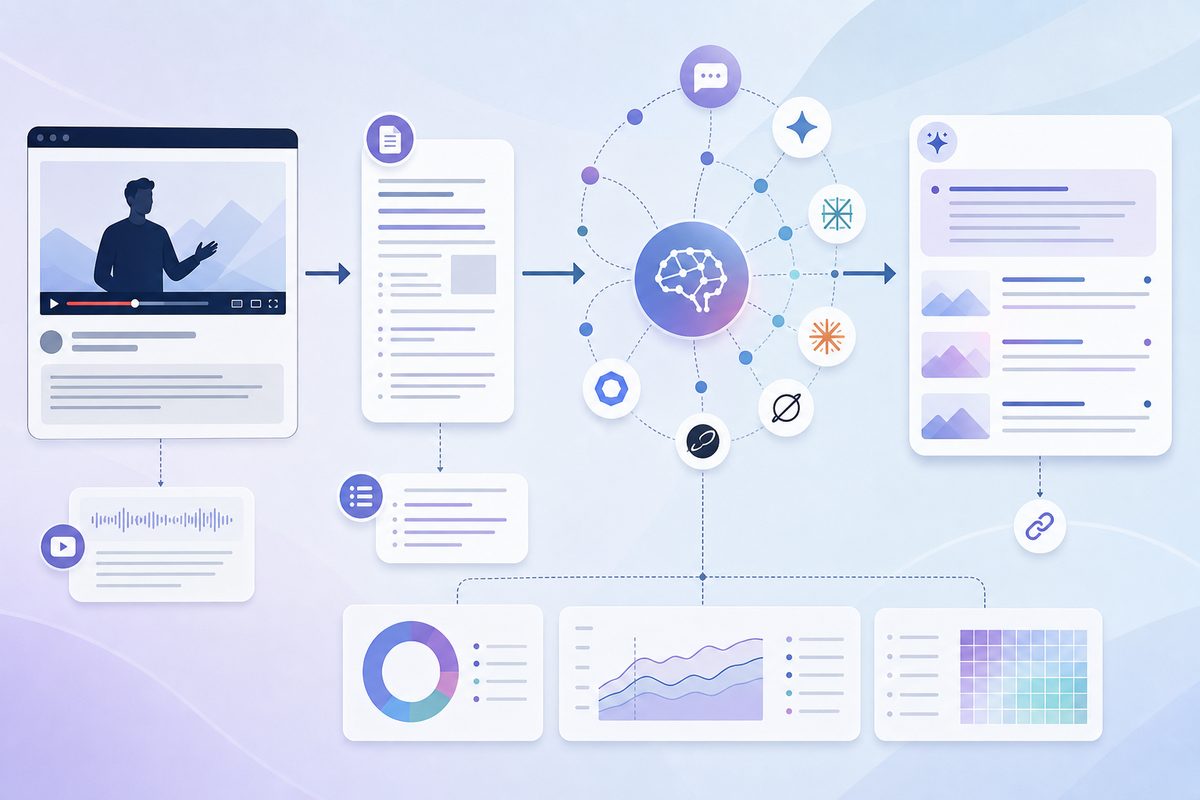
A YouTube AI search citation is a reference to a YouTube video that an AI engine attaches to an answer as a source—usually a clickable link, a thumbnail, or a named mention of the video or channel. It signals that the model used that video's transcript, description, or metadata to build its response.
This sits inside the broader practice of answer engine optimization (AEO) and generative engine optimization (GEO): structuring content so AI systems can extract, trust, and quote it. Video is just another source type competing for that slot. The catch: engines can't watch a video the way a person can—so they read the text wrapped around it. Knowing which text they read is the whole game.
Why do AI engines cite YouTube more than any other video source?
Because YouTube hands AI systems exactly what they need: large, structured, semantically dense text. Transcripts, multi-paragraph descriptions, chapters, and metadata turn a video into a block of quotable text—while most other video platforms expose almost none of that.
The gap is enormous. YouTube is cited roughly 200x more than the next video platform (Vimeo sits near 0.1% citation share), even on engines with no reason to favor a Google-owned property. Over the past six months YouTube also overtook Reddit as a source, appearing in about 16% of LLM answers versus Reddit's ~10%, per Search Engine Land's analysis—and its share is still climbing.
The takeaway: video is now a primary citation channel, not a "nice to have." If you wrote off YouTube as a brand-awareness play, the AI search layer changes the math.
Which AI engines actually cite YouTube?
Not evenly—and that's the most actionable fact here. Perplexity and Google's surfaces do almost all of it; ChatGPT, Copilot, and Gemini barely touch video. Otterly.ai's YouTube AI Citation Study (2026), which analyzed 100M+ AI citations across six platforms over 30 days, mapped where YouTube citations land:
| AI engine | Share of all YouTube AI citations |
|---|---|
| Perplexity | 38.7% |
| Google AI Overviews | 36.6% |
| Google AI Mode | 19.6% |
| ChatGPT | 4.4% |
| Microsoft Copilot | 0.5% |
| Gemini | 0.2% |
Source: Otterly.ai YouTube AI Citation Study (2026).
Read this as a targeting map. More than 95% of YouTube citations come from Perplexity plus Google AI Overviews and AI Mode. If your buyers research on those surfaces—especially Perplexity, where earning citations follows its own playbook—video is a high-use bet. If they live mostly in ChatGPT, video is a weaker lever today; chase text-based brand mentions through source pages and earned mentions, and treat video as supporting evidence.
What kinds of videos get cited—and what doesn't
Reference-style, long-form video wins; entertainment and Shorts lose. AI systems favor content that behaves like a citation: explainers, tutorials, walkthroughs, product comparisons, interviews, and case studies. The split is stark—94% of YouTube AI citations go to long-form videos, while Shorts capture just 5.7% and playlists, channels, and livestreams a rounding-error 0.3%.
Here's the counterintuitive part, and where most teams misallocate effort: popularity barely matters. In the Otterly.ai data, 40.8% of cited videos had under 1,000 views, 36% had fewer than 15 likes, and 35% of cited channels had under 10,000 subscribers. Views, likes, subscriber counts, video duration, and title length all showed near-zero correlation with getting cited (r ≈ 0.02 to −0.03).
What this means: you're not competing on reach. A 600-view explainer with a clean transcript can out-cite a viral video that has none. Engines reward reference value and structure over popularity signals.
The signals that turn a video into an AI source
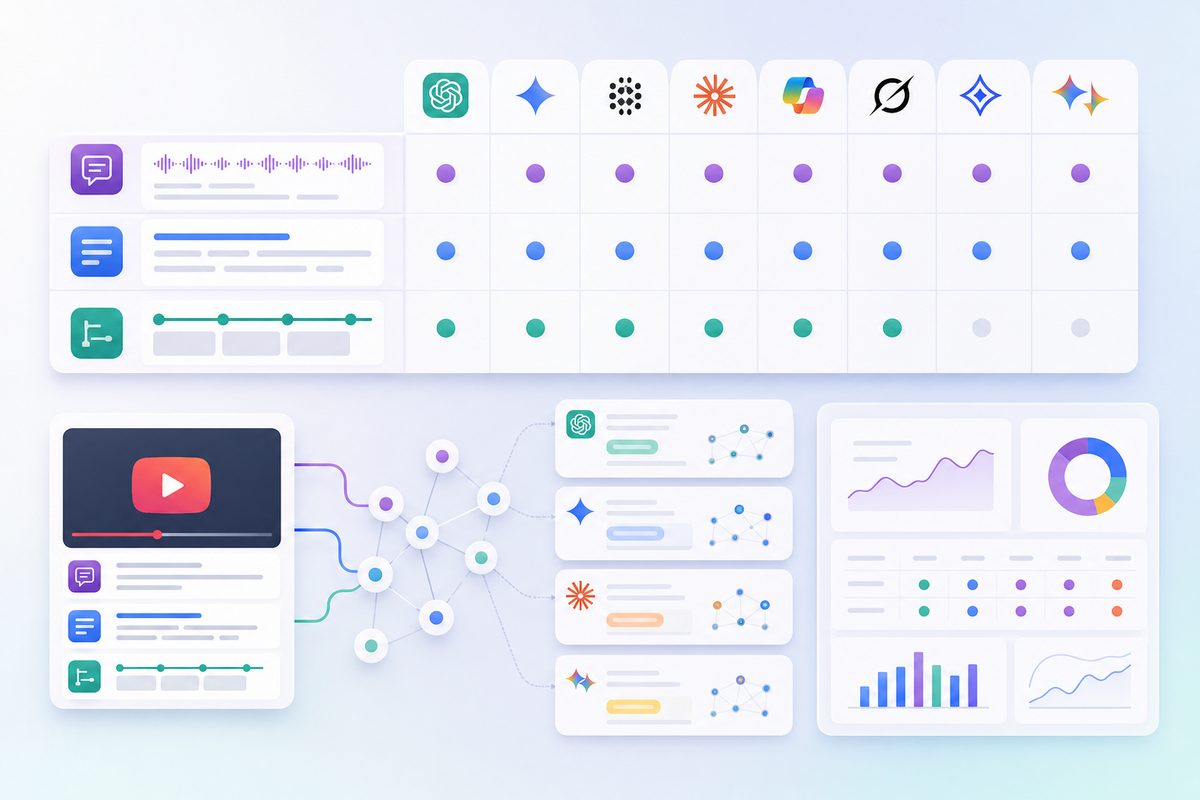
The signals that matter are text signals: transcript, description, title, and chapters—the parts an engine can actually read. AI systems extract meaning from the words around your video, then decide whether it's a quotable source for a given query.
The Otterly.ai correlations point to a clear hierarchy:
| Signal | What it does | Strength |
|---|---|---|
| Transcript | Gives the model the full spoken text to summarize and quote | Foundational—no transcript, little to cite |
| Description length | Restates key points as searchable text (cited videos averaged 334 words) | Weak-to-moderate (r ≈ 0.31) |
| Hashtags in description | Adds entity/topic signals (50% of cited videos used them) | Weak (r ≈ 0.20) |
| Recency | Newer videos get pulled for trend-relevant queries | Weak (r ≈ 0.3) |
| Title | Should match the question; cited titles averaged 19 words | Near zero on its own |
The sharpest, least-reported finding is about timestamps and chapters. They help—but only on Google. Of timestamped citations, 73% appeared in Google AI Overviews and 27% in AI Mode, and essentially zero in ChatGPT, Perplexity, Copilot, or Gemini. Timestamps effectively split one video into many citable passages: 78% of timestamped videos were cited more than once.
Translation: the generic advice to "add timestamps everywhere" is half-right. Treat chapters as a Google-surface lever for passage-level citations in AI Overviews, not a universal one. If your audience is on Perplexity, invest the same hour in a cleaner transcript and a longer description instead.
Citation vs. brand mention: the gap most teams miss
A video citation and a brand mention are not the same thing—and conflating them is why teams celebrate "visibility" that drives nothing. Picture three rungs on a ladder:
- Citation — the engine links your video as a source.
- Mention — your brand name appears in the answer text.
- Recommendation — the answer names you as a suggested option or shortlist entry.
A video can be cited without your brand ever being named—an engine can quote a generic "how to choose a CDP" tutorial, summarize the concept, and name no vendor at all. Worse, the cited video might not be yours. A third-party comparison video can be the source an engine trusts, and that answer may recommend a competitor while your product goes unmentioned. This is the video equivalent of AI engines citing competitor pages instead of yours.
So the real goal isn't "get cited." It's to own citable videos that name your brand in the quotable text, so a citation reliably becomes a mention—and, ideally, a step toward getting recommended by ChatGPT and its peers. That's a measurable outcome, not a vanity metric, and it's the bridge between AI search monitoring and revenue.
A worked example: getting a B2B SaaS brand into video-backed answers
Here's the citation-to-mention logic applied to a common scenario. Picture a mid-market B2B SaaS brand—say, a data-observability tool—whose category is heavily researched on Perplexity and Google AI Mode. Its written content already earns citations, but for queries like "how to monitor data pipeline freshness," the answers cite a competitor's YouTube walkthrough and recommend that competitor by name.
The fix follows the citation-to-mention logic:
- Publish the missing reference video — a 9-minute walkthrough that states the answer in the first 45 seconds, names the product on screen and in the transcript, and demonstrates the exact task the query asks about.
- Wrap it in text — a 300+ word description restating the steps, plus chapters for each stage (since Google surfaces are the target).
- Cross-link — embed the video on a matching source page that quotes its transcript, closing the loop between site and video.
The expected pattern is consistent: the brand's video starts appearing as a cited source on the target surfaces, and—because the brand name lives inside the quotable transcript and description—the citation shows up as a brand mention, not an anonymous link. The lesson isn't "video works." It's that the brand has to be in the text the engine can read, or the citation rung never connects to the mention rung.
How to optimize YouTube for AI search citations
Optimize the text around the video, target the right engines, and make your brand part of the quotable passage. That's the core of YouTube GEO—generative engine optimization applied to video. Work through these in order:
- Pick reference-style topics. Make explainers, walkthroughs, tutorials, and comparisons tied to real questions—not brand films. These are the formats engines cite.
- Upload a real transcript. Don't rely on auto-captions alone; correct names, products, and terms. The transcript is the single largest body of text an engine reads.
- Front-load the spoken answer. State the definition or answer clearly in the first 30–60 seconds, in plain language the model can lift verbatim.
- Write a 300+ word description that restates the key points and steps as text. Cited videos averaged 334 words—treat the description like a mini source page.
- Add chapters and timestamps when targeting Google AI Overviews or AI Mode. Skip the obsession if your audience is on Perplexity.
- Name your brand and key entities explicitly—on screen, in the transcript, and in the description—so a citation becomes a mention.
- Write titles for the question, not the click. Descriptive and specific beats clickbait; length isn't a ranking signal.
- Cross-link video and site. Embed the video on a source page built for answer engines and link back, reinforcing the same entity from two angles.
- Close citation gaps deliberately. Find the queries where competitors' videos win and ship the video that should win instead, using a repeatable citation-gap process.
Video is one chapter of a wider earned-source strategy that also spans Reddit, G2, Wikipedia, and review sites. For the broader playbook, see how to optimize for AI search.
How to track whether your videos are getting cited
You can't optimize what you can't see—so track citations and mentions per engine, per query, over time. Spot-checking a few prompts by hand misses the picture: citation behavior differs sharply between Perplexity, Google AI Overviews, AI Mode, and ChatGPT, and it shifts week to week.
An AI visibility tool like MaxAEO monitors how each engine mentions, ranks, and describes your brand daily—including when the source behind an answer is a video. Three questions are worth answering continuously:
- Is our video cited, or just a competitor's? Citation share is the leading indicator.
- Does the citation become a mention? Track whether your brand name appears in the answer text, not only the source link.
- Are we gaining or losing ground? Movement in share of voice on video-heavy queries shows whether the work is paying off.
Pair that with the right scorecard—the KPIs and formulas for AI search visibility—and video stops being a guess. Tracking turns "we posted a video" into "our video is cited on Perplexity for these 12 queries and named our brand in 9 of them." That's the evidence budgets are defended with.
Frequently asked questions
Do AI engines actually watch YouTube videos, or just read the text?
Mostly the text—transcripts, descriptions, titles, and chapters do the heavy lifting. Google's systems are expanding to process audio, video structure, and metadata, but a clean transcript remains the most reliable way to get cited. No readable text, little chance of a citation.
Does my video need a lot of views to get cited in AI answers?
No. In the Otterly.ai study, 40.8% of cited videos had under 1,000 views and 36% had fewer than 15 likes. Views, likes, and subscribers showed near-zero correlation with citations. Reference value and structure beat popularity.
Do YouTube Shorts get cited in AI search answers?
Rarely. Long-form video captures 94% of YouTube AI citations; Shorts account for just 5.7%. For citation goals, invest in reference-style long-form. Use Shorts for reach, not for citations.
Which AI engine cites YouTube the most?
Perplexity (38.7% of all YouTube citations), followed closely by Google AI Overviews (36.6%) and AI Mode (19.6%). ChatGPT (4.4%), Copilot, and Gemini cite video far less, so prioritize Perplexity and Google surfaces for video.
How do I know if my brand—not just my video—is being named?
Track citations and mentions separately. A citation links your video; a mention puts your brand in the answer text. AI search monitoring tools report both per engine and query, so you can confirm the citation actually carries your name. See how AI search citations work and how to earn them.