Your dashboard says brand mentions in ChatGPT are up 12% this week. Before that number goes in a board deck, ask one thing: is the AI visibility data quality good enough to trust? Most dashboards look authoritative—clean charts, confident percentages, a green trend arrow. Underneath, they sample non-deterministic models, dedupe prompts inconsistently, and quietly miss platforms. This checklist gives you six concrete checks plus a 30-minute self-test, so you can separate real signal from measurement noise before you act on any AI visibility tool's report.
The hard part is not collecting AI data. It is knowing which numbers are real. A polished interface can hide a thin sample, a mislabeled competitor, or a citation the model never actually made. Below is the QA process we use to pressure-test tracking data—written for marketers who have to defend these numbers to a CFO.
What does "AI visibility data quality" actually mean?
AI visibility data quality is the degree to which a tracking tool's reported metrics—mention rate, share of voice, citations, and sentiment—reflect what large language models genuinely say about your brand, rather than artifacts of how the data was sampled, deduplicated, and scored. High quality means the numbers are reproducible, attributable to a real source, and stable enough that week-over-week movement reflects reality.
Three properties define it. Reproducibility: run the same method again and you land in the same range. Provenance: every mention and citation traces back to a specific prompt, platform, date, and answer. Calibration: the tool reports uncertainty instead of false precision. Miss any one and your AI search monitoring becomes a confidence machine that produces decisions, not accuracy. The checks in this guide test all three.
Why two AI visibility tools never show the same numbers
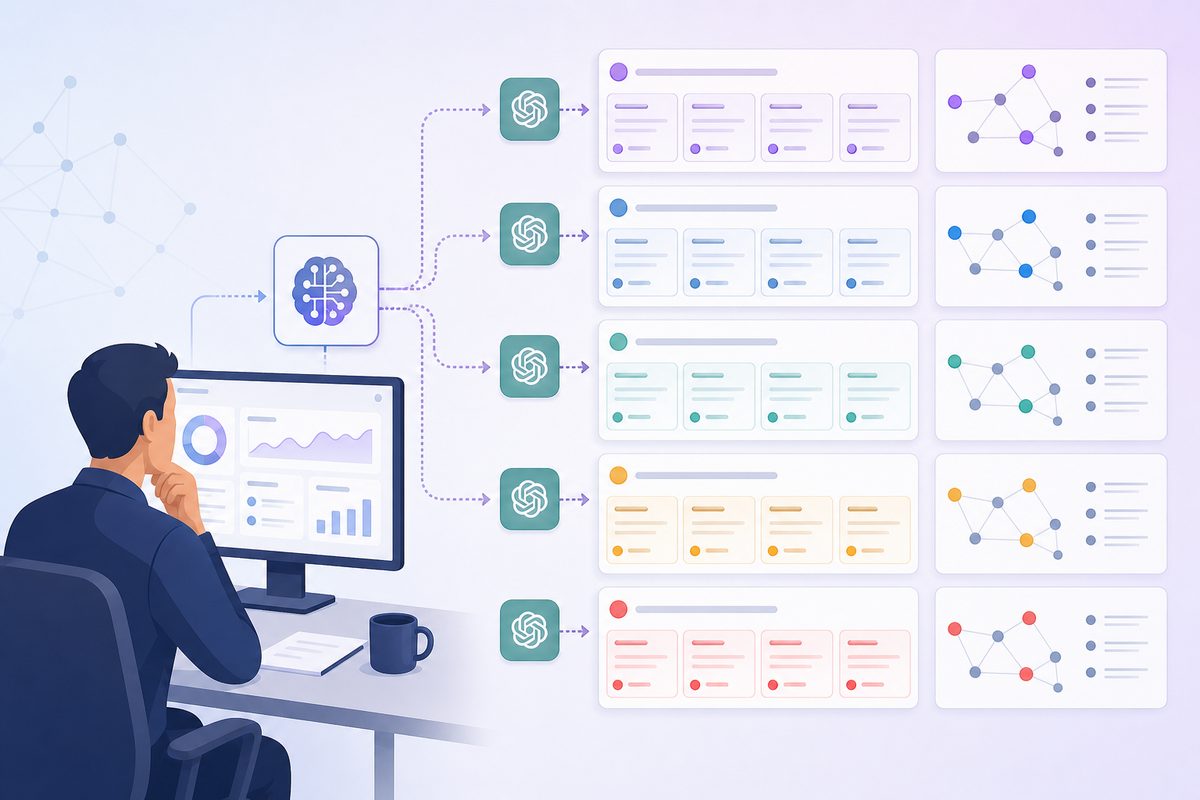
The root cause is non-determinism: LLMs sample from probability distributions, so the same prompt returns different answers on different runs. This is not a vendor bug—it is how the models work. Two tools tracking the same brand on the same day will disagree because they sampled at different moments, with different prompts and different parsing.
The variance is larger than most teams assume. In a 2025 study where 600 volunteers ran 12 prompts across three AI tools, SparkToro found, across 2,961 runs, there is a less than 1-in-100 chance that ChatGPT or Google's AI returns the same brand list across any two runs of the same prompt; identical ordering is rarer still, closer to 1 in 1,000. Agency analysts at Brainlabs reach the same verdict—your AI visibility data is "wrong," and that's okay—because every number is a probabilistic estimate, not a census. That is not a reason to give up; it is the reason a quality checklist exists.
The AI visibility data quality checklist (6 checks)
These six checks cover where tracking data most often breaks. Run them against your current dashboard. A trustworthy AI visibility tool should pass all six, or at least show you the underlying data so you can judge for yourself.
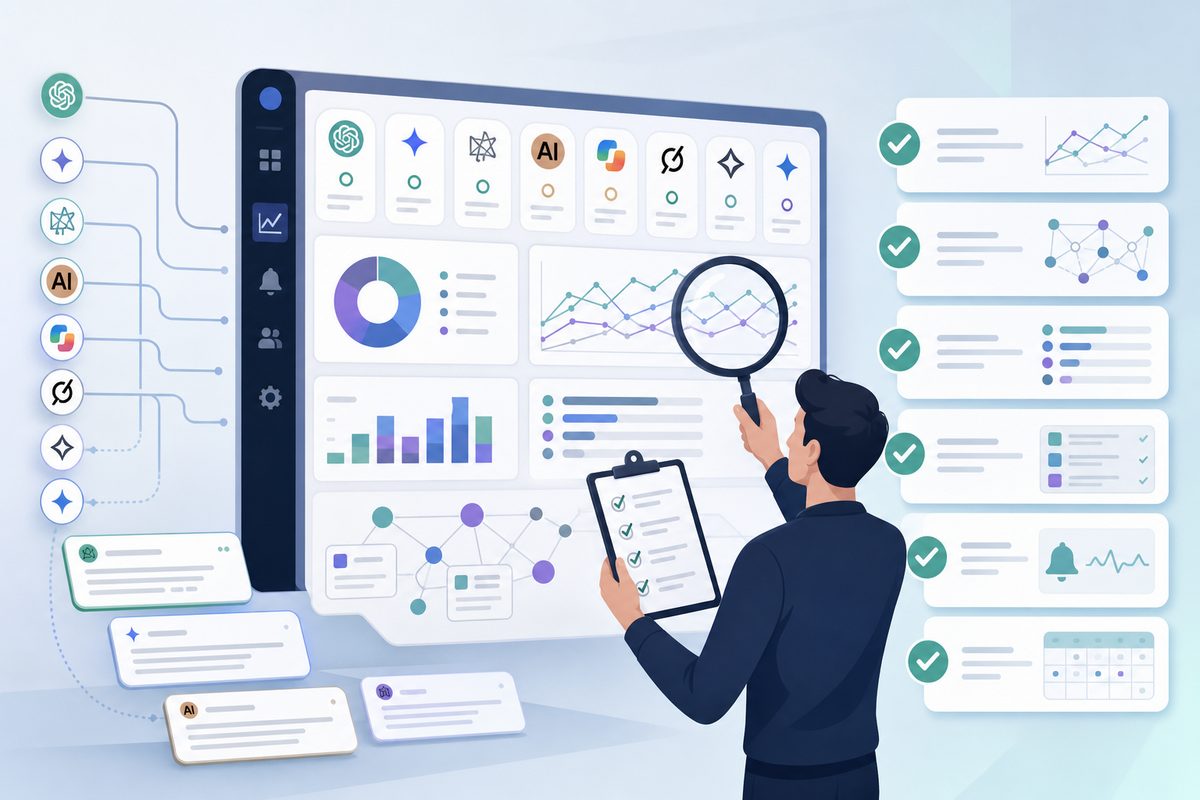
Check 1 — Prompt set hygiene: duplicates and near-duplicates
Inflated prompt counts are the most common data-quality lie. A dashboard advertising "500 prompts tracked" may really run 80 unique intents padded with near-duplicates—"best CRM for startups," "best CRM for small startups," "top CRM startup tools." Each near-clone re-weights the same intent, so a single popular phrasing dominates your share of voice without you realizing it.
Self-test: export the prompt list and sort it. Count how many differ only by a stop word or synonym. If more than ~15% are near-duplicates, your metrics are skewed toward whatever intent got cloned. Good tooling clusters semantically similar prompts and reports them as one intent with variants underneath. For help sizing a clean set, see how many AI search prompts you should actually track.
Check 2 — Competitor mapping: is it really your competitor?
Bad competitor mapping quietly corrupts every share-of-voice number you report. Tools auto-extract "competitors" from AI answers using entity recognition, and they routinely mislabel: a parent company, a feature, a generic noun, or an unrelated brand with a similar name gets counted as a rival. Your AI share of voice then measures the wrong field.
Self-test: pull the competitor list the tool generated and read every entry. Flag anything that is not a real, comparable alternative. In most B2B categories we review, 1–3 of the top 10 "competitors" are noise—an acquirer, a sub-brand, or a tooling category. A quality platform lets you confirm, merge, or exclude competitors and recalculates history when you do. If yours bakes the list in permanently, treat the share-of-voice chart as directional only.
Check 3 — Stale responses and refresh cadence
A dashboard showing today's date does not mean the answers behind it are from today. Many tools cache responses for days or weeks to control API costs, then surface them under a fresh timestamp. You end up optimizing against a model snapshot that no longer exists, especially after a model update resets the field.
Self-test: pick three tracked prompts, run them yourself in the live tool, and compare to what the dashboard shows. If the dashboard's "current" answer differs materially and the tool can't tell you the exact capture date per response, the freshness is unverifiable. Demand a visible per-response timestamp and a documented refresh cadence—daily for volatile categories, weekly at minimum. Reliable AI search monitoring methodology treats capture time as a first-class field, not a display gimmick.
Check 4 — Platform coverage: which engines, and API or web?
Coverage gaps are the difference between "AI visibility" and "ChatGPT visibility." A tool that monitors only one or two engines and labels the result "AI visibility" overstates its scope. Your buyers use ChatGPT, Gemini, Perplexity, Claude, Copilot, Grok, Google AI Overviews and AI Mode—and each behaves differently.
There is a second, subtler gap: API answers differ from what users see in the app. The web interface adds live retrieval, system prompts, and personalization the raw API call skips, so an API-only tracker can miss citations and mentions that real users get. Before trusting coverage, confirm which surfaces are monitored and how—this breakdown of API vs web-app AI answers explains why the choice changes your numbers. Self-test: ask your vendor to name every engine, the surface (API or web), and the geography for each. Vague answers mean undisclosed gaps.
Check 5 — Citation capture and attribution accuracy
False-positive citations are the quiet killer of AI visibility data quality. When parsing answers for ai citations and brand mentions, tools misattribute: similar phrasing, a competitor's name inside your quoted text, or a paraphrase with no link gets logged as "you were cited." Opaque model output makes this worse—there is often no clean source list to verify against.
Self-test: take 20 logged citations and open each underlying answer. Confirm three things—your brand is actually named, the cited URL really appears, and the sentiment label matches the text. If more than 2–3 of 20 are wrong, your citation count and sentiment are unreliable. The fix is a mixed method: automated capture plus a sample of manual validation, which is how serious llm brand tracking keeps attribution honest. A tool that only shows a number, not the source answer, fails this check by default.
Check 6 — False trend alerts: signal vs noise
Most "your visibility dropped 18%" alerts are sampling noise, not real change. Given the run-to-run variance documented above, a single-sample week will swing wildly. If a tool fires alerts off one capture per prompt, it will cry wolf constantly—and teams that chase those ghosts waste budget on non-problems.
Self-test: when an alert fires, check whether the tool sampled enough runs to clear its own confidence interval, and whether the "change" exceeds normal variance for that prompt. A real trend persists across multiple captures and multiple prompts pointing the same direction. A quality platform shows confidence bands and suppresses alerts inside the noise floor. When engines genuinely disagree, you need a method to triage—this guide on prioritizing AI visibility fixes when every platform says something different helps separate a real regression from a sampling blip.
The 30-minute dashboard self-test (do this before you trust any tool)
You do not need data-science resources to audit a dashboard—just 30 minutes and one spreadsheet. This hands-on procedure reproduces the tool's core claim and exposes the most common failures fast; it doubles as a no-code GEO baseline audit before you commit to a vendor.
- Pick 5 high-value prompts your buyers would actually type—mix branded, category, and "best tool" intents.
- Run each prompt 5 times in the live AI engines you care about (ChatGPT, Gemini, Perplexity). That is 25 captures per engine.
- Log whether your brand appears in each run, and in what position. Calculate your real mention rate as appearances ÷ runs.
- Compare to the dashboard's reported mention rate for the same prompts and dates. A gap larger than ~15 points means the sample or freshness is off.
- Spot-check 10 citations the tool logged against the live answers (Check 5).
- Read the competitor list and flag every entry that is not a true alternative (Check 2).
If your hand-collected numbers land inside the dashboard's stated range, the AI visibility data quality is credible. If they diverge sharply and the vendor cannot explain why, you have your answer.
AI visibility data quality at a glance (diagnostic table)
Use this table as a fast reference. Each row maps a common failure mode to the symptom you will see, the test that exposes it, and the fix.
| Failure mode | Symptom in the dashboard | Self-test | Fix |
|---|---|---|---|
| Prompt duplication | Suspiciously high prompt count; one intent dominates | Sort prompts, count near-duplicates | Cluster variants into one intent |
| Bad competitor mapping | Odd or generic names in share of voice | Read the competitor list line by line | Confirm, merge, exclude—recompute history |
| Stale responses | "Fresh" dates, outdated answers | Run 3 prompts live, compare | Require per-response capture timestamps |
| Thin platform coverage | "AI visibility" but few engines named | Ask for engine + surface + geo list | Add missing engines and web-surface capture |
| False-positive citations | Citation count looks too good | Verify 20 citations against answers | Add manual validation sample |
| False trend alerts | Frequent big swings | Check samples vs confidence band | Suppress alerts inside the noise floor |
How many samples make AI visibility data trustworthy?
One run per prompt is never enough; for a stable signal, sample each prompt-engine pair repeatedly and report a range, not a point. Given that identical brand lists appear in under 1% of paired runs, a single capture tells you almost nothing about your true mention rate.
A practical floor is 3–5 runs per prompt-engine pair for directional reads, scaling toward ~30 runs when you need a tight confidence interval for a high-stakes decision. SparkToro's data shows the payoff: in ChatGPT, City of Hope hospital appeared in 69 of 71 answers—a 97% visibility rate—even though its rank within those answers bounced around. The appearance rate was reliable; the ordering was not. So track mention rate over many runs, not position in one answer.
Score your dashboard: the AI visibility data quality scorecard
Turn the six checks into a number. Score each check 0, 1, or 2, then total out of 12. This gives you a defensible, repeatable verdict you can re-run every quarter or when comparing vendors.
- 0 — Fails: the tool hides the underlying data and you cannot verify the claim.
- 1 — Partial: you can verify with effort, but the default presentation is misleading.
- 2 — Passes: the tool exposes raw answers, timestamps, sources, and confidence by default.
Interpretation bands:
- 10–12: Trust the trends, and most point estimates with stated ranges. Strong foundation for answer engine optimization and reporting to leadership.
- 6–9: Use directionally only. Good for spotting big moves in generative engine optimization work; do not quote exact percentages.
- 0–5: Do not put these numbers in a board deck. Fix coverage and provenance first.
The goal is not a perfect score—remember, all AI data is estimate. The goal is knowing exactly how much weight each number can bear. A tool scoring 11/12 with honest confidence bands beats one claiming 99% precision it cannot defend.
Frequently asked questions
Is AI visibility data ever fully accurate?
No. Because LLMs are non-deterministic, every metric is a probabilistic estimate, not a census. The realistic goal is trustworthy, not exact: reproducible ranges, verifiable sources, and trends that hold across multiple samples. Treat brand mentions as impressions that shape consideration, not as click-level facts.
Why do two AI visibility tools show different numbers for my brand?
Different prompt sets, sample sizes, capture times, monitored engines, and parsing rules. None is necessarily "wrong"—they sampled different slices of a moving target. Convergence is the tell: when several imperfect tools point the same direction, trust the trend more than any single figure.
How often should AI visibility data refresh?
Daily for fast-moving or competitive categories, weekly at an absolute minimum. More important than frequency is a visible per-response capture date, so you know whether you are optimizing against the current model or a cached snapshot.
Can I audit my dashboard without a data team?
Yes. The 30-minute self-test above—five prompts, five runs each, compared to the dashboard—surfaces duplication, staleness, and false citations without any technical setup. Repeat it quarterly and whenever a model update lands.
Does platform coverage really change my numbers?
Substantially. An API-only tracker misses live retrieval and personalization users see in the app, and a tool covering two engines is not measuring "AI visibility." Confirm every engine, surface, and geography before you trust a single share-of-voice chart.