Why do AI search results change from one run to the next? Because AI assistants build each answer by probability, not by reading off a fixed ranking. Ask ChatGPT, Gemini, Perplexity, or Google's AI Mode the same question twice and you can get two different brand shortlists, two different sets of citations, and two different descriptions of your company.
That instability is not a bug you can file a ticket for. It is how generative search works—and it quietly breaks the way most teams measure and optimize. Treat a single AI answer as your "ranking" and you will chase noise: rewriting pages, re-pitching positioning, and reporting wins or losses that were never real.
This guide explains the actual reasons AI answers vary, shows how much they move in day-to-day tracking, and gives you a repeatable variance check to separate signal from noise before you spend a dollar optimizing.
Why Do AI Search Results Change? The Short Answer
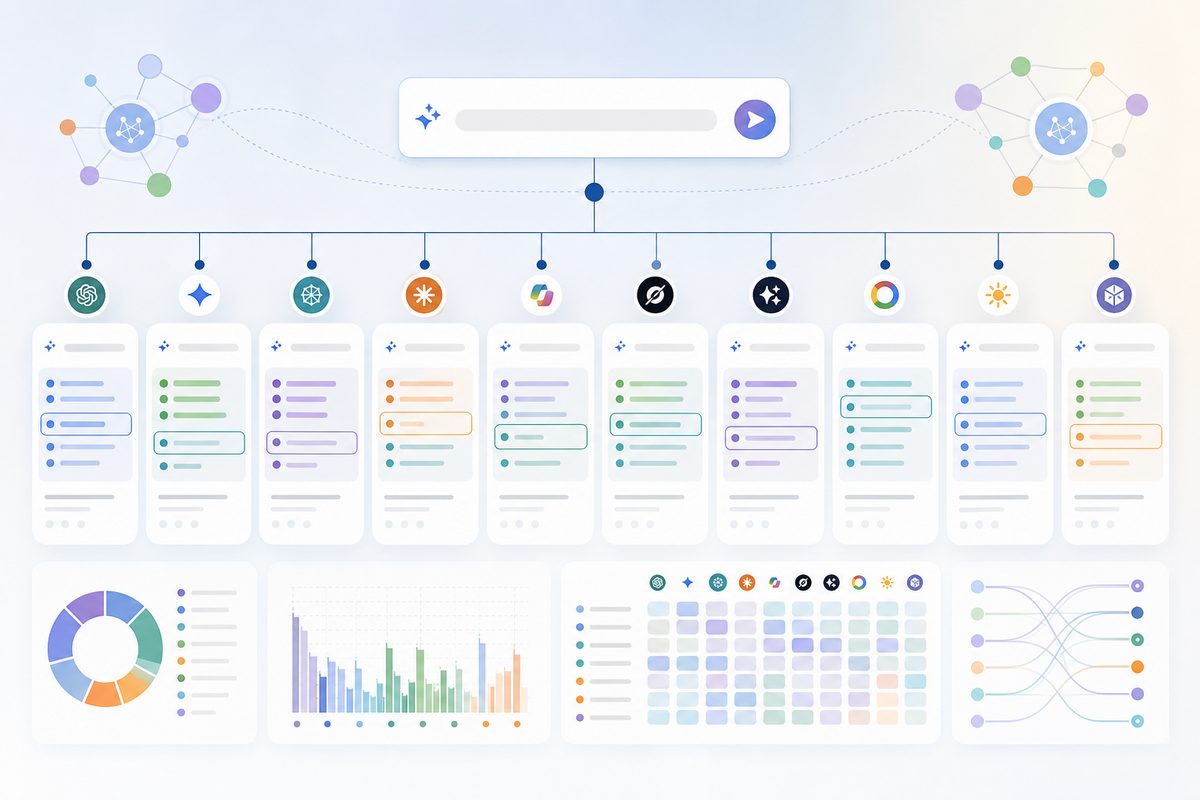
AI search results change because large language models generate answers token by token from a probability distribution, then layer on live web retrieval, personalization, and frequent silent model updates. No two runs are guaranteed to be identical—even with the same prompt, account, and minute.
Traditional search returns a stored index, so the same query usually yields a near-identical page. Generative engines don't store an answer and hand it back. They construct one on demand: sampling words, pulling fresh sources, and shaping the response to context. Five distinct forces drive that variability, and each one moves your brand's mention rate, cited sources, and share of voice in a different way. Identify which force is acting and you'll know whether a swing in your numbers is worth a response.
The Five Forces Behind AI Answer Variability
Most explanations stop at "AI is random." It isn't—the variance comes from five identifiable, separable sources. Knowing which one is moving your numbers tells you whether to act or wait.
| Force | What it changes | Can you control it? |
|---|---|---|
| Probabilistic sampling | Word choice, which brands get named | No—inherent to generation |
| Live retrieval | Which sources and citations appear | Indirectly, via earned mentions |
| Model / system updates | Tone, length, default recommendations | No—happens silently |
| Personalization & context | Answer tailored to account and history | Partly—control your test setup |
| Prompt phrasing | The entire framing of the answer | Yes—standardize your prompts |
1. Probabilistic Token Sampling
LLMs pick each next word from a probability distribution over the vocabulary. A parameter called temperature controls how much randomness is allowed: low temperature favors the single most likely word, higher temperature spreads the choice across more options. Because most consumer AI surfaces run above zero, ordinary word-by-word sampling alone produces different brand lists run to run. And determinism is not a switch you can flip on: a study that ran five models ten times each under their most "deterministic" settings still saw accuracy swing by up to 15%, with no model reproducing identical output strings, because requests get batched together on shared hardware in ways no prompt controls (Atil et al., Non-Determinism of "Deterministic" LLM Settings).
2. Live Retrieval and a Changing Web
ChatGPT search, Perplexity, Gemini, and Google's AI surfaces fetch real-time sources before answering. The web underneath them moves constantly: a new Reddit thread, a fresh G2 review, or an updated comparison page can rotate the citation set within hours. This also means the surface you watch matters, because API and web-app AI answers diverge—the same model can cite different sources depending on which retrieval pipeline it uses.
3. Silent Model and System-Prompt Updates
Vendors ship new model versions and tweak hidden system prompts without announcements. A default recommendation that named your brand last week can quietly drop this week after an update you never saw. Your baseline shifts under you, which is why tracking a brand across LLMs has to be continuous, not a one-time snapshot.
4. Personalization and Conversation Context
Earlier turns in a chat reshape the probability distribution for everything that follows, so a query asked cold differs from the same query asked after three related questions. Logged-in versus logged-out status, region, language, and account history all push the answer around. Unless you hold these constant—or deliberately segment your tracking by market, language, and buyer context—your measurements are contaminated before you start.
5. Prompt Phrasing Sensitivity
"Best [category] tools," "top [category] software," and "recommend a [category] platform" surface different shortlists, even though a human reads them as the same request. Small wording changes produce large answer changes. Standardizing exact prompt wording is the single cheapest way to cut needless variance out of your tracking.
How Much Do AI Answers Actually Vary?
A lot—often enough to flip a conclusion. In our own tracking, the same prompt run repeatedly on the same day commonly swings a brand's mention rate by 15–30 percentage points, and many brands that are genuinely "in consideration" still appear in well under a third of identical runs.
Independent research finds the same instability at the source level. A 2026 study of generative engines re-ran identical queries and found the set of cited sources overlapped only 32–43% between two runs—and citations followed a winner-take-most pattern (Gini ≈ 0.715), where a handful of domains capture most mentions while the rest rotate in and out (Schulte et al., Don't Measure Once).
| AI surface | Typical run-to-run mention-rate swing (same prompt, same day) | What that means in practice |
|---|---|---|
| ChatGPT (web) | ±15–30 points | A true 50% rate can read as 35% or 65% on any single run |
| Perplexity | ±10–20 points | Retrieval-led, but the cited source mix still rotates |
| Google AI Overviews / AI Mode | ±15–35 points | Sometimes not shown at all for a slice of identical searches |
| Gemini | ±10–25 points | Highly sensitive to phrasing and account context |
Two implications follow. First, a single run is nearly worthless as a metric—it tells you what happened once, not what typically happens. Second, the variance differs by platform, so a "drop" on one surface may be ordinary noise on another. An AI visibility tool that reports one number per day, with no spread around it, is hiding the most important part of the picture.
Why Variance Wrecks Optimization Decisions
Because teams mistake a single noisy run for a trend, then "fix" something that was never broken. Overreaction is the most expensive mistake in answer engine optimization, and it's the one this article exists to prevent.
Here is the failure mode, drawn from a pattern we see constantly. A team checks "best [category] tools" on Monday and their mention rate reads 60%. Wednesday it reads 40%. They panic: rewrite the comparison page, change positioning, brief the founder to post on LinkedIn. By Thursday the rate is back at 58%—with none of those changes live yet. The 40% was one noisy run inside a roughly ±20-point band. They "fixed" nothing, burned a week, and now can't attribute any future movement to their edits.
The lesson is blunt: you cannot tell whether an answer change came from your work or from sampling noise unless you measured the noise first. Optimization without a variance baseline isn't strategy—it's superstition with a content calendar.
The Variance Check: How to Measure Noise Before You Optimize
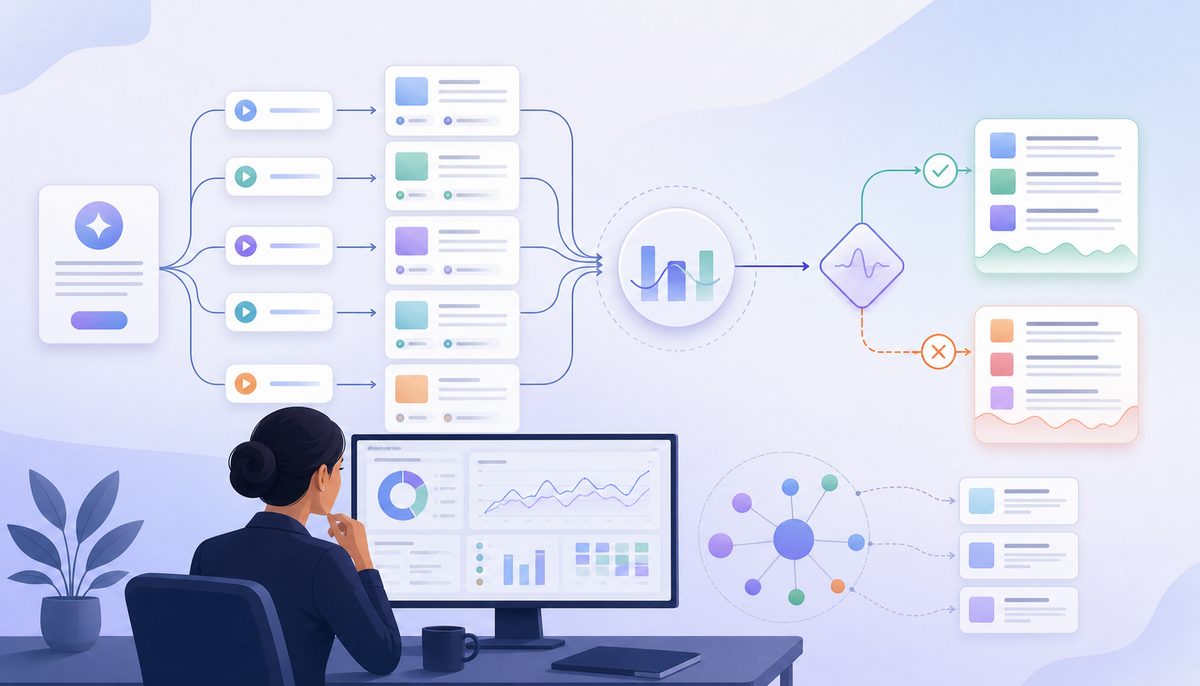
A variance check is a short, controlled experiment that measures how much your AI mention rate moves on its own—before you change anything—so you can tell which later fluctuations are real. Run it once to establish your noise floor for a prompt set, then re-run it on a schedule.
The method is deliberately simple, because complexity is where measurement bias sneaks in. Follow it in order:
- Fix the prompt set. Choose 10–30 prompts that represent how buyers actually ask—category shortlists, comparison questions, and direct "is [brand] good for X" queries. Lock the exact wording.
- Lock the variables. Same platform, same region, same language, same logged-in state, and decide up front whether you're testing the API or the web app. Document it so every later run matches.
- Run each prompt 8–10 times. Use fresh sessions so prior turns don't bleed into the next answer. Record the full response, the brands named, and the citations.
- Compute the mention rate. For each prompt, divide the runs that named your brand by total runs. Average across prompts for an overall rate.
- Calculate the spread. Note the highest and lowest mention rate you saw per prompt. That range is your variance band—your noise floor.
- Set a stability threshold. Write down the band explicitly: "Brand X normally lands 45–65% on this prompt set." Anything inside that band is noise, not news.
This is also the moment to standardize your data collection so results are comparable week to week—our AI search monitoring methodology walks through the controls that keep a baseline trustworthy.
The mention rate formula, stated plainly:
Mention rate = (number of answers that mention your brand ÷ total answers generated for the prompt set) × 100
Run each prompt k times and the per-prompt rate is simply mentions ÷ k. For a deeper treatment of the metric, its benchmarks, and edge cases, see our breakdown of the AI mention rate formula. The variance band is what turns that raw rate from a vanity number into a decision tool.
How Many Runs Is Enough?
For a directional gut check, 3–5 runs per prompt; for tracking you'll report on, 8–10; for high-stakes before-and-after tests, 15–20 or more. More runs narrow the confidence band, with the steepest gains in the first several runs and diminishing returns after.
| Your goal | Runs per prompt | Rough 95% confidence band* |
|---|---|---|
| Quick gut check | 3–5 | ±25–30 points — directional only |
| Standard ongoing tracking | 8–10 | ±12–16 points |
| Defensible reporting / pre-launch test | 15–20+ | ±8–11 points |
*The band is widest when the true rate sits near 50% and tightens as it approaches 0% or 100%. Exact widths depend on your prompt set.
These ranges line up with published work. A 2026 statistical framework for quantifying uncertainty in AI visibility re-sampled queries across Perplexity, SearchGPT, and Gemini and found citation-share confidence intervals of 5–7 percentage points are common—and that many apparent gaps between domains fall inside that measurement noise floor. Its conclusion is blunt: single-run visibility numbers are "misleadingly precise," and an improvement smaller than your confidence band can't be credited to your work without repeated sampling. If you're going to defend a budget with these figures, 8 runs is a floor, not a target. Skimping on runs doesn't save time—it just moves the cost downstream to a bad optimization decision.
Signal vs Noise: When an AI Visibility Change Is Real
Treat a change as real only when it exceeds your measured variance band and persists across at least two consecutive tracking cycles. Everything else is noise—log it, don't act on it.
Apply this rule before every optimization decision:
- Inside the band? No action. A 60%→52% move within a 45–65% band is normal breathing, not a decline.
- Outside the band, one cycle only? Wait. Re-run before you respond; one outlier cycle is the most common false alarm.
- Outside the band, two-plus cycles in the same direction? Real signal. Now investigate the cause and optimize.
- Tie the change to a force. A sudden, broad drop across many prompts usually means a model update or retrieval shift, not your content. A slow, prompt-specific climb usually means your earned mentions are landing.
This single rule is the difference between AI visibility work that compounds and a team that thrashes. It keeps you from "fixing" sampling noise and from missing a genuine decline because it looked like one more wobble.
Build the Variance Check Into Ongoing Monitoring
A one-time variance check tells you today's noise floor. But model updates, retrieval changes, and a shifting web move that floor week to week, so the band you measured in spring won't hold by summer. The check has to become a habit, not an event.
In practice that means re-establishing the band on a fixed cadence, watching the same locked prompt set, and flagging when the band itself widens or shifts—often the earliest sign a platform changed under you. And to know whether your stabilized mention rate is actually good, compare it against published AI search visibility benchmarks for your industry rather than guessing. Continuous AI search monitoring is what converts a noisy stream of answers into a trend you can defend—and act on.
Frequently Asked Questions
Why do AI search results change even when I ask the exact same question?
Because the model generates a new answer each time instead of retrieving a stored one. It samples words from a probability distribution, pulls live web sources that change by the hour, and adapts to your account and conversation history. Even at the most "deterministic" setting, hardware batching keeps outputs from being fully repeatable.
How many times should I run a prompt before I trust the result?
Run each prompt at least 8–10 times for tracking you intend to report, and 15–20+ before a high-stakes before-and-after test. Three to five runs is fine for a quick directional read but too noisy for decisions. More runs tighten the confidence band, with the biggest gains in the first several runs.
Does a single bad AI answer mean my visibility dropped?
No. A single answer is one sample from a wide distribution, not a ranking. Check it against your variance band: if the change stays inside your normal range, or appears in only one tracking cycle, it's noise. Only a move that exceeds the band and persists across two-plus cycles signals a real decline.
Can I make AI answers about my brand more consistent?
You can't force determinism, but you can raise the probability that you're named. Clear, well-structured brand facts, strong earned mentions and citations, and crawler-accessible content all increase how reliably engines recommend you. The goal of generative engine optimization isn't a fixed answer—it's making your brand the statistically likely one to get recommended by ChatGPT and its peers.
Is variance the same across ChatGPT, Perplexity, Gemini, and AI Overviews?
No. Swings tend to run wider on ChatGPT and Google's AI surfaces and somewhat tighter on retrieval-led Perplexity, though all of them rotate sources. Measure a separate variance band per platform, because a move that's ordinary noise on one surface can be a meaningful change on another.