About page SEO is the practice of optimizing an About or About Us page so search engines, AI answer engines and visitors can quickly verify who runs the business, what it does, who it serves, why it is trustworthy and where to find current company facts.
That means your About page is not only a brand story. It is a source-of-truth page for entity clarity, trust, branded search results and AI-generated company descriptions.
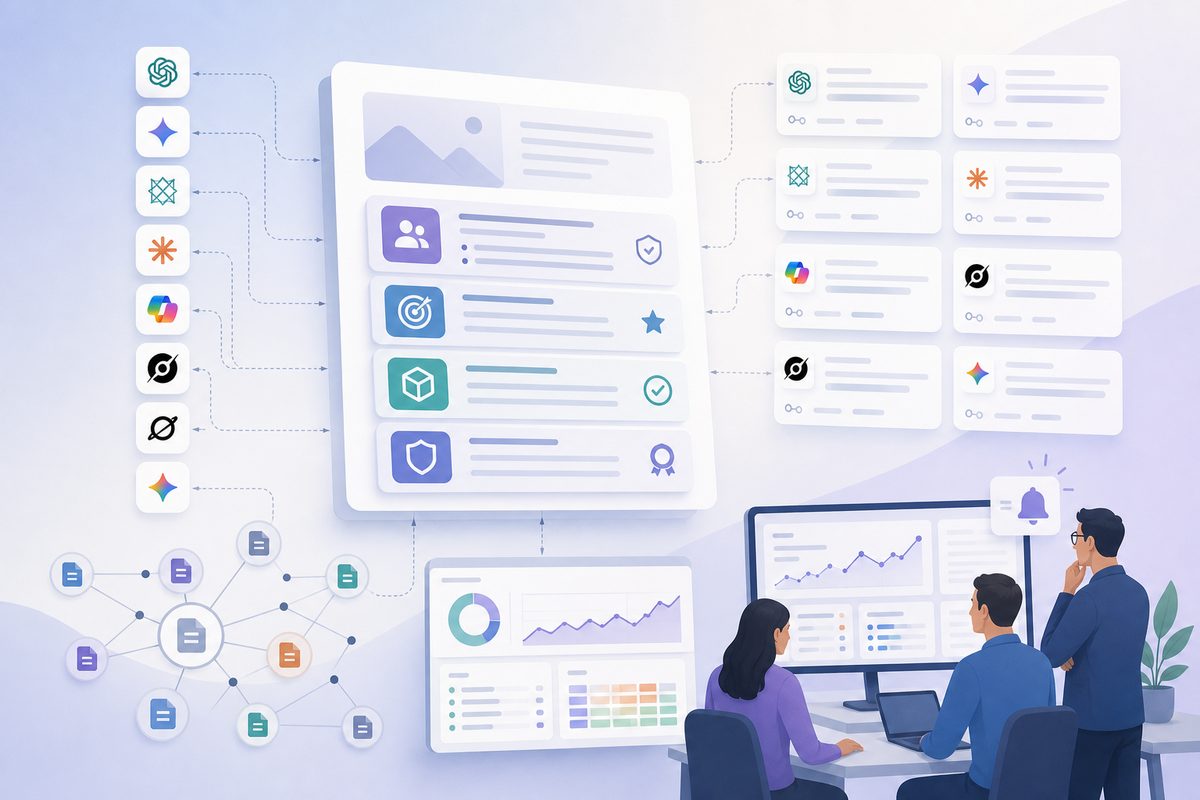
For B2B SaaS and technology companies, the stakes are higher than a prettier "About us" page. If ChatGPT, Gemini, Perplexity, Claude, Copilot, Grok, Google AI Mode or Google AI Overviews describes your company with the wrong category, old positioning, missing ownership details or vague product scope, buyers may form an opinion before they ever click your site.
Does an About Page Help SEO?
Yes. An About page can help SEO by clarifying the website owner, business purpose, product category, expertise, trust signals and internal site relationships. It usually supports rankings indirectly through entity understanding, E-E-A-T signals, branded search quality, internal links and AI citation readiness.
Do not expect an About page to rank for every commercial keyword. Its job is different:
- Help Google and users understand who is behind the site.
- Support branded and navigational searches.
- Reduce ambiguity around your company name, category and ownership.
- Strengthen trust signals for the rest of the domain.
- Give AI answer engines a clean source for company facts.
Google's guidance on helpful, reliable, people-first content asks whether content provides original information, comprehensive coverage, expertise and trust. A strong About page is one of the clearest places to demonstrate those signals.
What Searchers Want When They Search "About Page SEO"
Someone searching "about page SEO" usually wants more than a generic About page template. They want to know what actually matters for Google, what to include, whether keywords matter, how to show trust, what schema to use and how the page should support AI answers.
The practical answer is this: optimize the About page as a factual trust page, not a slogan page.
| Searcher question | Direct answer |
|---|---|
| Should an About page target keywords? | Yes, lightly. Use brand, category and "About" language naturally. |
| What should an About page include? | Identity, category, audience, product scope, proof, ownership, contact paths and internal links. |
| Does About page content affect E-E-A-T? | It can support trust and expertise by showing who runs the site and why they are credible. |
| Is schema enough? | No. Structured data should reinforce visible facts, not replace them. |
| How does this affect AI answers? | AI systems often compress company facts into short summaries, so explicit facts reduce wrong inferences. |
What Most About Page SEO Advice Gets Right and Misses
Conventional About page SEO advice is useful but incomplete. It usually covers title tags, headings, team bios, founder stories, calls to action, contact details and internal links. Those basics still matter.
The missing layer is fact control.
| Conventional advice | Why it helps | What AI and entity SEO still need |
|---|---|---|
| Tell the founder story | Builds trust and memorability | Current ownership, operating entity and leadership context |
| Add mission and values | Explains motivation | Plain category and market definition |
| Describe products or services | Helps visitors navigate | Exact product scope and exclusions |
| Show testimonials or logos | Adds proof | Dated, attributable proof in crawlable text |
| Add CTA buttons | Supports conversion | Quotable facts that stand alone without the CTA |
| Optimize title and meta description | Helps search display | Consistent entity facts across the site |
The information gain is this: the best About pages now include a Company Fact Layer, a visible set of concise facts that humans can trust and answer engines can quote.
The Company Fact Layer Framework
The Company Fact Layer is a structured block of visible About page content that states the facts an answer engine needs before it describes your company. It is not hidden metadata. It is readable copy that also works as a retrieval source.
Use this framework before rewriting the page:
| Fact layer | Question it answers | Example wording pattern |
|---|---|---|
| Identity | Who is the company? | "Company X is a privately held B2B SaaS company…" |
| Ownership | Who owns or operates it? | "Company X is operated by…" |
| Category | What type of product is it? | "The platform is an AI search visibility tool…" |
| Audience | Who is it for? | "It serves marketing, SEO and communications teams…" |
| Product scope | What does it do? | "It tracks brand mentions, rankings, citations and descriptions…" |
| Exclusions | What is it not? | "It does not replace web analytics or paid media reporting…" |
| Proof | Why believe it? | "Teams use it to monitor daily AI answers across…" |
| Geography | Where does it operate? | "The product is available to teams in…" |
| Freshness | How current is this? | "This page is reviewed quarterly." |
A weak About page says, "We help brands grow in the new search era."
A strong About page says, "MaxAEO is an AI search visibility platform for marketing, SEO and communications teams that monitor how AI answer engines mention, rank, cite and describe their brands."
The second sentence gives search systems a brand, category, audience, job and scope.
What to Include on an SEO-Friendly About Page
An SEO-friendly About page should include the information a skeptical buyer, search engine and answer engine need to verify the business quickly.
1. A Clear Above-the-Fold Identity Statement
The first screen should answer three questions:
- Who are you?
- What do you do?
- Who do you help?
For a company page, this is stronger than a vague mission headline. You can still include brand voice, but the first paragraph should be factual enough to stand alone in a search snippet or AI answer.
2. Ownership, Founder or Operator Details
State the company name, operating entity, founder or leadership context and relationship to any parent company when relevant. This helps search systems avoid mixing your brand with similarly named businesses, old subsidiaries or unrelated products.
For startups, "founded by" is useful but incomplete. Add whether the company is independent, acquired, open source, agency-owned, venture-backed or part of a larger platform if that status affects buyer understanding.
3. Product Category and Positioning
Your category sentence should be plain. This is not the place for poetic copy.
Weak:
"We help modern teams unlock growth in the age of intelligent discovery."
Better:
"MaxAEO is an AI search visibility platform for monitoring and improving how answer engines describe, cite and recommend brands."
That sentence gives Google and AI systems something specific to parse.
4. Product Scope and Exclusions
Product scope tells readers what the company does. Exclusions tell them what not to infer.
If your platform monitors AI citations but does not create ads, say so. If it tracks brand mentions in ChatGPT but does not access private user chats, say so. If your agency manages answer engine optimization but does not guarantee placement, say so.
Exclusions reduce false comparisons. They also help buyers qualify themselves.
5. Market, Buyer and Use Cases
"For businesses" is too broad. "For marketing and SEO leads at B2B SaaS companies" is useful because it gives systems a buyer profile.
Good About page use cases are concrete:
- Track AI share of voice against competitors.
- Monitor brand mentions in ChatGPT and other answer engines.
- Find incorrect company descriptions.
- Identify missing AI citations.
- Report AI search visibility to executives or clients.
- Repair stale product, pricing or positioning facts across sources.
If your brand is being summarized differently across AI systems, the issue is often inconsistent source material. MaxAEO's guide to why AI models describe brands differently explains that source drift in public pages can produce conflicting answers.
6. Trust Proof in Crawlable Text
Trust proof should be visible as text, not only locked inside logos, images, carousels or screenshots.
Use proof that can be verified or understood:
- Named customer segments.
- Public case studies.
- Methodology pages.
- Security, privacy or compliance pages.
- Founder or team expertise.
- Published research or data.
- Product coverage and update cadence.
- Customer quotes with attribution where permitted.
Google's structured data guidelines say structured data should represent visible page content and should not mark up content hidden from users. Apply the same rule to AI-ready About page facts: if you want a fact to be cited, make it visible in text.
How to Optimize an About Page for SEO
Use this sequence when rewriting an About page.
- Write a plain company definition. Put the brand, category, buyer and product scope in one complete sentence.
- Add ownership and operating context. Include founder, company status, parent company or location details when relevant.
- Name the product category once, consistently. Avoid using five competing labels for the same business.
- State the market served. Use buyer, industry, company type or use case language.
- List core use cases. Make them specific enough to match real search and AI prompts.
- Add proof. Prefer crawlable text, dated claims and links to deeper proof pages.
- Include exclusions. Clarify what the company does not do when misclassification is likely.
- Use descriptive title and meta copy. Keep it concise and aligned with the visible H1.
- Add internal links. Link to product, pricing, trust, contact, case study and category pages where relevant.
- Match schema to visible content. Use Organization and Article data only for facts shown on the page.
- Review after positioning changes. Update the About page when product, category, leadership or market facts change.
- Test AI answers. Track whether answer engines repeat the corrected facts.
Google's title link documentation recommends descriptive, concise title text and warns against keyword stuffing. The same discipline applies to About page copy: clear beats clever.
How About Page SEO Changes for AI Answers
AI answer systems compress sources into short responses. When company facts are vague, scattered or outdated, the system has to guess.
Google's guide to optimizing for generative AI features in Search describes retrieval-augmented generation and query fan-out as part of how AI features use relevant web pages from the Search index. The practical implication is simple: pages need to be crawlable, useful, specific and easy to extract.
A 2026 study, Measuring Google AI Overviews, analyzed 55,393 trending queries over 40 days and found that AI Overviews appeared for 13.7% of tested queries and 64.7% of question-form queries. It also reported that 11.0% of atomic claims in AI Overviews were unsupported by cited pages.
That matters for brand facts. Even when AI systems cite sources, they may omit context or join facts incorrectly. Your About page cannot control every model output, but it can reduce ambiguity.
Write Facts So Answer Engines Can Quote Them
A quotable About page fact is short, complete and portable. It still makes sense if removed from the surrounding paragraph.
Use this pattern:
- Name the brand.
- State the category.
- Name the buyer or market.
- Define the product scope.
- Add proof or cadence only if current and visible.
Weak:
"Built for the new search era, our platform gives ambitious brands the confidence to win wherever decisions are made."
Stronger:
"MaxAEO is an AI search visibility platform for marketing, SEO and communications teams that need to monitor how AI answer engines mention, rank, cite and describe their brand."
Strongest with scope:
"MaxAEO tracks brand visibility across ChatGPT, Gemini, Perplexity, Claude, Copilot, Grok, Google AI Mode and Google AI Overviews, then shows teams which facts, pages and sources need repair."
The strongest version helps humans understand the product and gives answer engines a clean factual statement.
A Practical About Page Structure
Use this structure when you need a page that can rank, build trust and support AI answers.
| Section | Purpose | What to include |
|---|---|---|
| H1 and intro | Immediate clarity | Brand, category, audience and primary value |
| Company facts | Entity clarity | Legal or operating name, ownership, leadership, location if relevant |
| What we do | Product scope | Products, services, use cases and supported workflows |
| What we do not do | Misclassification control | Exclusions, limits and no-guarantee statements |
| Who we serve | Market fit | Buyer roles, industries, company sizes or regions |
| Why trust us | E-E-A-T | Methodology, team expertise, security, case studies, customer segments |
| Our point of view | Differentiation | Clear belief or operating principle based on experience |
| Internal paths | Navigation | Product, pricing, trust, contact, blog and case study links |
| Review cadence | Freshness | Last updated date or review policy for company facts |
Do not turn the About page into a long autobiography unless the founder story helps readers verify expertise or understand the product. For most SaaS companies, facts beat chronology.
Internal Links Your About Page Should Have
Your About page should connect the company fact source to deeper pages that prove or expand the claims.
Useful internal links include:
- Product page for product scope.
- Pricing page if the commercial model is public.
- Security or privacy page for trust.
- Contact page for verification and support paths.
- Case studies for proof.
- Blog pillar pages for category education.
- Press or media page for current boilerplate.
- Careers page for team and operating signals.
For AI visibility topics, link only where the context is natural. For example, if the About page mentions wrong AI summaries, point readers to a practical source-repair guide such as Fix Wrong AI Answer About My Brand. If the issue is outdated facts, link to a workflow for fixing stale AI brand information.
Organization Schema for an About Page
Schema can support About page SEO, but it should not carry facts that users cannot see.
For a company About page, the most relevant structured data is usually:
| Schema type | When to use it | Important properties |
|---|---|---|
| Organization | Most company About pages | name, url, logo, sameAs, founder, foundingDate, contactPoint |
| LocalBusiness | Local or physical businesses | address, areaServed, openingHours, telephone |
| Person | Founder or expert profile sections | name, jobTitle, sameAs, affiliation |
| WebPage | Page-level context | name, description, about, mainEntity |
| Article | Editorial article about About page SEO | headline, author, publisher, datePublished, dateModified |
For a business About page, Organization schema should match the visible page: same name, same category, same founder or operator, same social profiles and same contact details. Contradictions create confusion.
Worked Example: Fixing a Wrong AI Company Description
A common B2B SaaS failure pattern is category drift. The company starts in one market, expands into another, changes positioning and leaves old copy across the web. AI systems then describe the company from the older, louder source.
| Before | After |
|---|---|
| AI answer says the company is a "content marketing agency." | AI answer says the company is an "AI search visibility platform." |
| About page says "we help brands grow online." | About page states category, buyer, supported AI engines and use cases. |
| Old blog posts use the phrase "SEO services." | Current pages distinguish SEO services from AI search monitoring. |
| No source explains what the company does not do. | About page says the platform monitors visibility and recommendations; it does not guarantee placement in AI answers. |
The fix is source repair:
- Replace vague About page copy with a Company Fact Layer.
- Align the homepage, product page and press boilerplate.
- Add a visible "What we do and do not do" section.
- Update old pages that still describe the company incorrectly.
- Monitor AI answers until stale descriptions decline.
If ChatGPT is already repeating the wrong facts, use a direct workflow for fixing wrong company information in ChatGPT.
How to Measure About Page SEO
Measure About page SEO by tracking both search performance and fact accuracy.
For traditional SEO, review:
- Branded impressions and clicks in Google Search Console.
- Branded SERP title and snippet quality.
- Indexation and crawl status.
- Assisted conversions from the About page.
- Internal link paths from About to product, pricing or contact pages.
- Engagement from users who view the About page before converting.
For AI answers, track:
| Metric | What it tells you |
|---|---|
| Brand description accuracy | Whether AI systems state the company correctly |
| Category match rate | Whether the brand appears in the right product class |
| Owned-page citation rate | Whether your pages are cited or surfaced as sources |
| Stale fact rate | Whether old positioning or discontinued products remain |
| Competitor confusion rate | Whether models compare you to the wrong tools |
| AI share of voice | How often your brand appears in relevant AI-generated shortlists |
A practical test uses a small prompt set:
- Select 12 prompts buyers might ask, including branded, category and comparison prompts.
- Run them across the answer engines that matter to your market.
- Record the exact brand description, cited sources and missing facts.
- Score each answer for accuracy, completeness and positioning fit.
- Publish the revised About page and update connected source pages.
- Re-run the same prompts weekly for at least four weeks.
- Track whether wrong facts decline and correct citations increase.
For broader monitoring, compare platforms that track brand visibility across AI systems in AI search visibility tracking tools.
About Page SEO Checklist
Use this checklist before publishing or updating an About page.
- The H1 clearly identifies the company or page purpose.
- The first paragraph states the brand, category, audience and product scope.
- The title tag is descriptive, concise and not stuffed with variants.
- The meta description explains why the page is useful.
- Ownership, founder, operator or parent-company details are current.
- The page names the buyer, market or audience served.
- Product or service scope is explicit.
- Product exclusions are clear when misclassification is likely.
- Trust proof is visible as text, not only logos or images.
- Claims that change often are dated or avoided.
- Internal links point to relevant product, trust, contact and proof pages.
- Organization schema matches visible page content.
- The same company description appears in press boilerplate and key profiles.
- The page has a review cadence for important company facts.
- AI answer monitoring checks whether answer engines repeat the right facts.
Common About Page SEO Mistakes
Most About page SEO mistakes come from treating the page as brand theater instead of a factual source.
Avoid these patterns:
- Mission-only copy: "We transform the future of work" does not say what the company sells.
- Category ambiguity: Using five category names makes it harder to classify the brand.
- Undated milestones: Old funding, launch or product facts can look current.
- Image-only proof: Logos and awards in images are harder to quote than text.
- Hidden ownership: Lack of entity clarity increases confusion with similarly named brands.
- Disconnected schema: Organization markup that contradicts visible page copy can create trust issues.
- Old press boilerplate: AI systems may pull outdated descriptions from high-authority press pages.
- No exclusions: Models may infer that you offer adjacent services you do not provide.
- Keyword stuffing: Repeating "About page SEO" unnaturally weakens readability and trust.
- No internal paths: Visitors who want proof, pricing or contact options should not hit a dead end.
The fix is simple but not always easy: remove ambiguity. Make current facts visible, consistent and quotable.
How Often Should You Update an About Page?
Update the About page whenever company facts change, and review it at least quarterly if search visibility or AI visibility matters to your pipeline.
Review the page after:
- Repositioning.
- Product launches.
- Pricing or packaging changes.
- Founder, leadership or ownership changes.
- Funding or acquisition announcements.
- Major customer segment changes.
- New security, privacy or compliance claims.
- Repeated wrong AI answers about the brand.
A review should compare the About page against the homepage, product pages, press boilerplate, Organization schema, social profiles, knowledge panels and AI answer outputs. If AI systems still repeat old facts after the About page is fixed, the issue is likely source distribution, not only page copy.
Common Questions
Does About Page SEO Help Traditional Google Rankings?
Yes, usually indirectly. An About page can rank for branded and navigational searches, but its bigger value is helping Google and users understand who is behind the website. That supports trust, entity clarity, internal linking and branded SERP quality.
Should an About Page Target a Keyword?
Yes, but lightly. Use the brand name, category and natural About page language in the title, H1, introduction and meta description. For a company About page, the most important phrase is often brand plus category, such as "MaxAEO AI search visibility platform."
Is Organization Schema Enough for AI Answers?
No. Organization schema can help search systems interpret facts, but it should support visible content, not replace it. Write the facts on the page first. Then use schema to reinforce the same facts.
What If AI Tools Still Describe the Company Wrong?
Treat it as a source problem. Identify which answer engines are wrong, which sources they cite or appear to rely on and which facts are stale. Then repair the About page, homepage, press pages, profiles and high-authority third-party descriptions.
How Is About Page SEO Different From Answer Engine Optimization?
Answer engine optimization is broader. It covers how content earns visibility, citations and recommendations in AI-generated answers. About page SEO is one page-level application focused on company identity, trust and brand accuracy.
The Practical Outcome
About page SEO is no longer a low-priority brand exercise. It is one of the clearest places to publish the facts that search engines, AI systems and buyers need when they evaluate your company.
The strongest About pages now do three jobs at once:
- Help humans trust the business.
- Help search engines understand the entity.
- Help AI systems quote accurate company facts.
Start with the Company Fact Layer. State ownership, category, market, product scope, exclusions and proof in plain English. Then monitor search results and AI answers to see whether the facts are being repeated correctly.