AI search alerts are rules that notify a team when monitored AI answers materially change in recommendation status, brand visibility, citations, sentiment, competitor placement, or factual accuracy. The best alerts show the prompt, engine, baseline, changed answer, evidence, severity, business impact, and owner.
That matters because AI search does not behave like classic rank tracking. ChatGPT, Gemini, Perplexity, Claude, Copilot, Grok, Google AI Mode, and AI Overviews can change the wording, sources, recommendations, and shortlist order without a clean "position 3 to position 7" movement.
The commercial question is not "Can a tool send a notification?" It is: can the alert separate model noise from a business problem that deserves action today?
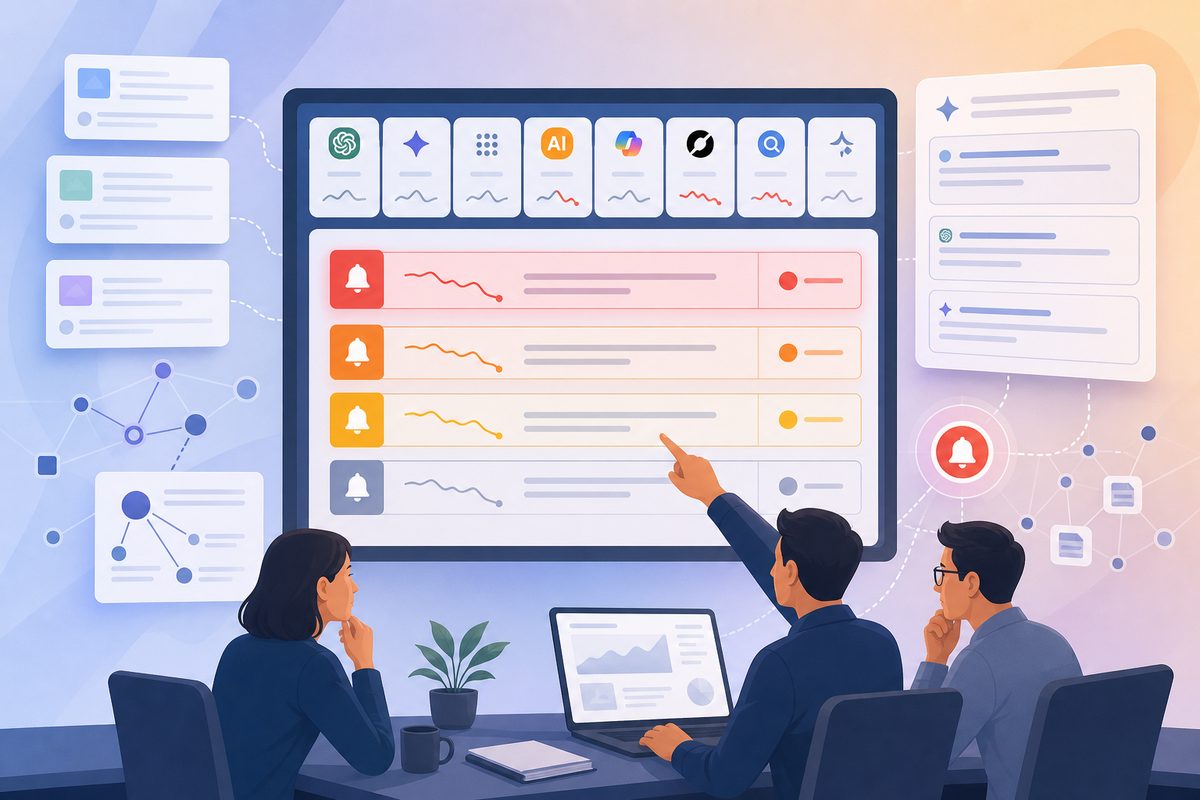
What Are AI Search Alerts?
AI search alerts are threshold-based warnings for answer engines. They trigger when a monitored prompt or prompt cluster shows a meaningful change in how an AI system describes, recommends, cites, compares, or evaluates a brand.
They are different from three familiar alert types:
| Alert Type | Watches | Useful For | What It Misses |
|---|---|---|---|
| SEO rank alerts | URLs in classic search results | Ranking drops, page movement, SERP changes | Whether an AI answer recommends or excludes your brand |
| Social listening alerts | Public posts, comments, forums, media mentions | Buzz, PR issues, customer sentiment | How AI systems synthesize the brand for buyers |
| Google Alerts | Newly indexed pages containing terms | Simple brand or topic monitoring | AI answer wording, citations, shortlists, and factual claims |
| AI search alerts | Generated answers, cited sources, sentiment, recommendations, competitors | Brand visibility and accuracy inside AI search | Requires baseline sampling and alert discipline |
A useful AI search alert answers three questions within seconds:
| Question | What the Alert Should Show |
|---|---|
| What changed? | Prompt, engine, answer excerpt, baseline, current result, citations, screenshot |
| Why does it matter? | Prompt tier, funnel stage, revenue or reputation exposure, competitor movement |
| Who owns it? | SEO, content, product marketing, PR, legal, security, or agency owner |
What Should AI Search Alerts Monitor?
An AI search alert system should monitor more than brand mentions. A mention can be neutral, buried, uncited, or paired with a limiting claim. For commercial prompts, recommendation language and source quality usually matter more.
| Signal | What to Track | Why It Matters |
|---|---|---|
| Brand presence | Whether the brand appears in the answer | Basic visibility baseline |
| Recommendation status | Whether the AI recommends, lists, ranks, or excludes the brand | Closest signal to shortlist influence |
| Answer position | First mention, top 3, below competitor, or only in caveats | Buyers often copy the first few options |
| Share of voice | Brand appearance rate across a prompt cluster | Trend-level visibility |
| Competitor displacement | Which competitor gained the language or placement you lost | Shows where demand may shift |
| Citations | URLs gained, lost, repeated, or downgraded | Explains why the answer changed |
| Sentiment and qualifiers | Positive, neutral, mixed, negative, "best for," "not ideal for" | Affects trust and conversion |
| Factual accuracy | Pricing, product, integrations, security, compliance, geography, leadership | Wrong answers can create immediate risk |
| No-answer patterns | Refusals, generic answers, or missing category responses | Can signal prompt, policy, or source changes |
For a broader metric setup, use a measurement workflow like How to Measure AI Search Visibility: Metrics, Scorecard, and Workflow. Alerts should sit on top of that baseline, not replace it.
Why AI Search Alerts Need a Noise Guardrail
AI search alerts need a noise guardrail because generated answers vary across runs, engines, time, and prompt wording. One changed answer is evidence. It is not always a decision.
A 2026 arXiv paper, Quantifying Uncertainty in AI Visibility, found that single-run citation visibility can be misleading because repeated samples from Perplexity Search, OpenAI SearchGPT, and Google Gemini produced substantial citation variability. Another 2026 paper, Don't Measure Once, makes the same operational point: AI visibility should be treated as a distribution, not a single snapshot.
Use a two-gate rule:
- Materiality gate: Did the change affect a high-value prompt, a revenue cluster, a reputation prompt, or a regulated claim?
- Confidence gate: Did the signal repeat across runs, engines, prompt variants, or supporting source changes?
Bypass both gates for material factual errors. If an AI answer says your company lacks SOC 2 when it has SOC 2, lists the wrong price, invents a security incident, or says your product lacks a core feature, treat it as same-day even if it appears once.
Same-Day AI Search Alert Thresholds
Same-day action is needed when a change can affect buyer shortlists, brand trust, legal exposure, security perception, pricing understanding, or competitive demand before the next weekly review.
Use this alert matrix as a starting configuration:
| Alert Type | Same-Day P0 Trigger | Noise Guardrail | First Owner |
|---|---|---|---|
| Recommendation drop | Brand loses 20%+ relative visibility and 5+ absolute points in a Tier 1 commercial prompt cluster | Confirm across 2 runs, 2 engines, or a priority engine plus source change | SEO or GEO lead |
| Competitor displacement | A named competitor replaces the brand in 10%+ of high-intent runs | Compare answer position, prompt cluster, and cited sources | Growth, SEO, product marketing |
| Bad citation change | Trusted source disappears, stale source appears, or competitor-owned source supports the answer | Inspect source freshness and claim fit | SEO, content, PR |
| Negative sentiment spike | Negative or limiting language doubles and appears in buying or trust prompts | Review excerpts and cited sources manually | PR, comms, brand |
| Incorrect factual claim | Any material error about pricing, product, compliance, security, availability, leadership, or market position | No repeat confirmation required | Product marketing, legal, security, comms |
| No-answer pattern | Engine stops answering a category or vendor prompt it previously answered | Check prompt wording, topic sensitivity, and engine behavior | SEO or analytics |
| Citation-without-mention loss | Brand pages are still cited but the brand is no longer recommended | Compare cited passages and answer wording | Content or SEO |
A P0 alert should be rare. If every movement becomes P0, the team will stop responding.
How to Build the Baseline Before Turning Alerts On
Do not activate strict AI search alerts on day one. First, build a baseline that shows normal variation.
- Group prompts by intent. Separate awareness, problem research, category education, alternatives, comparisons, security, pricing, and "best vendor" prompts.
- Assign business tiers. Tier 1 prompts influence revenue or trust. Tier 2 prompts influence evaluation. Tier 3 prompts are awareness only.
- Track multiple engines. At minimum, monitor the engines your buyers actually use. For many B2B teams that means ChatGPT, Gemini, Perplexity, Claude, Copilot, and Google AI surfaces.
- Run repeated samples. Use at least 7 days for launch calibration and 14 to 28 days for stricter executive thresholds.
- Freeze prompt versions. If prompts change every week, you cannot tell whether visibility changed or measurement changed.
- Separate mentions from recommendations. A brand that is mentioned as "not ideal for enterprise buyers" should not count the same as a brand recommended first.
- Archive raw evidence. Keep answer text, citations, timestamps, screenshots, engine, geography, device context where relevant, and prompt version.
For reporting below the urgent line, pair alerts with a weekly scorecard such as AEO Dashboard Metrics: Weekly Scorecard for AI Search Visibility.
MaxAEO's Priority Formula for AI Search Alerts
MaxAEO uses a practical severity model: priority equals commercial value multiplied by signal size, confidence, and risk.
Alert priority = commercial value x signal size x confidence x risk
| Factor | Score 1 | Score 3 | Score 5 |
|---|---|---|---|
| Commercial value | Awareness prompt | Mid-funnel research prompt | Buying, comparison, pricing, security, or shortlist prompt |
| Signal size | Small wording change | Meaningful position, sentiment, or citation movement | Brand removed, competitor replaces, or wrong claim appears |
| Confidence | One answer only | Repeated in one engine | Repeated across engines, prompt cluster, or source changes |
| Risk | Low business risk | Buyer confusion possible | Legal, security, compliance, pricing, PR, or investor risk |
| Priority | Score Range | Action Window | Response Standard |
|---|---|---|---|
| P0 | 80+ | Same day | Owner assigned, evidence captured, fix path started |
| P1 | 45-79 | 24 to 48 hours | Validate, diagnose source changes, add to sprint |
| P2 | Under 45 | Weekly review | Monitor trend and combine with dashboard context |
This model prevents two common failures: alert fatigue from low-value movement and false calm when one wrong answer creates real risk.
Example: Recommendation Drop That Deserves Same-Day Review
Here is a realistic composite pattern from B2B SaaS alert reviews. Use it as a decision example, not as a universal benchmark.
| Metric | 14-Day Baseline | Latest 24 Hours | Change |
|---|---|---|---|
| High-intent prompt runs | 1,260 | 1,260 | Stable |
| Brand recommended | 41% | 29% | -12 points, -29% relative |
| Top-3 answer position | 34% | 21% | -13 points |
| Competitor A recommended | 23% | 36% | +13 points |
| Brand-owned pages cited | 18% | 11% | -7 points |
| Third-party review pages cited | 31% | 44% | +13 points |
| Negative or limiting qualifiers | 6% | 14% | +8 points |
This should trigger same-day review because it crosses the absolute movement threshold, relative movement threshold, and competitor displacement threshold.
The first response should not be "publish another best tools article." The first response should be source-level diagnosis:
- Which cited sources appeared when the brand was recommended?
- Which sources replaced them?
- Did the competitor gain a stronger proof point, fresher comparison page, review profile, analyst mention, partner listing, or integration page?
- Did the AI answer start using different criteria, such as security, pricing, enterprise readiness, or integrations?
- Which owned or third-party source can correct the evidence gap fastest?
For the competitive workflow, use AI Search Competitor Analysis: How to Benchmark Brand Visibility Against Rivals.
How to Respond to Recommendation Drops
A recommendation drop is urgent when the brand stops appearing in prompts such as "best," "top," "alternatives," "compare," "shortlist," "which vendor," or "[brand] vs [competitor]."
Triage the drop in this order:
- Engine: Is the loss isolated to one engine or visible across several?
- Intent cluster: Is it one prompt wording or the whole buying cluster?
- Recommendation language: Did the brand disappear, move lower, or remain mentioned without endorsement?
- Source change: Did citations shift before the answer changed?
- Competitor gain: Did one competitor receive the exact positioning the brand lost?
- Criteria shift: Did the answer start prioritizing a feature, proof point, market, or compliance need where the brand has weaker evidence?
Best fixes usually fall into one of four buckets:
| Diagnosis | Fix |
|---|---|
| Owned page lacks direct evidence | Add clear feature, integration, pricing, security, or use-case proof to the canonical page |
| Third-party source is stale | Update review profiles, partner pages, listings, documentation, or analyst/contact materials |
| Competitor owns the comparison frame | Publish or improve neutral, specific comparison content with evidence |
| Prompt criteria changed | Build content around the new evaluation factor, not just the original keyword |
How to Respond to Competitor Displacement
Competitor displacement happens when an AI answer still covers the category but replaces your brand with a rival, ranks the rival above you, or uses the rival as the default recommendation.
Track three displacement metrics:
| Metric | Definition | Same-Day Threshold |
|---|---|---|
| Top recommendation loss | Brand was first or top 3, then falls out | P0 for Tier 1 buying clusters |
| Competitor replacement rate | Competitor appears where the brand previously appeared | P0 at 10%+ of high-intent runs |
| Share shift | Competitor gains while brand loses | P0 when both move 5+ points |
The best question is not "How do we get recommended by ChatGPT?" It is: which evidence caused the engine to recommend the competitor instead?
If the answer cites review sites, forums, analyst pages, or partner directories, the fix may involve third-party profile work. If it cites the competitor's own comparison page, the fix may require stronger owned comparison content. If it cites old content, the fix is entity cleanup and content refresh.
How to Respond to Citation Changes
Citation changes deserve alerts when the source behind an AI answer changes the trust level, freshness, or meaning of the recommendation.
For Google surfaces, citation work is especially important. Google says AI Overviews and AI Mode may use query fan-out and supporting links, and that pages must be indexed and eligible for snippets to appear as supporting links in those AI features. See Google's official guide to AI features and your website.
Flag these citation events:
| Citation Event | Why It Matters | Response |
|---|---|---|
| Trusted source removed | The answer may lose proof for a key claim | Check whether the page changed, was deindexed, blocked, or outranked by fresher evidence |
| Stale source added | Old pricing, positioning, or product gaps may resurface | Update or replace the stale source where possible |
| Competitor-owned source added | The answer may inherit competitor framing | Build neutral comparison evidence and strengthen third-party validation |
| Source contradicts answer | The answer may be unsupported or distorted | Capture evidence and correct the cited source or canonical page |
| Citation lost but mention remains | The brand is visible but less defensible | Improve citation-worthy passages and internal linking |
A 2026 arXiv study of Google AI Overviews, Measuring Google AI Overviews, found that nearly 30% of cited domains in the study did not appear in co-displayed first-page results, and 11.0% of decomposed atomic claims were unsupported by cited pages. That is why citation alerts should inspect both which source was cited and whether the cited page actually supports the claim.
For tool selection, use a buyer framework like AI Visibility Tools with Citation Tracking: Buyer’s Guide and Scorecard.
How to Respond to Negative Sentiment Spikes
A negative sentiment spike needs same-day action when it appears in commercial, reputation, security, compliance, or pricing prompts.
Do not treat every negative phrase equally. "Expensive" can be neutral in an enterprise category if paired with "robust." "Lacks SOC 2" is a serious factual claim if the company has SOC 2. "Poor support" needs source review if the answer cites recent complaints, review pages, or news coverage.
A March 2026 Business Insider report on BrightEdge data reported that negative brand sentiment was uncommon but meaningful at scale: 2.3% of observed Google AI Overview brand mentions skewed negative versus 1.6% for ChatGPT. The same report noted Google's criticism of the methodology and Google's statement that the difference was less than one percentage point. The operational lesson is still useful: rare negative mentions deserve attention when they appear in high-visibility buying contexts.
Classify the cause before acting:
| Cause | Example | Best Response |
|---|---|---|
| Accurate limitation | "Does not offer native X integration" | Add nuance, roadmap status, alternatives, and exact scope |
| Outdated claim | "No enterprise plan available" | Update pricing, docs, product pages, profiles, and listings |
| Reputation issue | "Recent outage affected customers" | Coordinate comms and publish a clear reliability update |
| Unsupported criticism | "Known for poor security" without evidence | Capture answer, inspect citations, correct sources, escalate if needed |
| Competitor-framed weakness | "Less mature than Competitor A" | Add proof points, customer evidence, security docs, and comparison assets |
AI reputation work is not about suppressing criticism. It is about making sure AI systems can access current, specific, well-sourced evidence.
How to Respond to Incorrect Factual Claims
Incorrect factual claims are the clearest same-day AI search alert. They do not need to cross a share-of-voice threshold if they can mislead buyers, customers, partners, journalists, analysts, investors, or regulators.
Trigger P0 alerts for errors about:
| Claim Area | Examples |
|---|---|
| Product | Features, integrations, supported platforms, roadmap status |
| Commercial | Pricing, plan limits, contract terms, free trial availability |
| Trust | SOC 2, ISO, HIPAA, GDPR, data residency, uptime, security posture |
| Company | Founder, headquarters, funding, acquisition status, customer count |
| Market | Category, target audience, use cases, competitors |
| Reputation | Lawsuits, outages, layoffs, recalls, controversies |
Use this response workflow:
- Capture the prompt, answer, engine, timestamp, location context, and screenshot.
- Save every citation and the exact answer excerpt.
- Classify the cause as hallucination, outdated citation, ambiguous entity, incorrect source, or missing owned evidence.
- Fix the most authoritative public source first.
- Update owned pages, help docs, schema, third-party listings, partner directories, and review profiles.
- Recheck the prompt cluster after 24, 48, and 72 hours.
- Route to legal, security, PR, or executive stakeholders if the claim affects risk, compliance, or public trust.
Google's guide to optimizing for generative AI features emphasizes unique, helpful, non-commodity content and clear technical access. In practice, that means factual fixes should be easy for both humans and crawlers to find.
What Should Be Inside a Useful AI Search Alert?
A useful AI search alert is a decision packet, not a vague warning.
| Field | Example |
|---|---|
| Engine | ChatGPT, Gemini, Perplexity, Claude, Copilot, Grok, AI Mode, AI Overviews |
| Prompt | "Best enterprise data catalog tools for fintech teams" |
| Prompt version | v3, updated after Q2 messaging refresh |
| Intent cluster | Commercial comparison |
| Business tier | Tier 1 revenue prompt |
| Baseline | 42% recommendation rate over 14 days |
| Current result | 29% recommendation rate today |
| Movement | -13 points, -31% relative |
| Competitor change | Competitor A +11 points |
| Answer excerpt | Sentence where brand was removed or reframed |
| Citations gained or lost | URLs added, removed, or changed |
| Source quality | Owned page, third-party review, forum, analyst, news, competitor-owned |
| Sentiment shift | Positive, neutral, mixed, negative |
| Factual risk | None, low, high, critical |
| Severity | P0, P1, P2 |
| Owner | SEO, content, PR, product marketing, legal, security, agency |
| Suggested next step | Inspect source change, update comparison page, correct profile, escalate factual error |
| Evidence | Raw answer, citation list, screenshot, timestamp |
Screenshots matter because AI answers can change between the alert and stakeholder review.
How to Set AI Search Alerts Without Creating Alert Fatigue
The best AI search alerts are selective. They cluster related changes, suppress low-impact noise, and escalate only when the signal affects a prompt that matters to the business.
Use these rules:
- Group prompts by intent, not only by keyword.
- Assign revenue and reputation tiers before setting thresholds.
- Use both absolute and relative movement thresholds.
- Require repeat confirmation for non-factual, non-reputation alerts.
- Alert once per issue cluster, not once per prompt-engine combination.
- Use cooldown windows so the same issue does not fire every hour.
- Keep P0 alerts rare enough that stakeholders respond immediately.
- Review false positives monthly and adjust thresholds.
- Keep a weekly dashboard for everything below the urgent line.
- Separate alerting from reporting so leadership sees both urgent incidents and trend context.
A practical configuration:
| Prompt Tier | Example Prompt | Run Frequency | P0 Rule | P1 Rule |
|---|---|---|---|---|
| Tier 1 buying | "Best AI visibility tools for B2B SaaS" | Daily | Lost top recommendation across 2 engines | Visibility down 20% in one priority engine |
| Tier 1 reputation | "Is [brand] secure for enterprise use?" | Daily | Any wrong security or compliance claim | Negative wording repeats twice |
| Tier 2 comparison | "[brand] vs [competitor]" | Daily | Competitor-framed false claim | Citation source changes materially |
| Tier 2 pricing | "How much does [brand] cost?" | Daily | Wrong pricing or plan availability | Outdated pricing source appears |
| Tier 3 awareness | "What is answer engine optimization?" | 2-3x weekly | None unless factual risk | Mention share drops 25% |
What to Look For in an AI Search Alert Tool
For commercial buyers, AI search alerting should be evaluated as an operating system, not a notification feature.
| Capability | Why It Matters | Buying Question |
|---|---|---|
| Multi-engine coverage | Buyers do not use one AI surface | Which engines are monitored, and are they sampled consistently? |
| Prompt clustering | One prompt is not a market | Can prompts be grouped by intent, funnel stage, product line, region, and competitor set? |
| Mention, citation, and recommendation separation | Visibility is not one metric | Does the tool distinguish brand mentions from recommendations and citations? |
| Baselines and thresholds | Alerts need context | Can teams set absolute, relative, and tier-based thresholds? |
| Raw evidence archive | Stakeholders need proof | Are answers, citations, screenshots, timestamps, and prompt versions stored? |
| Competitor displacement tracking | Demand can move quietly | Does the tool show which competitor gained the lost position or claim? |
| Sentiment and factual-risk review | Reputation risk needs routing | Can high-risk topics bypass noise filters? |
| Owner routing | Alerts without owners decay | Can alerts route to SEO, PR, legal, product marketing, or agency teams? |
| Exports and reporting | Executives need trend context | Can alerts connect to weekly scorecards, CSV exports, APIs, or BI workflows? |
| False-positive review | Thresholds improve with use | Can teams label noise and tune rules over time? |
For executive reporting, connect alerting to a weekly narrative like the AI Visibility Report Template. Alerts explain what needs action now. Reports explain what changed over time.
Frequently Asked Questions
What are AI search alerts?
AI search alerts are automated rules that notify a team when AI-generated answers materially change in brand visibility, recommendation status, citations, sentiment, competitor placement, or factual accuracy. They help teams respond to meaningful AI search changes without treating every answer variation as urgent.
How often should AI search alerts run?
Run Tier 1 buying, pricing, security, compliance, and reputation prompts daily. Run comparison prompts daily or several times per week. Run awareness prompts 2 to 3 times per week unless they support a major campaign or known reputation issue.
What AI visibility drop is urgent enough for same-day action?
A strong starting threshold is a 20% relative drop and at least a 5 percentage point absolute drop in a Tier 1 prompt cluster, confirmed across repeated runs or multiple engines. Treat material factual errors as same-day even if they appear once.
Should every brand mention in ChatGPT trigger an alert?
No. A brand mention alone should not trigger a same-day alert. Alert on material changes in recommendation status, answer position, competitor displacement, citations, sentiment, or factual accuracy. Low-intent mention movement usually belongs in a weekly report.
Can AI search alerts help a brand get recommended by ChatGPT?
Yes, indirectly. Alerts show where the brand lost recommendation language, which competitor replaced it, and which sources or claims changed. The fix is usually stronger evidence: clearer owned pages, updated third-party profiles, better comparison content, and citation-worthy proof.
Are AI search alerts only for SEO teams?
No. SEO teams often own measurement and crawlable content fixes, but PR, comms, product marketing, legal, security, growth, and agency teams may own the response. Ownership depends on whether the alert concerns visibility, reputation, citations, competitors, or factual accuracy.
Do AI search alerts replace SEO rank alerts?
No. AI search alerts complement SEO rank alerts. Rank alerts show URL movement in classic search. AI search alerts show how answer engines synthesize, cite, and recommend brands. A strong monitoring stack uses both.
The Bottom Line
AI search alerts should be strict enough to avoid noise and sensitive enough to catch commercial or reputational risk quickly. The same-day triggers that matter most are high-intent recommendation drops, competitor displacement, harmful citation changes, negative sentiment in buying contexts, and incorrect factual claims.
The strongest setup combines a stable baseline, repeated sampling, severity thresholds, screenshot evidence, citation review, and named owners. That turns answer engine optimization from a passive dashboard into an operating workflow for protecting and growing AI visibility.