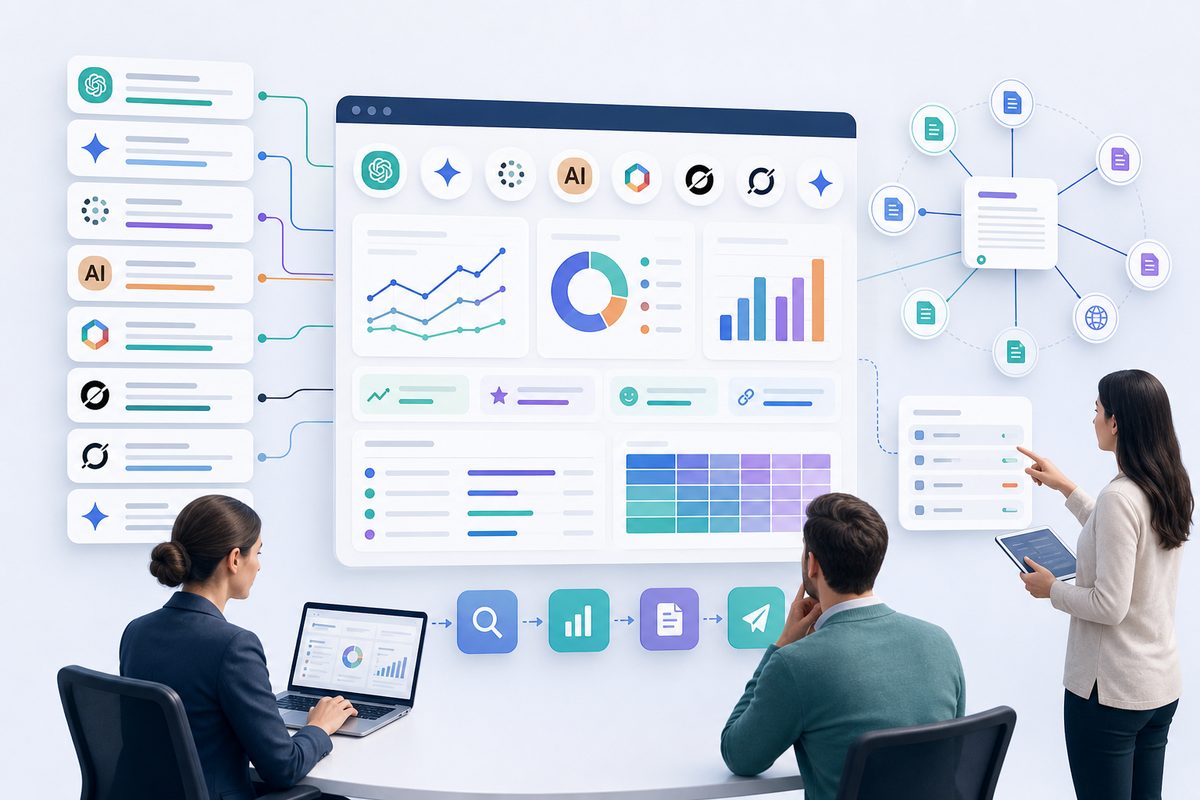
Answer first: GEO for agencies is a multi-client service model for measuring and improving how AI answer engines mention, cite, rank, compare, and describe each client across buying prompts. It turns AI visibility data into client-specific content, PR, technical SEO, and reputation actions.
The agency opportunity is clear: clients are asking why competitors appear in ChatGPT, Perplexity, Gemini, Claude, Copilot, Grok, Google AI Mode, and AI Overviews while they do not. The risk is also clear: a generic "AI visibility score" does not tell an account team what to fix.
The short version: standardize the measurement system, not the diagnosis. Every client needs its own prompt library, competitor set, evidence graph, and action backlog.
What Is GEO for Agencies?
GEO for agencies is the process of monitoring and improving client visibility in AI-generated answers across the prompts that influence research, comparison, vendor shortlists, and reputation checks.
It combines generative engine optimization, answer engine optimization, SEO, digital PR, content strategy, entity clarity, and AI reputation management. The agency version is harder than in-house GEO because each client has a different category, buyer vocabulary, competitor field, proof base, risk profile, and approval process.
A cybersecurity client may need stronger evidence for "best vendor risk management platforms for financial services." A devtools client may need AI systems to understand integrations, docs, and deployment models. A healthcare or fintech client may need stricter claim review before any content is pushed into the web.
What Clients Actually Want When They Search "GEO for Agencies"
Most agency buyers are not looking for another dashboard. They are trying to answer five commercial questions:
- Can we sell GEO as a credible service without overpromising results?
- How do we monitor multiple client brands without manual prompt chaos?
- Which AI engines, prompts, competitors, citations, and sentiment signals matter?
- How do we turn AI visibility findings into billable content, PR, SEO, and reputation work?
- What tool and reporting workflow will let account teams scale this across clients?
A strong GEO for agencies program answers all five. A weak program stops at screenshots.
Why Template GEO Reports Fail
Template GEO reports fail because AI visibility is prompt-sensitive, engine-sensitive, and category-sensitive. One client may lose because answer engines do not associate the brand with the category. Another may appear often but be described with outdated positioning. A third may only lose in high-intent comparison prompts.
The 2026 arXiv paper "Don't Measure Once: Measuring Visibility in AI Search" argues that AI answers vary across runs, prompts, and time, making one-off observations unreliable. For agencies, that means a single ChatGPT screenshot is weak evidence.
Use repeatable reporting formats, but keep the interpretation client-specific. GEO reporting should explain:
- Which prompt clusters changed.
- Which competitors gained or lost visibility.
- Which sources influenced the answer.
- Whether the client was absent, misdescribed, poorly cited, or unfavorably framed.
- Which owned, earned, or technical action should happen next.
GEO for Agencies vs SEO, AEO, and AI Search Monitoring
GEO is not a replacement for SEO. It is a visibility layer on top of search, content, entity, and reputation work.
| Discipline | Primary Object | Agency Output |
|---|---|---|
| SEO | Pages ranking in search results | Technical fixes, content, links, information architecture |
| AEO | Direct answers and answer extraction | Structured answers, FAQs, snippets, schema, concise explanations |
| AI search monitoring | Brand behavior inside AI answers | Mentions, share of voice, citations, sentiment, competitor visibility |
| GEO for agencies | Client performance across AI-generated buying journeys | Measurement, diagnosis, execution roadmap, client reporting |
Google's guide to optimizing for generative AI features on Search says its generative AI features are rooted in core Search ranking and quality systems, including retrieval-augmented generation and query fan-out. That is why agency GEO work should strengthen crawlable content, trusted evidence, and entity clarity instead of chasing AI-only tricks.
Start With a Client-Specific Baseline
The first month should establish a baseline, not promise instant wins. A baseline gives the agency and client a shared view of where the brand appears, where it is missing, how AI engines frame it, and which competitors are being recommended.
A practical baseline includes:
- 50-150 prompts per B2B client, with smaller accounts starting at 25-50 high-intent prompts.
- 3-8 competitors per prompt cluster, including direct rivals and substitute solutions.
- Multiple engines, selected by client audience and market.
- Daily or weekly checks, depending on retainer scope and volatility.
- Citation, sentiment, and source review, not just mention counts.
- Evidence capture, including prompt, engine, date, answer excerpt, cited URL, and screenshot for material findings.
For a deeper setup process, use how to build an AI search visibility baseline.
Build Prompt Libraries Around Buying Moments
A client prompt library should start with buying moments, not keyword exports. The best prompts reflect what a real buyer, analyst, founder, developer, procurement lead, or executive might ask before forming a shortlist.
Use five prompt groups:
| Prompt Group | Example | Why It Matters |
|---|---|---|
| Category discovery | "Best SOC 2 automation platforms for startups" | Measures whether the client appears in the market shortlist |
| Comparison | "Vendor A vs Vendor B for enterprise teams" | Shows positioning against named rivals |
| Use case | "Best software for automated customer onboarding" | Connects AI visibility to revenue use cases |
| Problem | "How to reduce support tickets with AI" | Tests whether AI recommends software, services, or manual workarounds |
| Reputation | "Is Vendor A reliable for regulated companies?" | Finds trust, risk, and sentiment issues |
Do not reuse the same prompt set across every client. A CRM client, cybersecurity client, and infrastructure client may all need AI search monitoring, but their buying moments should look different.
A more detailed prompt design workflow is covered in how to build an AI search prompt set for brand monitoring.
Use Competitor Sets by Prompt Context
GEO for agencies should define competitors by prompt context, not by the client's homepage positioning. AI answer engines often compare brands by use case, audience, geography, price tier, integration, and proof source.
| Prompt Type | Competitor Set Should Include | Agency Question |
|---|---|---|
| Category prompts | Direct category leaders | Who owns the obvious shortlist? |
| Use-case prompts | Workflow alternatives and vertical specialists | Who solves the buyer's actual job? |
| Comparison prompts | Named rivals and close substitutes | Which claims shape the final decision? |
| Problem prompts | Services, tools, templates, and manual workarounds | Does AI frame software as necessary? |
| Reputation prompts | Review sites, forums, publishers, analysts, and social sources | Which sources shape trust? |
This is where template reporting breaks. If the competitor graph is wrong, the report will optimize for the wrong market.
Measure Visibility as a Distribution, Not a Screenshot
GEO for agencies should measure repeated answer patterns. A useful client report shows how often the brand appears, where it appears, what language describes it, which competitors appear with it, and which sources support the answer.
The original "GEO: Generative Engine Optimization" paper introduced a black-box optimization framework for generative engines and reported visibility gains of up to 40% in generative engine responses. The practical agency lesson is not "add statistics everywhere." It is that visibility can be tested, measured, and improved by changing the evidence that engines can retrieve and use.
Report changes by prompt cluster, not by isolated answers. A client should see whether AI share of voice improved across "enterprise comparison prompts" or "mid-market use-case prompts," not whether one answer looked better on Tuesday.
Track Metrics That Lead to Decisions
AEO dashboards for agencies should separate awareness metrics from action metrics. Awareness tells the client whether they appear. Action metrics tell the team what to fix.
| Metric | What It Answers | Agency Use |
|---|---|---|
| AI share of voice | How often is the client named versus competitors? | Executive reporting and competitive trend tracking |
| Mention rank | Where does the client appear in a list? | Shortlist quality and positioning analysis |
| Prompt coverage | Which buying prompts produce weak or no visibility? | Content roadmap and retainer prioritization |
| Citation rate | Is the client or a supporting source cited? | Owned content, PR, and source-gap planning |
| Source gap | Which domains support competitors but not the client? | Digital PR, partner content, analyst outreach |
| Sentiment/framing | Is the description favorable, neutral, outdated, or wrong? | Brand, comms, and reputation work |
| Claim accuracy | Are AI answers making correct claims? | Legal, compliance, product marketing, and support risk |
| Evidence depth | Does crawlable proof exist for the claims the client wants AI to repeat? | Case studies, data pages, docs, comparison pages |
For measurement design beyond one-off prompts, see how to measure brand visibility in AI answers.
Use the Client Evidence Graph Framework
The Client Evidence Graph is a practical framework for non-template GEO reporting. It maps every weak AI answer to the missing evidence that would make the client easier to recommend.
The graph has four layers:
- Prompt: the buyer question where visibility matters.
- Answer pattern: who is mentioned, ranked, cited, omitted, or misdescribed.
- Evidence source: the owned pages, third-party articles, reviews, docs, videos, profiles, forums, and partner pages AI engines appear to rely on.
- Fix: the owned, earned, or technical action that would strengthen the client's case.
This turns a vague finding like "AI visibility is 27%" into a useful diagnosis:
| Weak Finding | Evidence Graph Diagnosis |
|---|---|
| "Client is missing from AI answers" | "The client is absent from enterprise comparison prompts because there is no crawlable page proving implementation depth for regulated teams." |
| "Competitor is cited more often" | "Competitor pages are supported by review sites, partner pages, and integration docs. The client only has a homepage claim." |
| "Sentiment is neutral" | "AI answers describe the client as early-stage because older funding and launch articles outrank newer enterprise proof." |
That is the information gain agency clients pay for.
Classify Visibility Failures Before Recommending Fixes
The fix should match the visibility failure. Agencies waste time when every problem becomes "publish more content."
| Visibility Failure | Likely Cause | Recommended Fix |
|---|---|---|
| Brand absent from shortlist prompts | Weak entity-category association | Build category pages, comparison pages, partner mentions, and third-party validation |
| Brand appears below weaker competitors | Competitors have clearer proof or broader source coverage | Add comparison proof, use-case evidence, review depth, and differentiated claims |
| Brand mentioned without citation | Owned content exists but lacks trust or extractable evidence | Add original data, expert quotes, customer proof, references, and clearer page structure |
| Brand described incorrectly | Outdated sources or vague positioning | Update core pages, schema, profiles, PR boilerplate, review-site copy, and product docs |
| Competitor cited repeatedly | Competitor has stronger publisher, review, or community footprint | Build source-gap outreach and citation-worthy assets |
| High visibility but poor sentiment | Reputation issue, weak differentiation, or unresolved objections | Create objection-handling content, customer proof, and comms briefs |
| AI answer includes risky claims | Ambiguous public information or unsupported web content | Create approved claims, update public sources, and flag legal/compliance review |
Google's guidance on helpful, reliable, people-first content asks whether content provides original information, substantial analysis, and value beyond other search results. That standard applies directly to GEO: the work should make the web more useful and more accurate, not just louder.
Report AI Citations With Context
AI citations should be reported as evidence, not trophies. A citation from a weak or irrelevant page may not help the client. A citation from a trusted third-party comparison may explain why a competitor keeps winning a prompt cluster.
For each meaningful citation, record:
- The prompt that triggered it.
- The engine where it appeared.
- The cited URL or domain.
- The claim the citation supported.
- Whether the claim was accurate.
- Whether the client owns, influences, or can respond to that source.
- Whether the source appears repeatedly across related prompts.
A 2026 arXiv preprint, "Measuring Google AI Overviews", studied 55,393 trending queries across 19 categories and found that nearly 30% of AI Overview-cited domains did not appear in the co-displayed first-page organic results. It also found that 11.0% of decomposed claims were unsupported by the cited pages. The agency takeaway: citation analysis needs source review and claim review, not just URL counting.
Package GEO Services Around Workflows, Not Slides
Agencies can sell GEO in several ways, but the deliverable must connect measurement to action.
| Package | Best For | Core Deliverable |
|---|---|---|
| GEO baseline audit | New clients, sales pilots, SEO strategy resets | Prompt library, competitor set, visibility baseline, citation map, action priorities |
| AI visibility monitoring retainer | Brands in competitive categories | Weekly internal checks, monthly client reporting, competitor movement, risk alerts |
| GEO execution retainer | Clients ready to act on findings | Content updates, comparison pages, source-gap PR, technical fixes, validation |
| AI reputation watch | Regulated, high-trust, or founder-led brands | Reputation prompts, incorrect claims, sentiment changes, escalation workflow |
| Multi-brand agency program | Agencies managing many client accounts | Workspaces, reporting templates, prompt governance, QA standards, account enablement |
Pricing should reflect the number of clients, prompt volume, engine coverage, reporting cadence, evidence review depth, and execution scope. For buying and budgeting considerations, see AI search monitoring pricing.
Build Monthly Reports That Account Teams Can Use
A strong monthly GEO report should help four teams act: SEO, content, PR/comms, and leadership. If the report only contains charts, it will die in a client meeting.
A useful monthly deliverable includes:
- Executive summary: top gains, losses, risks, and decisions needed.
- Prompt cluster review: movement by buying moment.
- Competitor movement: who gained visibility and why.
- Citation analysis: which sources influenced answers.
- Sentiment and claim review: how AI describes the client and whether the description is accurate.
- Action backlog: fixes ranked by impact, owner, effort, and revenue proximity.
- Evidence appendix: prompts, dates, engines, screenshots, cited URLs, and answer excerpts.
Use confidence labels. Mark a finding as directional when it appears in a small sample, confirmed when it repeats across prompts or engines, and urgent when the answer contains a reputation, legal, or product accuracy issue.
Prioritize Fixes by Revenue Proximity
Not every weak AI answer deserves immediate work. GEO for agencies needs prioritization because multi-client teams cannot chase every prompt, mention, or citation gap.
Score each issue by:
| Factor | High-Priority Signal |
|---|---|
| Revenue proximity | Prompt appears near vendor selection, comparison, pricing, migration, or implementation |
| Visibility gap | Competitors appear and the client does not |
| Fixability | Agency can improve the asset or source within 30-60 days |
| Risk | AI answer is inaccurate, outdated, or reputation-damaging |
| Proof gap | Client has evidence, but it is not crawlable, cited, or clearly stated |
| Source use | One source can influence many prompts or pages |
| Client readiness | Subject-matter experts and approvals are available |
This keeps the work commercial. The agency is not "optimizing for AI." It is improving the evidence buyers see when AI systems help them compare vendors.
Choose an AI Visibility Tool for Multi-Client Work
A useful AI visibility tool for agencies must reduce manual reporting, not create more cleanup work. At minimum, it should support multi-brand workspaces, custom prompt libraries, client-specific competitors, multi-engine monitoring, citation review, sentiment review, screenshots, exports, and action notes.
Evaluate tools against agency workflows:
| Requirement | Why Agencies Need It |
|---|---|
| Multi-brand workspaces | Keeps client data separate and reportable |
| Custom prompt libraries | Prevents generic tracking |
| Competitor sets by client and prompt cluster | Makes benchmarks commercially relevant |
| Multi-engine coverage | Reduces blind spots across ChatGPT, Gemini, Perplexity, Claude, Copilot, Grok, and Google surfaces |
| Citation and sentiment tracking | Supports content, PR, and AI reputation management |
| Evidence exports | Helps account teams prove findings in client meetings |
| Permission controls | Protects client data across account teams |
| Notes and action ownership | Connects monitoring to execution |
| Pricing that scales by client need | Prevents low-margin reporting retainers |
For a deeper buying checklist, use how to evaluate GEO tools for a multi-brand agency.
MaxAEO is built for agencies that need client-specific prompt tracking, AI share of voice, multi-engine visibility, citation analysis, sentiment review, and evidence exports. The platform should support the strategist, not replace the strategist. The value still comes from turning patterns into client-specific actions.
Use a 90-Day Rollout Plan
A 90-day rollout keeps GEO for agencies manageable and gives clients a clear path from measurement to execution.
- Days 1-15: Baseline setup. Confirm business goals, ICPs, product lines, prompt clusters, competitors, engines, reporting cadence, and risk terms.
- Days 16-30: First measurement cycle. Track visibility, citations, sentiment, source patterns, and claim accuracy without overprescribing fixes.
- Days 31-45: Diagnosis. Build the Client Evidence Graph for the most important weak prompt clusters.
- Days 46-70: Execution. Publish or update assets, brief PR opportunities, improve crawlability, refresh profiles, and correct outdated brand descriptions.
- Days 71-90: Validation. Compare prompt clusters against the baseline and explain what changed, what did not, and what should be tested next.
The key is restraint. GEO work compounds when agencies fix the evidence system behind answers, not when they publish disconnected AI content.
What Good Client Recommendations Look Like
Good GEO recommendations are specific, evidence-backed, and tied to a prompt cluster. Weak recommendations sound like "create more authoritative content." Strong recommendations name the missing proof and the asset needed.
| Weak Recommendation | Strong Recommendation |
|---|---|
| Improve AI visibility | Build a comparison page for "best customer onboarding software for B2B SaaS" because ChatGPT and Perplexity mention three competitors but omit the client in 18 of 24 tracked answers. |
| Get more citations | Add implementation data, customer proof, and integration details to the enterprise use-case page because AI answers cite review sites but not the client's owned content. |
| Improve sentiment | Update public boilerplate, review-site profiles, and analyst-facing messaging because Claude describes the product as "early-stage" despite enterprise customer proof. |
| Publish more GEO content | Create one evidence-rich integration hub instead of five shallow AI-search pages because missing integration proof is the repeated reason competitors are recommended. |
This is how agencies turn GEO for agencies from a reporting add-on into a strategic service.
Common Questions
Is GEO for agencies different from SEO services?
Yes. GEO for agencies uses SEO foundations, but the reporting object changes from ranked pages to generated answers. The agency tracks brand mentions in ChatGPT and other AI engines, AI citations, competitor recommendations, sentiment, source patterns, and claim accuracy across multiple clients.
How many prompts should an agency track per client?
Most B2B clients should start with 50-150 prompts. Smaller accounts can begin with 25-50 high-intent prompts. Enterprise programs may need several hundred prompts split by product line, geography, buyer role, funnel stage, and risk category.
Which AI engines should agencies monitor?
Start with the engines your client's buyers are likely to use. For many B2B clients, that means ChatGPT, Gemini, Perplexity, Claude, Copilot, and Google AI surfaces. Add Grok or vertical engines when the audience, category, or client request justifies it.
Should every client use the same GEO dashboard?
The dashboard structure can be shared, but the prompt library, competitor set, diagnosis, and recommendations should be client-specific. Shared dashboards create operational consistency. Shared interpretation creates bad strategy.
How often should agencies report AI search visibility?
Weekly internal reviews work best for active retainers. Monthly client reporting is usually enough for executive summaries unless the client is managing a launch, rebrand, reputation issue, or competitive campaign.
What should agencies charge for GEO services?
Charge based on scope: number of clients, prompts, engines, competitors, reporting cadence, evidence review, and execution support. A baseline audit can be a fixed project. Ongoing monitoring and execution usually work better as retainers.
What is the biggest mistake agencies make with GEO?
The biggest mistake is treating AI visibility as a reporting product instead of an action system. Clients need to know why they are missing, which sources influence answers, and what content, PR, technical, or reputation fix should happen next.