
Stale AI answer brand information is outdated company data that AI systems repeat as if it were still current. It usually appears as old pricing, retired product names, obsolete positioning, missing features, outdated company descriptions, or claims copied from stale third-party pages.
The fix is not to “correct the chatbot” once. The fix is to replace the evidence AI systems keep finding: owned pages, review profiles, directories, docs, PDFs, comparison articles, partner listings, and cited sources.

What is stale AI answer brand information?
Stale AI answer brand information is a brand fact that was once true, partly true, or widely repeated but no longer reflects the company today. The risk is confidence: AI answers compress multiple sources into one plain statement, so an old price, category, or feature gap can sound current to a buyer.
Common examples:
- ChatGPT says your product “starts at $49/month” after pricing moved to custom plans.
- Gemini describes your company as a “social listening tool” after you repositioned as an AI customer intelligence platform.
- Perplexity cites a 2024 review page saying you lack a feature shipped in 2026.
- Copilot lists an acquired product under its old brand name.
- Google AI Overviews summarizes a partner directory with an obsolete category.
Stale information is different from a pure hallucination. A hallucination may have no reliable source. A stale answer often has a source that used to be accurate. That makes the repair more operational: find the outdated source, publish the current fact, and make the current fact easier to retrieve.
| Problem | What it means | Best first response |
|---|---|---|
| Stale AI answer brand information | Old fact is repeated as current | Replace and corroborate the current source |
| Hallucinated brand fact | Claim has no clear supporting source | Publish a clear correction and monitor recurrence |
| Negative AI sentiment | Answer emphasizes criticism or risk | Audit sources, reviews, and sentiment patterns |
| Citation gap | Correct answer appears but cites weak or wrong pages | Improve citation-worthy source pages |
Why do AI answers keep repeating old brand facts?
AI systems repeat old brand facts when outdated evidence is clearer, more cited, easier to crawl, or more consistent than the current evidence. The model is not judging your internal truth. It is assembling an answer from accessible signals.
Google’s official guide says generative AI features in Search use core Search systems, retrieval-augmented generation, and query fan-out to find supporting pages (Google Search Central). That matters because stale facts can enter through more than one path:
- Training memory: older public descriptions influence model behavior.
- Live retrieval: a search-connected answer finds an outdated page.
- Third-party consensus: review sites, directories, listicles, and press boilerplates repeat the old claim.
- Owned-source conflict: your own site has old docs, PDFs, launch posts, or unredirected pages.
- Weak canonical page: the current page is vague, gated, thin, undated, or hard to extract.
- Citation mismatch: the answer cites one source but borrows the stale claim from another.
For brands, the practical lesson is simple: the answer is the symptom; the source graph is the cause.
Use the STALE triage before rewriting anything
The STALE triage is a quick scoring model for deciding whether a stale fact needs urgent repair, monitoring, or no action. It prevents teams from spending days editing low-impact pages while buyer-facing errors keep spreading.
Score each stale claim from 0 to 2 in five areas:
| Factor | 0 | 1 | 2 |
|---|---|---|---|
| Source visibility | Rarely cited or ranking | Visible in search or one AI answer | Cited repeatedly or ranking for the stale phrase |
| Truth gap | Minor wording issue | Partly misleading | Clearly wrong or superseded |
| Authority | Low-trust page | Moderate third-party page | Owned canonical page or high-authority third party |
| Likelihood of retrieval | Hard to crawl or obscure | Occasionally retrieved | Clean, crawlable, repeated text |
| Economic risk | Little buyer impact | May affect perception | Affects pricing, category, features, or trust |
Use the total score:
| Score | Priority | Action |
|---|---|---|
| 8-10 | Critical | Repair sources this week and monitor daily |
| 5-7 | High | Add to the next source repair sprint |
| 3-4 | Medium | Fix when touching the related page or profile |
| 0-2 | Low | Log and monitor only |
The highest-priority stale AI answer brand information is not always the most embarrassing mistake. It is the claim most likely to change a buyer’s decision: wrong pricing, wrong category, missing core features, unsupported compliance claims, or outdated acquisition details.
Build a canonical brand fact ledger
A canonical brand fact ledger is a controlled list of the facts AI systems should be able to repeat about your company. It turns “AI describes us incorrectly” into a set of approved, dated, crawlable statements.
Use one row per fact:
| Field | What to record | Example |
|---|---|---|
| Canonical claim | The current wording | “Acme is an AI customer intelligence platform for B2B support and product teams.” |
| Fact type | Pricing, category, feature, company, compliance, audience | Category |
| Status | Current, deprecated, regional, seasonal, grandfathered | Current |
| Effective date | When the fact became true | 2026-04-15 |
| Owner | Team accountable for accuracy | Product marketing |
| Canonical URL | Page AI systems should cite | Current category page |
| Supporting proof | Docs, release notes, screenshots, changelog, policy page | Release note and docs |
| Stale variants | Old phrases to search for | “social listening tool,” “CX dashboard” |
This is the step many stale-answer guides skip. If the current fact is not approved, dated, and published in one clear place, AI systems have little reason to prefer it over the older version.
Google’s helpful content guidance emphasizes original information, substantial coverage, clear sourcing, and demonstrable expertise (Google Search Central). A canonical brand fact page should meet that bar for buyers first, not just search engines.
Find the sources behind the stale answer
To fix stale AI answer brand information, separate visible citations from likely uncited influences. Cited URLs are useful, but they are not the whole evidence set.
Run this audit:
- Capture the answer exactly. Save the prompt, engine, date, region, mode, answer text, citations, and screenshots.
- Extract each stale claim. Separate wrong pricing from wrong positioning, missing features, or outdated company facts.
- Open every cited URL. Check whether the page actually supports the stale claim.
- Search the stale phrase verbatim. Look for pages repeating the same wording.
- Search your own domain. Use old product names, plan names, feature gaps, and boilerplate phrases.
- Check non-obvious assets. PDFs, help docs, app marketplaces, partner pages, release notes, archived pages, and press kits often lag behind.
- Classify every source. Use current, stale, conflicting, irrelevant, or unavailable.
- Identify the strongest stale source. The page with the most retrieval power is usually more important than the page that annoys your team most.
For a repeatable process, use AI citation tracking to connect AI answers back to the sources shaping them.
Replace the citation trail, not just the sentence
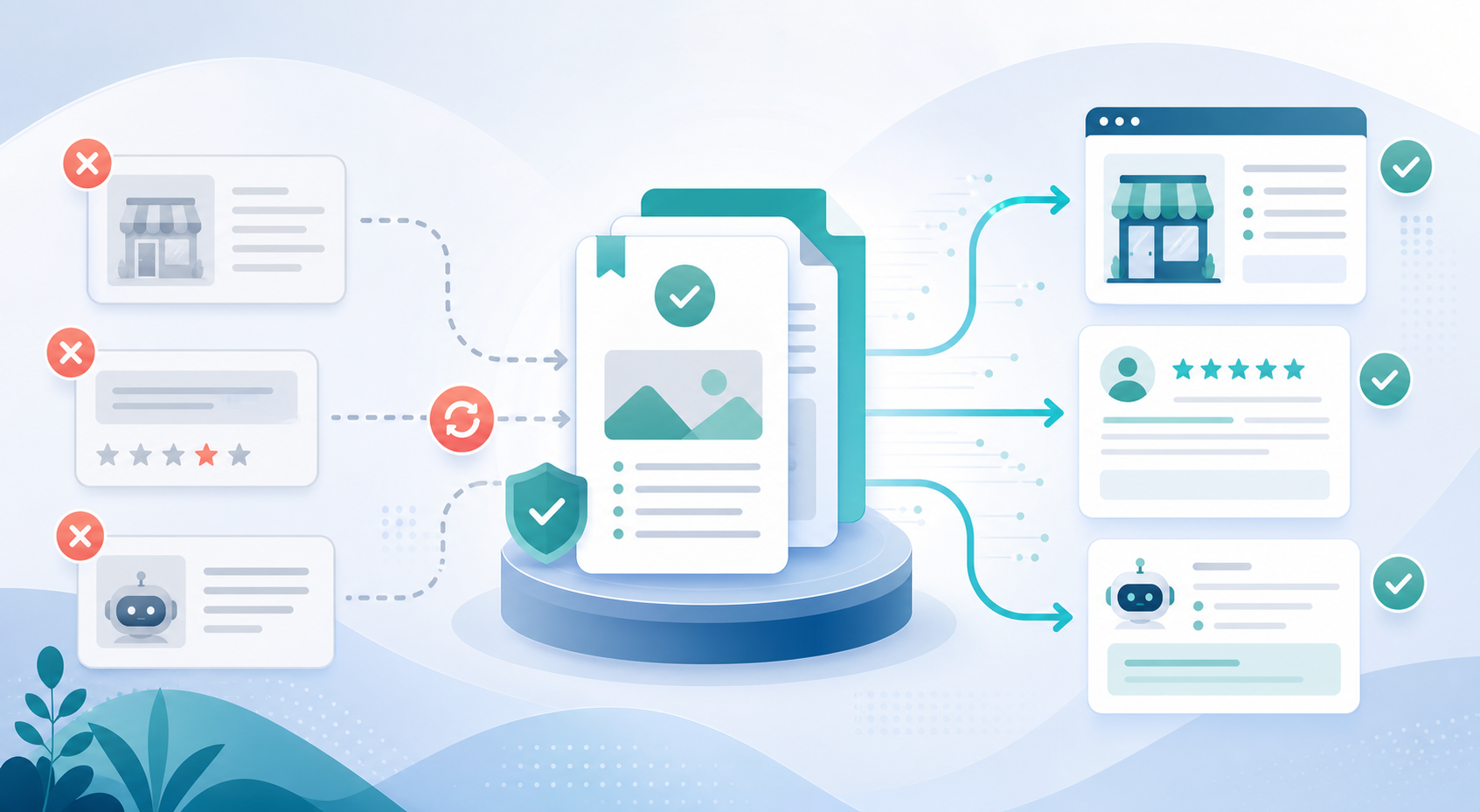
The durable fix is citation replacement: publish a stronger current source, neutralize stale sources, and build enough corroboration that AI systems retrieve the new fact more often than the old one.
Use this sequence:
- Publish or improve the canonical page. Put the current fact in the first screen, not buried in brand copy.
- Add dated evidence. Include effective dates, release notes, changelog links, screenshots, docs, or policy pages where relevant.
- Repair owned contradictions. Update, redirect, noindex, or annotate stale pages that can mislead current buyers.
- Use schema only when visible content matches it. Google’s structured data policies require up-to-date, user-visible, non-misleading marked-up content (Google Search Central).
- Update third-party profiles. Prioritize cited pages, ranking pages, software directories, review platforms, marketplaces, and partner listings.
- Publish corroborating content. Comparison pages, help docs, release notes, customer proof, and partner pages should repeat the current fact consistently.
- Request recrawling where available. Use Search Console for Google-owned surfaces; expect other engines to refresh on different timelines.
- Measure repeated answers. Do not declare success from one corrected response.
This is the practical core of a source repair workflow for wrong AI brand answers: the answer changes after the evidence changes.
Which sources should brands fix first?
Fix sources in the order they are most likely to influence the answer: owned canonical pages, owned conflicts, cited third-party pages, high-ranking third-party pages, and repeated stale profiles.
| Source | Why it matters | Priority |
|---|---|---|
| Pricing, product, category, and About pages | Defines the current brand facts | 1 |
| Help center and docs | Often retrieved for feature and integration questions | 1 |
| Old owned blog posts, PDFs, and launch pages | Create self-inflicted contradictions | 1 |
| Cited AI answer sources | Already visible in the answer path | 1 |
| Review and software directory profiles | Influence B2B evaluation and tool comparisons | 2 |
| “Best tools” and comparison articles | Shape category and shortlist language | 2 |
| Partner and marketplace listings | Repeat integration, category, and compatibility facts | 3 |
| Press boilerplate and media kits | Influence company descriptions | 3 |
| Social bios | Helpful for consistency, rarely enough alone | 4 |
Owned pages are faster to change. Third-party pages often carry more independent trust. The right first move is whichever source is currently giving the stale fact retrieval power.
How to write the canonical replacement page
A canonical replacement page should state the current fact plainly, explain what changed, and give AI systems a clean passage to cite. Avoid vague positioning copy. Answer the exact question AI is getting wrong.
For stale pricing information, include:
- Current pricing model in the first 100 words.
- Whether old plans are retired, renamed, grandfathered, or region-specific.
- Effective date of the change.
- A short “what changed” table.
- Links to current pricing, packaging, billing docs, or sales contact pages.
- A visible last-updated date.
For stale feature information, include:
- Current feature status.
- Launch or general availability date.
- Supported plans, regions, or integrations.
- Documentation link.
- Screenshot or product UI proof if useful.
- Clear wording for unsupported or deprecated variants.
For stale positioning information, include:
- What the product is.
- Who it is for.
- What category it belongs in.
- What it should not be confused with.
- Current alternatives or legacy categories that no longer apply.
The page should be useful even if no AI system ever cites it. For more on publishing source material AI systems can extract accurately, see AI-ready brand content.
Worked example: old pricing keeps appearing in AI answers
When old pricing appears in AI answers, the usual cause is a stale third-party profile plus an owned page that does not clearly explain what replaced the old plan. The fastest repair is to publish a pricing-change explainer, update cited profiles, and mark the old plan as deprecated.
| Step | Finding | Action |
|---|---|---|
| Prompt capture | “What does Acme cost?” returns “starts at $39/month” | Capture the answer across ChatGPT, Gemini, Perplexity, Copilot, and Google AI experiences |
| Citation audit | A 2024 directory page lists the old $39 plan | Request a profile update and provide the current pricing URL |
| Owned conflict | An old launch blog still says “$39 starter plan” | Add a deprecation note and link to the current pricing page |
| Canonical gap | Pricing page says “Talk to sales” but does not mention retired self-serve plans | Add a visible note: “The $39 starter plan was retired on March 1, 2026” |
| Corroboration | Partner marketplace still lists old tiers | Update marketplace copy and partner enablement text |
| Measurement | One engine corrects quickly; another repeats the old price | Track stale answer rate until the trend changes across repeated runs |
The goal is not to erase history. Some old pages should remain historically accurate. The goal is to make the current fact clearer, more retrievable, and better corroborated than the stale fact.
How to measure whether the fix worked
Measure stale-answer repair with repeated prompts, answer text tracking, citation tracking, and source mix changes over time. A single corrected answer is a weak signal because AI responses vary.
Track these metrics:
| Metric | Definition | Why it matters |
|---|---|---|
| Stale answer rate | Share of tracked responses containing the outdated fact | Core correction KPI |
| Correct answer rate | Share of responses using the current canonical fact | Shows replacement, not just disappearance |
| Citation replacement rate | Share of citations pointing to current sources instead of stale ones | Proves source graph movement |
| Source conflict count | Number of crawlable pages still repeating the stale phrase | Shows remaining repair work |
| Answer position | Where your brand appears in recommended lists | Connects correction to visibility |
| AI share of voice | Brand mention share across target prompts and competitors | Shows broader market impact |
A 2026 paper on generative search measurement found that repeated identical queries can produce different responses and citations, making single-run visibility metrics misleading (arXiv:2603.08924). Another 2026 study of Google AI Overviews analyzed 55,393 trending queries and 98,020 atomic claims; it reported that 11.0% of claims were unsupported by cited pages and nearly 30% of cited domains did not appear in the co-displayed first-page results (arXiv:2605.14021).
That is why you need both answer tracking and citation tracking. Citations alone do not prove the claim is fixed.
For a measurement model that avoids one-off prompt screenshots, use a recurring process for measuring brand visibility in AI answers.
What should teams avoid?
Avoid shortcuts that create more ambiguity: hidden schema, fake mentions, mass correction pages, and one-off prompt tests. These tactics rarely improve the evidence AI systems retrieve.
Do not:
- Add structured data that says something the visible page does not say.
- Create dozens of thin “AI answer correction” pages for prompt variations.
- Rewrite only the homepage while ignoring docs, PDFs, directories, and review sites.
- Ask employees to generate artificial mentions in forums or reviews.
- Delete old pages without redirects, deprecation notes, or historical context.
- Treat one corrected chatbot answer as proof the market has changed.
- Assume ChatGPT, Gemini, Perplexity, Claude, Copilot, Grok, Google AI Mode, and AI Overviews refresh on the same schedule.
A 2025 paper on hallucinations argues that language models may produce plausible incorrect statements when uncertainty is rewarded more than abstention (arXiv:2509.04664). For brands, the practical response is not to hope the model becomes cautious. It is to make the correct evidence easier to find.
How to prevent stale AI answer brand information from coming back
Prevention requires brand fact operations: every pricing, positioning, naming, product, or company change should trigger source updates and AI search monitoring.
Use this operating model:
- Create a change trigger. Pricing, packaging, rebrands, acquisitions, feature launches, compliance updates, and audience changes automatically open an AI visibility task.
- Update the canonical fact ledger. Mark the old fact as deprecated and approve the new wording.
- Publish the current source. Make the change visible, dated, crawlable, and internally linked.
- Search for old phrases. Check your domain, docs, PDFs, profiles, and partner pages before announcement.
- Repair third-party profiles. Update review platforms, software directories, marketplaces, and partner listings.
- Monitor prompts for two to eight weeks. Watch stale answer rate, citations, and competitor substitutions.
- Report by engine. Perplexity, ChatGPT, Gemini, Copilot, and Google AI experiences may move differently.
This work should not sit only with PR. It crosses SEO, product marketing, support, RevOps, partnerships, and communications. For a broader operating model, see AI brand reputation management.
How does this fit into GEO and AEO?
Stale-answer repair is a maintenance loop inside generative engine optimization and answer engine optimization. GEO and AEO aim to improve how AI systems understand, cite, and describe a brand. Stale-answer repair focuses on replacing obsolete evidence with current facts.
Classic SEO asks, “Can this page rank?”
GEO asks, “Can generative systems understand and cite this brand?”
AEO asks, “Can the page answer the question clearly?”
Stale-answer repair asks, “Which old fact is still winning, and what evidence must replace it?”
That distinction matters. Sometimes a brand does not need a new content program. It needs to remove contradictions. Other times, the owned site is correct but third-party consensus is stale. Good ai search monitoring separates those cases by tracking answer text, citations, source patterns, and movement over time.
Common questions
Can a brand directly force ChatGPT or Gemini to update old information?
Usually, no. Brands can rarely force a public AI system to change a general answer on demand. The practical route is to update the sources the system is likely to retrieve, correct high-authority third-party pages, and monitor whether the stale claim declines across repeated prompts.
How long does it take to fix stale AI answer brand information?
Live-retrieval systems can shift within days or weeks, while model-memory and consensus-driven answers may take longer. The timeline depends on crawl frequency, source authority, how many stale pages repeat the claim, and whether the new canonical fact is clear.
Should old pages be deleted after a rebrand or pricing change?
Not always. If an old page has historical value, update it with a deprecation note and link to the current page. Delete, redirect, or noindex pages that are thin, duplicative, or likely to mislead current buyers.
Are AI citations enough to diagnose the problem?
No. Citations are useful but incomplete. Some answers cite pages that do not fully support the claim, and some uncited sources can still shape the response. Track both answer text and citation sets.
What is the fastest first step?
Search the exact stale phrase across your own domain and the web. If your own pages repeat it, fix those first. If third-party pages dominate the phrase, prioritize the sources most visible in AI citations and traditional search results.
When should a company use an AI visibility tool?
Use an AI visibility tool when the same stale fact affects pricing, positioning, product claims, or competitive shortlists across multiple engines. Manual checks are enough for a one-off issue. Recurring monitoring is better when the claim can affect pipeline or brand trust.
The practical takeaway
Stale AI answer brand information gets fixed when the evidence changes. Publish the current fact, make it crawlable and visible, repair owned contradictions, update third-party sources, and measure repeated answers until the stale version loses ground.
The goal is not to control every AI answer. The goal is to make the correct answer the easiest answer to support.