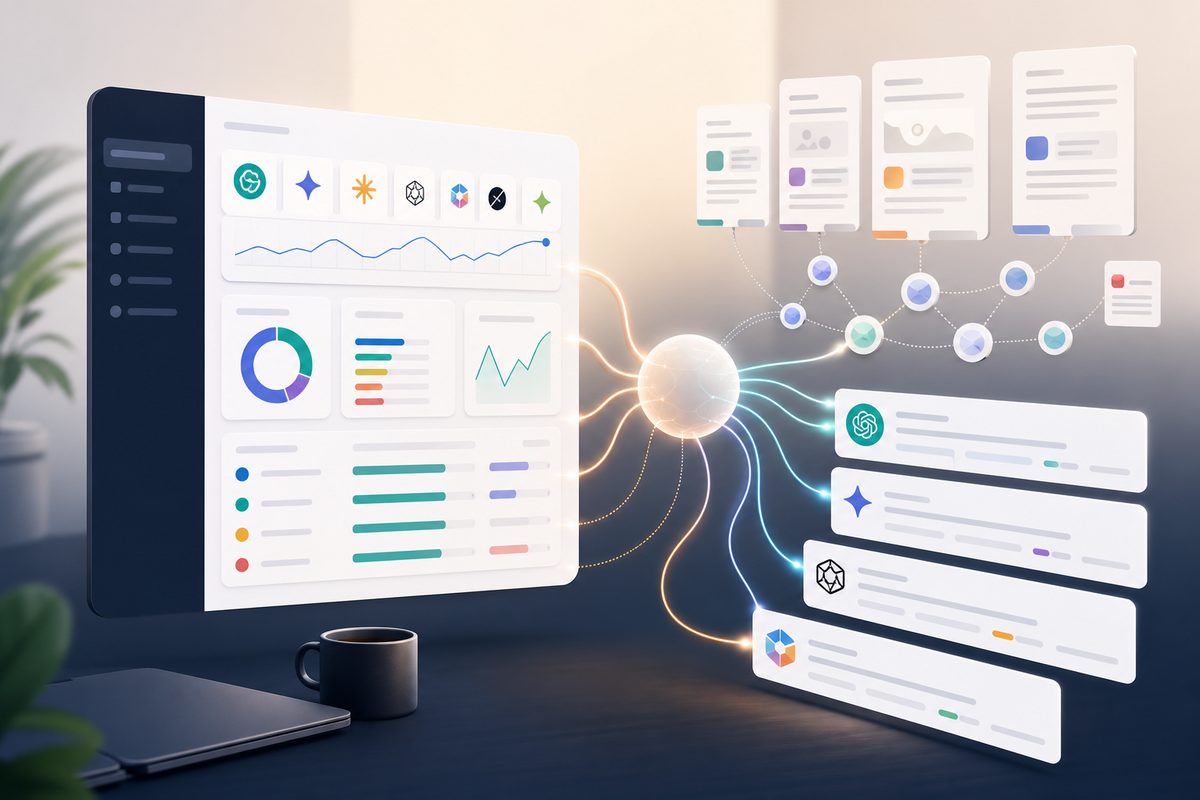
GEO citation tracking is the process of recording which sources AI answer engines cite for your target prompts, mapping those sources to answer claims, and turning the evidence into fixes for owned content, third-party coverage, reviews, documentation, and brand reputation.
It matters because AI search visibility is not only about whether your brand appears. The operational question is sharper: which source made the answer say that?
A useful GEO citation tracking workflow connects five things:
- The prompt a buyer or stakeholder might ask.
- The answer an AI engine returned.
- The URLs, domains, and source types cited.
- The exact claims those sources support or fail to support.
- The next repair owner: SEO, content, PR, product marketing, reviews, docs, support, or comms.
That is the difference between collecting screenshots and running a defensible generative engine optimization program.

What Is GEO Citation Tracking?
GEO citation tracking is source-level analysis for AI answers. It records the prompt, engine, generated response, cited URLs, cited domains, claim evidence, brand mentions, sentiment, and source ownership so teams can understand why an AI answer included, ignored, recommended, or misrepresented a brand.
Traditional rank tracking asks, "Where does our URL rank?"
GEO citation tracking asks, "Which sources shaped the answer, and what should we fix?"
That distinction is important because ChatGPT, Gemini, Perplexity, Claude, Copilot, Grok, Google AI Mode, and AI Overviews do not expose source influence in the same way. An answer may:
- Mention your brand but cite no page.
- Cite a third-party article instead of your product page.
- Cite a page that supports only one sentence in the answer.
- Recommend a competitor because review sites or analyst pages frame them better.
- Use outdated language from an old profile, forum thread, or documentation page.
If you already measure AI search visibility across engines, citation-level tracking explains why visibility changed.
GEO Citation Tracking vs Rank Tracking vs Brand Monitoring
Rank tracking, AI brand monitoring, and GEO citation tracking measure different layers of discovery. You need all three if AI answers influence how buyers evaluate your category.
| Measurement Type | Main Question | Unit Tracked | Best For |
|---|---|---|---|
| Traditional rank tracking | Where does a URL rank in Google results? | Keyword + URL position | SEO performance, content prioritization, SERP changes |
| AI brand monitoring | Is the brand mentioned, recommended, or criticized? | Prompt + answer + brand status | Awareness, reputation, competitor visibility |
| GEO citation tracking | Which sources shaped the answer? | Prompt + claim + cited source | Source repair, citation growth, claim accuracy, cross-team action |
A brand can rank well and still lose AI recommendations if answer engines prefer review sites, competitor comparison pages, analyst roundups, or documentation pages. A brand can also be mentioned frequently but in a negative or inaccurate way. Citation tracking is the layer that shows the source cause.
Why Citation Counts Alone Are Not Enough
A citation count tells you how often URLs appear; it does not prove those URLs shaped the answer. The practical question is not only "Were we cited?" but "Did the cited source make the answer recommend us, misunderstand us, or choose a competitor?"
A 2026 paper, From Citation Selection to Citation Absorption, analyzed 602 controlled prompts, 21,143 valid search-layer citations, and 18,151 fetched pages across ChatGPT, Google AI Overview/Gemini, and Perplexity. The authors found that citation breadth and citation influence differ by platform, and that high-influence pages tend to be structured, semantically aligned, and rich in definitions, numerical facts, comparisons, and procedural steps (arXiv:2604.25707).
The marketing lesson is direct: track citations, but optimize for answer influence.
A page can be cited without supplying the decisive claim. Another page can shape the answer even when the visible attribution goes elsewhere. That is why citation tracking must include claim mapping, not just URL counting.
How AI Answers Connect Back to Source Pages
AI answers connect to source pages through retrieval, source selection, answer generation, and attribution. A search-enabled model finds candidate documents, selects or reranks sources, generates an answer, and may attach citations to some pages that support the response.
A practical workflow separates four layers:
| Layer | Question to Ask | What to Track |
|---|---|---|
| Retrieval | Was the source likely found? | Indexation, crawlability, query match, internal links, external references |
| Selection | Was the source shown as a citation? | Cited URL, citation order, cited domain, source type |
| Absorption | Did the answer use the source's facts or framing? | Claim-source match, copied terminology, numbers, comparisons, criteria |
| Attribution | Did the interface visibly credit the source? | Visible citation, citation label, linked page, answer placement |
Google's AI features guidance says the same foundational SEO practices still apply to AI Overviews and AI Mode, pages must be indexed and snippet-eligible to appear as supporting links, and there is no special schema required just for those features (Google Search Central).
That means GEO citation tracking should not become a hunt for secret markup. The stronger move is to make important claims crawlable, visible, current, well-linked, and corroborated by trusted sources.
What Current GEO Guides Usually Miss
Most GEO content explains definitions, tools, and broad AI visibility tactics. The missing operational layer is citation-to-action diagnosis: deciding whether the next fix belongs to content, PR, reviews, documentation, support, or reputation management.
Typical coverage looks like this:
| Common Topic | Usually Covered | Missing Piece |
|---|---|---|
| GEO definitions | What generative engine optimization means | How to inspect a cited source at claim level |
| AI visibility tools | Mention tracking, share of voice, engine coverage | How to turn source evidence into a repair queue |
| Citation earning | Add stats, structure, sources, and clarity | Which source type is failing and who owns it |
| AI Overview guidance | Crawlability, indexation, snippets | Cross-engine source comparison |
| Brand reputation | Whether the answer is positive or negative | Which page or profile caused the statement |
This article uses a practical unit that is more useful than a screenshot: the claim-source pair.
A claim-source pair contains:
- The answer sentence.
- The cited URL or likely source.
- Whether the source fully supports, partially supports, contradicts, or does not support the claim.
- The owner who can repair the source.
- The expected business impact if the answer changes.
For a broader primer before going deeper, read AI Search Citations: Definition, Tracking, and How to Earn Them.
The GEO Citation Ledger: What to Record
A citation ledger is the working database behind GEO citation tracking. It should preserve raw evidence, normalize cited sources, map answer claims, and assign next actions. Without this ledger, teams usually debate anecdotes instead of fixing source gaps.
Use these fields:
| Field | What to Record | Why It Matters |
|---|---|---|
| Prompt ID | Stable ID for each prompt | Lets you compare results over time |
| Prompt text | Exact query tested | Preserves intent and wording |
| Prompt cluster | Category, comparison, integration, reputation, pricing, use case | Groups work by business priority |
| Engine | ChatGPT, Gemini, Perplexity, Claude, Copilot, Grok, AI Mode, AI Overviews | Shows platform differences |
| Run date and time | Timestamp of the answer | AI answers change frequently |
| Location or market | Country, language, or region if relevant | Localizes source behavior |
| Account state | Logged in/out, personalization known or unknown | Reduces false certainty |
| Raw answer | Full answer text or stored snapshot | Preserves what users saw |
| Brand status | Recommended, listed, mentioned, absent, criticized | Connects citations to visibility |
| Sentiment | Positive, neutral, negative, mixed | Finds reputation risk |
| Cited URL | Exact source URL shown | Connects answer to source page |
| Canonical URL | Normalized page after parameter cleanup | Prevents duplicate counting |
| Domain | Root domain | Shows source concentration |
| Source type | Owned, competitor, earned media, review, forum, docs, marketplace, analyst, social | Routes the fix |
| Citation position | First, middle, late, hidden, unavailable | Estimates prominence |
| Answer claim | Sentence or claim the citation appears to support | Enables verification |
| Support score | 0-3 claim support rating | Separates strong evidence from weak attribution |
| Fix owner | Team responsible for repair | Turns tracking into action |
| Repair action | Rewrite, update, outreach, profile cleanup, docs fix, review program | Creates a work queue |
| Post-fix result | Change after rerun | Proves impact |
The most important fields are answer claim, support score, and fix owner. Those are what turn GEO citation tracking from reporting into execution.
The Claim Support Score
The Claim Support Score grades whether a cited source actually backs the AI answer. It is a simple 0-3 scale that helps teams prioritize accuracy, reputation risk, and source repairs.
| Score | Meaning | Example | Action |
|---|---|---|---|
| 0 | Unsupported | Answer claims your tool lacks an integration, but the cited page does not discuss integrations | Treat as accuracy risk; inspect other sources and repair the clearest public page |
| 1 | Weak or indirect | Source mentions a feature but not the buyer use case in the answer | Add a clearer use-case section or supporting page |
| 2 | Partially supported | Source supports the claim but is outdated, incomplete, or missing context | Update facts, dates, examples, and limitations |
| 3 | Directly supported | Source clearly supports the claim with current visible evidence | Preserve the page and strengthen internal/external corroboration |
Use this score at the claim level, not the page level. One cited page can strongly support a pricing claim but weakly support a security claim.
A 2026 measurement study of Google AI Overviews issued 55,393 trending queries over 40 days and decomposed responses into 98,020 atomic claims. It found that 11.0% of claims were unsupported by cited pages, and nearly 30% of AI Overview-cited domains did not appear in co-displayed first-page results (arXiv:2605.14021). That is why citation tracking must verify claims instead of assuming every citation is accurate.
The Citation-to-Action Matrix
The Citation-to-Action Matrix turns citation evidence into an owner and a fix. It prevents the common mistake of assigning every AI visibility problem to the blog team when the real issue may sit in PR, reviews, documentation, support, or third-party profiles.
| Citation Pattern | What It Means | Primary Owner | Best Next Fix |
|---|---|---|---|
| Owned page cited, answer accurate | The page is eligible and useful | SEO or content | Preserve URL, strengthen internal links, add current examples |
| Owned page cited, answer incomplete | The page is useful but not extractable enough | Content, product marketing | Add direct definitions, "best for" language, comparison tables, dates, and evidence |
| Owned page cited, answer wrong | The source is ambiguous, outdated, or contradicted elsewhere | Content, docs, product marketing | Rewrite the claim block, update visible facts, remove obsolete language |
| Competitor page cited, your brand absent | Competitor has a better source for the prompt | SEO, content, growth | Build or improve the missing page type; compare evidence, not slogans |
| Third-party article cited, competitor framed better | Earned media is shaping shortlist language | PR or comms | Pitch updated proof, correct outdated descriptions, earn category coverage |
| Review site cited with weak profile | Review ecosystem lowers confidence in your brand | Customer marketing | Update categories, use cases, integrations, review responses, and customer proof |
| Docs page cited for product claims | Technical sources are trusted for feature details | Documentation, product marketing | Add plain-language summaries, examples, limitations, and changelog links |
| Forum or community thread cited | Community language is filling evidence gaps | Support, community, comms | Address recurring complaints, publish durable support answers, correct outdated narratives |
| Brand mentioned with no citation | Model may rely on memory or unshown retrieval | AI search monitoring owner | Rerun in web-enabled modes, inspect surfaced sources, track volatility |
| No mention and no citation | Source coverage is weak or prompt set is misaligned | SEO lead | Validate prompt demand, create sourceable pages, build external corroboration |
If AI engines recommend competitors instead of your brand, pair this matrix with What to Do When AI Recommends Your Competitor Instead of You.
How to Track AI Citations Step by Step
To track AI citations, define business-critical prompts, run them across engines, save raw answers, normalize cited URLs, map claims to sources, score support, assign repair owners, and rerun the same prompt set after fixes.
Follow this workflow:
-
Build a prompt set. Group prompts by category, use case, competitor comparison, integration, pricing sensitivity, industry, job role, and reputation risk. Prioritize prompts that could influence pipeline or executive perception.
-
Run prompts across multiple engines. Include ChatGPT, Gemini, Perplexity, Claude, Copilot, Grok, Google AI Mode, and AI Overviews where access is available. One engine is not the market.
-
Repeat important prompts. AI answers are variable. For high-intent prompts, run at least three variants or repeated checks before treating a change as meaningful. A 2026 statistical paper on AI visibility measurement warned that single-run point estimates can be misleading because citation distributions vary across repeated samples (arXiv:2603.08924).
-
Capture raw evidence. Save answer text, timestamp, engine, market, account state if known, citation links, citation order, and screenshots when needed.
-
Normalize cited URLs. Remove tracking parameters, consolidate canonicals, group by domain, and tag each source as owned, competitor, earned media, review, community, documentation, marketplace, analyst, or social.
-
Map claims to sources. Highlight each important answer claim and identify which source supports it. Mark the claim as supported, partially supported, contradicted, outdated, or unsupported.
-
Score business impact. Weight prompts by buying intent, revenue relevance, brand risk, competitor exposure, and funnel stage. A citation in "best SOC 2 automation tools for enterprise SaaS" is not equal to a citation in "what is SOC 2?"
-
Assign the repair. Use the Citation-to-Action Matrix so the right team owns the fix.
-
Rerun and compare. Measure citation rate, brand mention rate, recommendation rate, claim support, sentiment, and competitor displacement after the source repair.
For the broader execution layer, use How to Optimize for AI Search: The GEO Checklist (2026).
What Metrics Belong in a GEO Citation Dashboard?
A GEO citation dashboard should measure visibility, source quality, answer accuracy, and actionability. If it only counts mentions, it will not show whether your brand is gaining influence, losing to competitors, or being described incorrectly.
| Metric | Definition | Why It Matters |
|---|---|---|
| Citation rate | Share of prompt runs where your URL is cited | Measures owned-source visibility |
| Domain citation share | Share of all citations captured by your domain | Shows source footprint versus competitors |
| Brand mention rate | Share of answers that mention your brand | Measures AI answer awareness |
| Recommendation rate | Share of answers where your brand is recommended | Measures shortlist performance |
| AI share of voice | Your brand presence versus competitors across prompt sets | Benchmarks category visibility |
| Cited URL coverage | Number and type of URLs cited | Finds source concentration and gaps |
| Citation prominence | Whether your source appears early, late, or only in expanded citations | Estimates user-visible influence |
| Claim support rate | Share of important claims supported by cited sources | Measures accuracy and trust |
| Unsupported claim count | Claims with no clear source support | Flags reputation and legal review risk |
| Negative or incorrect mention rate | Share of answers with damaging or wrong descriptions | Supports AI reputation management |
| Fix velocity | Time from issue detection to source repair | Measures operational response |
| Post-fix lift | Change in citations, mentions, recommendations, and support score | Proves whether repairs worked |
Do not use AI share of voice as the only KPI. A brand can have high visibility because answers repeatedly say it is expensive, limited, risky, or less suitable than a competitor. Use AI Search Share of Voice: How to Measure, Benchmark, and Improve It for the competitive layer, then use citation tracking to explain source causes.
How to Prioritize Citation Fixes
Prioritize citation fixes by prompt value, answer influence, claim risk, and repair difficulty. The best first fix is not always the page with the most citations. It is the source gap most likely to change high-value answers.
Use this priority formula:
Priority = Prompt Value x Answer Prominence x Business Risk x Repair Feasibility
| Factor | High Score Looks Like | Low Score Looks Like |
|---|---|---|
| Prompt value | Buying, comparison, pricing, security, or reputation prompt | Broad educational prompt with weak pipeline relevance |
| Answer prominence | Brand absent from shortlist or competitor recommended first | Brand mentioned in a low-visibility paragraph |
| Business risk | Wrong claim affects revenue, trust, legal, support, or executive perception | Minor wording issue |
| Repair feasibility | Owned page, profile, docs page, or responsive partner source | Unreachable third-party article or volatile forum thread |
A practical weekly queue should include:
- Critical accuracy fixes: wrong product claims, outdated pricing, false limitations, negative reputation claims.
- High-intent competitor losses: prompts where competitors are recommended and your brand is absent.
- Owned-page extraction fixes: pages cited but not used clearly.
- Third-party source repairs: review profiles, analyst pages, partner listings, roundups, and outdated bios.
- Authority-building gaps: categories where no credible source explains your fit.
This keeps GEO citation tracking tied to business outcomes instead of vanity metrics.
How Citation Analysis Routes Work Across Teams
Citation-level analysis shows which surface needs work. Owned pages usually call for content and SEO fixes; third-party citations often call for PR; review citations require customer marketing; documentation citations require product and technical writing.
| If the AI Answer Cites… | Likely Diagnosis | Best Repair Path |
|---|---|---|
| Your product page | Page is eligible, but claims may need clearer structure | Add extractable definitions, use cases, proof, and current facts |
| Your blog post | Informational source exists, but product fit may be weak | Add product-led context or link to stronger commercial pages |
| Competitor comparison page | Competitor owns the comparison frame | Build a comparison-ready page with evidence and clear criteria |
| Review site | Buyers and AI systems are using review ecosystems as proof | Improve category tags, use-case language, integrations, and review coverage |
| Analyst or media article | Third-party authority shapes category framing | Pitch updated proof and correct outdated positioning |
| Documentation | Technical pages are trusted but may lack buyer context | Add summaries, examples, limitations, and links to product pages |
| Community thread | Public objections or outdated narratives are visible | Publish clear support answers and address recurring complaints |
| Marketplace listing | Integration or ecosystem proof is thin | Update listing copy, screenshots, compatibility, and customer use cases |
The most common mistake is treating all citation problems as blog problems. In many B2B categories, the decisive source is a review profile, integration listing, help doc, analyst mention, or comparison page.
Worked Example: Turning One AI Answer Into a Fix Plan
A single AI answer can produce several workstreams when citations are mapped correctly. The useful move is to split the answer into claims, sources, source owners, and repair actions.
Assume a B2B SaaS company asks:
What are the best customer onboarding platforms for enterprise software teams?
The AI answer recommends three competitors and omits the company. It cites:
| Cited Source | Source Type | What It Supports | Likely Fix |
|---|---|---|---|
| Competitor comparison page | Competitor owned | "Best for complex enterprise onboarding" | Create or improve an enterprise onboarding use-case page with implementation evidence |
| G2 category page | Review site | "Highest-rated onboarding tools" | Update profile, category tags, integrations, review request targeting, and responses |
| Trade publication roundup | Earned media | "Popular tools for SaaS onboarding" | Pitch updated category story and customer proof |
| Old company template post | Owned content | "Useful onboarding templates" but not core product positioning | Refresh, consolidate, or redirect so it supports the product narrative |
The fix plan is not "publish more content." It is:
- Build a sourceable enterprise onboarding page.
- Add comparison-ready facts: integrations, implementation timeline, security, analytics, customer fit, and limitations.
- Update review profiles and request reviews from enterprise users.
- Pitch a trade publication with a current customer example.
- Refresh or redirect the old template post so it does not dilute positioning.
- Rerun the same prompt set after updates are crawled or published.
Success is not only a click. It is whether the brand appears in the shortlist, whether the cited URL changes, whether the answer uses the correct positioning, and whether competitors lose citation share.
What Makes a Page Easier for AI Engines to Cite?
AI-citable pages are clear, specific, current, crawlable, and evidence-rich. They answer one intent directly, include extractable facts, use consistent entity language, and make important claims visible in text.
Prioritize these page elements:
| Page Element | Better Pattern |
|---|---|
| Definition | One direct "X is…" paragraph near the top |
| Category fit | Clear "best for" and "not best for" statements |
| Use cases | Named industries, teams, workflows, and buyer problems |
| Comparison | Tables with criteria, differences, limitations, and evidence |
| Proof | Numbers, dates, customer examples, screenshots, product facts |
| Entity clarity | Consistent brand, product, category, audience, and competitor names |
| Freshness | Visible update dates where they genuinely matter |
| Internal links | Links from category, product, docs, comparison, and use-case pages |
| Structured data | Markup that matches visible page content |
| Access | Indexable, snippet-eligible, and not blocked by robots or preview controls |
Google's people-first content guidance asks whether content provides original information, a complete description, analysis beyond the obvious, and enough detail for readers to achieve their goal (Google Search Central). That standard fits GEO work because generic pages give answer engines little to quote, compare, or trust.
Also keep structured data honest. Google's structured data guidelines say not to mark up content that is hidden from readers and to keep structured data representative of the visible page (Google Search Central). Schema can help machines understand a page, but it cannot rescue unclear or contradictory visible content.
How to Diagnose Citation Gaps
A citation gap exists when an AI answer relies on another source where your brand should have been eligible, accurate, and useful. The gap may come from missing content, weak evidence, poor entity clarity, outdated third-party descriptions, thin reviews, or inaccessible source pages.
Use this taxonomy:
| Gap Type | Symptom | Repair |
|---|---|---|
| Page gap | Competitor cited for a use case you do not cover | Create or improve the relevant page |
| Evidence gap | Your page exists but lacks proof | Add examples, numbers, screenshots, customer evidence, and current facts |
| Entity gap | AI confuses your product, category, audience, or company name | Standardize naming across site, schema, profiles, PR, docs, and listings |
| Authority gap | Third-party pages dominate the answer | Earn stronger external corroboration from credible sources |
| Review gap | Review sites shape the shortlist against you | Improve profile accuracy, category coverage, and customer review volume |
| Freshness gap | AI cites outdated descriptions | Update owned pages and request corrections from third-party sources |
| Technical gap | Important content is not available as text | Fix crawlability, rendering, indexation, snippets, and blocked resources |
| Sentiment gap | Brand appears with negative or outdated framing | Repair source pages and prioritize reputation workflows |
| Comparison gap | Competitors define the evaluation criteria | Publish evidence-based comparison and alternatives pages |
If the citation gap is mainly about wrong or damaging brand descriptions, use the repair workflow in How to Fix Negative ChatGPT Mentions Before They Cost Pipeline.
How Often Should Teams Run GEO Citation Tracking?
Run high-value prompts daily, strategic prompt sets weekly, and full prompt libraries monthly. AI answers change often enough that one-off checks are weak, but not every prompt deserves daily monitoring.
| Prompt Type | Example | Recommended Cadence |
|---|---|---|
| High-intent buying prompts | "best X software for enterprise teams" | Daily |
| Competitor comparison prompts | "X vs Y alternatives" | Daily or weekly |
| Reputation prompts | "is [brand] reliable" | Daily |
| Pricing and packaging prompts | "how much does [category] software cost" | Weekly |
| Category education prompts | "what is X" | Weekly |
| Integration prompts | "tools that integrate with Y" | Weekly |
| Long-tail workflow prompts | "how to solve [specific issue]" | Monthly |
| Campaign or incident prompts | Launch, funding, outage, pricing change, controversy | Daily during the event window |
Daily tracking is most useful when the answer could influence pipeline, reputation, sales enablement, analyst perception, or executive visibility. Weekly tracking is enough for steady optimization. Monthly audits work for long-tail source coverage.
The output should be a fix queue, not a report archive. Every recurring run should answer:
- What changed?
- Which prompts matter?
- Which source caused the change?
- Is the answer accurate?
- Who owns the repair?
- Did the previous fix move citations, recommendations, or claim support?
Manual Tracking vs GEO Citation Tracking Tools
Manual tracking works for a small prompt set, but tools become necessary when you need repeated sampling, cross-engine coverage, source normalization, competitor benchmarks, and historical trend analysis.
| Approach | Best For | Limitations |
|---|---|---|
| Manual spreadsheet | Early validation, small teams, 20-50 priority prompts | Slow, inconsistent screenshots, weak trend analysis |
| SEO rank tracker only | Traditional Google rankings | Does not map AI answer claims to sources |
| AI brand monitoring tool | Mentions, sentiment, share of voice | May not provide enough claim-level source diagnosis |
| GEO citation tracking workflow | Source repair, claim verification, team ownership | Requires clean prompt design and disciplined review |
| Full AI visibility platform | Multi-engine dashboards, history, alerts, competitor tracking | Still needs human diagnosis for complex source repairs |
No tool can see every hidden retrieval step inside every model. The realistic goal is to track observable answer evidence consistently enough to make better decisions.
Common Mistakes in GEO Citation Tracking
The biggest mistake is treating GEO as keyword SEO with a new label. Citation-level work requires prompt sampling, source analysis, claim verification, and cross-functional ownership.
Avoid these mistakes:
| Mistake | Why It Hurts |
|---|---|
| Checking one prompt once | AI answers vary, so one run is weak evidence |
| Counting citations without claim mapping | You may credit a source that did not support the important claim |
| Counting brand mentions without sentiment | A mention can be negative, inaccurate, or non-recommendatory |
| Ignoring citations that do not mention your brand | Those sources may define criteria that exclude you |
| Treating all prompts equally | Low-intent education prompts should not outrank high-intent buying prompts |
| Optimizing only owned content | AI answers often rely on reviews, media, docs, forums, and marketplaces |
| Adding schema that contradicts visible text | Structured data should represent what readers can see |
| Hiding key claims in images or scripts | Important facts should be available in crawlable text |
| Rewriting every page generically | Citation failures need diagnosis, not blanket edits |
| Reporting screenshots instead of actions | Executives need trend, cause, risk, and repair plan |
A 2026 paper on diagnosing citation failures introduced AgentGEO, a system that reported more than 40% relative improvement in citation rates while modifying only 5% of content, compared with 25% for baselines (arXiv:2603.09296). The practical lesson is simple: targeted source repair usually beats generic rewriting.
How to Report GEO Citation Tracking to Executives
Executive reporting should connect citations to market visibility, recommendation share, source causes, and fixable risks. Do not lead with screenshots. Lead with what changed, why it matters, and what action will improve the next run.
A useful executive summary has five lines:
- Visibility: "We appeared in 42% of priority AI answers this week, up from 35%."
- Recommendation: "We were recommended in 18% of high-intent shortlist prompts, while Competitor A appeared in 54%."
- Source cause: "The largest gap is review-site and analyst-source coverage, not owned blog content."
- Risk: "Three answers describe our integration support incorrectly, sourced from outdated third-party pages."
- Action: "Next sprint: update integration pages, correct two third-party profiles, and pitch one category proof story."
This style makes GEO citation tracking defensible. It connects AI search monitoring to work the business already understands: pipeline influence, reputation risk, competitive positioning, and content investment.
Frequently Asked Questions
What is GEO citation tracking?
GEO citation tracking is the process of recording which URLs AI answer engines cite for target prompts, mapping those URLs to answer claims, and assigning source repairs. It helps teams understand why AI answers mention, recommend, ignore, or misrepresent a brand.
How is GEO citation tracking different from traditional rank tracking?
Traditional rank tracking follows URL positions in search results. GEO citation tracking follows source influence inside AI answers. It records cited pages, answer claims, brand status, sentiment, recommendation rate, and source ownership across AI engines.
Can we force ChatGPT, Gemini, Perplexity, or Google AI Overviews to cite our page?
No. You can improve eligibility and usefulness, but you cannot force a citation. The practical path is to make source pages clearer, more current, crawlable, better linked, and corroborated by credible third-party evidence. Then track whether citation rate and recommendation rate improve.
Should every AI answer cite our homepage?
No. Homepages are usually too broad. AI engines may prefer product pages, comparison pages, documentation, review profiles, analyst articles, category guides, customer stories, or community discussions depending on the prompt. The goal is the right source for the question.
What should we do when AI mentions the brand but gives no citation?
Treat it as a visibility signal, not proof. Rerun the prompt in web-enabled modes where available, test paraphrases, inspect surfaced sources, and compare the answer against known owned and third-party pages. If the claim is wrong, prioritize source repair and reputation management.
What is the fastest way to improve AI citations?
The fastest reliable improvement is usually a targeted source repair. Start with high-intent prompts, identify the sources currently winning citations, compare their evidence against yours, and fix the specific gap: missing page type, outdated claim, weak review profile, unclear documentation, or lack of third-party corroboration.
How many prompts should a team track?
Start with 30-100 prompts: high-intent buying prompts, competitor comparisons, category education, integrations, pricing, use cases, and reputation queries. Expand only after the team can consistently map citations to claims and ship repairs.