I’ll verify the external evidence first so the rewrite only keeps links that are real, accessible, and directly support the claims.—
title: "Why AI Cites Competitors Instead of You: Causes, Audit, and Fixes | maxaeo"
description: "Find out why AI cites competitors instead of your brand, how citation selection works, and how to repair source gaps across freshness, proof, authority, and structure."
slug: "why-ai-cites-competitors"
keywords: ["why AI cites competitors", "ai citations", "AI search visibility", "answer engine optimization", "generative engine optimization", "AI share of voice", "LLM brand tracking", "source freshness", "citation gap audit"]
intent: "informational"
author: "maxaeo"
schema: "Article"
datePublished: ""
dateModified: ""
Why AI Cites Competitors Instead of Your Pages
If you are asking why AI cites competitors, the short answer is this: their source is easier for the answer engine to find, trust, quote, and connect to the user's question. The competitor may not have a better product. It may simply have clearer evidence, fresher facts, stronger third-party validation, and a passage that fits the prompt better than your page.
This matters because AI search visibility is no longer a soft brand metric. In a 2026 Semrush survey reported by Business Insider, 37% of marketers said competitors were mentioned more often than their brand in AI search, and 30% said AI systems described their brand inaccurately.
The fix is not “publish more GEO content.” The fix is to identify which source beat you, why it was safer to cite, and what source-level repair will change the answer.
The Direct Answer
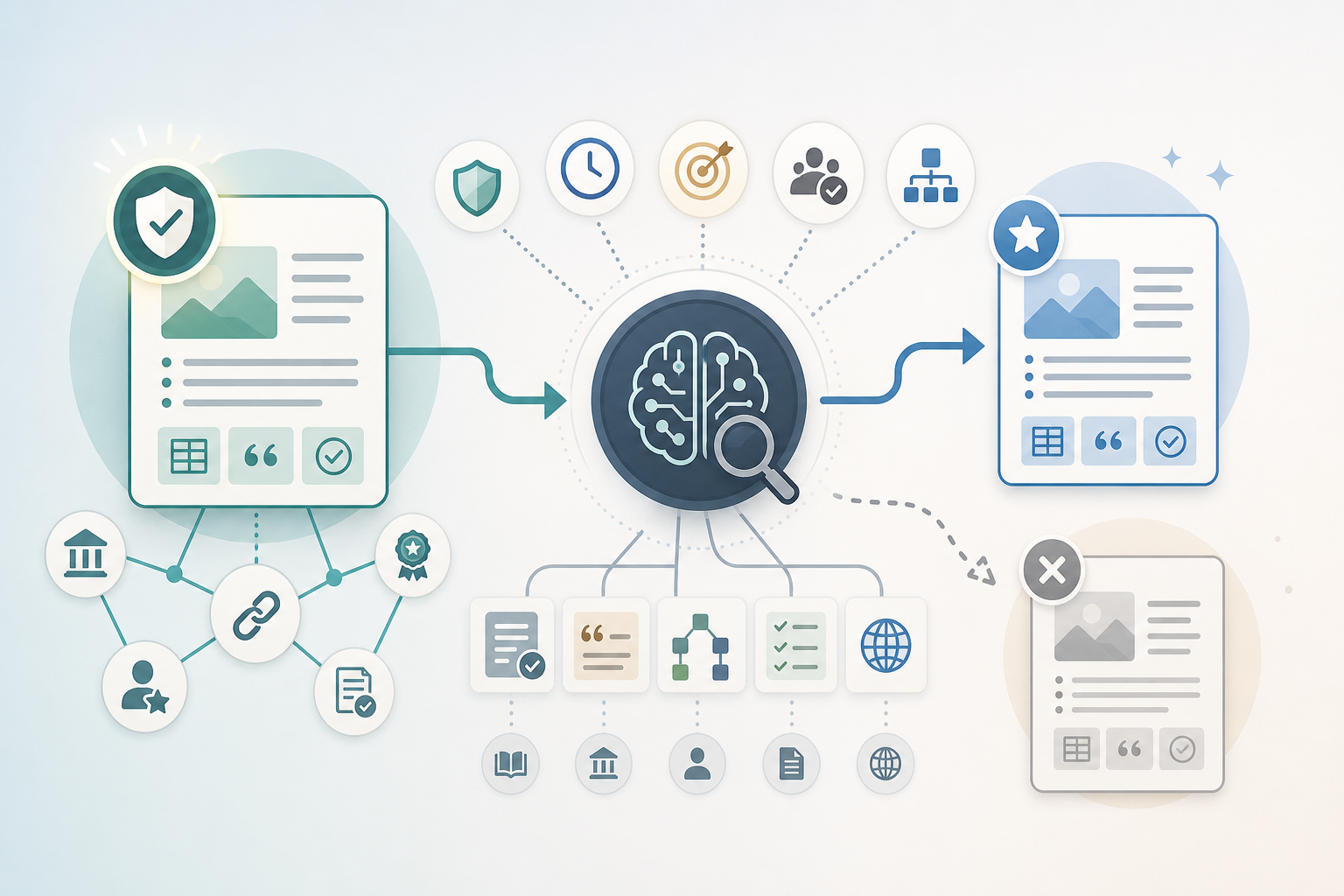
AI cites competitors when their pages or third-party mentions are more retrievable, specific, current, corroborated, and extractable than yours. Citation selection is influenced by search ranking, page accessibility, prompt relevance, visible proof, source reputation, entity consistency, and whether the answer can reuse a clean passage without inventing missing context.
Think of AI citation selection as a five-layer filter:
- Discovery: Can the system find and crawl the source?
- Retrieval fit: Does the source match the user's exact question and related sub-questions?
- Evidence quality: Does the page contain facts, examples, dates, comparisons, and proof?
- Source confidence: Do other credible sources confirm the same brand, category, and claims?
- Answer usability: Can the system quote or summarize a passage without heavy interpretation?
Your competitor only needs to beat you on one or two of those layers to earn the citation.
What an AI Competitor Citation Actually Means
An AI citation is a source link used to support a generated answer. A competitor citation means the system selected a rival's owned page, review profile, partner listing, documentation, comparison article, media mention, community thread, or marketplace page as better evidence for that prompt.
For diagnosis, separate five outcomes:
| Outcome | What happened | What to diagnose |
|---|---|---|
| Mention | The AI names your brand but does not link to you | Entity awareness and category association |
| Citation | The AI links to a source about your brand | Source quality and extractable evidence |
| Recommendation | The AI includes a brand in a shortlist | Fit-case relevance and comparative proof |
| Description | The AI explains what your company does | Accuracy of public brand facts |
| Omission | The AI cites competitors but not you | Source gaps, retrievability, and external corroboration |
This is why why AI cites competitors is not only an SEO problem. It is also a source governance problem. AI systems may be building answers from pages your brand team rarely audits: review sites, partner directories, changelogs, docs, YouTube transcripts, Reddit threads, analyst pages, old PR, and comparison posts.
Why Competitors Win: The 9 Most Common Causes
1. Their Page Matches the Prompt Better
AI search is not limited to exact keywords. Google's guide to optimizing for generative AI features explains that AI features can use retrieval-augmented generation and query fan-out, where related searches are generated to answer a broader question.
That means your page is competing across many hidden sub-questions, not only the keyword you optimized for.
For example, a user may ask:
“Best AI visibility tool for tracking competitor mentions in ChatGPT and Perplexity”
A vague product page that says “improve AI search performance” is less useful than a competitor page that names:
- ChatGPT, Perplexity, Gemini, Claude, Google AI Overviews, and AI Mode
- citation tracking
- competitor prompt monitoring
- share of voice reporting
- sentiment and description accuracy
- screenshots and cited URLs
The competitor page wins because it gives the system language it can directly map to the user's task.
2. Their Source Is Easier to Crawl and Parse
AI systems cannot cite content they cannot access, index, parse, or confidently associate with the query. Common blockers include:
- important copy rendered only after complex JavaScript
- product details hidden behind tabs, modals, or gated forms
- thin pages with little indexable text
- broken canonical tags
- no internal links to the relevant page
- blocked crawlers or restrictive robots rules
- pricing, integrations, or feature details only available in PDFs
- duplicated pages that confuse the canonical source
Google's AI search guidance says pages need to be indexed and eligible to appear with a snippet, and that crawlable content and technical SEO fundamentals still matter for generative AI features. There is no citation shortcut if the source is not technically usable.
3. Their Page Has a Better “Answer Block”
An answer engine needs a concise passage it can reuse. If your point is spread across a hero headline, three benefit cards, a testimonial carousel, and a PDF, the system has to infer too much.
A citation-ready answer block usually has:
- a descriptive H2 or H3
- a 40-60 word direct answer
- supporting bullets or a table
- visible facts close to the claim
- a source or methodology for external claims
- specific nouns instead of abstract positioning language
Weak answer block:
“Our platform helps modern teams unlock better AI discovery.”
Strong answer block:
“maxaeo tracks how AI systems mention, rank, cite, and describe your brand across prompt sets. Teams use it to monitor competitor recommendations, identify missing source citations, repair inaccurate AI answers, and measure AI search share of voice by product category, use case, and platform.”
The second version is easier to cite because it names the task, audience, outputs, and use cases.
4. Their Facts Are Fresher
Freshness changes citation odds when the prompt implies current information: pricing, feature availability, integrations, rankings, benchmarks, compliance, leadership, funding, customer counts, market maps, or “best tool” recommendations.
The 2026 paper What Gets Cited: Competitive GEO in AI Answer Engines ran 252,000 controlled trials across six LLMs. The authors found topical relevance and list position were major drivers of first citation, while explicit price information and recent timestamps also helped consistently. Completeness and trust cues added smaller gains, and formatting-only edits had little impact.
The lesson is not to fake freshness. Google's helpful content guidance warns against changing dates when the content has not substantially changed. The right repair is to update the facts:
- replace old screenshots
- remove retired features
- refresh pricing or packaging language
- add a visible “last updated” note when meaningful
- show what changed
- update third-party profiles that still describe the old product
5. Their Claims Have Visible Proof
AI systems prefer sources that reduce uncertainty. A page that says “trusted by leading enterprises” is weaker than a page with named customers, quantified outcomes, screenshots, security details, integration lists, review evidence, or a transparent methodology.
For B2B SaaS, citation-ready proof can include:
- named integrations and supported platforms
- security certifications and data handling details
- implementation time ranges
- pricing model or packaging logic
- customer examples tied to a use case
- screenshots of workflows
- benchmark methodology
- public changelog entries
- comparison tables with limitations
- third-party review or partner profile links
The practical rule: put proof next to the claim it supports. Do not make the answer engine hunt across a site to verify one sentence.
6. Their Third-Party Source Graph Is Cleaner
Owned pages are not the only citation candidates. AI systems may choose review sites, analyst pages, GitHub repositories, marketplace listings, documentation, forum discussions, media articles, app directories, partner pages, podcasts, or YouTube transcripts.
Third-party pages often win because they look less self-promotional. They also help resolve entity confidence: what your company is called, what category it belongs to, who uses it, and what it is known for.
Competitors win when their source graph is consistent:
| Source type | Strong signal | Weak signal |
|---|---|---|
| Website | Clear category, use cases, proof | Abstract positioning copy |
| Reviews | Recent, specific buyer language | Few reviews or outdated categories |
| Partner pages | Named integrations and descriptions | Logo-only listings |
| Media | Current product narrative | Old funding or launch story |
| Community | Repeated use-case mentions | Conflicting or inaccurate threads |
| Docs | Detailed capabilities and limits | Marketing claims without specifics |
Google's AI guidance also warns against seeking inauthentic mentions. The durable move is to earn and maintain credible third-party sources that a human buyer would trust.
For a competitor-specific response plan, see what to do when AI recommends your competitor instead of you.
7. Their Entity Is Clearer Than Yours
AI systems need to know which brand, product, category, and audience a source refers to. Entity confusion is common when a company has changed positioning, merged products, rebranded, renamed features, or uses different descriptors across channels.
Audit these facts across your site and third-party profiles:
- official company name
- product name
- category
- primary use cases
- target customer
- industries served
- competitors and alternatives
- integrations
- pricing model
- regions served
- old names and acquired products
- founder or leadership facts, if relevant
If your homepage calls you an “AI growth platform,” your G2 profile says “SEO software,” your press coverage says “content automation,” and your docs say “brand monitoring,” an answer engine may choose a competitor with a cleaner category trail.
8. Their Page Is More Commercially Specific
Informational AI answers often sit close to buying decisions. Users ask “why,” but they also want to know what to fix, what tools to use, what proof matters, and how to compare options.
Competitor sources win when they include decision details such as:
- who the product is for
- who it is not for
- pricing model
- setup requirements
- supported platforms
- key limitations
- comparison criteria
- implementation timeline
- reporting outputs
- proof of accuracy
- data sources monitored
This is not keyword stuffing. It is buyer clarity. A page with specifics is easier for both humans and AI systems to evaluate.
9. Their Page Is Cited, but Yours Is Only Mentioned
A brand mention and a citation are different. A mention means the AI knows your name. A citation means the AI found a source it trusts enough to link.
The 2026 paper From Citation Selection to Citation Absorption analyzed 602 prompts, 21,143 valid search-layer citations, and 18,151 fetched pages. It found that being cited and actually shaping the answer are separate outcomes. High-influence pages tended to be longer, more structured, semantically aligned, and richer in extractable evidence such as definitions, numerical facts, comparisons, and steps.
That means your goal is not just “get a link.” Your goal is to publish sources whose facts are absorbed into the answer accurately.
Why Google Ranking Alone Does Not Guarantee AI Citations
Traditional SEO strength helps, but it does not guarantee AI citation visibility.
A 2026 study, Measuring Google AI Overviews, issued 55,393 trending queries over a 40-day window and found that nearly 30% of AI Overview-cited domains did not appear in the co-displayed first-page organic results. Another 2026 study comparing Google Search, Gemini, and AI Overviews across 11,500 queries found low overlap between retrieved sources across systems, with average Jaccard similarity below 0.2 in the reported comparisons.
The takeaway is simple: if AI cites competitors while you rank organically, do not assume Google ranking is the whole problem. Inspect the exact cited source, the passage used, and the sub-question the answer is trying to satisfy.
The Competitor Citation Gap Matrix
The fastest way to answer why AI cites competitors is to compare the winning source against your nearest equivalent source. Do not begin with a full site rewrite. Begin with the exact URL that beat you.
| Gap | Competitor source has | Your page may lack | First fix |
|---|---|---|---|
| Retrieval fit | Prompt language, category terms, use-case wording | Broad positioning copy | Add sections that mirror buyer questions |
| Passage answer | One clear paragraph that answers the query | Scattered claims | Add concise answer blocks under descriptive headings |
| Freshness | Updated facts, date, current screenshots | Old claims or stale examples | Refresh facts and state what changed |
| Proof | Numbers, examples, screenshots, sources | Unsupported benefits | Add evidence next to each key claim |
| Third-party validation | Reviews, partner pages, media, community references | Only owned content | Build credible external corroboration |
| Entity clarity | Consistent brand, product, and category descriptors | Conflicting public descriptions | Standardize source-of-truth facts |
| Commercial specificity | Pricing model, integrations, fit cases, limits | Generic benefits | Add buyer decision details |
| Source usability | Crawlable text, clean HTML, internal links | Blocked or buried content | Improve technical accessibility |
| Citation absorption | Facts that appear in the answer | URL appears but facts are ignored | Rewrite for extractable definitions, comparisons, and steps |
Use this matrix for each prompt cluster. It prevents a common mistake: publishing new content when the real issue is one stale comparison page, one weak third-party profile, or one missing proof section.
A Worked Example: Why the Competitor Got Cited
Prompt:
“What are the best tools to track AI search share of voice?”
Competitor source cited:
A comparison page with a definition of AI share of voice, a list of supported platforms, screenshots of dashboards, a methodology section, pricing notes, and a table comparing citation tracking, sentiment tracking, and competitor monitoring.
Your nearest source:
A blog post about AI search trends that mentions share of voice once, links to no product workflow, and does not define the metric.
Diagnosis:
| Layer | Competitor | Your source | Repair |
|---|---|---|---|
| Retrieval fit | Uses “AI search share of voice” in headings | Uses “AI visibility” broadly | Create a dedicated AI share of voice section or page |
| Evidence | Shows metric formula and screenshots | Explains concept abstractly | Add formula, examples, and reporting fields |
| Specificity | Names ChatGPT, Perplexity, Gemini, Google AI Overviews | Mentions “AI platforms” | Name monitored platforms where accurate |
| Commercial fit | Explains tool selection criteria | No buyer criteria | Add comparison criteria and use cases |
| Internal support | Links to product and measurement guides | No internal path | Link to measurement and citation tracking pages |
Repair path:
- Add a 50-word definition of AI search share of voice.
- Add a table showing mention share, citation share, rank position, sentiment, and description accuracy.
- Add screenshots or product examples where available.
- Link to a deeper guide on AI search share of voice.
- Retest the same prompt set after the page is crawled or updated in the relevant AI platform.
How to Diagnose Why AI Cites Competitors
A reliable audit starts with repeated prompt runs, not one screenshot. AI answers vary by platform, prompt wording, location, freshness, personalization, and retrieval state.
Step 1: Build a Prompt Set
Use prompts buyers would actually ask. Include:
- category prompts: “best [category] tools”
- problem prompts: “how to fix [pain]”
- comparison prompts: “[brand] vs [competitor]”
- use-case prompts: “best tool for [team/use case]”
- integration prompts: “[category] for [platform]”
- risk prompts: “is [brand] reliable/safe/accurate”
- evaluation prompts: “what should I look for in [category] software”
For this topic, sample prompts include:
- “why AI cites competitors instead of my brand”
- “how to get cited in AI search results”
- “how to track competitor mentions in ChatGPT”
- “why Perplexity cites competitors”
- “how to improve AI search share of voice”
- “why Google AI Overviews cite another website”
Step 2: Capture the Answer Evidence
For each prompt, record:
- platform
- date and location, if relevant
- exact prompt
- answer text
- cited URLs
- cited passage, if visible
- brand mentions
- competitor mentions
- brand position in the answer
- sentiment
- description accuracy
- screenshot
- whether the answer reused facts from the source
For ongoing monitoring, use a repeatable workflow rather than ad hoc searches. A buyer's guide to AI visibility tools with citation tracking can help define the fields your team should require.
Step 3: Pair Each Competitor URL With Your Nearest Source
Do not compare a competitor's review profile to your homepage. Match source types:
| Competitor source | Your comparison source |
|---|---|
| Product page | Product page |
| Comparison page | Comparison page |
| Review profile | Review profile |
| Partner directory | Partner directory |
| Documentation | Documentation |
| Blog guide | Blog guide |
| Analyst/media mention | Analyst/media mention |
| Community thread | Community or support source |
If you have no equivalent source, that absence is the diagnosis.
Step 4: Score the Gap
Score each pair from 0 to 2:
- 0: missing or weak
- 1: present but incomplete
- 2: strong and citation-ready
| Factor | Score |
|---|---|
| Crawlable/indexable source | 0-2 |
| Prompt language and category match | 0-2 |
| Direct answer block | 0-2 |
| Current facts and date integrity | 0-2 |
| Visible proof | 0-2 |
| Third-party corroboration | 0-2 |
| Entity consistency | 0-2 |
| Commercial specificity | 0-2 |
| Extractable structure | 0-2 |
Prioritize fixes where the competitor scores 2 and your page scores 0. Those are usually the clearest citation gaps.
What to Fix First by Symptom
| Symptom in the AI answer | Likely cause | First repair |
|---|---|---|
| AI cites a competitor comparison page | You lack direct comparison content | Publish a balanced comparison with proof, limits, and buyer criteria |
| AI cites a review profile | Your third-party proof is weaker | Improve review coverage and update public profiles |
| AI cites your old page but describes you incorrectly | Stale or conflicting source facts | Repair the source and align brand descriptors |
| AI mentions you but does not cite you | Relevant brand, weak evidence | Add specific facts, examples, tables, screenshots, and sources |
| AI recommends competitors for your use case | Missing fit-case content | Create use-case pages with criteria and proof |
| AI ignores your product page | Poor retrievability or vague copy | Improve indexable text, headings, internal links, and page focus |
| AI cites a forum thread with outdated claims | Uncorrected third-party narrative | Publish a source-of-truth correction and update high-visibility profiles |
| AI cites competitors in Perplexity specifically | Competitor sources are more citation-friendly in that engine | Audit Perplexity cited URLs and repair source structure; see Perplexity SEO |
| AI gives a wrong negative answer | A bad or stale source is shaping the response | Use a source repair workflow for fixing wrong AI answers about your brand |
How to Build Pages AI Engines Can Reuse
A citation-ready page answers one question clearly and supports that answer with visible, current proof. It should be written for humans first, but structured so retrieval systems can identify the useful passage.
Use this pattern:
- Start with a direct 40-60 word answer.
- Define the category, problem, or metric in plain language.
- State who the page is for and who it is not for.
- Add a comparison table when users evaluate alternatives.
- Include current facts, dates, examples, named integrations, and limitations.
- Put proof near the claim it supports.
- Cite authoritative sources for external claims.
- Link internally to related product, comparison, proof, and education pages.
- Use structured data accurately, matched to visible content.
- Update the page when the product, market, or buyer criteria change.
Google's helpful content guidance asks whether content provides original information, comprehensive coverage, insightful analysis, clear sourcing, and value beyond other search results. Those are also the traits that make a page easier for AI systems to cite.
Schema Helps, but It Does Not Replace Proof
Structured data can help search systems understand page content, but it will not turn vague claims into reliable evidence. Google's structured data documentation describes structured data as a standardized format for classifying page content and says not to add structured data about information that is not visible to users.
Google's generative AI guidance also says there is no special schema.org markup required for AI Overviews or AI Mode.
Use schema for clarity. Use visible proof for citation.
Good schema hygiene:
- Article schema matches the visible title, description, author, and dates.
- FAQ schema matches visible FAQ content.
- Product or SoftwareApplication schema reflects visible product details.
- Organization schema uses consistent name, logo, sameAs, and contact details.
- Review markup follows Google guidelines and does not mark up hidden or self-serving claims.
How to Measure Whether Fixes Are Working
Measure citation performance at the prompt-source level. A brand-level visibility score is useful, but it will not tell you which page to repair.
Track these metrics:
| Metric | Definition | Why it matters |
|---|---|---|
| AI citation rate | Percentage of eligible prompt runs where your domain is cited | Shows source-level visibility |
| AI share of voice | Your share of brand mentions across a prompt set | Shows category presence |
| Source win rate | How often your URL is cited when a competitor source is also eligible | Shows competitive source strength |
| Recommendation rate | How often your brand appears in shortlists | Shows commercial influence |
| Description accuracy | Whether the answer describes your brand correctly | Shows reputation and positioning health |
| Citation absorption | Whether the answer uses facts from your source | Shows whether the citation actually shaped the answer |
| Negative mention rate | Share of prompts with negative or misleading claims | Shows risk and repair urgency |
For reporting, combine screenshots, cited URLs, prompt history, and competitor deltas. A practical AI search share of voice view should show not only whether your brand appeared, but which sources caused the appearance.
What Not to Do
Do not respond to competitor citations with shortcuts that create more noise.
Avoid:
- publishing dozens of thin pages for every prompt variation
- changing dates without meaningful updates
- adding unsupported claims because competitors mention them
- buying fake mentions or spammy list placements
- hiding important facts in images, PDFs, or scripts
- treating schema as a substitute for visible evidence
- optimizing only your homepage
- measuring one prompt once and calling it a trend
- ignoring third-party pages that describe your brand incorrectly
Google's generative AI guidance specifically says Google Search does not use LLMS.txt files for visibility in its generative AI features and warns against overfocusing on special AI markup, chunking, or inauthentic mentions.
Common Questions
Why does AI cite competitors even when we rank on Google?
AI citation selection is related to search visibility, but it is not identical to organic ranking. The cited source still needs to match the prompt, contain extractable evidence, and fit the system's source selection process. A page can rank well and still lose citations if a competitor has a fresher, clearer, more specific source.
Is schema enough to stop AI from citing competitors?
No. Schema helps classify page content, but it does not make unsupported claims trustworthy. Use schema as a clarity layer, then improve the visible page: answer blocks, proof, current facts, comparison tables, examples, and third-party corroboration.
How long does it take to change AI citations?
There is no fixed timeline. Owned-page fixes may appear after recrawling and reprocessing, while third-party changes depend on review sites, directories, media pages, and platform update cycles. Measure repeated prompt runs weekly and look for trend movement, not one perfect answer.
Should we create an llms.txt file?
For Google Search, an llms.txt file is not required and does not help or harm visibility in Google Search generative AI features. Google says it ignores LLMS.txt for this purpose. Other systems may experiment with different conventions, but llms.txt is not a substitute for crawlable, accurate, evidence-rich pages.
What is the fastest way to find why AI cites competitors?
Capture the exact prompt, answer, competitor cited URL, cited passage, and your nearest equivalent source. Then score both sources for retrieval fit, freshness, proof, third-party validation, entity clarity, commercial specificity, and extractable structure. The largest score gap is usually the first repair.
Should we create competitor comparison pages?
Yes, if buyers genuinely compare you with those competitors and you can write a fair, evidence-based page. A useful comparison page explains fit, tradeoffs, pricing logic, integrations, limitations, and proof. A biased attack page is less useful and can weaken trust.
Why does Perplexity cite competitors more often than ChatGPT?
Different AI search systems retrieve, rank, cite, and display sources differently. Perplexity is citation-forward, while ChatGPT may cite fewer sources depending on mode and prompt. Diagnose by platform. A source that works for one engine may need clearer structure, fresher facts, or better third-party corroboration for another.
What if AI cites a competitor because their page mentions us?
That can happen when the competitor's comparison page is a clearer source about your category than your own pages. Build a stronger first-party source that accurately explains your product, category, use cases, strengths, limitations, and comparison criteria. Then support it with credible third-party validation.
Bottom Line
The reason why AI cites competitors is usually not mysterious. Their source is easier to retrieve, more current, more specific, more corroborated, or easier to quote inside an answer.
Do not start with generic AI SEO tactics. Start with the cited competitor URL. Compare it to your nearest source. Repair the gap that made the competitor safer to cite. Then measure citation rate, AI share of voice, source win rate, description accuracy, and citation absorption across the prompts that matter to revenue.