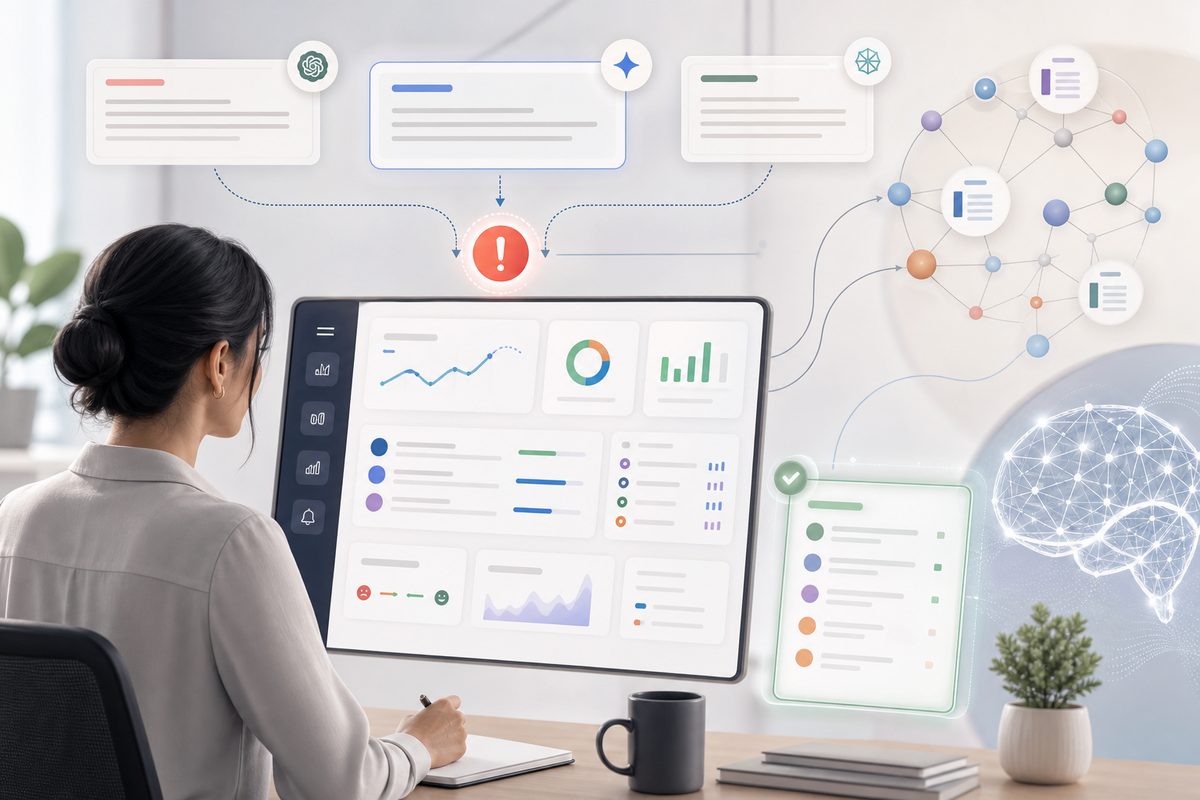
If you searched fix wrong AI answer about my brand, the fastest useful answer is this: do not start by publishing random content or only clicking a feedback button. Capture the exact AI answer, identify the source path behind the wrong claim, repair the most influential owned and third-party sources, then recheck the same prompts over time.
A wrong AI brand answer is usually not one isolated model mistake. It is often a symptom of a messy public record: old positioning pages, stale directories, outdated review profiles, contradictory press boilerplate, thin product pages, or third-party comparisons that define your category better than you do.
Quick answer: how to fix a wrong AI answer about your brand
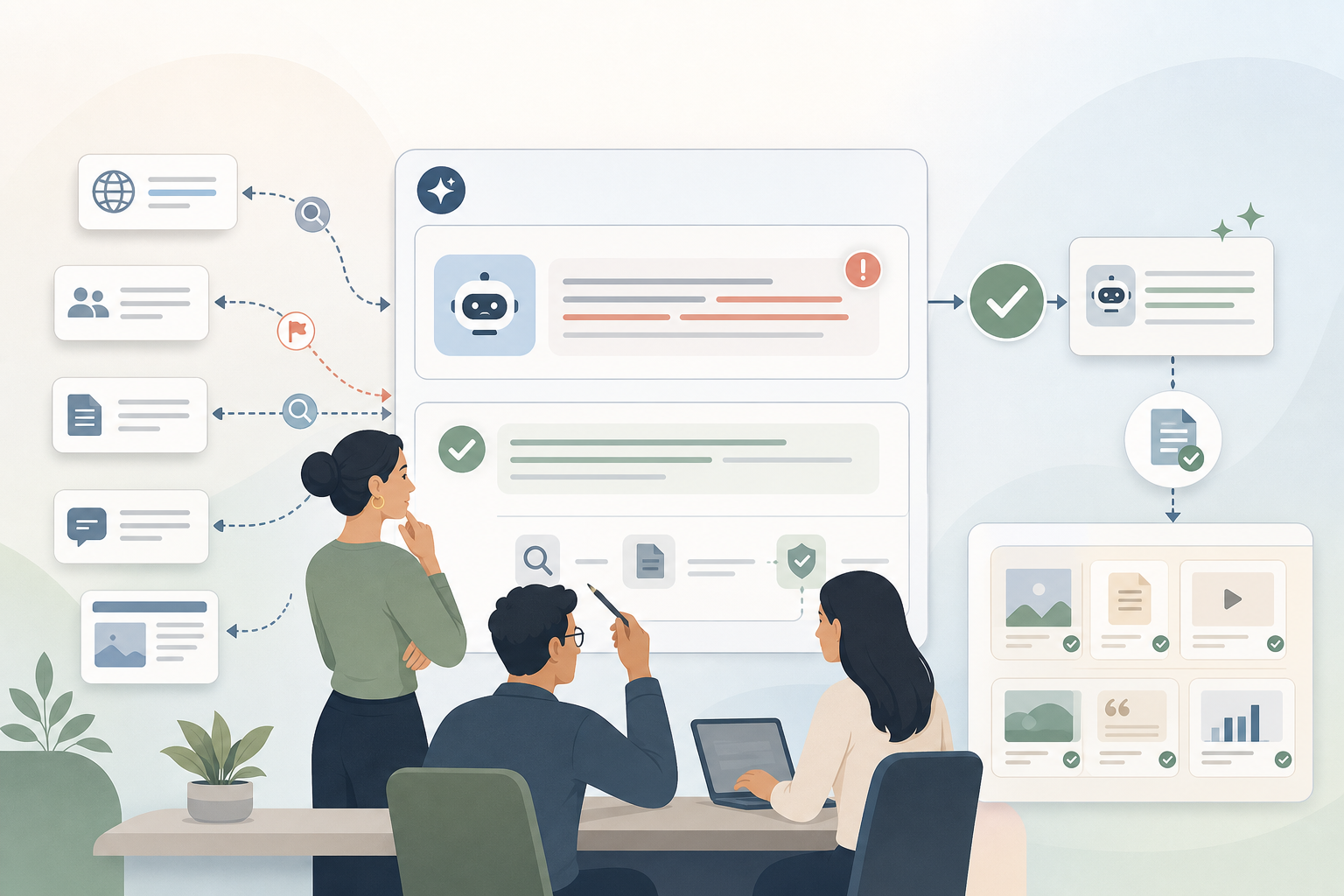
To fix a wrong AI answer about your brand, use a source repair workflow:
- Capture the answer: Save the prompt, AI product, model or mode, date, location, citations, screenshots, and exact wrong claim.
- Classify the error: Mark it as outdated, factually wrong, misleading, missing, harmful, or legally sensitive.
- Trace the source: Check cited URLs, top Google results, snippets, structured data, old profiles, review sites, and syndicated pages.
- Repair owned sources: Update the homepage, product page, about page, pricing page, docs, comparison pages, schema, and internal links.
- Correct third-party sources: Request updates from directories, review platforms, marketplaces, partners, analyst pages, and media profiles.
- Submit platform feedback: Use AI product feedback only after you have a better source URL to provide.
- Validate repeatedly: Recheck the same prompt set across ChatGPT, Gemini, Perplexity, Claude, Copilot, Google AI Mode, and AI Overviews.
The goal is not to “force” an AI model to say your preferred sentence. The goal is to make the accurate version of your brand the easiest, clearest, most verifiable answer available on the web.
What does it mean to fix a wrong AI answer about your brand?
Fixing a wrong AI answer about your brand means correcting the information ecosystem that answer engines use: generated claims, cited pages, search snippets, crawlable owned pages, third-party profiles, and repeated query patterns. It is not a one-click removal request.
AI answers can come from different mechanisms. Some use live web search. Some blend retrieved pages with model knowledge. Some show citations. Some do not. Google says its generative AI features in Search are rooted in core Search ranking and quality systems, use retrieval-augmented generation, and may use query fan-out to gather related evidence from indexed pages. OpenAI says ChatGPT Search ranking uses multiple factors and that allowing OAI-SearchBot to crawl a site is important for inclusion.
That creates a practical rule: fix the source record, not just the answer surface. If the wrong answer came from an old G2 profile, updating a blog post may not move it. If the wrong answer came from your own outdated pricing page, asking an AI company for help while leaving the page live will not solve the root cause.
If you are building a broader measurement system, start with how to measure AI search visibility across ChatGPT, Gemini, Perplexity, and Google AI Overviews. A single bad answer is painful, but trend data across prompts tells you whether the problem is isolated or systemic.
Why do AI tools get brand facts wrong?
AI tools get brand facts wrong when the available evidence is outdated, contradictory, weakly structured, overrepresented on third-party sites, or absent from crawlable pages. The model may also misread a source, over-trust a stale profile, or answer a comparison prompt using old category language.
Google’s own explanation of early AI Overview errors named several relevant causes: query misinterpretation, misreading web-language nuance, limited high-quality information, data voids, satire, and misleading user-generated content. Those same causes appear in brand incidents, just in less viral form.
For brands, the common failure modes are more specific:
| Error type | Example | Likely source | First owner |
|---|---|---|---|
| Outdated positioning | AI says you are an “email marketing tool” after a platform pivot | Old homepage, press boilerplate, directories | SEO or product marketing |
| Wrong category | AI lists you under the wrong software class | Review platforms, comparison pages, marketplaces | Growth or partnerships |
| Incorrect fact | AI gives old pricing, leadership, headquarters, funding, or availability | About page, structured data, knowledge profiles, PR | Comms or web |
| Misleading summary | AI overweights one old complaint or incident | News, forums, reviews, social discussions | PR or customer marketing |
| Missing recommendation | AI omits you from relevant vendor shortlists | Thin owned pages, weak category proof, few credible mentions | SEO, content, demand gen |
| Entity confusion | AI mixes your brand with a similar company or product | Similar names, weak schema, inconsistent naming | SEO or brand |
Research supports the need for source-level diagnosis. The 2023 paper “ChatGPT Hallucinates when Attributing Answers” found that ChatGPT’s generated references existed only 14% of the time in its tested setting. A 2026 study of Google Search, Gemini, and AI Overviews found that AI Overviews appeared for 51.5% of representative real-user queries, retrieved sources differed substantially from traditional search results, and AI Overviews were less consistent across repeated runs and minor query edits.
The practical takeaway: a citation is evidence to inspect, not proof that the answer is correct.
First, decide what kind of incident you have
Not every unwanted AI answer deserves the same response. Before editing pages, classify the incident by risk and remedy.
| Incident level | What it looks like | Response |
|---|---|---|
| Low | Slightly outdated wording with little buyer impact | Add to backlog, monitor recurrence |
| Medium | Wrong category, missing feature, old pricing, inaccurate comparison | Repair owned and third-party sources |
| High | Revenue-impacting shortlist omission, false claim about product capability, unfair negative summary | Run source repair within 14 days and alert sales/comms |
| Critical | Defamation, safety claim, regulated industry claim, legal or consumer harm | Preserve evidence, involve counsel, use platform reporting, repair sources in parallel |
For critical cases, this article is not legal advice. Preserve evidence before changes, involve qualified counsel, and follow the relevant platform’s reporting route.
Step 1: Capture the exact answer before anyone edits anything
Capture the answer before making changes because AI responses are unstable. You need a timestamped baseline that shows the prompt, answer, citations, product, model or mode, location, and account state. Without that baseline, you cannot prove what changed.
Create an AI answer incident record with these fields:
| Field | What to record |
|---|---|
| Prompt | Exact wording, including capitalization and context |
| Variants | Three buyer-like alternatives to the same question |
| Product | ChatGPT, Gemini, Perplexity, Claude, Copilot, Grok, Google AI Mode, AI Overview |
| Mode | Search, browsing, default chat, deep research, logged-in or anonymous |
| Location | Country, language, device, and whether location services were enabled |
| Output | Full answer text, citations, source panel, screenshots, and visible timestamps |
| Wrong claim | One sentence describing what is inaccurate |
| Business risk | Sales, PR, legal, hiring, investor, partner, or support impact |
| Suspected source | Owned page, third-party profile, search snippet, model memory, or unknown |
This prevents false alignment inside the team. A founder may see a bad answer in a logged-in ChatGPT conversation. A prospect may see a different answer in Google AI Overview. An SEO lead may see a third answer in Perplexity with citations. Those are separate surfaces and should be tracked separately.
For prompt design, pair this workflow with how to build an AI search prompt set from your SEO keywords. A prompt set turns one alarming screenshot into a measurable sample.
Step 2: Separate cited-source errors from uncited answer errors
A cited-source error means the AI answer is repeating, compressing, or misreading a visible page. An uncited answer error means the model may be relying on hidden retrieval, training data, snippets, entity associations, or sources it did not expose. The fix path is different.
Start with citations when they exist. Open every cited page and inspect:
- Title tag and meta description.
- H1, H2s, opening paragraph, and summary blocks.
- Comparison tables and category labels.
- Pricing, availability, leadership, location, and date fields.
- Organization, Product, SoftwareApplication, Article, FAQ, and Breadcrumb schema.
- Last updated date and visible page freshness.
- Canonical URL, redirects, noindex, robots.txt, and rendered content.
- Snippets shown in Google, Bing, and AI search citation panels.
If there are no citations, search for the wrong phrase in quotes. Then search the brand plus the outdated descriptor, the category term, the old product name, and the comparison query that triggered the answer. This often reveals a stale directory, an old launch article, a marketplace category, or a syndicated profile.
Use this diagnostic table:
| Diagnostic question | If yes | Action |
|---|---|---|
| Is the wrong claim on a cited page? | Source-level error | Update or request correction on that page |
| Is the cited page accurate but the AI answer is wrong? | Interpretation error | Add clearer definitions, summaries, tables, and structured context |
| Are citations absent? | Hidden-source or model-memory issue | Search phrase matches and strengthen authoritative sources |
| Are citations mostly third-party? | Authority gap | Improve owned pages and correct external profiles |
| Are cited pages old but ranking well? | Freshness conflict | Update, redirect, or supersede stale pages |
| Is your site blocked from AI search crawlers? | Access issue | Review robots.txt, firewall, CDN, and bot policies |
OpenAI’s crawler documentation says OAI-SearchBot is used to surface websites in ChatGPT search features, while GPTBot relates to training. That distinction matters: a brand can accidentally block the very crawler needed for ChatGPT Search visibility.
For deeper citation behavior, read AI search citations: how answer engines choose sources and what brands can influence.
Step 3: Repair owned pages where answer engines expect the fact
Fix owned pages first when they are crawlable, authoritative, and directly relevant to the wrong claim. Owned pages are the fastest controllable source, but they only help if answer engines can discover, parse, and trust them.
Do not bury the correction in a vague blog post. Put it where buyers and machines expect the fact to live:
| Wrong AI claim | Best owned page to repair |
|---|---|
| “Brand is a social media scheduling tool” | Homepage, product overview, category page |
| “Brand does not offer enterprise plans” | Pricing page, enterprise page, sales FAQ |
| “Brand is based in the wrong city” | About page, contact page, Organization schema |
| “Brand competes in the wrong category” | Comparison pages, alternatives pages, product positioning page |
| “Brand lacks feature X” | Feature page, docs, changelog, release notes |
| “Brand is not recommended for use case Y” | Use-case page, customer proof, methodology page |
A strong owned-page correction includes:
- A direct definition: “Brand is a [category] for [audience] that helps [job].”
- A distinction block: “Brand is not [old category] and does not [common misconception].”
- Current facts: pricing, headquarters, leadership, product availability, integrations, and market category.
- Visible proof: docs, release notes, changelog entries, customer examples, screenshots, methodology, or third-party validation.
- Internal links: from homepage, product nav, footer, about page, and high-authority articles.
- Clean technical access: indexable URL, canonical tag, rendered HTML, sitemap inclusion, no accidental blocking.
- Aligned schema: structured data that matches visible page content.
Google’s helpful content guidance asks whether a page provides original information, substantial value, clear sourcing, and evidence of expertise. Its structured data guidelines also warn against marking up content that is not visible to readers. For AI reputation work, that means the correction should be human-visible first, machine-readable second.
Step 4: Remove contradictions inside your own site
Contradiction cleanup is the most overlooked part of fixing wrong AI answers. If your homepage says one thing and your 2021 launch post says another, an answer engine may retrieve either one.
Run a site audit for the wrong term and its variants:
- Search your site for old category labels.
- Check old launch posts, funding announcements, boilerplate, event pages, PDFs, and press kits.
- Review title tags and meta descriptions, not just body copy.
- Update or redirect pages that still rank for the old positioning.
- Add a “current as of” date where facts change often.
- Keep historical content clear: “In 2021, Brand launched X. Today, Brand is Y.”
Example: if AI says your company is “an email marketing tool” but you are now a “customer intelligence platform,” do more than rewrite the homepage hero. Update your about page, product overview, comparison pages, schema, boilerplate, app marketplace listings, partner pages, and old blog intros that still use the former category.
Step 5: Correct third-party sources AI systems over-trust
Third-party sources matter because AI answers often use external evidence to describe a brand more confidently than the brand describes itself. Review sites, directories, analyst pages, partner profiles, app marketplaces, Wikipedia-like pages, news articles, and comparison pages can all shape brand summaries.
The priority is not “get more mentions.” The priority is to correct influential sources that already rank, get cited, or define your category.
Start with:
| Source type | What to inspect |
|---|---|
| Review platforms | Category, product name, pricing, feature tags, “best for” labels |
| Directories | Company description, industry, headquarters, founding date |
| Marketplaces | App category, integration copy, screenshots, support links |
| Partner pages | Old boilerplate, discontinued integrations, outdated use cases |
| Media profiles | Old funding blurbs, pivot language, leadership facts |
| Comparison pages | “Alternative to” framing, feature gaps, market category |
| Knowledge profiles | Entity name, sameAs links, logo, social profiles |
Use a factual correction request, not an “AI visibility” pitch:
Subject: Factual update request for [Brand] profile
Hi [Name],
Your page about [Brand] currently says: “[old claim].” That is outdated. The accurate description is: “[correct claim].”
Source: [official URL]
Supporting proof: [release note, docs, announcement, customer page]Could you update the page when possible? We are correcting public references so buyers and researchers see accurate company information.
For opinion-based pages, you may not be able to force a change. In that case, publish stronger evidence and earn credible coverage that reflects the current reality.
Step 6: Use a root-cause score to prioritize fixes
A root-cause score ranks which source to fix first based on influence, controllability, severity, and contradiction risk. It prevents teams from spending weeks editing low-impact pages while the cited source that keeps driving wrong answers remains untouched.
Score each suspected source from 1 to 5:
| Factor | 1 point | 5 points |
|---|---|---|
| Influence | Rarely ranks, cited, or appears in AI answers | Frequently ranks, cited, or appears in AI answers |
| Controllability | No realistic edit path | Owned page or responsive partner |
| Severity | Minor wording issue | Material sales, PR, legal, or revenue risk |
| Contradiction risk | Old but harmless | Directly conflicts with current positioning |
| Freshness | Current or evergreen | Outdated and likely to be trusted because it still ranks |
Add the scores:
| Total | Priority |
|---|---|
| 21-25 | Fix immediately |
| 15-20 | Fix in current sprint |
| 10-14 | Monitor and batch |
| Below 10 | Backlog unless legal or safety risk exists |
Worked example:
| Source | Influence | Controllability | Severity | Contradiction | Freshness | Total | Decision |
|---|---|---|---|---|---|---|---|
| Old G2 category page | 5 | 3 | 4 | 5 | 5 | 22 | Request correction and update profile |
| Your old launch post | 4 | 5 | 4 | 5 | 5 | 23 | Update or add current-note immediately |
| Current product page | 5 | 5 | 5 | 3 | 2 | 20 | Rewrite definition block and proof |
| Partner integration page | 3 | 4 | 3 | 4 | 4 | 18 | Send correction request |
| One forum comment | 2 | 1 | 2 | 2 | 2 | 9 | Monitor, do not chase |
This gives SEO, PR, legal, product marketing, and leadership a shared triage language.
Step 7: Submit feedback after source repair
Submit feedback to the AI product, but treat it as a supporting action, not the main repair. Feedback is more useful when you can provide the exact wrong claim, the affected prompt, screenshots, and a corrected source URL.
Use this structure:
- The answer is wrong because: [one sentence].
- The correct fact is: [one sentence].
- Official source: [URL].
- Supporting source: [URL].
- The issue creates risk because: [buyer confusion, legal harm, safety issue, etc.].
- Screenshot and date: [attached or recorded].
For urgent reputational harm, use the platform’s reporting flow and preserve evidence before submitting.
Step 8: Validate the fix across prompts, engines, and time
Validation means rerunning the same prompt set after source updates and measuring answer accuracy, citation replacement, sentiment, and recommendation position. One corrected answer is not enough. You need repeated checks across engines and buyer-intent prompts.
Track four metrics:
| Metric | What to measure |
|---|---|
| Answer accuracy | Did the wrong claim disappear? |
| Citation replacement | Did better sources replace stale ones? |
| Positioning quality | Is the brand described in the right category and use case? |
| AI share of voice | Is the brand mentioned in relevant recommendation prompts? |
Manual checks work for the first incident. They break down when you need daily monitoring across ChatGPT, Gemini, Perplexity, Claude, Copilot, Grok, Google AI Mode, and AI Overviews. For vendor evaluation, see how to choose an AI visibility tool when citation tracking matters.
The key is time series evidence. If an answer improves once and regresses three days later, you have not fixed the root cause. You have seen answer variation.
How long does it take for AI answers to update?
AI answer updates can take hours, days, weeks, or longer depending on the system, source, crawl frequency, citation selection, and whether the answer uses live search or older model knowledge. Search-grounded tools usually change faster than model-only answers.
Use this expectation table:
| Fix type | Expected movement | Notes |
|---|---|---|
| Owned page update on crawlable URL | Days to weeks | Faster if the URL is already crawled often |
| Robots.txt change for OAI-SearchBot | At least about a day for systems to adjust, then variable | OpenAI says search-related robots.txt updates can take about 24 hours to adjust |
| Third-party profile correction | Days to months | Depends on publisher update speed and recrawl |
| Search citation replacement | Variable | Requires better sources to be selected |
| Model-only answer without search | Slow or uncertain | May require product feedback and stronger web consensus |
| Google AI Overview or AI Mode answer | Variable | Google says pages must be indexed and eligible, but indexing and serving are not guaranteed |
Do not promise executives a universal timeline. Promise a measurable process: baseline, source repair, crawl checks, prompt reruns, and weekly reporting until the answer stabilizes.
What should you change on your website?
Change the pages that answer engines and buyers already treat as authoritative: homepage, product pages, about page, comparison pages, docs, pricing, press boilerplate, schema, and high-ranking historical content. Add clear, visible facts rather than hidden machine-only text.
Use this page-level checklist:
- Put the current brand definition near the top of the page.
- Add a short “not the same as” clarification where confusion exists.
- Refresh title tag, H1, meta description, and primary body copy.
- Add current dates to release notes, product announcements, and changelogs.
- Use schema only for facts visible on the page.
- Link from high-authority owned pages to the corrected page.
- Update or redirect old pages that contradict current positioning.
- Check robots.txt, noindex tags, canonical tags, sitemap inclusion, and JavaScript rendering.
- Make the page readable without requiring a login.
- Add proof: customer examples, screenshots, docs, methodology, or public announcements.
A good correction page is not a keyword-stuffed “AI answer bait” page. It is a concise, verifiable source that a buyer would trust.
What should you not do?
Do not try to manipulate AI answers with fake mentions, doorway pages, hidden text, or mass-produced long-tail pages. Those tactics create low-quality signals, increase contradiction risk, and can violate search quality policies.
| Bad tactic | Why it fails | Better alternative |
|---|---|---|
| Publishing dozens of near-duplicate AI answer pages | Adds little value and creates scaled-content risk | Build one strong authoritative source |
| Adding hidden text for models | Not user-visible and undermines trust | Put corrections in visible copy |
| Creating fake third-party mentions | Low trust and policy risk | Correct or earn credible sources |
| Only submitting thumbs-down feedback | Does not repair source evidence | Use feedback plus source correction |
| Editing schema without page copy | Creates markup/content mismatch | Align schema with visible facts |
| Chasing every forum comment | Low use | Prioritize cited, ranking, or recurring sources |
| Rewriting every page at once | Creates QA risk and new contradictions | Fix high-score sources first |
Google’s helpful content guidance warns against mainly summarizing others without adding value and against creating content primarily for search engines. The same principle applies to answer engine optimization: quality and clarity beat volume.
A practical 14-day repair plan
A 14-day repair plan should move from evidence to source correction to validation. The goal is not to make every AI tool say the same sentence. The goal is to remove the most influential wrong evidence and replace it with accurate, crawlable, well-supported information.
| Day | Action | Output |
|---|---|---|
| Day 1 | Capture prompts, screenshots, citations, model names, account state, and locations | Incident record |
| Day 2 | Classify the error and risk level | Triage label |
| Day 3 | Trace cited pages, phrase matches, snippets, and third-party profiles | Suspected source list |
| Day 4 | Score root causes with the 25-point model | Prioritized repair queue |
| Days 5-7 | Update owned pages, schema, internal links, and contradictory old content | Published source repairs |
| Days 8-10 | Send third-party correction requests with proof | Outreach log |
| Day 11 | Submit platform feedback with corrected source URLs | Feedback record |
| Days 12-14 | Recheck prompts across engines and compare citations | Validation report |
For severe defamation, consumer harm, or regulated claims, compress the timeline and involve legal counsel. For ordinary positioning drift, keep the workflow evidence-based.
How maxaeo turns monitoring into source repair
maxaeo monitors how ChatGPT, Gemini, Perplexity, Claude, Copilot, Grok, Google AI Mode, and AI Overviews mention, rank, cite, and describe a brand. The useful output is not just a dashboard. It is the connection between a bad answer and the source most likely causing it.
A practical LLM brand tracking workflow should show:
| Monitoring view | Why it matters |
|---|---|
| Prompt-level answer history | Shows whether the issue is persistent or random |
| Brand mention frequency | Measures AI share of voice across buyer questions |
| Citation tracking | Identifies pages influencing the answer |
| Sentiment and positioning labels | Finds misleading summaries before they spread |
| Competitor shortlist tracking | Shows whether the brand is recommended or omitted |
| Source repair tasks | Turns monitoring into owned-page and third-party work |
This is where generative engine optimization becomes operational. The work is not mystical. It is technical SEO, digital PR, product marketing, and reputation management working from the same evidence file.
Common questions
Can I directly ask ChatGPT, Gemini, or Perplexity to correct a wrong brand answer?
You can submit feedback, and you should for serious errors, but feedback alone is unreliable. Also fix the source ecosystem: owned pages, cited URLs, third-party profiles, snippets, and contradictory public information. AI products are more likely to improve when the web evidence also improves.
What if the AI answer has no citations?
Treat it as a hidden-source or model-memory problem. Search for the wrong phrase, check top-ranking pages, review old brand profiles, and strengthen your official pages. Then rerun the same prompt in search-enabled modes to see whether better sources are retrieved.
Should I create a page titled “What is [Brand]?” for AI search?
Only if it helps real buyers. A clear “What is [Brand]?” section on your about, product, or comparison page can help. A thin page made only for AI systems is weaker than a useful, well-linked source with proof.
Are AI citations the same as SEO rankings?
No. AI citations and organic rankings overlap, but they are not identical. Generative search systems can retrieve, summarize, and cite sources differently from traditional results. Track both, especially for high-value buyer prompts.
How do I know the repair worked?
The repair worked when the wrong claim stops appearing across your tracked prompt set, better sources replace stale citations, and the corrected description holds over repeated checks. A single clean answer is a signal, not proof.
Should I block AI crawlers if AI tools describe my brand incorrectly?
Usually no, not as a first move. Blocking crawlers can reduce your ability to appear as a source in AI search. For normal brand-fact errors, repair the public record first. For legal, safety, or content misuse concerns, evaluate crawler controls with counsel and your SEO team.
Final takeaway
To fix wrong AI answer about my brand, start with evidence, not panic. Capture the exact answer, trace the source path, update the most authoritative owned page, correct influential third-party sources, submit feedback with proof, and validate the change across prompts and engines.
The brands that win in AI search will not be the ones that publish the most pages. They will be the ones that maintain the clearest, most current, most verifiable public record of who they are, what they do, and why they should be recommended.
This article was created with AI assistance and reviewed by a human editor.