
By maxaeo.ai | Published 2026-10-10 | Updated 2026-10-10
The SaaS demo conversion rate from ChatGPT recommendations is the percentage of attributable prospects who request a demo after discovering or evaluating a product through ChatGPT. The calculation sounds simple, but referral loss, cross-device visits, branded searches, and multi-touch buying journeys can make a basic GA4 ratio misleading.
This guide provides a practical measurement model for separating direct referrals from AI-assisted demand—and turning both into credible pipeline reporting.
What Is a Good ChatGPT-to-Demo Conversion Rate?
There is no defensible universal benchmark for ChatGPT-to-demo conversion because companies use different definitions of a conversion, visitor, qualified demo, and attributed session. Your most useful benchmark is your own 60- or 90-day rate compared with organic non-brand, paid non-brand, review-site, and direct traffic.
Semrush has reported that the average AI search visitor can be 4.4 times as valuable as a traditional organic search visitor based on conversion rate. However, that finding covers broader conversion activity and should not be presented as a SaaS demo-booking benchmark. (semrush.com)
Use external studies to form a hypothesis—not a forecast. ChatGPT visitors may arrive after the system has already summarized alternatives, pricing models, integrations, and use cases. That can create higher intent, but the result still depends on product category, contract value, landing-page relevance, and how “demo” is defined.
How Should the Conversion Rate Be Calculated?
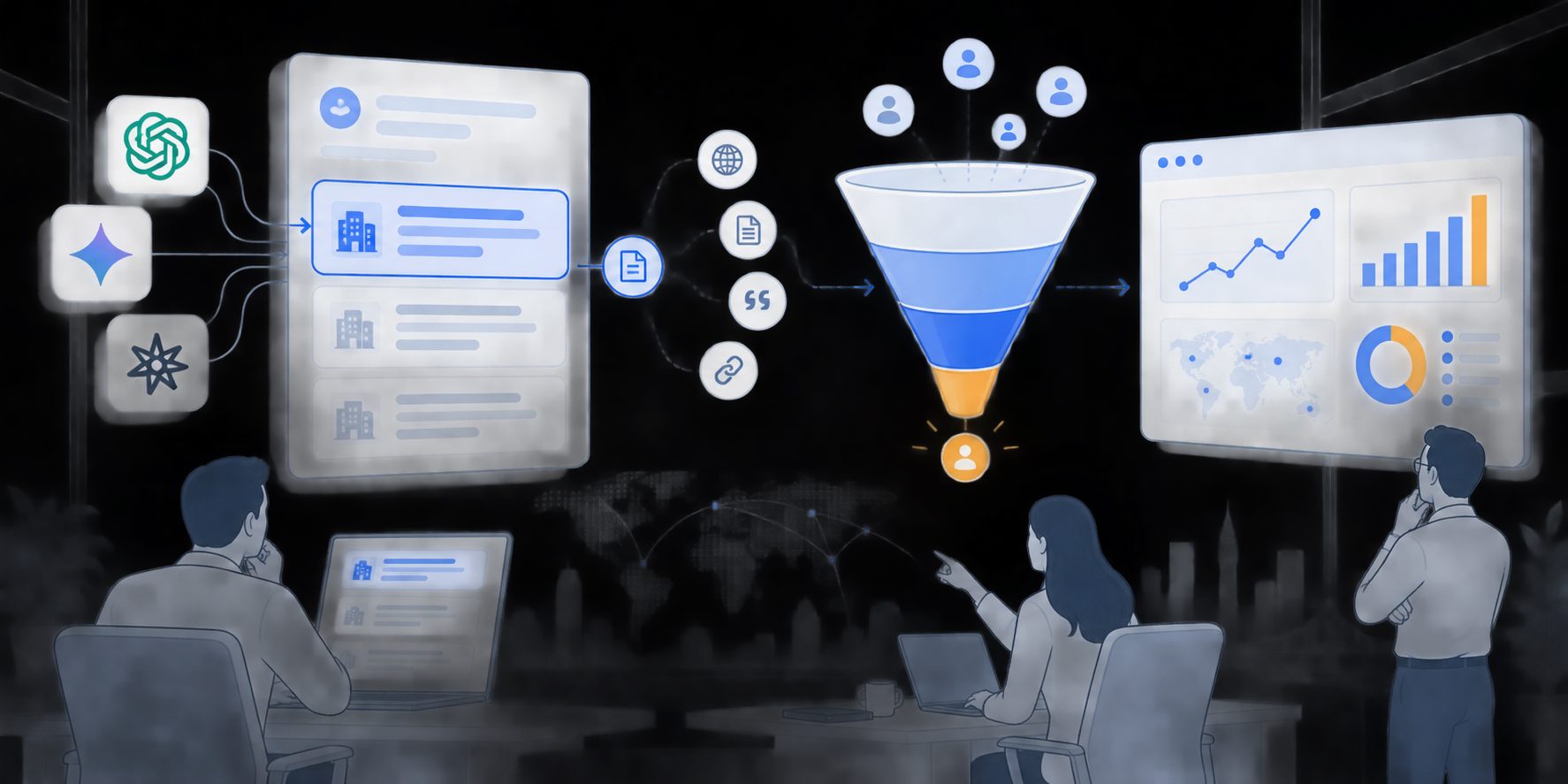
The primary rate should divide attributable demo requests by attributable ChatGPT sessions. Teams should also calculate qualified-demo, held-demo, and opportunity rates so that an increase in form submissions is not mistaken for an increase in genuine pipeline.
Use these formulas:
- Demo request rate = ChatGPT-attributed demo requests ÷ ChatGPT-attributed sessions
- Qualified demo rate = Qualified ChatGPT demos ÷ ChatGPT-attributed sessions
- Demo hold rate = Held ChatGPT demos ÷ Booked ChatGPT demos
- Opportunity rate = ChatGPT-sourced opportunities ÷ ChatGPT-attributed sessions
- Pipeline per session = ChatGPT-attributed pipeline value ÷ ChatGPT-attributed sessions
A modeled example shows why the additional stages matter:
| Funnel stage | Modeled result | Rate from 240 sessions |
|---|---|---|
| Demo requests | 18 | 7.5% |
| Qualified demos | 14 | 5.8% |
| Held demos | 9 | 3.8% |
| Opportunities | 3 | 1.3% |
These numbers are illustrative, not an industry benchmark. The useful insight is the gap between form completion and sales acceptance.
Why Does GA4 Understate ChatGPT Influence?
GA4 can identify visits carrying a usable referrer, but not every AI-influenced buyer clicks directly from an answer. A prospect may copy a URL, switch devices, return through branded Google search, or type the company domain manually. Those visits can appear as direct, organic, or another source.
Google defines (direct) / (none) as traffic without a clear referral source and notes that missing referral information or tracking parameters can contribute to this classification. (support.google.com)
That creates two different measurements:
| Measurement | What it captures | Main limitation |
|---|---|---|
| Click-attributed conversion | Sessions with a recognizable ChatGPT referrer | Misses no-click and cross-device discovery |
| AI-assisted conversion | Buyers who report or demonstrate ChatGPT influence | Depends on CRM and survey discipline |
Use Session source/medium for the initial traffic comparison and event-scoped attribution for conversion-path analysis. Google documents that these dimensions have different scopes and may assign credit differently. (support.google.com)
The Three-Ledger Framework for More Reliable Attribution
A stronger model reconciles three independent ledgers instead of forcing every conversion into last-click analytics. This is the article’s recommended framework for measuring AI recommendations without pretending that invisible discovery can be observed perfectly.
1. The referral ledger
Create an AI referral channel grouping that recognizes domains associated with ChatGPT and other answer engines. Record sessions, landing pages, demo requests, qualified demos, opportunities, and pipeline.
Preserve the original referrer on form submission. Do not overwrite it when a visitor later returns through another channel.
2. The self-report ledger
Add a “How did you hear about us?” field to the demo form. Keep ChatGPT or another AI assistant as a selectable option, followed by an optional free-text field asking what the buyer searched for.
Self-reported attribution catches recommendations that produced no trackable referral click.
3. The CRM influence ledger
Give sales representatives a structured discovery field: “Did an AI assistant recommend, compare, or research this product?” Store the platform and the buyer’s remembered prompt when available.
Reconcile the ledgers monthly. Report direct, assisted, and blended results separately rather than combining them into one artificially precise number.
For implementation details, use a broader CRM framework for attributing pipeline to AI search engines.
How Can You Compare ChatGPT With Other Channels?
Compare equivalent cohorts and outcomes. A ChatGPT visitor landing on a competitor-comparison page should not be evaluated against all organic sessions, including low-intent glossary traffic. Segment by buyer intent, geography, device, product line, and landing-page type.
A useful comparison table includes:
| Metric | ChatGPT | Organic non-brand | Paid non-brand | Review sites |
|---|---|---|---|---|
| Sessions | ||||
| Demo request rate | ||||
| Qualified demo rate | ||||
| Demo hold rate | ||||
| Opportunity rate | ||||
| Pipeline per session | ||||
| Median sales cycle |
Apply a minimum sample threshold before drawing conclusions. For example, 2 demos from 20 sessions produce a 10% rate, but the sample is too small to support a major budget decision.
When financial efficiency matters, connect the analysis to a consistent model for calculating CAC from ChatGPT and Perplexity referrals.

How Do You Improve the Rate Without Inflating Attribution?
Improving the SaaS demo conversion rate from ChatGPT recommendations requires continuity between the AI recommendation and the website experience. The landing page should immediately confirm the use case, product category, audience, limitations, and next step described in the answer.
Prioritize these actions:
- Audit recommendation context. Record whether ChatGPT positions the product as a leader, alternative, niche option, or poor fit.
- Match high-intent prompts to pages. Build comparison, integration, security, migration, and use-case pages for actual buyer questions.
- Reduce demo friction. Explain who the demo is for, what it covers, and what information is required.
- Track source evidence. Identify the pages and third-party sources that AI answers cite.
- Review qualification quality. Optimize for accepted opportunities, not form volume alone.
MaxAEO monitors brand mentions, citations, recommendations, sentiment, and competitor performance across eight AI engines with daily data updates. A free AI visibility diagnosis can help identify whether weak conversion begins with low visibility, inaccurate positioning, poor source coverage, or a mismatched landing page.
Teams can then connect visibility findings to a structured process for turning AI brand mentions into pipeline and use the AI search attribution model for enterprise SaaS for longer buying cycles.
What Should Be Included in a Monthly Report?
A decision-grade monthly report should show volume, quality, pipeline, and attribution confidence. Reporting only the headline demo rate hides whether results came from five sessions, whether the demos were qualified, and whether ChatGPT was the original discovery source.
Include:
- Direct ChatGPT referral sessions
- Self-reported AI discoveries
- CRM-confirmed AI-assisted opportunities
- Demo request, qualification, and hold rates
- Pipeline and revenue by attribution category
- Landing pages receiving AI referrals
- Buyer prompts collected through forms or calls
- Mention rate, recommendation position, and cited sources
- Sample size and known tracking gaps
Label each result as direct, assisted, or blended. This prevents stakeholders from comparing a multi-touch AI figure with a last-click paid-search figure.
Frequently Asked Questions
Does ChatGPT referral traffic always convert better than Google organic traffic?
No. Higher intent is plausible because ChatGPT can pre-educate buyers, but performance varies by query, category, page, and sample size. Compare matched high-intent cohorts before concluding that one channel is superior.
Should branded searches count as ChatGPT conversions?
Count them as AI-assisted only when a self-report, CRM note, or journey signal supports the connection. Do not automatically reclassify every branded search as AI-driven demand.
How much data is needed before evaluating performance?
Avoid firm conclusions from a handful of sessions or conversions. Use at least a 60- to 90-day window, disclose the sample size, and emphasize qualified opportunities when traffic remains limited.
Can MaxAEO measure demo bookings?
MaxAEO measures AI search visibility signals such as mentions, recommendation position, citations, sentiment, and competitor performance. Demo and pipeline outcomes should be connected through the company’s analytics and CRM systems; MaxAEO does not need internal revenue data or customer lists to generate its basic visibility diagnosis.