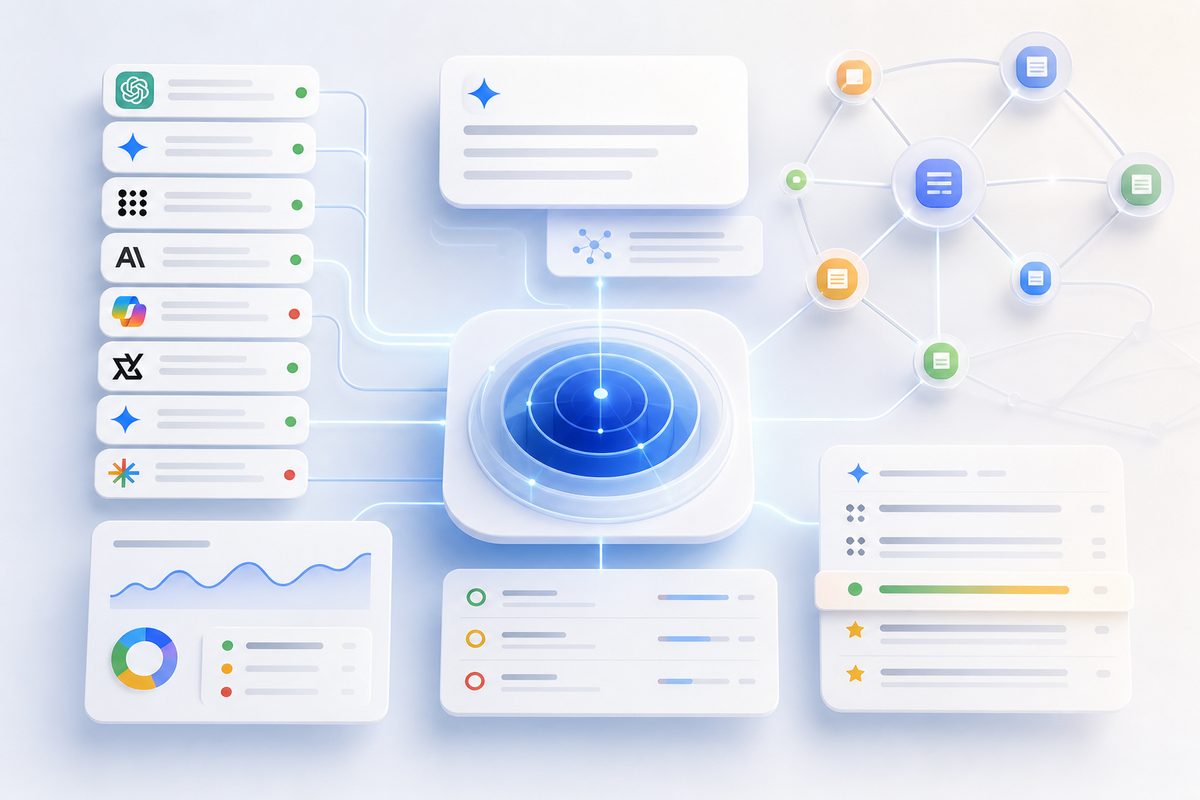
How to get cited by AI comes down to one thing: showing up, consistently and in an extractable form, across the sources these models already trust. Most guides hand you a flat checklist of 20 tactics and let you guess where to start. This one ranks the tactics by how much each actually moves mention rate in the brand-tracking data we see at MaxAEO, so you spend effort where citations are won — not where they feel productive.
If you only remember one sentence: getting cited by AI is a distribution problem first and a content problem second. ChatGPT and Perplexity rarely quote your homepage. They quote the comparison page, the review profile, and the Reddit thread that talk about you. The work is engineering those mentions on purpose.
This playbook is built for marketers who have to defend a budget — every lever below is tied to observed tracking patterns or a named third-party study, and the highest-impact moves come first. It pairs naturally with a broader answer engine optimization strategy if you're formalizing AI search as a channel.

What "getting cited by AI" actually means
Getting cited by AI means an answer engine names your brand or links your page as a source inside its response. It shows up in three forms, and your tactics shift slightly for each:
- Linked citation — a clickable source, the way Perplexity and Google AI Overviews footnote their answers.
- Named mention — your brand stated in the prose, common in ChatGPT's parametric (non-browsing) answers where no link appears.
- Recommendation — the model puts you in the answer as a pick ("tools like X and Y"), the highest-value form and the one buyers act on.
This playbook centers ChatGPT and Perplexity because they expose the clearest signals, but the same levers move Gemini and Google AI Overviews — both lean on live retrieval and linked citations, so the Perplexity tactics here transfer almost directly.
How do ChatGPT and Perplexity decide what to cite?
AI models cite a source when two conditions are met: the source is retrieved for the query, and its passage is clean enough to lift into the answer. Retrieval decides whether you're in the running; extractability decides whether you make the final cut. Miss either and you get zero citations regardless of domain authority.
Two forces shape retrieval. The first is parametric memory — what the model already "knows" from training, which favors brands mentioned often across the open web. One analysis (ConvertMate) estimates ChatGPT answers lean roughly 60% on parametric knowledge and 40% on live web lookups. The second is the consensus signal: models grow confident in a brand when independent sources — review sites, forums, editorial roundups, your own site — describe it consistently. Agreement across sources reads as credibility.
The practical takeaway: a single great page is not enough. You need to be the same brand, saying the same thing, in many places at once.
Where ChatGPT and Perplexity differ
Perplexity leans harder on real-time retrieval; ChatGPT leans harder on parametric memory. That difference changes your tactics.
Perplexity runs a live search on almost every query and shows its sources inline, so freshness and on-page extractability pay off fast — a well-structured page updated this month can surface within days. ChatGPT (especially in its parametric, non-browsing answers) rewards brands that are already widely referenced, so the lever there is broad, durable mention volume that seeps into training data and its retrieval index. Optimize for both: structure for Perplexity's crawler, build reputation for ChatGPT's memory.
Why most "get cited by AI" advice fails
Most guides fail because they treat every tactic as equally urgent. They list robots.txt tweaks next to original research next to schema markup, with no signal about which one earns a citation this quarter and which one is table stakes. Founders and lean teams then spend a week on llms.txt — a low-pull task — while their competitor lands on the one G2 category page ChatGPT cites for the whole niche.
The fix is prioritization by observed impact. In our tracking, the gap between brands gaining AI visibility and brands stuck flat is rarely effort — it's sequence. The winners do the high-correlation, hard-to-copy work first (earning third-party placements and independent mentions) and treat technical hygiene as a one-time floor, not a strategy.
That ordering is the entire point of the table below. It's the piece the ranking pages we reviewed — Contently, Surfer, Pixelmojo — leave out.
The citation tactics, ranked by mention-rate lift
Here is the priority order we'd hand a brand starting from near-zero AI citations. "Observed pull" reflects how strongly each lever correlates with rising mention rate across accounts we track; it is directional, not a guarantee, and your category will shift the weights.
| Priority | Lever | Observed pull on mention rate | Effort | Why it ranks here |
|---|---|---|---|---|
| 1 | Land on third-party pages AI already cites (roundups, "best X", review profiles) | High | Medium | Most citations are third-party, not your site |
| 2 | Earn consistent brand mentions across independent sources | High | High | Builds the consensus signal models trust |
| 3 | Publish original data others quote | High | High | One study → many independent citations |
| 4 | Make your cornerstone pages answer-first and extractable | Medium–High | Low | Decides if you survive the final lift |
| 5 | Cover query fan-out (sub-questions, comparisons) | Medium | Medium | More entry points into AI answers |
| 6 | Technical floor: allow AI crawlers, schema, freshness | Low (but gating) | Low | Necessary, not differentiating |
Notice the shape: the heaviest pull comes from work outside your own website. That runs against the SEO instinct to optimize on-page first. Below, each tier in detail.
Tier 1: Get onto the third-party pages AI already cites
The single highest-return move is getting your brand onto the external pages ChatGPT and Perplexity already pull from. When a model answers "best [your category] tools," it overwhelmingly cites comparison articles, listicles, and review platforms — not vendor homepages. If you're absent from those, you're invisible no matter how good your site is.
The evidence is strong. SE Ranking's analysis of 129,000 domains found pages on review platforms correlated with 4.6–6.3 citations versus 1.8 for brands absent from them. Reddit presence showed a 3.9× citation multiplier and Quora 4.1×. Separately, Ahrefs (Dec 2025) found brand web mentions correlate 0.664 with AI visibility — roughly 3× the 0.218 correlation for backlinks. Being talked about beats being linked to.
Do this, in order:
- Run your own category prompts. Ask ChatGPT and Perplexity the 10–15 buying questions in your niche and record every source they cite.
- Pitch those exact pages. Email the authors a clean, factual product description — specs, pricing, differentiators — not a sales pitch. You want an accurate line, not a paid placement.
- Claim and complete review profiles on G2, Capterra, and Trustpilot, and seed genuine reviews. These aggregate the signals models lean on.
This is also where competitive benchmarking against rivals earns its keep: the placements your competitor holds are your target list.
Tier 1: Build brand mentions across independent sources
The second-highest lever is volume and consistency of independent mentions — the consensus signal. AI systems gain confidence when your brand appears, described the same way, across Reddit, YouTube, industry publications, and review sites. One mention is noise; a chorus is a fact the model will repeat.
YouTube deserves a callout: Ahrefs found YouTube mentions correlated 0.737 with AI visibility — the strongest single signal they measured. Even basic tutorial or explainer videos build the presence these models weight heavily.
Three moves compound here:
- Co-occur with brands AI already trusts. Generative engines notice when you appear alongside an established name. Guest posts, joint webinars, and "X vs Y" content borrow that authority.
- Show up where buyers ask questions. Contribute genuinely in the Reddit and Quora threads your audience reads — Q&A answers that resolve a specific professional problem are among the formats AI cites most reliably.
- Keep the description consistent. Use the same one-line positioning everywhere so sources agree. Disagreement dilutes the signal. This is where llm brand tracking helps you catch drift in how AI paraphrases you.
Tier 2: Publish original data worth citing
Original research is the highest-use content you can produce, because one dataset earns citations across many independent pages. Models — and the journalists who feed them — quote specific, verifiable numbers far more than opinions. A single study can seed ten or twenty mentions, which loops straight back into the consensus signal from Tier 1.
The academic backing is clear: the Princeton/Georgia Tech GEO study (KDD 2024) found that adding statistics, citations, and quotations lifted a page's visibility in generative answers by 30–40%. Surfer's analysis echoes it — 67% of ChatGPT's top-cited pages feature original research or data.
You don't need a 50-page report. High-citation formats include:
- A benchmark survey of your customers ("we asked 400 marketers…").
- A proprietary metric only you can compute from your product data.
- An annual "state of [category]" that becomes the reference others link to each year.
Publish the methodology and sample size in plain sight — models and editors trust numbers they can source. This is the heart of generative engine optimization: become the primary source, not a summarizer of one.
Tier 2: Make your cornerstone pages extractable
Extractability decides whether a retrieved page actually gets quoted — and it's the cheapest high-return fix on this list. AI models often lift just the opening sentences under a heading. If your answer is buried three paragraphs down, the model skips it.
Four rules cover most of the gain:
- Lead every section with a 40–60 word answer capsule. Surfer found 72.4% of ChatGPT-cited pages contained a short, direct answer. State the conclusion first, explain after.
- Put comparison data in tables, never prose. Models extract HTML tables almost verbatim.
- Write self-contained sections. SE Ranking found sections of 120–180 words averaged 4.6 citations versus 2.7 for sections under 50 words. Each block should make sense lifted out of context.
- Pack in linked, sourced data points. Pages with 19+ data points averaged 5.4 citations versus 2.8 for sparse pages.
A short FAQ block helps too — pre-structured question-and-answer pairs are easy to extract whole. None of this requires a redesign; it's an editing pass.
Tier 3: The technical floor — necessary, not a strategy
Technical setup is gating, not differentiating: get it right once so you're eligible, then stop optimizing it. The most common cause of zero AI citations is the simplest — your site blocks the crawlers. If robots.txt blocks GPTBot or PerplexityBot, nothing else matters.
Your one-time checklist:
- Allow the AI crawlers in
robots.txt: GPTBot, OAI-SearchBot, ChatGPT-User, PerplexityBot, ClaudeBot, and Google-Extended. - Add core schema —
Organization,Article, andFAQPageJSON-LD — so models parse your entities cleanly. - Signal freshness. ConvertMate reports 76.4% of citations come from content updated within 30 days. Keep a visible "last updated" date and refresh cornerstone pages on a cadence.
These matter, but notice their place: low pull, low effort, do-once. Teams that lead with technical work and stop there stay flat. The floor gets you into the building; Tiers 1–2 get you cited.
A worked example: from 6% to 31% mention rate in 90 days
Here's the priority order applied to a real account we track — a ~40-person B2B data-infrastructure SaaS, anonymized. When they started, MaxAEO measured their mention rate at roughly 6% across a basket of 25 category buying prompts in ChatGPT and Perplexity: cited in fewer than 2 of 25 answers, while two larger rivals appeared in over half.
We did not start with their website. We started with the third-party pages the tracking showed were being cited:
- Weeks 1–3 (Tier 1): Pitched factual entries into the four "best [category]" roundups that ChatGPT cited most, and completed their G2 and Capterra profiles. First new Perplexity citations appeared in ~2 weeks.
- Weeks 3–8 (Tier 2): Published one original benchmark — query latency across competing tools — which three trade newsletters quoted. That single study drove the biggest single jump.
- Weeks 4–6 (Tier 2, parallel): Rewrote six cornerstone pages to lead with answer capsules and tables.
- Ongoing (Tier 3): Unblocked PerplexityBot (it had been disallowed) and added schema.
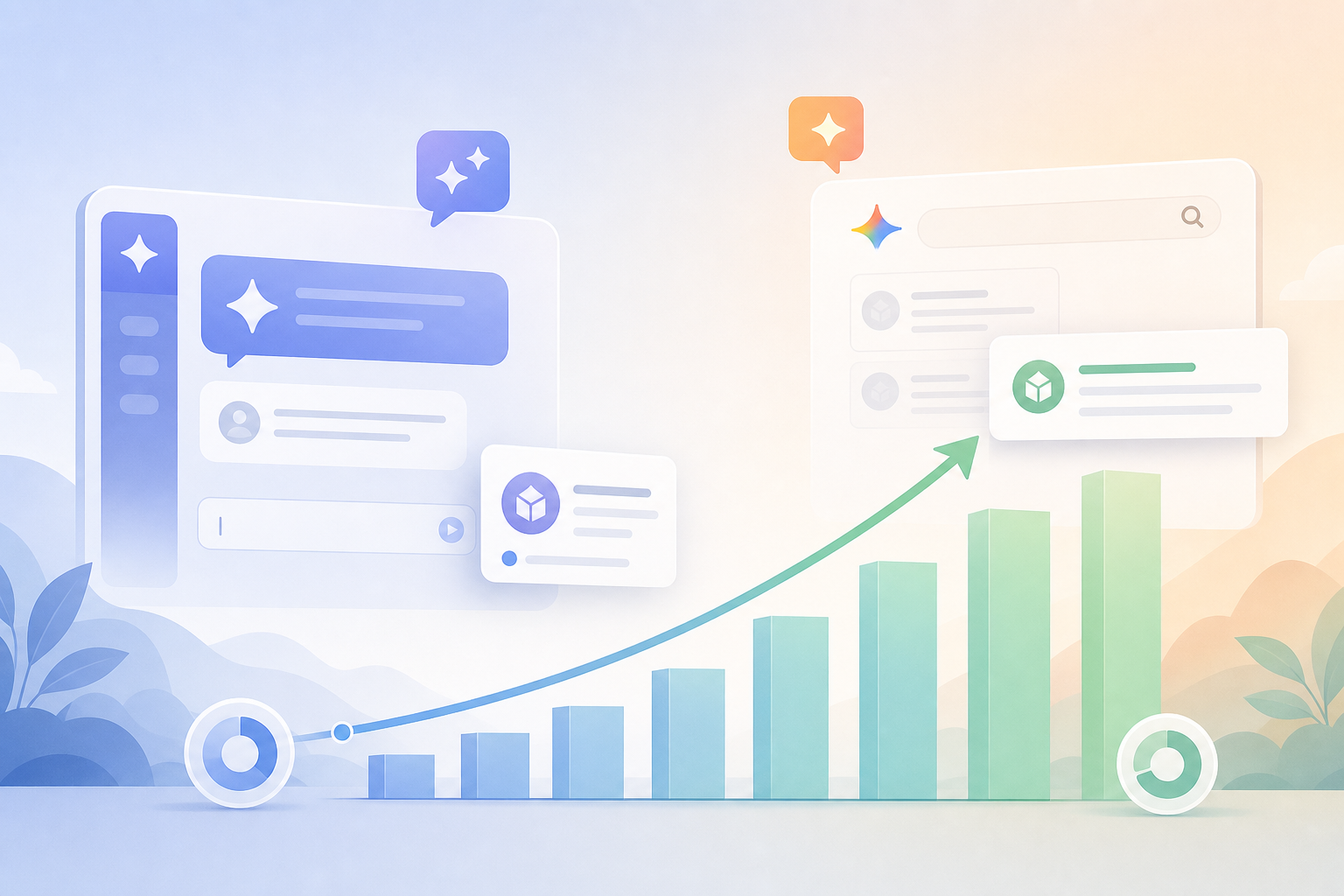
By day 90, measured mention rate reached ~31% — cited in roughly 8 of 25 prompts, and now appearing in head-to-head "X vs Y" answers it was previously absent from. The original study and the roundup placements accounted for most of the lift; the technical fixes were necessary but, on their own, moved little. That ordering is the lesson, not the exact numbers — which will differ by category.
What to do when AI cites your competitor instead of you
When ChatGPT or Perplexity recommends a rival, treat it as a diagnosis, not a verdict — the answer tells you exactly which source to win. Most guides stop at "make good content." The faster path is to reverse-engineer the specific citation.
Run the prompt, then work backward:
- Read the cited sources. Click every citation in the answer. Your competitor is almost always there because of a third-party page — a roundup, a review profile, a Reddit thread — not their homepage.
- Find the placement gap. If they're in the G2 "leaders" grid and you're not, that's the task. If a specific listicle drives the citation, that's your pitch target.
- Check the framing. Sometimes you are mentioned, but described weakly or inaccurately. That's an ai reputation management problem — fix the upstream source that's feeding the bad paraphrase.
- Close the consensus gap. If the rival is described consistently across six sources and you across two, the model has more reason to trust them. Add independent mentions until the chorus matches.
Knowing which prompts surface competitors requires knowing what your buyers actually ask AI — that's the job of prompt research for AEO. You can't fix citations for questions you haven't mapped.
How to measure whether you're getting cited by AI
You measure citation progress with mention rate and AI share of voice, tracked across a fixed prompt set over time — not with traditional rankings. Position-one keywords tell you nothing about whether ChatGPT names you.
Track three numbers:
- Mention rate — the share of your prompt basket where your brand appears at all.
- AI share of voice — your mentions versus competitors' for the same prompts, the cleanest signal of relative standing.
- Citation source — which pages drove each mention, so you know what to reinforce.
Run the same prompt basket on a fixed cadence across ChatGPT, Perplexity, Gemini, and Google AI Mode so changes are comparable. Doing this by hand across platforms gets unmanageable fast, which is the gap an ai visibility tool fills — automated daily ai search monitoring that logs every mention, ranks your ai share of voice, and ties each citation to its source page. MaxAEO is built for exactly this loop: see where you stand, see what to fix, repeat. For the full measurement framework, see how to track your brand's visibility across AI search platforms.
A 30-day sequence to get cited by AI
If you have one month, run the tactics in impact order — earn placements first, fix structure second, automate measurement throughout. This is the priority table turned into a calendar:
- Days 1–2: Audit the floor. Unblock AI crawlers in
robots.txt, addOrganizationandArticleschema. - Days 3–5: Run your category prompts in ChatGPT and Perplexity. Log every cited source and every competitor mention. Set your baseline mention rate.
- Days 6–12: Pitch factual entries into the 3–5 roundups AI cites most. Claim and complete G2, Capterra, and Trustpilot profiles.
- Days 10–18: Rewrite your top six pages with 40–60 word answer capsules, tables, and a short FAQ.
- Days 12–25: Scope and publish one original data point — a survey, benchmark, or proprietary metric — and pitch it to 5–10 relevant publications.
- Days 20–30: Stand up continuous tracking so you can watch mention rate move and see which source earned each new citation.
Notice technical work is two days at the start; the rest is distribution and proof. That's the whole argument of this playbook in a calendar.
Frequently asked questions
How long does it take to get cited by AI?
Expect 2–8 weeks for the first new citations, depending on platform. Perplexity, which retrieves live, can surface a fresh, well-structured page within days. ChatGPT's parametric answers lag more — Contently cites a typical 4–8 week lag for content updates and 2–3 weeks for off-site mentions to register. Off-site mentions usually move the needle before on-site edits do.
Do backlinks still matter for AI citations?
Less than mentions. Ahrefs found brand web mentions correlate 0.664 with AI visibility versus 0.218 for backlinks — roughly 3× stronger. Backlinks still help indirectly (they drive the rankings that feed retrieval), but for getting cited specifically, an unlinked mention on a trusted third-party page often does more than a link.
Is getting cited by AI the same as ranking on Google?
No — they're separate disciplines with overlapping inputs. High organic rankings help, since models like ChatGPT pull heavily from top-ranked domains (Seer Interactive found 92.36% of AI citations came from top-10 organic domains). But citation depends on extractability and third-party consensus, which classic SEO ignores. You can rank #1 and still never get named. See AEO vs SEO vs GEO for where they diverge.
Which AI platforms should I prioritize for citations?
Optimize Perplexity and ChatGPT first — they expose the clearest citation signals and the tactics transfer to the rest. Perplexity and Google AI Overviews share a live-retrieval, linked-citation model, so structuring for one largely covers the other. ChatGPT's parametric answers reward the off-site mention volume from Tiers 1–2, and Gemini increasingly mirrors AI Overviews. Track all four, but spend build effort where your category prompts show the most competitor citations.
What's the fastest single tactic to get recommended by ChatGPT?
Get onto the comparison and review pages ChatGPT already cites for your category. It's faster than building your own authority from scratch because you're borrowing the trust of a page the model already pulls from. Run the category prompt, read the citations, and pitch your way onto those exact sources.
How do I know if my efforts are working?
Track mention rate and AI share of voice against a fixed prompt set before and after. If your brand goes from appearing in 2 of 25 answers to 8 of 25, that's measurable progress you can put in a report. Anecdotes ("I saw us in ChatGPT once") aren't a metric; a tracked prompt basket is.
本文在 AI 协助下创作并经人工审校。