作者:maxaeo.ai|发布日期:August 25, 2026|更新日期:August 25, 2026
Top answer engine optimization services for the AI industry are the ones that can show where an AI brand appears today, why it appears there, and what needs to change next. For AI companies, that means more than content edits. It means monitoring mentions, citations, recommendations, competitor comparisons, and factual accuracy across engines such as ChatGPT, Perplexity, Gemini, Claude, Copilot, Grok, and Google AI surfaces.
If the category feels fuzzy, start with What Is AEO? and then compare it with AEO vs. GEO for AI search teams. The short version: AI companies need a service model that is measurable, citation-aware, and built for prompt-driven discovery, not just traditional SEO.
What do top answer engine optimization services for the AI industry actually do?
The best services turn AI visibility into a repeatable system. They diagnose where your brand appears, trace the sources that shape answers, and convert gaps into content, entity, and citation fixes. For AI companies, that matters because the buyer journey often starts inside an answer, not on a search results page.
A good provider usually covers four jobs:
- Baseline visibility across relevant engines and prompts.
- Citation-source analysis to identify which domains AI systems trust.
- Answer-ready content work for pages, docs, comparisons, and product facts.
- Ongoing measurement against competitors and buyer-intent queries.
That last part is the separator. A service that only writes content may improve your site, but it will not tell you whether ChatGPT, Perplexity, or Gemini actually changed its answer. For AI products, the service must connect strategy to evidence.
What the top-ranking pages cover—and what they usually miss
Most ranking pages on answer engine optimization services cover the same core ideas: a definition of AEO, a list of platforms, content formatting, schema, and some version of monitoring. A few also add pricing ranges, FAQs, or a process section. That is helpful, but it is still generic.
What they often miss is AI-industry specificity. AI companies do not compete only on homepage copy. They compete on documentation quality, integration pages, comparison pages, GitHub presence, review sites, Reddit discussions, technical explainers, and third-party proof. Those sources often shape AI answers more than polished brand language does.
They also miss the measurement layer. If a service cannot show mention rate, recommendation rank, citation source mix, and competitor share of voice, it is hard to separate real movement from marketing noise.
A 2026 comparative study on arXiv found low domain-level overlap between Google Search results and generative AI-cited domains in its test set, which is one reason SEO rank is not a reliable proxy for AI visibility. See the paper on web search vs. generative AI response generation.
Which service model fits an AI company best?
The right model depends on where your gaps are. For many AI teams, the best setup is not “agency or software.” It is a hybrid: a monitoring layer plus an execution layer.
| Service model | Best for | Strength | Main gap |
|---|---|---|---|
| Monitoring-first platform | SaaS teams that need visibility baselines fast | Shows mentions, citations, and competitors over time | Needs internal or partner execution |
| Strategy-led agency | Teams with content, PR, and technical capacity | Can rewrite pages, improve entities, and fix authority gaps | May lack continuous AI-answer tracking |
| Hybrid stack | AI companies treating AEO as an acquisition channel | Connects measurement, content, and iteration | Requires process discipline |
For AI vendors, the hybrid model usually wins because the market shifts too fast for monthly guesswork. If you only need the monitoring layer, compare that stack with best answer engine optimization tools for SaaS teams. If you need a broader service blueprint, the companion guide on best answer engine optimization services is the next step.
The AI Industry AEO Fit Score
A useful provider should score well on evidence, coverage, and actionability. This buyer scorecard is designed for AI companies, not generic local businesses. It is a screening tool, not a vendor ranking.
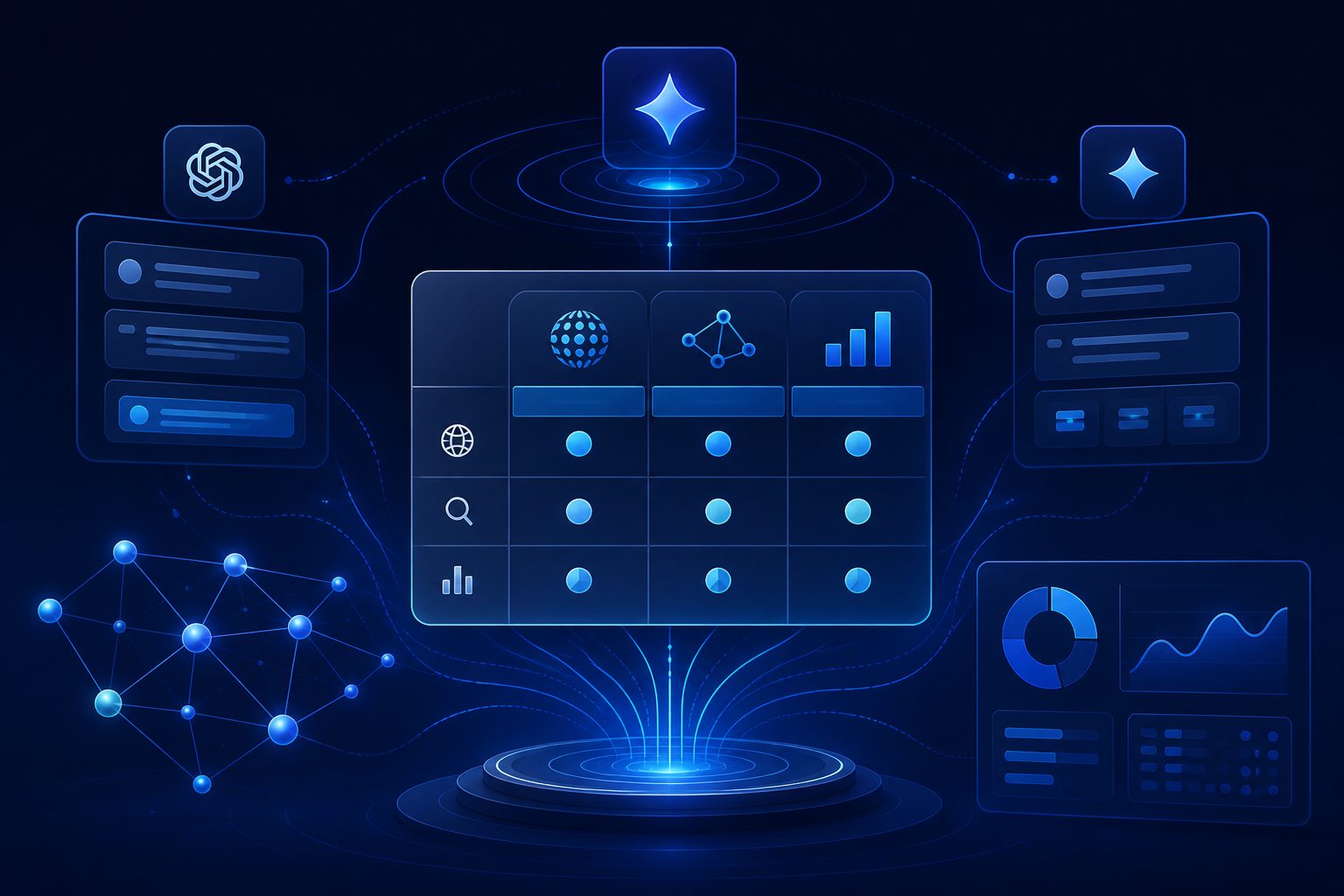
| Dimension | Weight | What strong providers show | Red flag |
|---|---|---|---|
| AI engine coverage | 25 | Clear tracking across major AI surfaces and daily or frequent updates | One-off screenshots or vague “AI search” claims |
| Citation transparency | 20 | Source-level detail: domains, articles, docs, forums, and reviews | “We optimize for citations” without proof paths |
| Competitor benchmarking | 20 | Side-by-side mention, rank, and source comparison | No named competitors, no baseline |
| Accuracy and sentiment | 15 | Tracking of misstatements, tone, and brand framing | Only positive/negative labels with no context |
| Actionability | 20 | Specific next steps tied to prompts and sources | Reports that end without implementation guidance |
Interpretation:
- 85–100: Strong fit for AI companies treating AEO as a growth channel.
- 70–84: Useful, but likely missing one important layer.
- Below 70: Probably repackaged SEO or a content-only service.
The real insight here is simple: AI firms need a provider that can translate answer changes into operational work. That usually means content, documentation, source cleanup, and tracking in one loop.
What should you ask before you buy?
The best service conversations are concrete. You want to know how the provider finds gaps, what it measures, and how it decides what to fix first. If they cannot answer those questions clearly, the engagement may become expensive guesswork.
Ask these questions:
- Which AI engines do you monitor?
- How often do you update the data?
- Do you store the original AI answers for review?
- Can you compare my brand against named competitors?
- Can you show citation sources at the domain and page level?
- Do you track sentiment and factual accuracy?
- How do you convert SEO keywords into AI-search prompts?
- What happens when different engines give different answers?
- What changes require content, technical, PR, or documentation work?
- What will I see after 30, 60, and 90 days?
For AI companies, the strongest signal is not a polished pitch deck. It is a provider that can explain how a prompt becomes a recommendation gap, and how that gap becomes a fix.
A 30-day rollout plan for AI companies
A serious engagement should produce a baseline, a prioritized opportunity map, and the first round of measurable fixes within 30 days. Longer strategy decks are fine, but they should not delay action.
-
Days 1–3: Define the prompt set.
Include category prompts, competitor prompts, use-case prompts, integration prompts, pricing prompts, and “best tool” queries. -
Days 4–7: Capture the baseline.
Measure mention rate, recommendation position, sentiment, competitor visibility, and citation sources by engine. -
Days 8–12: Classify the gaps.
Separate missing entity clarity, thin comparison content, weak third-party trust, outdated docs, and negative framing. -
Days 13–20: Produce answer-ready assets.
Build concise definitions, comparison tables, FAQ blocks, product fact pages, and use-case pages. -
Days 21–25: Improve citation paths.
Update owned pages, technical docs, and source profiles that AI systems appear to trust. -
Days 26–30: Re-measure and decide.
Compare the new answers with the baseline and choose the next prompt set.
This is where monitoring matters. Without daily or frequent measurement, it is hard to know whether the change came from your work or from the engines themselves.
Where MaxAEO fits in the stack
MaxAEO fits the measurement and optimization layer for AI companies that need daily visibility, competitor context, and citation tracing. It monitors brand visibility across 8 AI engines, including ChatGPT, Perplexity, Gemini, Claude, Copilot, Grok, Google AI Mode, and Google AI Overview.
It also supports free AI visibility diagnosis, competitor comparison, sentiment analysis, factual accuracy checks, citation-source tracing, prompt research, and daily trend updates. That makes it useful for SaaS teams that want a clear baseline before deciding whether to buy a service, build in-house, or do both.
A practical way to use it is simple: start with the free report, identify the prompts where competitors appear instead of you, and map those answers back to the sources AI systems trust. Then decide whether you need content work, source work, or both.
Common mistakes AI companies make when choosing AEO services
The biggest mistake is buying content volume instead of answer visibility. A second mistake is treating SEO and AEO as identical. They overlap, but they do not behave the same way in practice.
Other common mistakes include:
- Tracking only one engine.
- Ignoring competitor citations.
- Measuring traffic but not answer placement.
- Over-relying on schema without source authority.
- Optimizing pages without testing prompts.
- Assuming a strong homepage will fix product discovery.
For the AI industry, the highest-value services are the ones that connect brand facts, source trust, and answer behavior. If a provider cannot show that chain, the strategy is incomplete.
FAQ
Do AI companies need AEO if they already rank in Google?
Yes. Google rankings help, but they do not guarantee visibility inside AI answers. AI systems can cite different sources, compress different facts, and recommend different brands.
Is AEO the same as GEO?
They are closely related and often used interchangeably. In practice, both aim to improve visibility in AI-generated answers, citations, and recommendations.
Should I hire an agency or buy software first?
If you lack visibility data, start with software or a monitoring platform. If you already know the gaps and need execution, an agency or hybrid model makes more sense.
What sources do AI engines trust for AI products?
Common sources include product docs, comparison pages, review sites, forums, technical explainers, and credible third-party coverage. The exact mix depends on the engine and prompt.
How fast can answer engine optimization services change results?
It varies by engine, prompt type, and source mix. The safest expectation is to look for early directional change first, then iterate based on what the answers actually show.
Bottom line
Top answer engine optimization services for the AI industry are not defined by a long service list. They are defined by measurable visibility, source-level transparency, competitor benchmarking, and repeatable improvement. If a provider can show those four things, it is worth serious consideration.
For AI companies, that is the difference between guessing at visibility and engineering it.