
ChatGPT product ads are paid placements that can appear separately from ChatGPT’s answer when a user’s conversation shows commercial intent. For brands, the bigger shift is not just a new ad channel; it is the merger of advertising, AI shopping, and organic answer visibility in one decision environment.
OpenAI says ads are clearly labeled, separate from responses, and do not let advertisers alter ChatGPT’s answers, according to its Ads in ChatGPT Help Center page. But marketers still face a practical question: if a user asks “what should I buy?” or “which tool is best for my team?”, how should a brand balance paid placement, organic recommendation, citation quality, and trust?
This guide explains how ChatGPT ads work, how they differ from product results, where brands should measure visibility, and what to do before allocating budget.
What are ChatGPT product ads?
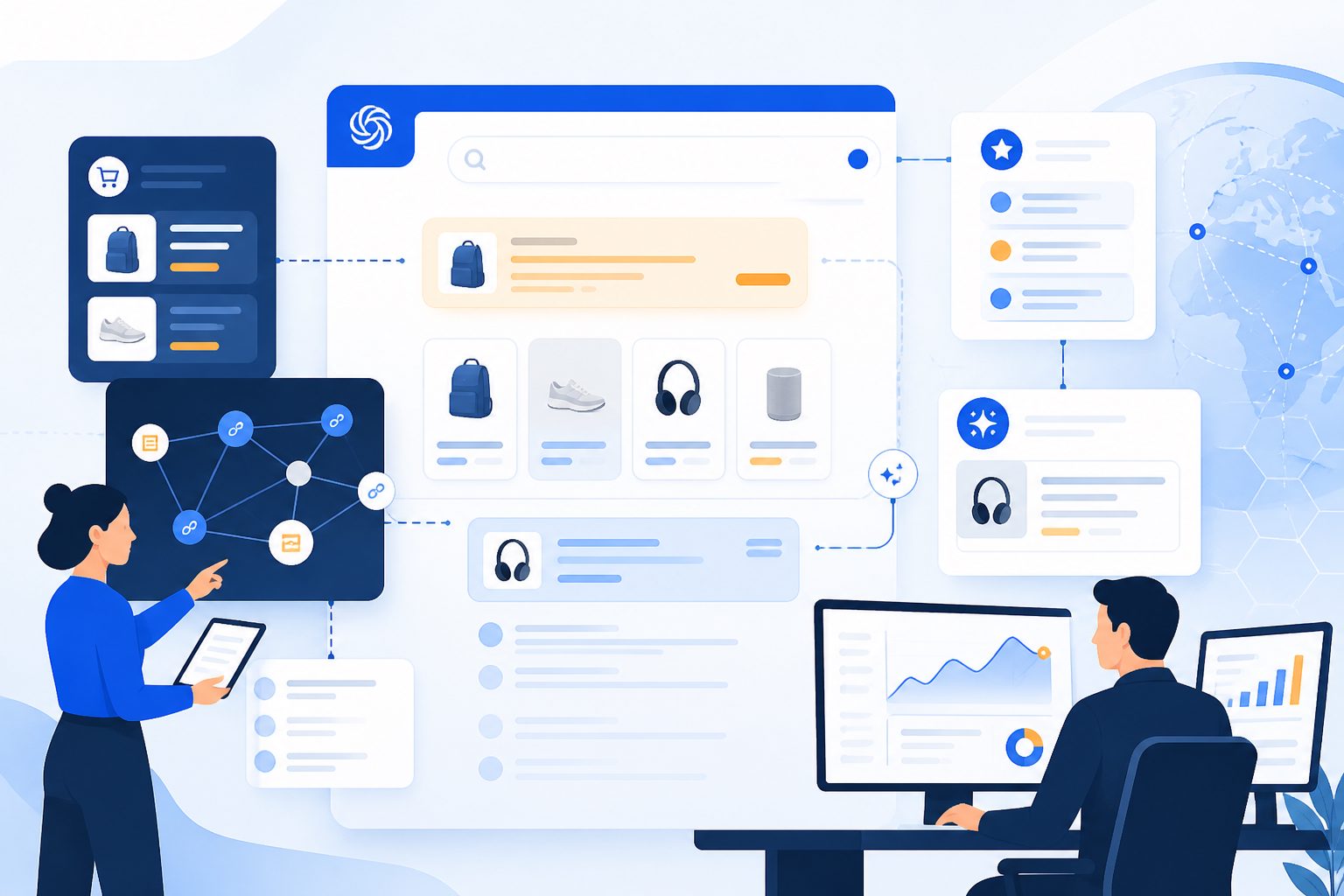
ChatGPT product ads are sponsored placements inside ChatGPT that are matched to conversational intent rather than only to a typed keyword. They may appear below responses or as ad units connected to relevant shopping or decision-making conversations, depending on availability and eligibility.
OpenAI’s ads site describes ChatGPT as a place where people “explore options, compare alternatives, weigh tradeoffs, and make informed decisions,” and it positions ads around those high-intent moments via OpenAI Ads. That makes the format closer to decision-stage advertising than classic display advertising.
The important distinction is separation. OpenAI states that ads are paid placements, not endorsements, and that advertisers do not shape or rank the model’s answer. In other words, an ad may appear near a response, but the organic answer can still recommend a competitor, cite a third-party review, or omit the advertiser entirely.
For marketers, this creates two visibility layers:
| Layer | What the user sees | How it is earned or bought | Main risk |
|---|---|---|---|
| Paid ad | Labeled sponsored unit | Campaign setup, bid, relevance, landing page | Clicks without trust if the answer favors another brand |
| Organic answer | Brand mention, comparison, recommendation, citation | AI-search visibility, content quality, source authority | Being invisible even while competitors are recommended |
| Product result | Product card, image, details, purchase link | Relevance, structured metadata, third-party data | Incorrect positioning or missing product attributes |
| Citation | Source link used by the AI answer | Crawlable, useful, structured, trusted content | AI cites outdated or low-quality sources |
How do ChatGPT product ads differ from ChatGPT shopping results?
ChatGPT shopping results are selected independently by ChatGPT, while ads are paid sponsored placements. OpenAI’s shopping documentation says product results are not ads and are not influenced by OpenAI partnerships, while ads are separate from product results.
That distinction matters because many teams use “ChatGPT ads,” “AI shopping ads,” and “ChatGPT shopping” interchangeably. They should not.
OpenAI’s Shopping with ChatGPT Search documentation says ChatGPT can show product options with imagery, details, and purchase links when a question suggests shopping intent. It also notes that product selection can consider structured metadata, product descriptions, third-party content, price, reviews, and user context.
So a brand can be visible in three ways in the same broad journey:
- As an organic recommendation in the model’s answer.
- As a product result in a shopping-style carousel or product list.
- As a sponsored ad below or near the response.
The strategic mistake is treating paid ads as a substitute for AI visibility. If a user asks for “best project management software for a 20-person agency” and the answer names three competitors before your sponsored unit appears, the ad is fighting the answer, not reinforcing it.
How are ChatGPT ads matched and ranked?
ChatGPT ads are matched using conversational context, relevance signals, advertiser inputs, landing pages, and bids. OpenAI says ranking can combine relevance and advertiser bids when multiple eligible ads are available.
The OpenAI Help Center guidance on creating ads says ChatGPT advertising differs from keyword-based platforms because it considers conversational intent and multiple relevance signals. It also advises advertisers to use clear, specific, benefit-focused copy rather than vague slogans.
This changes ad planning. In search advertising, one keyword often maps to one landing page. In conversational advertising, a single user journey can include budget, use case, constraints, comparisons, alternatives, implementation fears, and category education.
A SaaS buyer might ask:
- “What is the best CRM for a remote sales team?”
- “Compare HubSpot alternatives for a seed-stage startup.”
- “Which tool has the easiest migration from spreadsheets?”
- “What should I avoid when buying sales automation software?”
All four can express commercial intent, but they require different proof points. A generic ad headline will be less useful than a message that matches the decision context.
The new buyer journey: from query matching to answer adjacency
The key shift is answer adjacency: brands now appear beside an AI-generated recommendation environment, not just beside a list of links. That means paid media, SEO, AEO, and product data quality must be planned together.
In Google Search, users scan results and choose a link. In ChatGPT, users often receive a synthesized answer first. The ad appears in a conversation where the AI may have already framed the problem, shortlisted vendors, or explained what criteria matter.
This creates a new conversion sequence:
- Prompt: The buyer states a need in natural language.
- Interpretation: ChatGPT infers intent, constraints, and likely next steps.
- Answer: The model gives advice, options, or a product shortlist.
- Commercial layer: Product cards or sponsored placements may appear.
- Verification: The user clicks sources, reviews, product pages, or checkout links.
The fourth step is visible, but the second and third steps often determine trust. If your brand is absent from the answer and only present as an ad, the user may treat it as an interruption. If your brand is mentioned naturally and the ad provides a relevant next step, the paid unit can act as a bridge.
This is why AI visibility measurement is becoming a prerequisite for paid AI media. MaxAEO’s AI share of voice tracking framework explains how brands can compare mentions, rankings, sentiment, and citations across AI answers before deciding where to invest.
A practical readiness framework for ChatGPT product ads
Brands should prepare for ChatGPT product ads by auditing five assets: prompts, product data, landing pages, citations, and competitive answer position. The goal is to make paid visibility reinforce the answer, not compensate for weak organic presence.
Use the following checklist before launching campaigns.
| Readiness area | What to inspect | Why it matters |
|---|---|---|
| Buyer prompts | Real questions buyers ask before choosing a product | Ads are matched to conversational intent, not only keywords |
| Product data | Names, categories, features, pricing pages, availability, schema | Shopping-style results depend on structured and third-party information |
| Landing pages | Use-case pages, comparison pages, product pages, collections | OpenAI recommends linking to relevant destinations, not generic homepages |
| AI citations | Review sites, blogs, docs, Reddit, comparison pages, support content | AI answers often rely on external sources to justify recommendations |
| Competitive position | Who is mentioned, ranked, cited, or sentiment-framed | Paid ads can underperform if the organic answer favors competitors |
For SaaS teams, this readiness work overlaps with Generative Engine Optimization. A strong starting point is MaxAEO’s guide to Generative Engine Optimization as an AI visibility framework, which connects content structure, citations, and answer presence.
Original prompt-risk model: which conversations deserve ad budget first?
The best early ChatGPT ad tests should focus on prompts where commercial intent is high and organic brand visibility is unstable. A simple scoring model helps prioritize conversations before spending.
Use this 3-factor model for each buyer prompt:
- Intent score: Is the user actively comparing, buying, switching, or requesting recommendations?
- Answer influence score: Does ChatGPT’s answer shape the shortlist before the user clicks?
- Visibility gap score: Is your brand absent, mispositioned, or cited through weak sources?
Score each from 1 to 5. Prompts with a total of 11–15 deserve immediate attention because the buyer is close to action and the AI answer can heavily influence the decision.
Example for a B2B SaaS product:
| Prompt type | Intent | Answer influence | Visibility gap | Priority |
|---|---|---|---|---|
| “Best tools for X use case” | 5 | 5 | 4 | High |
| “Alternative to competitor Y” | 5 | 4 | 3 | High |
| “What is X category?” | 2 | 3 | 4 | Medium |
| “How to solve workflow problem Z?” | 3 | 4 | 5 | High |
| “Brand A vs Brand B” | 4 | 5 | 2 | Medium-high |
This model adds a missing layer to most ChatGPT ads discussions: not every high-intent prompt is equally worth paid budget. The highest-value prompts are those where the answer creates or changes the shortlist.
MaxAEO can support this type of monitoring by tracking brand mention rate, competitive ranking, average recommendation position, sentiment, and citation sources across 8 AI engines, including ChatGPT, Gemini, Perplexity, Claude, Copilot, Grok, Google AI Mode, and Google AI Overview. Brands can also generate a free AI visibility diagnostic report from maxaeo.ai.

What should ecommerce brands do differently?
Ecommerce brands should treat ChatGPT ads as both a product-feed challenge and a trust challenge. Product attributes must be machine-readable, but third-party validation may decide whether the AI answer makes the product feel credible.
OpenAI’s shopping documentation says ChatGPT may consider structured metadata, product descriptions, third-party content, price, reviews, and other context when selecting products. That means ecommerce teams should audit more than ad creative.
High-priority actions include:
-
Clean product feeds and metadata
Product names, images, categories, variants, prices, and availability should be consistent across the site and feed sources. -
Build use-case landing pages
Pages such as “best running shoes for wide feet” or “starter espresso machines under $500” can align with conversational prompts better than a generic category page. -
Strengthen independent proof
Reviews, expert roundups, buying guides, comparison pages, and user discussions can help AI systems understand where the product fits. -
Monitor mislabeling
If an AI product card labels an item as “budget-friendly,” “most popular,” or best for a use case, verify whether that positioning helps or harms conversion.
For a broader shopping-specific framework, MaxAEO’s guide on optimizing for AI shopping assistants covers product data, intent mapping, and recommendation visibility.
What should SaaS brands do differently?
SaaS brands should focus less on SKU feeds and more on category framing, comparison prompts, and citation quality. In B2B software, the decisive moment is often a shortlist recommendation rather than an instant purchase.
A SaaS buyer may ask ChatGPT to narrow a category based on team size, integrations, workflow, compliance, budget, migration complexity, or implementation effort. If ChatGPT misunderstands your ideal customer profile, your ad may reach the wrong audience or appear after an answer that positions you poorly.
SaaS teams should monitor:
- Whether the brand is mentioned for core use cases.
- Whether the brand is recommended for the right company size.
- Which competitors appear in the same answer.
- Whether the sentiment is positive, neutral, or negative.
- Which sources are cited when the answer explains the recommendation.
- Whether outdated pricing pages, old reviews, or incomplete docs shape the response.
MaxAEO is designed for this exact visibility layer. It monitors brand mentions, citations, recommendations, sentiment, and competitive comparisons across AI engines, with daily updates and bilingual market coverage for English and Chinese markets. Its competitive benchmarking can compare your brand and competitors by mention rate, citation source, sentiment, and average recommendation position.
Measurement: what KPIs matter beyond clicks?
ChatGPT product ads should be measured with both ad metrics and AI visibility metrics. Clicks and conversions show paid performance; mention rate, sentiment, citation quality, and recommendation position show whether the AI answer environment supports that performance.
A useful dashboard should include:
| KPI | Paid media question | AI visibility question |
|---|---|---|
| Impressions | Did the ad show? | Was the brand also present in the answer? |
| CTR | Did users respond to the sponsored unit? | Did the answer create trust before the click? |
| Conversion rate | Did the landing page convert? | Was the brand positioned for the right use case? |
| Brand mention rate | Not usually captured in ad tools | How often does AI mention the brand for target prompts? |
| Citation source | Not usually captured in ad tools | Which pages or domains shape AI’s recommendation? |
| Sentiment | Limited in ad reporting | Is the brand framed positively, neutrally, or negatively? |
| Competitive rank | Campaign-level view | Who appears above or instead of the brand? |
This is where a pure ad-platform view is incomplete. If paid performance declines, the cause might not be the bid or creative. It could be that ChatGPT’s organic answer has started recommending a competitor more often.
MaxAEO’s AI search strategy framework outlines how to connect visibility monitoring with prompt research, citation improvement, and content planning.
Risks and policy constraints marketers should understand
The main risks are trust erosion, category restrictions, weak landing-page alignment, and over-reliance on paid placement. OpenAI’s ad policies restrict or disallow several sensitive categories and require ads to be clearly distinguishable from the ChatGPT interface.
OpenAI’s Ad Policies include rules on misleading content, interface imitation, counterfeit goods, adult content, alcohol and tobacco, and restrictions around financial products and services. The policies also state that ads may be rejected if creatives, images, or landing pages are inconsistent or non-compliant.
Academic researchers are also watching this space. A 2026 paper, The Beginning of ChatGPT Ads, reported an audit using 91 sock-puppet accounts, more than 3,000 collected ads, and 186 unique advertisers. The authors found that early ads were clearly separated from response text and skewed heavily toward consumer goods, while also observing demographic differences in exposure.
For brands, the takeaway is not alarmism. It is governance. AI advertising sits inside a high-trust interaction, so compliance, transparency, and accurate positioning matter more than they do in many traditional ad units.
A 30-day action plan for brands
The fastest way to prepare is to map prompts, audit current AI visibility, fix the sources that AI systems cite, and then test paid placements only where the answer context supports conversion.
A practical 30-day plan:
-
Days 1–3: Build a prompt set
Convert SEO keywords, sales questions, comparison terms, and support objections into 30–100 natural-language buyer prompts. -
Days 4–7: Capture baseline answers
Check whether ChatGPT and other AI engines mention your brand, competitors, or category sources. -
Days 8–12: Classify prompt opportunity
Use the intent, answer influence, and visibility gap model to prioritize prompts. -
Days 13–18: Fix content and citation gaps
Update product pages, comparison pages, documentation, buying guides, and structured data. -
Days 19–23: Prepare ad-message variants
Create clear, benefit-focused ads for different use cases rather than one generic message. -
Days 24–30: Test and monitor together
Track ad metrics alongside AI mention rate, sentiment, citations, and competitive answer position.
This sequence prevents a common mistake: launching into ChatGPT ads before knowing what ChatGPT already says about the category.
Common questions about ChatGPT product ads
Are ChatGPT product ads the same as organic recommendations?
No. ChatGPT product ads are sponsored placements, while organic recommendations are generated by ChatGPT’s answer systems. OpenAI says ads are separate from answers and do not mean OpenAI endorses the advertiser.
Can paying for ads make ChatGPT recommend my product?
OpenAI states that advertisers cannot shape, rank, or alter ChatGPT’s responses through ads. Brands should treat paid placement and organic AI visibility as separate but connected workstreams.
Do ChatGPT ads replace SEO or AEO?
No. They add a paid layer to AI discovery, but SEO, Answer Engine Optimization, citation quality, and structured product information still influence whether a brand appears in organic AI answers and product results.
What should a brand audit before running ChatGPT ads?
Audit buyer prompts, current AI mentions, competitor visibility, sentiment, citation sources, landing-page relevance, product metadata, and policy eligibility. This shows where paid placement is likely to reinforce existing trust.
How can MaxAEO help with ChatGPT ad readiness?
MaxAEO monitors brand visibility across 8 AI engines, including ChatGPT, and tracks mentions, citations, recommendations, sentiment, competitor benchmarks, and daily trends. A free AI visibility diagnostic report is available on maxaeo.ai.
Final takeaway
ChatGPT product ads are not just another paid media slot. They appear inside an AI-mediated decision journey where the answer, product data, citations, and sponsored unit all influence trust.
The brands best prepared for this channel will not be the ones that simply move search ads into ChatGPT. They will be the ones that know which prompts matter, how they are currently represented in AI answers, which sources shape those answers, and where a paid placement can genuinely help the user take the next step.
For most teams, the right first move is not budget allocation. It is visibility diagnosis.