
Agentic commerce optimization is the practice of making products, offers, policies, and checkout paths easy for AI shopping agents to discover, compare, recommend, and act on. It goes beyond SEO because the “visitor” is often not a human browsing pages, but an agent deciding whether a brand deserves to enter a short list.
That shift matters because agentic commerce changes the buyer journey from “search, click, compare, buy” to “ask, delegate, verify, transact.” A customer may ask ChatGPT, Gemini, Perplexity, Copilot, or another AI assistant to find the best product for a need, compare options, check constraints, and sometimes complete the purchase.
For brands, the new question is not only “Do we rank?” It is: Can an AI agent understand why our product is the right choice, trust the evidence, and route the buyer to a purchasable path?
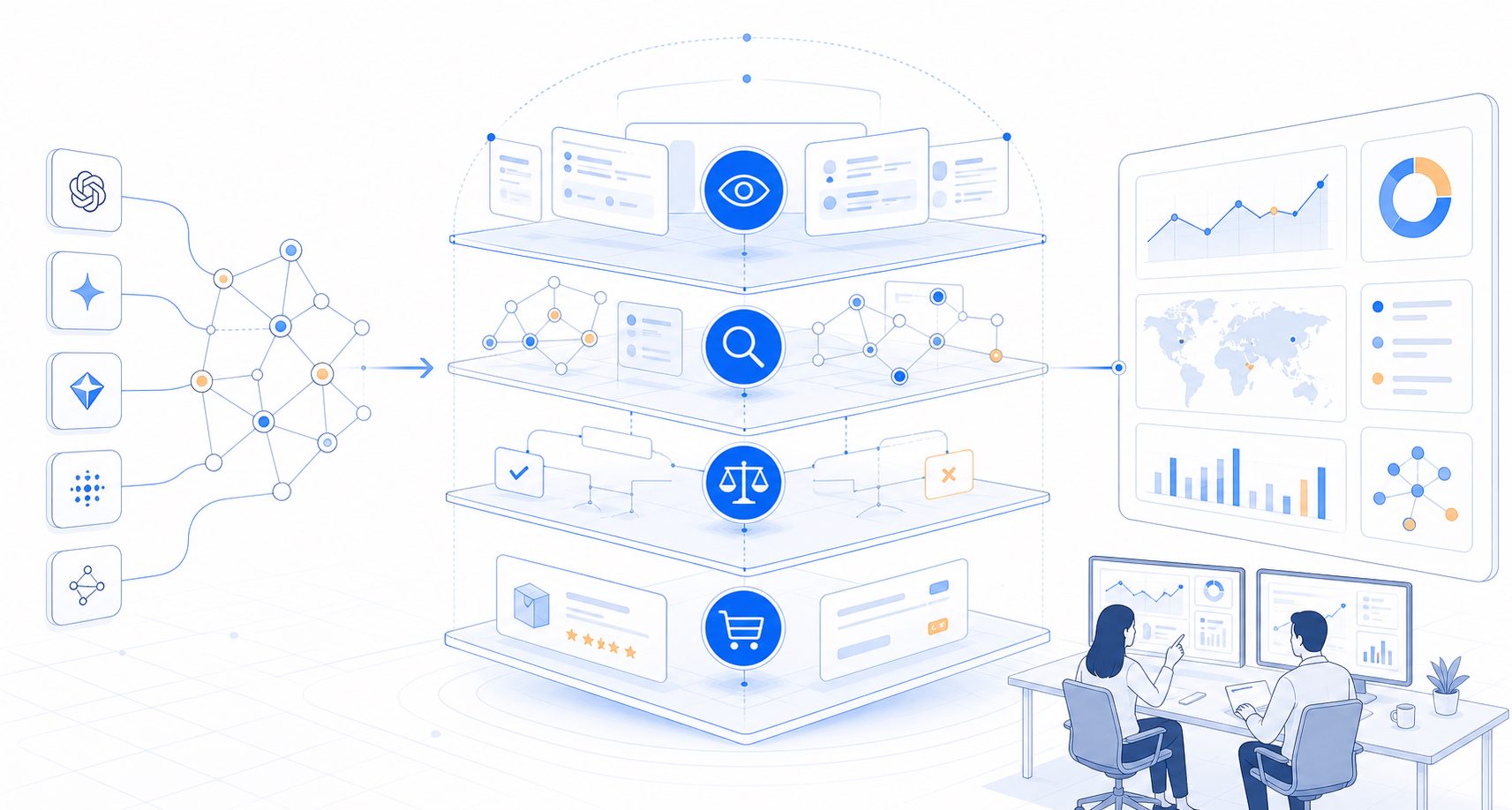
What Is Agentic Commerce Optimization?
Agentic commerce optimization is the discipline of preparing a brand’s digital presence for AI agents that research, filter, compare, and recommend products. It combines product data quality, answer engine visibility, third-party evidence, policy clarity, and transaction readiness.
Traditional ecommerce optimization assumes a person sees a page, interprets the offer, and makes a decision. Agentic commerce assumes an AI intermediary may summarize the market before the buyer sees any page at all.
That intermediary may rely on:
- Product pages and structured data
- Review sites, marketplaces, forums, and comparison pages
- Shipping, return, warranty, and availability information
- Public documentation and help content
- Brand mentions in AI-generated answers
- Price, fit, trust, and constraint signals
- Checkout and payment compatibility
In practice, agentic commerce optimization sits between answer engine optimization, generative engine optimization, ecommerce merchandising, and conversion rate optimization. It is not a replacement for SEO. It is a new layer that prepares your brand for AI-mediated discovery and selection.
Why Agentic Commerce Changes the Optimization Problem
Agentic commerce compresses discovery, comparison, and selection into one conversational flow. The brand may not get a click until after the agent has already decided which options are worth presenting.
That creates a “shortlist economy.” In a classic search journey, a buyer might scan ten blue links, several ads, a marketplace page, and a few reviews. In an AI-assisted shopping journey, the buyer may see three recommendations with a short explanation.
This changes the optimization target in three ways:
| Old ecommerce question | Agentic commerce question |
|---|---|
| Can users find our page? | Can agents include us in the recommendation set? |
| Is our product page persuasive? | Is our product data interpretable and evidence-backed? |
| Can we convert clicks? | Can the agent verify fit, trust, availability, and purchase path? |
Large consultancies are describing a similar shift. PwC frames agentic commerce as an added layer where AI agents participate in, and sometimes lead, the journey. IBM’s overview of agentic commerce also connects the trend to AI agents that research, negotiate, and complete purchases.
The practical implication is simple: brands need to optimize for machine evaluation before human persuasion.
The Four-Layer ACO Framework
The strongest agentic commerce programs optimize four layers together: visibility, interpretation, evidence, and action. A weakness in any layer can prevent a product from being recommended, even if the other layers are strong.
1. Visibility: Can AI Engines Find and Mention You?
Visibility is the first gate. If AI engines rarely mention your brand for relevant buyer prompts, your product may never enter the agent’s consideration set.
For ecommerce and SaaS brands, visibility should be measured at the prompt level, not only the keyword level. A buyer rarely asks an AI agent for a head term like “running shoes.” They ask with constraints:
- “Best lightweight running shoes for flat feet under $150”
- “Compare sustainable refillable skincare brands for sensitive skin”
- “Which project management tools are best for a 20-person agency?”
- “Find a giftable espresso machine with low maintenance”
This is where traditional SEO keyword research must be converted into buyer prompts. MaxAEO supports turning existing SEO keywords into AI monitoring prompts and tracking brand visibility across 8 AI platforms, including ChatGPT, Gemini, Perplexity, Claude, Copilot, Grok, Google AI Mode, and Google AI Overview.
For a deeper view of AI-mediated product discovery, see MaxAEO’s guide to AI shopping agent visibility.
2. Interpretation: Can Agents Understand the Product Fit?
Interpretation is the second gate. AI agents need clear, structured information to map products to buyer constraints.
A product page written only for emotion may fail here. Agents need explicit facts: who the product is for, who it is not for, sizes, materials, integrations, ingredients, compatibility, warranty limits, delivery constraints, and return rules.
A strong agent-ready product page should answer:
- What category does this product belong to?
- Which use cases is it best for?
- Which constraints does it satisfy?
- What are the trade-offs?
- What proof supports the claims?
- What variants, bundles, or plans exist?
- What availability, shipping, and return rules apply?
For SaaS, the same principle applies to pricing pages, comparison pages, documentation, and integration pages. An AI agent recommending software needs to understand company size fit, integrations, security posture, onboarding effort, and pricing model.
This is why a generic “best for teams of all sizes” message can hurt agentic commerce optimization. Agents need specificity to match a buyer’s context.
3. Evidence: Can Agents Verify the Recommendation?
Evidence is the trust layer. AI agents often favor brands that are described consistently across multiple sources, especially when claims are supported by independent or structured references.
Evidence sources may include:
- Expert reviews
- Comparison pages
- Marketplace listings
- Reddit discussions
- Documentation
- Case studies
- Help center articles
- Product schema
- Third-party ratings
- Editorial buying guides
The important point is not to flood the web with repetitive content. It is to create verifiable, consistent, and specific evidence that an AI system can use when explaining why a product fits a need.
For example, a vague claim such as “best quality skincare” is weak. A clearer claim is: “fragrance-free moisturizer for sensitive skin, accepted by a dermatologist-reviewed publication, with a 30-day return policy and recyclable refill packaging.” The second version gives an agent usable selection criteria.
MaxAEO’s citation tracking can show which domains, articles, and platforms AI answers cite when discussing a brand or category. That helps teams see whether agents rely on their own site, review sites, marketplaces, blogs, technical docs, Reddit, or competitor pages.
For more on how autonomous engines evaluate product options, read MaxAEO’s analysis of AI agent product recommendations.
4. Action: Can the Agent Route the Buyer to Purchase?
Action is the transaction layer. A product can be visible and trusted, but still lose if the agent cannot determine how to complete the purchase.
Agentic commerce readiness includes:
- Clear canonical product URLs
- Up-to-date availability
- Transparent price and variant data
- Shipping regions and delivery timelines
- Return and warranty policies
- Guest checkout or low-friction account creation
- Payment options
- Order confirmation and support paths
- Machine-readable product and organization data
Payment providers are already describing this shift. Stripe’s guide to agentic commerce notes that businesses need to make themselves legible to agents, not only to human shoppers.
The key idea: transaction readiness is now part of discoverability. If an agent can recommend a product but cannot verify the next step, it may choose a competitor with a clearer path.
A Practical Agentic Commerce Readiness Score
A useful way to operationalize agentic commerce optimization is to score each product line or offer from 0 to 3 across eight dimensions. This creates a practical benchmark without pretending that AI recommendations can be fully controlled.
| Dimension | 0 = Missing | 1 = Weak | 2 = Usable | 3 = Agent-ready |
|---|---|---|---|---|
| Prompt visibility | Not mentioned | Rare mentions | Mentioned for some buyer prompts | Consistently appears in relevant shortlists |
| Product clarity | Vague positioning | Basic specs | Clear use cases and constraints | Fit, trade-offs, and alternatives are explicit |
| Structured data | None | Partial schema | Product/Organization data present | Complete, consistent, validated data |
| Evidence depth | Only brand claims | Thin reviews | Multiple credible sources | Independent, current, category-specific proof |
| Citation quality | AI cites weak or outdated sources | Mixed sources | Mostly relevant sources | High-quality, controllable or influenceable sources |
| Policy clarity | Hard to find | Human-readable only | Clear shipping/returns/warranty | Easy for agents to parse and summarize |
| Competitive context | No comparisons | Brand-led claims | Fair comparison pages | Specific, factual, constraint-based comparisons |
| Transaction path | Unclear | Friction-heavy | Purchasable path exists | Agent can verify product, price, availability, and next step |
A score below 12 suggests the brand is still optimized mainly for human browsing. A score between 12 and 18 indicates partial agent readiness. A score above 18 means the brand has enough structure, evidence, and transaction clarity to compete in AI-mediated buying journeys.
This scoring model is deliberately conservative. It does not assume that any brand can force an AI agent to recommend it. It focuses on the inputs brands can improve.
How to Start: A 30-Day ACO Audit
The fastest way to begin is not a site redesign. It is a focused audit of buyer prompts, AI answers, cited sources, and product-page gaps.
Week 1: Build the Prompt Set
Start with 30 to 50 buyer prompts across four intent types:
- Discovery prompts: “best products for…”
- Comparison prompts: “compare brand A vs brand B…”
- Constraint prompts: “under $100,” “for sensitive skin,” “for remote teams”
- Action prompts: “where can I buy,” “which option ships fastest,” “what should I choose”
Include branded, non-branded, competitor, and problem-led prompts. For SaaS teams, include company size, integration, compliance, and budget constraints.
Week 2: Capture AI Visibility and Competitor Mentions
Run the prompts across multiple AI engines and record:
- Whether your brand appears
- Which competitors appear
- The order of recommendations
- The sentiment of the description
- The cited or implied sources
- Whether the answer is factually accurate
MaxAEO provides AI search visibility reports across 8 AI platforms, with mention rate, ranking, competitor visibility, citation sources, sentiment, and action recommendations. Teams can also generate a free AI visibility diagnostic report from maxaeo.ai by entering a brand website.
Week 3: Map Missing Evidence
Next, identify why competitors may be selected instead. Often the issue is not that your product is worse. It is that the agent has more usable evidence for another option.
Look for gaps such as:
- Missing comparison content
- Unclear category positioning
- Thin product specifications
- Reviews that mention benefits but not constraints
- Help content that is not connected to product pages
- Outdated third-party descriptions
- AI answers citing competitor pages for your category
This is where ACO becomes a content and distribution problem, not only a technical SEO problem.
Week 4: Publish Agent-Ready Fixes
Prioritize fixes that help both humans and agents:
- Add concise “best for / not best for” sections.
- Expand product attributes and compatibility details.
- Create fair comparison pages for common alternatives.
- Clarify shipping, returns, warranty, and support policies.
- Add structured data where appropriate.
- Update outdated third-party profiles.
- Create answer-ready explanations for high-intent prompts.
- Monitor whether AI answers change after publication.
For brands that need a broader measurement model, MaxAEO’s guide to AI share of voice tracking explains how to benchmark visibility against competitors over time.

Agentic Commerce Optimization vs. SEO, AEO, and GEO
Agentic commerce optimization overlaps with SEO, AEO, and GEO, but it has a more commerce-specific goal: being selected by AI agents in product or vendor decisions.
| Discipline | Primary target | Main output | Success signal |
|---|---|---|---|
| SEO | Search engines and human searchers | Ranking pages | Organic clicks and conversions |
| AEO | Answer engines | Direct answers and citations | Mentions, citations, answer inclusion |
| GEO | Generative AI systems | AI-readable, source-worthy content | AI-generated visibility and attribution |
| ACO | AI shopping and buying agents | Product selection readiness | Inclusion in recommendations and purchasable paths |
AEO and GEO help agents understand and cite a brand. ACO adds product, policy, inventory, payment, and purchase-path readiness.
For example, a SaaS company may use AEO to appear in “best CRM for startups” answers. It uses agentic commerce optimization to make sure the AI can also compare plans, understand integrations, verify fit, and recommend the correct next step.
What Most Brands Get Wrong
The most common mistake is treating agentic commerce as a future payment feature instead of a current visibility problem. Even before agents complete purchases, they already influence research and shortlisting.
Other mistakes include:
- Optimizing only the homepage while product pages stay thin
- Publishing generic “best” content with no decision criteria
- Ignoring third-party sources that AI engines cite
- Using inconsistent product names across platforms
- Hiding important policies in PDFs or checkout-only pages
- Assuming schema alone will solve visibility
- Measuring Google rankings but not AI answer inclusion
- Tracking ChatGPT only while ignoring Perplexity, Gemini, Copilot, and Google AI surfaces
The deeper issue is organizational. Agentic commerce touches SEO, merchandising, product marketing, legal, support, ecommerce operations, and analytics. If no team owns the full journey, the agent sees fragments.
Metrics That Matter for Agentic Commerce
The right metrics combine visibility, interpretation, evidence, and action. Traffic alone is not enough because many AI journeys are zero-click until late in the buying process.
Track these metrics monthly:
- AI mention rate: percentage of relevant prompts where the brand appears
- Recommendation position: average placement when multiple brands are listed
- Competitor mention gap: how often competitors appear without the brand
- Citation source mix: which domains AI answers rely on
- Sentiment trend: whether the brand is framed positively, neutrally, or negatively
- Fact accuracy: whether AI answers describe the offer correctly
- Prompt coverage: how many high-intent buyer prompts are monitored
- Policy extractability: whether shipping, returns, warranty, or plan limits are easy to summarize
- Transaction clarity: whether the next purchase step is obvious
MaxAEO Brand Monitoring supports daily tracking of brand mention rate, competitive ranking, average recommendation position, sentiment, citation sources, and optimization suggestions across 8 AI engines. It does not require technical installation; users can create monitoring from a brand website and receive diagnostic reporting.
Common Questions
Is agentic commerce optimization only for ecommerce brands?
No. Agentic commerce optimization applies to any business where AI agents may compare options and recommend a purchase path. That includes DTC products, marketplaces, SaaS tools, subscriptions, travel, financial software, B2B vendors, and local services.
Does ACO replace SEO?
No. ACO builds on SEO but changes the evaluation layer. SEO helps pages become discoverable in search engines. ACO helps AI agents understand, verify, compare, and recommend a product or brand in a task-based buying journey.
What is the first thing to audit?
Start with AI answer visibility. Run realistic buyer prompts across multiple AI engines and record whether your brand appears, which competitors are recommended, what sources are cited, and whether the description is accurate.
Can structured data guarantee AI recommendations?
No. Structured data can improve clarity, but it cannot guarantee inclusion or ranking. AI agents also evaluate relevance, evidence, third-party context, freshness, user constraints, and transaction feasibility.
How often should brands monitor AI shopping visibility?
Daily or weekly monitoring is best for competitive categories because AI answers can change as models, indexes, citations, and competitor content change. MaxAEO’s monitoring prompts run daily and provide trend updates across supported AI platforms.
The Bottom Line
Agentic commerce optimization is about becoming eligible for AI-mediated buying decisions. The winning brands will not simply have attractive pages. They will have clear product data, consistent evidence, trustworthy citations, transparent policies, and measurable visibility across AI engines.
The practical starting point is a prompt-based audit: discover where your brand appears, why competitors are chosen, which sources agents trust, and which product or policy gaps block recommendation. From there, ACO becomes a repeatable workflow: measure, fix, publish, verify, and monitor.