Short answer: when a buyer asks an AI assistant about the downsides of your product, your own pages supply almost none of the answer. Across four rounds of testing on 180 B2B SaaS brands and six engines, brand-controlled pages supplied 41% of citations on the shortlist turn and only 12% on the downsides turn. Review platforms and forums fill the gap.
That collapse is the whole problem. The objection turn is a distinct moment with its own retrieval behavior, its own failure modes, and its own fix list — and most visibility programs never measure it.
What is the objection turn in AI search?
The objection turn is the moment a buyer explicitly asks an AI assistant for the weaknesses, cons, complaints or trade-offs of a product it just recommended. It is an elicited negative — the user requested it — which makes it different from unsolicited caveats an engine adds on its own.
That distinction matters because the two behave differently. Unsolicited negativity is rare and controversy-driven. Elicited negativity is near-universal: in our panel, engines named at least one specific downside 94% of the time when asked directly. Refusing is not an option the model takes. Something will be said about you. The only variable is whether it is accurate, current, and sourced.
Most visibility programs never see this turn, because they track one prompt at a time. Buyers do not work that way — they shortlist, then interrogate. The late-funnel version of this pattern, where the question is framed as "is it worth it," follows the same retrieval logic and is mapped in our analysis of how AI answers late-funnel objection prompts.
How we measured the downsides turn
We built a controlled two-turn test rather than scraping one-off answers. Turn 1 was a category shortlist prompt ("best [category] tools for [segment]"). Turn 2, in the same conversation, was a direct objection prompt: "what are the downsides of [brand]?"
The panel:
- 180 B2B SaaS brands across 12 categories (CRM, analytics, HR tech, security, dev tools, and others)
- 6 engines: ChatGPT, Gemini, Perplexity, Claude, Copilot, and Google AI Mode
- 4 sampling rounds between March and June 2026, run from clean sessions with no memory or personalization
- 4,320 two-turn conversations in total
For every turn-2 answer we recorded the cited URLs, the single most-emphasized criticism, whether that criticism was still factually true on the test date, and whether the brand survived on the shortlist when the conversation continued. Criticisms were then deduplicated into 1,140 distinct brand–criticism pairs for the staleness analysis below.
Known limits of this method: the panel is B2B SaaS only, sampled from US-English prompts, and each brand was tested with one category framing rather than several. Consumer brands, non-English prompts and multi-category products may behave differently. Every percentage below is a panel figure, not an industry constant.
Why the citation set flips between the pitch turn and the objection turn
Engines do not reuse turn-1 sources to answer turn 2. They re-retrieve against a query whose shape has changed from "what is good" to "what is wrong," and vendor documentation almost never contains the second thing. So the retrieval set rotates toward complaint-shaped text.
Here is the shift we measured, as a share of all cited URLs:
| Source type | Turn 1 (shortlist) | Turn 2 (downsides) | Change |
|---|---|---|---|
| Brand-controlled (site, docs, help center) | 41% | 12% | −29 pts |
| Review platforms (G2, Capterra, TrustRadius) | 15% | 34% | +19 pts |
| Community forums (Reddit, Hacker News, archived Slack/Discord) | 8% | 24% | +16 pts |
| Editorial articles and listicles | 21% | 17% | −4 pts |
| Competitor comparison pages | 6% | 9% | +3 pts |
| News, filings, other | 9% | 4% | −5 pts |
Review platforms plus community forums move from 23% of the citation set to 58%. In practice, the "cons" field of a two-year-old G2 review and a downvoted Reddit comment can carry more weight in this answer than every page you have ever published.
That concentration is not unique to objection prompts. The AI Platform Citation Source Index 2026 from 5W, built on 680 million citations collected between August 2024 and April 2026, found Reddit cited at roughly 40% frequency across major engines and the top 15 domains capturing 68% of all citation share. Our data says that skew gets sharper, not softer, the moment a user asks for criticism.
Which external sources actually decide your downside answer
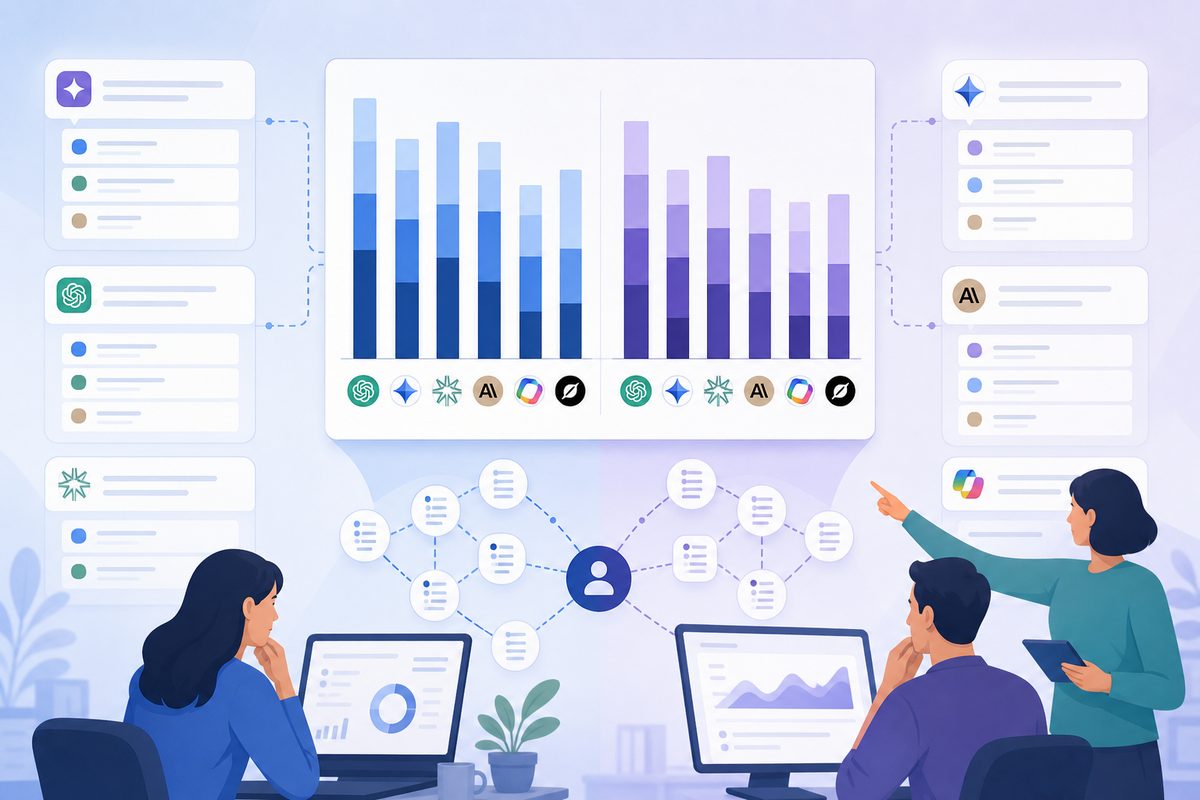
Three source families do most of the damage, and they are earnable in a specific order.
Structured review fields rank first. G2, Capterra and TrustRadius separate pros from cons in the review form itself, which hands engines a pre-labeled negative passage. No extraction work required.
Forum threads with a problem in the title rank second. "Anyone else hitting the API rate limit on [tool]?" is a perfect retrieval target for a cons query, and it stays retrievable for years.
Migration and churn posts rank third — "why we moved off X" essays, usually written by an engineer, usually never updated after the vendor shipped the fix.
Editorial listicles matter less here than teams expect. They tend to hedge, and hedged text is poor material for a direct question. Which of these families carries weight varies sharply by category; our citation-share study of the most-cited domains in B2B SaaS answers breaks the ranking down per vertical.
The four kinds of downside an engine can name
Not every criticism deserves the same response, and treating them alike is the most common mistake in ai reputation management. We coded all 1,140 brand–criticism pairs into four classes:
| Class | Share of pairs | What it actually is | Correct response |
|---|---|---|---|
| True and current | 41% | A real, present limitation | Reframe as fit, not defect |
| True but fixed | 34% | A limitation you resolved; the source never updated | Publish dated proof, refresh third-party records |
| True but misframed | 17% | Real fact, wrong context (price without segment, complexity without use case) | Supply the missing comparison |
| False or misattributed | 8% | Hallucinated, or another company's problem | Build corroboration; never argue with the model |
True and current: stop treating it as a leak
If the criticism is accurate today, the goal is not suppression. It is context. An answer that says "expensive for teams under 20 seats, strong for regulated enterprises" qualifies buyers instead of losing them. Vague denial produces a worse outcome than an honest boundary.
True but fixed: the single biggest addressable loss
This is where the money is. In 34% of pairs, the engine named a limitation the vendor had already publicly resolved — with a median lag of nine months between the fix shipping and the criticism still being quoted. One security vendor in the panel was still described as "no SSO on lower tiers" fourteen months after SSO shipped on every tier, because the top-cited review was from the prior pricing model.
Nine months of buyers hearing a solved objection is not a content problem. It is a records problem: the fix exists in your changelog and nowhere the engines look.
The four records that close the lag, in the order that moved answers fastest in our re-tests:
- A dated changelog entry naming the old limitation in the words the criticism uses ("SSO on all tiers, previously Enterprise-only — shipped March 2026"). Engines match on the complaint's language, not your feature name.
- An updated G2/Capterra profile field — vendors can respond to reviews and correct product facts; the response text is retrievable alongside the review.
- One third-party mention published after the fix — a release note in a newsletter, a partner blog, an analyst note. Corroboration is what raises confidence.
- A line on your pricing or docs page stating the current state plainly, so the "what is true now" query has a brand-controlled answer.
True but misframed: the context you failed to supply
"Steep learning curve" is technically true of most data platforms and useless without a comparison. When your own material never states onboarding time in numbers, engines fill the gap with whichever anecdote is loudest. Publishing "median time to first dashboard: 9 days, versus 3–6 weeks for traditional BI deployments" gives the model something specific to extract, which is exactly the kind of claim-and-proof structure that survives extraction into AI answers.
Misframing is often a category problem rather than a fact problem. "Too expensive" usually means the engine placed you in a cheaper category than the one you compete in — a mismatch that gets fixed by teaching answer engines where your product belongs, not by arguing about price.
False or misattributed: rarer than feared, harder to fix
Only 8% of criticisms were flatly wrong, usually from entity confusion with a similarly named company. These resolve through corroboration across independent sources, not corrections sent to the model. Sharpening the entity itself — via consistent naming, category language and organization schema — reduces the confusion at its root.
What the objection turn costs you when it goes badly
An inaccurate downsides answer does not just bruise sentiment. It removes you from the conversation you had already won.
When the conversation continued after turn 2, brands stayed on the shortlist 71% of the time when the named downside was accurate and current — and only 38% of the time when the engine cited a stale or false criticism. Same brand, same category, same first-turn win. The difference was whether the criticism held up.
Survival also varied by engine:
| Engine | Names a specific downside when asked | Cites ≥1 source for it | Brand survives on shortlist |
|---|---|---|---|
| Perplexity | 99% | 93% | 54% |
| ChatGPT | 96% | 61% | 60% |
| Google AI Mode | 94% | 77% | 57% |
| Copilot | 93% | 71% | 53% |
| Gemini | 91% | 55% | 62% |
| Claude | 88% | 42% | 68% |
Note the inverse relationship: the engines that cite sources most rigorously drop brands most often. Perplexity almost always shows its evidence, and almost always makes the criticism feel substantiated. Claude hedges more and cites less, which is softer on brands but harder to diagnose.
The pattern intensifies when the buyer is not chatting at all but has delegated the work. In agentic research modes, the assistant runs a multi-step plan that frequently includes an explicit "find criticisms and limitations" sub-query, then reads several sources per finding — a workflow that surfaces older complaint threads a single-shot answer would never reach. How multi-step research agents change which brands get cited covers that shift in retrieval depth.
Do the engines agree on your biggest weakness?
No, and the disagreement is wider than most teams assume. The six engines named the same top downside for only 22% of brands in our panel. For the remaining 78%, your "biggest weakness" depends entirely on which assistant the buyer opened.
That matches what other researchers find on brand negativity. BrightEdge's February 2026 analysis reported Google AI Overviews carrying negative mentions at 2.3% versus ChatGPT's 1.6%, with the two engines disagreeing on which brand to flag 73% of the time on overlapping prompts. Their framing is useful: Google behaves like an investigative reporter drawn to controversy, ChatGPT like a product advisor drawn to feature gaps.
The practical consequence is that a single-engine spot check will mislead you. If you test only ChatGPT, you will optimize against feature-depth complaints and never see the lawsuit summary Google is surfacing. Systematic ai search monitoring across engines is the only way to see the full objection surface; our comparison of tools that track brand visibility across ChatGPT, Perplexity, Gemini and AI Overviews covers which ones can capture multi-turn conversations rather than isolated prompts.
Objection prompts are not only about the product
Two adjacent question shapes pull from the same complaint-shaped corpus and are worth testing in the same session:
- "Is [brand] a good place to work?" — retrieval rotates toward Glassdoor, Blind and layoff coverage rather than G2. The mechanics of that answer are covered in how AI answers employer-brand questions.
- "Is [brand] safe / reliable / still around?" — retrieval pulls status-page histories, breach disclosures, funding news and acquisition rumours. Outage postmortems stay retrievable long after the incident closes.
Both matter because a buyer who gets a clean product answer and then reads "mass layoffs in 2025" in the next turn drops you for the same reason a stale feature complaint does: perceived risk, not feature fit.
How to audit your own objection turn in one afternoon
Run this as a fixed sequence. It takes roughly three hours for one brand across six engines.
- Write your two-turn script. Turn 1: a genuine category shortlist prompt a buyer would type. Turn 2: "what are the downsides of [brand]?" Keep both identical across engines so results are comparable.
- Use clean sessions. Log out, disable memory and personalization. Otherwise you are measuring your own history, not the default answer.
- Run all six engines. ChatGPT, Gemini, Perplexity, Claude, Copilot, Google AI Mode. Capture full screenshots, not summaries.
- Log the top criticism per engine in one row each — verbatim wording, cited URLs, and the publication date of every source.
- Classify each criticism into the four classes above. Mark true-but-fixed items with the date your fix actually shipped.
- Open every cited URL and find the exact sentence driving the claim. This tells you whether to update a review profile, earn a new third-party source, or publish your own record.
- Re-run in 30 days with no other changes, then again after your fixes land, so you can separate genuine movement from engine drift.
Step 7 is the one teams skip, and it is the one that makes the rest defensible. Engine answers move on their own; without a no-change control window you will credit your content for drift.
Pair the audit with first-party evidence. Buyers who used an assistant during evaluation can tell you which objection they saw and where it came from — adding "did an AI tool raise any concerns about us, and what did it say?" to demo forms and win-loss interviews turns the audit's guesses into confirmed prompts. Our guide to the ChatGPT questions worth adding to forms, demos and win-loss calls lists the exact wording.
What actually moved the answer: publishing your own limitations
The counterintuitive finding came from a small cohort. 23 of the 180 brands had a public page explicitly stating who the product is not for, or listing known limits with dates. Their objection-turn answers looked measurably different from the panel:
| Metric | Panel average | Brands with a public limitations page (n=23) |
|---|---|---|
| Brand-controlled citations on turn 2 | 12% | 31% |
| Stale ("true but fixed") criticism rate | 34% | 15% |
| Shortlist survival after turn 2 | 58% | 74% |
The mechanism is straightforward: when you are the only party who has written down your limits with dates, you become a retrievable source for a question you previously had no content for. Engines are not avoiding your domain out of bias. There was simply nothing on it that answered the question.
What the effective pages had in common — the shared traits across the 23, in descending order of how often they appeared:
- A "who this is not for" section naming specific disqualifying segments, team sizes or use cases (21 of 23)
- Dates on every limitation, plus a visible "last reviewed" stamp (19 of 23)
- A resolved-limits section stating what used to be true and when it changed (14 of 23)
- Numbers instead of adjectives — seat minimums, API rate limits, supported regions, onboarding time (13 of 23)
- Plain URLs like
/limitationsor/who-its-not-for, linked from pricing rather than buried in docs (11 of 23)
Two honest caveats. The cohort is small, and the direction of causality is not settled — brands confident enough to publish limitations may also be better run in ways that reduce genuine complaints. Treat this as a strong hypothesis worth testing on your own domain, not a proven law. It does, however, sit comfortably inside Google's long-standing guidance to create helpful, reliable, people-first content, which rewards demonstrable expertise over promotional framing.
Turning the objection turn into a metric you can defend
Sentiment scores are too blunt for this. A single number cannot distinguish "buyers hear a real trade-off" from "buyers hear a lie we fixed last year." Score the turn on three binary conditions instead.
Objection Turn Score (OTS) = the share of tracked objection-turn answers where all three hold:
- The named criticism is factually current as of the test date.
- At least one brand-controlled or brand-corroborating source appears in the citation set.
- The brand remains on the shortlist when the conversation continues.
Our panel median OTS was 41%. The limitations-page cohort hit 63%. Because each condition maps to a different owner — product marketing owns currency, the third-party source program owns citations, positioning owns survival — a falling OTS tells you which team to route the work to.
Track it monthly, per engine, on your ten highest-intent brand prompts. Ten prompts across six engines is 60 data points — enough to see movement, small enough to sustain.
Reading a drop: if condition 1 fails first, a source went stale or a competitor published a comparison. If condition 2 fails first, you lost a citation slot rather than gaining a criticism. If condition 3 fails while 1 and 2 hold, the problem is positioning — the criticism is true, current, sourced, and still disqualifying, which is a product or segment message to fix rather than a content one.
Four things that make the objection turn worse
Some responses reliably backfire.
- Review gating. Soliciting only happy customers produces a suspiciously clean profile and invites forum commentary about the gap, which engines then cite.
- Astroturfing forums. Community moderation catches it, and a removal thread is far more retrievable than the original post you planted.
- Legal-sounding rebuttals. Defensive boilerplate is rarely extracted as an answer to "what are the downsides," so it consumes budget without changing output.
- Arguing with the model. Telling ChatGPT it is wrong changes one session. It does not change retrieval for anyone else.
The pattern behind all four: they attack the answer rather than the evidence. Independent research keeps confirming that the evidence layer is what moves. Columbia Journalism Review's Tow Center tested eight generative search tools across 1,600 queries in March 2025 and found incorrect answers to more than 60% of them, with fabricated or broken URLs common. Engines are stitching together whatever they can retrieve. Change what is retrievable and you change the stitch.
Frequently asked questions
Why does ChatGPT list downsides of my product that we already fixed?
Because the sources it retrieves were written before the fix and never updated. In our panel, 34% of named criticisms referenced resolved limitations, with a median nine-month lag. Fixing this means publishing dated proof and refreshing third-party review profiles, not prompting the model differently.
Should we publish a page about our product's limitations?
The data leans yes. The 23 panel brands with a public limitations page saw 31% brand-controlled citations on the downsides turn versus 12% for everyone else, and higher shortlist survival. Write it as fit guidance — who the product suits and who it does not — with dates on anything you have since resolved.
Will publishing our limitations hurt conversion?
It did not in the cohort, and the mechanism argues against it: buyers who read a clear disqualifier self-select out before a demo, while buyers who fit get a specific reason to trust the rest of the page. The risk is writing it as a confession rather than as fit guidance — "not built for teams under 20 seats" reads as a boundary, "we are often called expensive" reads as an admission.
Can I get a false criticism removed from an AI answer?
Not directly, and no vendor can promise it. False claims fade when independent sources agree on the correct fact. Where the cause is entity confusion with a similarly named company, tightening naming, category language and structured data is more effective than any takedown attempt.
How long does it take to change a downsides answer?
In our re-tests, the fastest movement came from updating third-party review profiles, which shifted answers within one sampling round (roughly 30 days). New brand-controlled pages took two rounds before they appeared in citation sets. Criticisms anchored in a highly-linked forum thread were the slowest — several did not shift across the full four rounds.
How often should we test the objection turn?
Monthly for your top ten brand prompts, plus an immediate re-test after any pricing change, funding announcement, outage or major release. Citation sets shift within weeks — the 5W index recorded ChatGPT's Reddit share moving from roughly 60% to 10% in six weeks — so quarterly checks will miss most of what happens.
Is this different from tracking brand sentiment?
Yes. Sentiment tracking measures tone across all mentions. Objection-turn tracking isolates one deliberate question and measures accuracy, sourcing and survival on it. A brand can hold positive aggregate sentiment while losing every buyer who asks the follow-up, which is exactly the failure mode this audit is designed to catch.