Category design for AI search is the systematic practice of making a product’s market category clear in the web evidence that answer engines retrieve and summarize. It combines positioning with prompt monitoring, co-mention analysis, citation analysis, and third-party corroboration so systems classify the product beside the right alternatives for the right buying jobs.
You cannot directly assign a category to your company inside Google AI Overviews, ChatGPT, Perplexity, Gemini, or another answer engine. You can make the evidence those systems encounter more consistent, specific, and defensible.
Three principles guide the work:
- Visibility is not category accuracy. A frequently mentioned product can still be described incorrectly.
- Category claims need boundaries and proof. Repeating a new label does not establish it.
- The current classification must be measured before it can be changed. Otherwise, teams optimize against assumptions.
How does category design for AI search work?
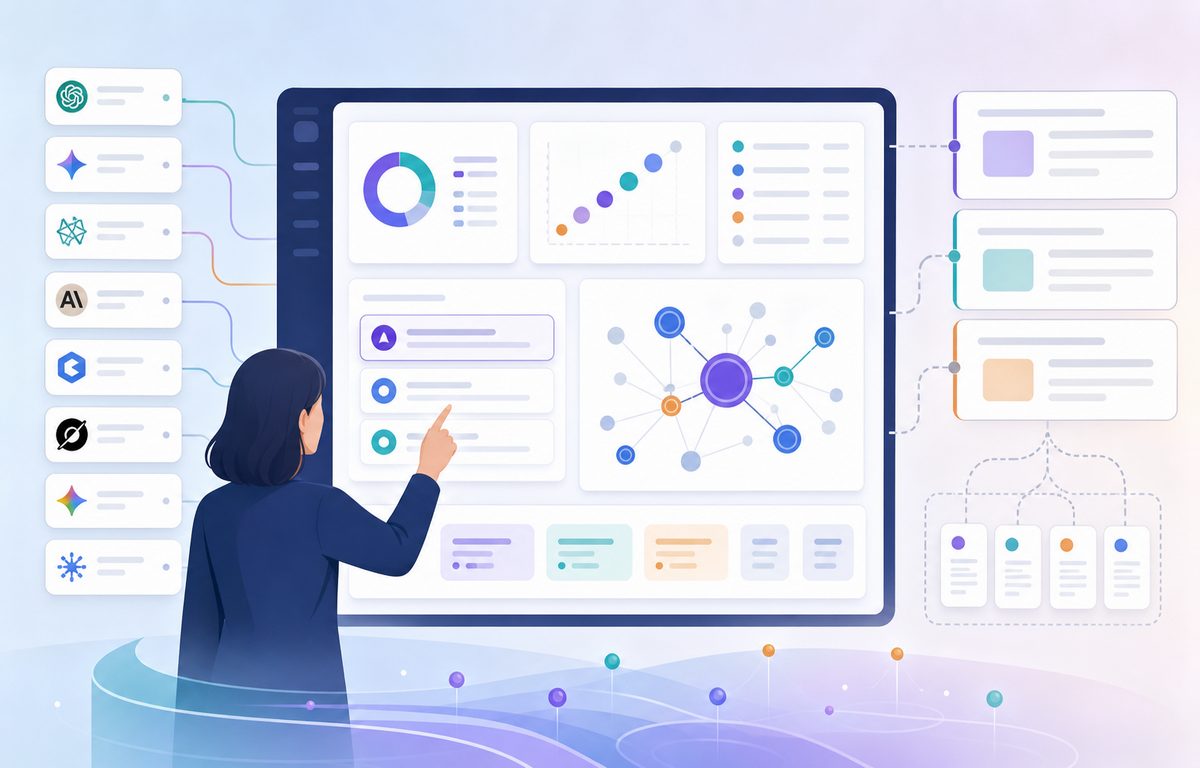
Category design for AI search aligns three elements:
- The intended category: Where the company believes the product belongs.
- The observed category: How answer engines currently describe and compare it.
- The evidence layer: Which owned, independent, and ecosystem sources support either classification.
At maxaeo, we organize this work as a Category Evidence Loop:
- Observe: Run a versioned set of buyer prompts.
- Code: Classify descriptors, peers, rationales, exclusions, and citations.
- Diagnose: Separate discovery, category, reputation, and evidence problems.
- Choose: Attach to, narrow, bridge, or create a category.
- Publish: Repair the pages and external records that support the chosen classification.
- Verify: Rerun the same prompt set and compare category movement.
This is not a method for reverse-engineering proprietary models. It is an evidence-based way to evaluate their observable outputs.
Results should always be tied to a specific engine, interface, locale, account state, prompt, and date. There is no universal category ranking because different systems retrieve different sources and can return different answers to the same question.
Why must an answer engine classify a product before recommending it?
A recommendation requires a working model of what the product is, which job it performs, and which alternatives belong in the same consideration set. If that classification is wrong, the product may be omitted, compared with unsuitable competitors, or recommended for the wrong use case.
Three observable signals reveal the working category:
- Language: The noun phrase used to identify the product, such as “AI search visibility platform,” “SEO tool,” or “social-listening software.”
- Neighbors: The brands appearing beside it in shortlists, alternatives, and comparisons.
- Evidence: The sources used to explain its category, capabilities, use cases, and differences.
These signals expose category debt: the gap between the category a company intends to occupy and the category repeatedly reflected in observed answers.
Category debt can take several forms:
- A platform is reduced to one of its features.
- A specialist product is grouped with broad enterprise suites.
- An integration partner is treated as a competitor.
- An old product description persists after the offering changes.
- The brand appears for branded questions but is absent from unbranded discovery prompts.
- Different buyer personas receive incompatible descriptions.
Understanding how AI search engines choose brands and supporting sources helps explain why category clarity, retrievability, and corroboration must be addressed together.
Is the problem visibility, category, evidence, or reputation?
Do not treat every weak answer as a category failure. Use the pattern across multiple metrics to locate the actual problem.
| Observed pattern | Likely diagnosis | First action |
|---|---|---|
| Low mention rate, high category match | Discovery or coverage gap | Expand relevant problem, use-case, and comparison evidence |
| High mention rate, low category match | Category-definition gap | Clarify the primary category, boundaries, and approved descriptors |
| Correct category, wrong co-mentioned products | Peer-set gap | Publish direct-versus-adjacent comparison evidence |
| Correct description, weak or irrelevant citations | Evidence gap | Strengthen claim-level proof and independent corroboration |
| Accurate answers for one persona but not another | Persona evidence gap | Add role-specific jobs, requirements, and use cases |
| Accurate category but negative recommendation | Reputation or product-fit issue | Investigate objections, reviews, limitations, and customer outcomes |
| Large changes between repeated runs | Output volatility | Increase repetitions before changing strategy |
This diagnostic prevents a common mistake: responding to a citation problem with more category slogans, or responding to a reputation problem with technical SEO work.
How is category design different from positioning, SEO, AEO, and GEO?
Positioning chooses the product’s most useful place in a buyer’s mind. Category design establishes the market context around that position. SEO, AEO, and GEO make the supporting evidence accessible and extractable.
| Discipline | Primary question | Core evidence | Useful measurement |
|---|---|---|---|
| Positioning | Why should this buyer choose the product? | Audience, alternatives, differentiated value | Message comprehension and conversion |
| Traditional category design | What market should exist around this problem? | Category name, point of view, ecosystem, customer adoption | Buyer and market adoption |
| SEO | Can search engines crawl, understand, index, and rank the pages? | Technical accessibility, content, links, entities | Rankings, qualified traffic, conversions |
| AEO/GEO | Can an answer engine extract and support the right answer? | Direct claims, structured passages, citations, corroboration | Answer inclusion and citations |
| Category design for AI search | Where do answer engines place the product? | Prompt outputs, descriptors, co-mentions, rationales, sources | Category match, leakage, and peer alignment |
The disciplines reinforce one another but are not substitutes. Strong technical SEO cannot resolve an incoherent category. A memorable category name cannot compensate for missing product proof. An AI visibility platform can expose the classification gap, but the business must decide which category is truthful and strategically useful.
How do you establish a reliable category baseline?
A reliable baseline uses a frozen category decision, a balanced prompt panel, consistent test conditions, complete answer records, and fixed coding rules. Its purpose is to locate classification errors—not to produce the most flattering visibility score.
1. Write the category decision statement
Before collecting answers, document:
- Primary category
- Acceptable parent or subcategory labels
- Prohibited or misleading labels
- Direct competitors
- Feature-level neighbors
- Integration and ecosystem partners
- Primary buyer roles and jobs
- Claims that require proof
This statement becomes the reference used to code every observed answer.
2. Build a balanced prompt panel
A practical starting panel contains 40–60 prompts. This is an operating range, not an industry benchmark.
A 50-prompt panel might use this distribution:
| Prompt family | Number | Example |
|---|---|---|
| Category discovery | 10 | “What are the best platforms for monitoring brand visibility in AI search?” |
| Problem or job | 10 | “How can a company find out why ChatGPT recommends its competitors?” |
| Comparison | 10 | “Which tools compare brand citations across AI answer engines?” |
| Use case or constraint | 10 | “What AI visibility software supports multi-country reporting?” |
| Persona or buying stage | 10 | “What should an SEO director use to track AI-generated recommendations?” |
At least most of the panel should be unbranded. Branded prompts help diagnose how a system understands a known entity, but they do not show whether the brand enters a real discovery or comparison set.
Prompts should also reflect likely reformulations and subqueries. One buyer question can generate several retrieval paths, as explained in this guide to query fan-out in AI search.
3. Freeze the test conditions
Record the following for every run:
- Engine and product surface
- Model or version when displayed
- Locale and language
- Account or signed-out state
- Personalization settings when known
- Prompt text
- Run date and time
- Whether browsing or web search was enabled
- Number of repeated runs
Repeat commercially important prompts at least three times during the initial baseline. A single answer is an example; repeated observations reveal whether the classification is stable.
4. Store the complete answer record
For each response, capture:
- Whether the brand appeared
- Ordered position when a list was returned
- Exact category phrase
- Product description
- Recommendation rationale
- Co-mentioned brands
- Explicit exclusions or caveats
- Visible citations and cited passages
- Screenshot or archived answer
- Coding label and reviewer notes
An eligible answer is one where the prompt could reasonably return the product or its category. Refusals, errors, and non-responsive outputs should be reported separately rather than silently removed from the denominator.
5. Apply a fixed classification taxonomy
Use these labels:
| Label | Coding rule |
|---|---|
| Exact | The intended category is stated clearly |
| Acceptable adjacent | The label is accurate but broader, narrower, or persona-specific |
| Ambiguous | Features are described without resolving what the product is |
| Incorrect | The answer assigns a misleading category or use case |
| Absent | The brand does not appear in an eligible answer |
Double-code a sample of the first measurement wave. At maxaeo, the practical review rule is to have a second reviewer examine ambiguous answers and at least 20% of the remaining coded records before the taxonomy is frozen. The percentage is a quality-control convention, not a statistical standard.
What do descriptors, co-mentions, and citations reveal?
Descriptors show the category label, co-mentions show the consideration set, and citations show whether retrievable evidence supports the classification. An audit is incomplete if it tracks only whether the brand appeared.
Descriptor analysis
Extract the shortest noun phrase that identifies the product. Keep the model’s wording rather than paraphrasing it.
Code each descriptor as:
- Approved primary category
- Approved variation
- Parent category
- Feature-level label
- Adjacent category
- Incorrect category
- No category stated
This separates healthy contextual variation from semantic drift. The goal is not identical wording in every answer; it is stable meaning.
Co-mention analysis
Do not convert every neighboring brand into a competitor. Label each one as:
- Direct budget rival
- Parent-category platform
- Feature neighbor
- Integration or partner
- Services provider
- General-purpose incumbent
- Unrelated result
For prioritization, maxaeo uses a simple co-mention weighting convention:
| Context | Suggested weight |
|---|---|
| Unbranded shortlist or recommendation | 3 |
| Direct comparison or alternatives answer | 2 |
| Branded explanation | 1 |
Add the weights for each neighboring brand, then review the highest-scoring relationships manually. These weights are an audit convention—not a universal ranking model—but they prevent a one-off branded answer from carrying the same importance as repeated unbranded recommendations.
The direct-peer co-mention rate is:
Recommendation and comparison answers containing the brand plus at least one direct peer ÷ recommendation and comparison answers containing the brand
A rising rate is useful only if the selected peers reflect the real buying decision.
Citation analysis
Classify citations by both ownership and relevance.
Source ownership:
- Owned: Product pages, documentation, research, use cases, and comparisons
- Independent: Customer sites, publications, analysts, communities, and reviews
- Ecosystem: Partner pages, marketplaces, directories, and technical documentation
Citation relevance:
- Direct support: The cited passage supports the category or differentiation claim.
- Contextual support: The source confirms the company or capability but not the category.
- Outdated: The source reflects an earlier product or position.
- Irrelevant: The source does not support the statement attached to it.
Not every answer surface displays citations. Compare citation performance within the same engine and interface rather than interpreting an uncited answer as proof that no external source influenced it.
Should you attach to, narrow, bridge, or create a category?
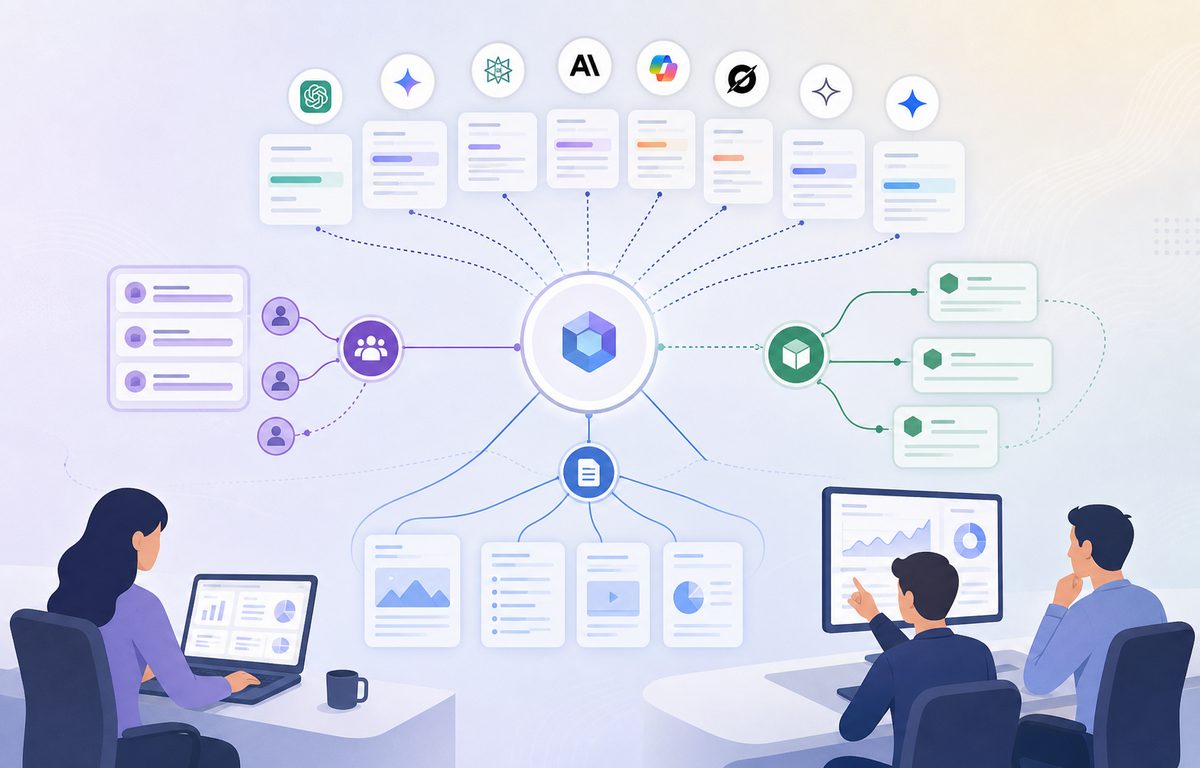
Use the smallest truthful category change that improves buyer comprehension. Creating a new category requires the most education and corroboration; it should not be the default response to a crowded market.
| Strategy | Use it when | Evidence required | Main risk |
|---|---|---|---|
| Attach | An established category accurately describes the product | Clear category statement, use cases, comparisons, customer proof | Weak differentiation |
| Narrow | A specific audience, problem, or mechanism creates a meaningful segment | Parent-category relationship and a defensible narrowing criterion | An audience that is too small |
| Bridge | Two familiar categories are both necessary to explain the product | Explicit relationship, boundaries, and hybrid workflows | Inconsistent classification |
| Create | The problem, buying motion, and peer set are genuinely different | Definition, point of view, customer proof, independent adoption, ecosystem evidence | A label used only by its creator |
Ask four questions before choosing:
- Do buyers recognize the problem expressed by the category?
- Does the product deliver a distinct workflow or outcome?
- Can customers explain why the distinction matters?
- Could independent sources use the label without repeating company copy?
If the answer to the fourth question is no, the proposed category is probably still a positioning slogan.
What belongs in a category contract?
A category contract is a one-page specification defining the product’s primary category, approved variations, boundaries, peer set, and required proof. It keeps product, content, SEO, PR, sales, and partner teams from publishing incompatible classifications.
Include these seven fields:
- Buyer: Who makes or influences the decision?
- Job: What progress is the buyer trying to make?
- Named problem: What costly, slow, or risky condition exists beforehand?
- Primary category: Which stable noun phrase identifies the product?
- Permitted descriptors: Which contextual variations remain accurate?
- Boundaries and peers: What should the product not be confused with, and which alternatives are direct?
- Proof threshold: Which capabilities, methods, outcomes, and independent sources substantiate the category?
Use this sentence test:
[Product] is a [primary category] for [buyer] that helps [job], unlike [adjacent category], because [verifiable mechanism or boundary].
For maxaeo, a working version is:
maxaeo is an AI search visibility platform for marketing and SEO teams that monitors how answer engines mention, classify, compare, and cite brands, rather than functioning as a conventional rank tracker or social-listening suite.
The sentence is not copy to repeat verbatim across every page. It is a semantic control: contextual descriptions may vary, but they should not contradict its buyer, job, category, or boundaries.
How do you build retrievable category evidence?
Every important category claim should appear on a crawlable page beside the proof needed to evaluate it. Evidence must explain what the product is, who it serves, how it works, what it replaces or complements, and why the distinction matters.
Build a claim-to-evidence matrix before commissioning new pages:
| Classification claim | Reader question | Owned evidence | Independent corroboration |
|---|---|---|---|
| Product category | “What is this product?” | Homepage and category definition | Customer or partner profile using compatible language |
| Buyer and job | “Who uses it, and why?” | Persona and use-case pages | Customer workflow or case study |
| Mechanism | “How does it work?” | Methodology and documentation | Technical partner validation |
| Differentiation | “Why not use another category of tool?” | Comparison and boundary pages | Documented customer rationale or expert review |
| Product proof | “Can it perform the claimed job?” | Demonstration, research, and product documentation | Customer outcomes and credible coverage |
| Compatibility | “Will it work in this environment?” | Integration and compatibility pages | Marketplace or partner documentation |
A minimum viable evidence set usually contains:
- A canonical product and category definition
- Problem and use-case pages for priority buyers
- A methodology or “how it works” page
- Direct and adjacent-category comparisons
- Product documentation or demonstrations
- Customer, partner, or marketplace corroboration
Write passages in a claim → proof → use case → limitation sequence. This AEO content structure framework shows how to make those elements easier to extract without reducing a page to disconnected answer snippets.
Original research is especially valuable when it publishes a reproducible method, dataset boundaries, and findings that others can verify. That creates a genuine citation magnet for AI search instead of another unsupported category assertion.
What technical requirements matter?
Technical optimization cannot create category evidence, but it can prevent valid evidence from being retrieved or indexed.
Check that priority pages:
- Return a successful HTTP status
- Are crawlable and indexable
- Use the intended canonical URL
- Contain the category claim in visible HTML
- Are internally linked from relevant hub and product pages
- Do not hide essential proof behind login walls
- Use descriptive titles and headings
- Keep outdated category pages redirected or clearly superseded
- Match structured data to visible page content
- Allow appropriate search snippet and preview controls
Google Search Central’s guidance for AI features states that pages do not need special AI-specific markup or machine-readable files to appear in AI Overviews or AI Mode. The normal technical requirements for Google Search still apply.
Structured data can clarify entities and page types, but it does not prove a category claim. Google’s structured data guidelines require markup to represent visible page content. Do not add an unsupported category only inside JSON-LD.
Which changes can affect AI answers first?
Category evidence operates across different time horizons.
| Evidence layer | What can change | Practical implication |
|---|---|---|
| Owned web content | Definitions, comparisons, use cases, documentation | Usually the most controllable starting point |
| Ecosystem records | Partner descriptions, directories, marketplaces | Correct inconsistent or outdated classifications |
| Independent coverage | Reviews, customer stories, publications, research citations | Must be earned through useful proof and accurate outreach |
| Retrieval behavior | Which current pages an engine selects | Can vary by prompt, engine, freshness, and interface |
| Model-level knowledge | Information embedded in a model version | Cannot be directly updated on demand |
This distinction matters. A recently corrected product page may influence a web-enabled answer while an answer relying on older model knowledge continues to use the previous category. Record whether search or browsing was active before comparing the outputs.
What does a worked category audit look like?
The following synthetic example demonstrates the calculations. It is not maxaeo customer data, an industry benchmark, or evidence of causation.
A fictional B2B SaaS company sells cloud incident automation and wants to be classified as an “AI incident response platform.” It runs 60 frozen prompts across four answer engines, producing 240 eligible answers in each measurement wave.
The company then:
- Approves a category contract
- Rewrites its canonical product overview
- Publishes two detailed role-specific use cases
- Distinguishes direct competitors from observability platforms
- Documents its incident-triage method
- Corrects inconsistent partner descriptions
The same panel is rerun eight weeks later.
| Metric | Baseline | Follow-up | Change |
|---|---|---|---|
| Mention rate | 96/240 (40.0%) | 98/240 (40.8%) | +0.8 points |
| Exact category match among mentions | 21/96 (21.9%) | 46/98 (46.9%) | +25.0 points |
| Acceptable adjacent classification | 39/96 (40.6%) | 31/98 (31.6%) | −9.0 points |
| Incorrect classification | 27/96 (28.1%) | 14/98 (14.3%) | −13.8 points |
| Ambiguous classification | 9/96 (9.4%) | 7/98 (7.1%) | −2.3 points |
| Classification-supporting citation | 29/96 (30.2%) | 55/98 (56.1%) | +25.9 points |
The useful finding is not the nearly unchanged mention rate. It is the movement from incorrect or vague descriptions toward the intended category, accompanied by more directly supporting citations.
A real audit should not attribute that change to the content updates alone. Record:
- Publication and indexation dates
- Engine or interface changes
- Prompt edits
- New press or customer coverage
- Product launches and rebrands
- Changes in browsing availability
- Untouched control prompts
The example demonstrates why visibility and classification must be measured separately.
Which metrics belong on a category dashboard?
Use separate metrics for inclusion, classification, peer alignment, and evidence. A single visibility score can conceal a serious category problem.
| Metric | Formula | Question answered |
|---|---|---|
| Mention Rate | Eligible answers mentioning the brand ÷ eligible answers | Is the brand included? |
| Exact Category Match Rate | Exact classifications ÷ brand-mentioned answers | Is the intended category stated? |
| Approved Category Rate | Exact plus acceptable-adjacent classifications ÷ brand-mentioned answers | Is the classification usable? |
| Category Leakage Rate | Incorrect classifications ÷ brand-mentioned answers | How often is the product misclassified? |
| Descriptor Consistency | Mentions using an approved descriptor ÷ mentions containing a descriptor | Is the product described coherently? |
| Direct-Peer Co-Mention Rate | Relevant brand mentions containing a direct peer ÷ relevant brand mentions | Is the product entering the correct consideration set? |
| Citation Support Rate | Brand mentions with a directly supporting citation ÷ brand mentions on citation-enabled surfaces | Does visible evidence support the category? |
Every dashboard should disclose:
- Prompt panel and prompt families
- Eligible-answer definition
- Engine and interface coverage
- Locale and account conditions
- Number of repeated runs
- Measurement dates
- Sample sizes and denominators
- Coding rules and material changes
Track AI share of voice separately. It measures relative presence, not category accuracy. Mention rate and citation rate also answer different questions; this guide explains when to use each AI visibility metric.
Segment results before aggregating them. A global average can conceal category leakage within one persona, country, prompt family, or engine.
How can a team execute the strategy in 90 days?
A 90-day program should establish a baseline, choose a defensible category posture, repair the strongest evidence sources, align external descriptions, and rerun the unchanged test. The schedule controls the work; it does not guarantee that every engine will update within 90 days.
Days 1–15: Establish the baseline
- Approve the category decision statement
- Freeze the prompt panel and coding taxonomy
- Run repeated observations
- Map descriptors, peers, rationales, exclusions, and citations
- Separate category issues from visibility and reputation issues
Days 16–30: Choose the category posture
- Decide whether to attach, narrow, bridge, or create
- Approve the category contract
- Validate the proposed language with customers and sales conversations
- Remove unsupported category claims
- Prioritize the highest-impact evidence gaps
Days 31–60: Repair owned evidence
- Update the homepage or canonical product overview
- Improve problem, persona, and use-case coverage
- Publish methodology and proof assets
- Clarify direct and adjacent alternatives
- Consolidate or redirect contradictory legacy pages
- Verify crawlability, canonicalization, and indexation
Days 61–75: Align ecosystem evidence
- Correct partner and marketplace descriptions
- Update executive bios and approved PR language
- Give customers accurate product descriptions without scripting endorsements
- Identify independent sources using obsolete categories
- Earn corroboration through publishable methods, data, and customer proof
Days 76–90: Rerun and diagnose
- Use the original prompt panel and test conditions
- Compare match, leakage, descriptors, peer alignment, and citations
- Review changed answers manually
- Check for engine, product, or press confounders
- Assign the next evidence gap to a named owner
Every dashboard issue should map to a changeable asset: a product page, comparison, methodology, partner record, customer proof point, technical problem, or category decision.
What causes category design programs to fail?
The most common failures are operational rather than creative:
- Category theatre: The company announces a name that customers, product evidence, and independent sources do not support.
- Prompt cherry-picking: The team reports favorable branded prompts while excluding unbranded discovery and comparison questions.
- Taxonomy sprawl: Departments use conflicting category synonyms without defining primary and contextual terms.
- False competitor equivalence: Every co-mentioned brand is treated as a direct rival.
- Citation inflation: Any citation is counted as supportive, including irrelevant or outdated sources.
- Evidence duplication: Many thin pages repeat the category claim without adding proof.
- Markup substitution: Structured data introduces claims that visible content does not substantiate.
- Uncontrolled testing: Prompts, content, technical architecture, and PR change simultaneously.
- Buyer-free categories: The proposed label expresses company ambition but does not improve a real purchase decision.
- Single-answer conclusions: Strategy changes are based on one volatile response rather than repeated observations.
Preserve raw answers, coding decisions, and test conditions. Screenshots help reviewers inspect individual outputs; structured records are required to compare them over time.
Frequently asked questions
Can a startup create a new category in ChatGPT or another answer engine?
A startup cannot directly assign itself a category inside an answer engine. It can define a useful market concept, build a product and customer base around it, publish verifiable evidence, and earn adoption of the terminology from customers, partners, and independent sources.
Creating a new category is appropriate only when the problem, buying motion, and peer set are meaningfully different. Otherwise, attaching to or narrowing an established category is usually clearer.
How long does a category change take to appear?
There is no reliable universal timeline. Changes depend on crawling, indexation, retrieval behavior, source freshness, interface settings, model updates, and independent corroboration.
Monitor weekly for directional changes, but make strategic decisions over a longer stable window. Preserve the same prompts and test conditions so prompt drift is not mistaken for category movement.
Is structured data enough to establish a product category?
No. Organization, Product, SoftwareApplication, and Article structured data can help machines understand entities and page relationships, but markup does not prove a category claim.
The visible page still needs a clear definition, supported capabilities, use cases, boundaries, and evidence. Markup should describe what a reader can verify on the page.
What is the best KPI for category design for AI search?
The most direct KPI is Exact Category Match Rate among answers that mention the brand. It measures classification accuracy without confusing it with discovery.
Pair it with Mention Rate, Category Leakage Rate, Descriptor Consistency, Direct-Peer Co-Mention Rate, and Citation Support Rate. Together, these distinguish discovery, classification, and evidence problems.
Is category design for AI search manipulation?
No—provided the category is truthful and the evidence is transparent. The work should clarify a product’s market context, not manufacture false reviews, disguise sponsorships, fabricate research, or seed unsupported claims.
The durable approach is to publish verifiable product information and help independent sources describe it accurately.
Must every page use exactly the same category wording?
No. Different buyers may need different contextual descriptions. A finance leader, technical evaluator, and SEO director can describe the same product from different angles.
The primary noun phrase, buyer job, product boundaries, and core mechanism should remain compatible. Variation becomes harmful when pages imply different products, markets, or direct competitors.
Make category a monitored evidence system
Category design for AI search turns market positioning into a measurable operating system. Start with observed answers, code the recurring descriptors and peer sets, inspect supporting citations, choose the smallest defensible category change, and publish evidence that buyers and independent sources can verify.
The objective is not to force every answer engine to repeat identical wording. It is to make the product’s market role clear enough that different systems can compare it with the right alternatives and recommend it for the right jobs.
When category match rises while leakage falls, the evidence is becoming more coherent. When results remain unchanged, the prompt-level record reveals whether the next fix belongs in discovery coverage, category language, product proof, technical retrieval, ecosystem descriptions, reputation, or the category decision itself.