By maxaeo
Organization schema for AI search is JSON-LD that declares a company’s stable identity facts—such as its name, canonical URL, logo, legal name, and official profiles. It can reduce entity ambiguity when crawlers and downstream systems process the page, but it cannot prove reputation, create authority, or guarantee rankings or AI citations.

The practical implications are straightforward:
- Use Organization markup to identify the company, not to advertise it.
- Publish one canonical Organization node with a persistent
@id. - Keep structured facts consistent with visible pages and controlled profiles.
- Use
sameAsonly for URLs representing the identical entity. - Resolve contradictory evidence before adding optional properties.
- Measure identity accuracy and citations separately from schema validity.
Does Organization schema help with AI search?
Potentially—but indirectly and unevenly. Organization schema gives machines a structured version of facts already published on a website. It is most useful for resolving identity questions, such as which domain, logo, legal name, or social profile belongs to a company.
Google explicitly says Organization structured data can help it understand administrative details and disambiguate organizations. The documentation does not establish that every AI assistant reads or weights the markup in the same way.
Treat Organization schema as entity-resolution infrastructure, not a universal AI ranking factor.
| Organization schema can help clarify | Organization schema cannot establish |
|---|---|
| Canonical company name | That the company is the “best” |
| Official website and logo | Product quality or performance |
| Legal and alternate names | Customer satisfaction |
| Official corporate profiles | Security or compliance without evidence |
| Parent, subsidiary, and brand relationships | Market leadership |
| Public identifiers and contact details | Recommendation eligibility |
| Publisher identity across articles | A guaranteed AI citation or ranking |
An answer engine may encounter the facts through a search index, a retrieved web page, or another system that has processed the site. It may also retrieve an older or contradictory source instead. Valid JSON-LD therefore improves the declaration layer without controlling the entire retrieval and answer-generation pipeline.
What Organization schema actually describes
The Organization type is Schema.org vocabulary for representing a company, institution, nonprofit, government body, or other organized entity. JSON-LD is usually the most maintainable implementation because it can define one entity and connect that entity to pages, articles, people, products, and websites through stable identifiers.
Organization schema should answer factual questions such as:
- What is the organization’s preferred public name?
- What is its legal name?
- Which website is canonical?
- Which logo officially represents it?
- Has it used another name?
- Which external profiles represent the same entity?
- Is it a parent company, subsidiary, or product brand?
- Which public identifiers distinguish it from similarly named entities?
It should not be used as a hidden container for sales copy. Properties such as description and knowsAbout remain publisher-supplied statements; they do not turn promotional language into independently verified evidence.
Which Organization properties should you prioritize?
Start with a small, accurate identity core. Add optional properties only when the values are public, supported by visible content, and assigned to someone who will maintain them.
| Property | Purpose | Include when | Main risk |
|---|---|---|---|
@id |
Gives the entity a persistent graph identifier | Always | Different templates create competing IDs |
@type |
Identifies the entity type | Always | Product and company types are conflated |
name |
Declares the preferred brand name | Always | It conflicts with the site’s visible branding |
url |
Identifies the canonical website | Always | Old or regional domains are mixed |
logo |
Associates an official logo with the entity | A stable, crawlable image exists | Temporary or blocked image URLs |
sameAs |
Connects exact identity equivalents | Official profiles are current | Promotional or unrelated pages are added |
legalName |
States the registered company name | It is public and relevant | It is mistaken for the public brand |
alternateName |
Records abbreviations or former names | The relationship is documented | Unrelated names are merged |
foundingDate |
States when the organization was founded | Sources use the same definition and date | “Founded” and “incorporated” are confused |
address |
Supplies a public organizational address | The address is appropriate to publish | Directories retain older locations |
contactPoint |
Describes a support, sales, or other contact channel | The channel is monitored | Details become stale |
parentOrganization |
Links the entity to its parent | Ownership is clear and public | Brand and parent are collapsed together |
subOrganization |
Identifies an organizational subsidiary | The relationship is factual | Products are incorrectly treated as companies |
leiCode, taxID, vatID, iso6523Code |
Distinguishes registered entities | Disclosure is appropriate | Private or jurisdiction-specific data is exposed |
@id is a JSON-LD identifier rather than a Schema.org property, but it is central to a coherent graph. A durable pattern is:
https://www.example.com/#organization
Keep that identifier unchanged when an Article, WebSite, WebPage, or other node references the organization.
Which organization type should you use?
Use the most specific accurate subtype, but do not force a company, location, product, and software application into one entity.
| Entity being described | Typical type |
|---|---|
| General company or institution | Organization |
| Legally incorporated company | Corporation |
| Business tied to a physical location or service area | LocalBusiness or an appropriate subtype |
| Online-only business | OnlineBusiness |
| Nonprofit organization | NGO |
| University or school | EducationalOrganization |
| Software product | SoftwareApplication, not Organization |
| Commercial product or product line | Product or Brand, as appropriate |
| Individual founder or author | Person |
A SaaS vendor and its application are related entities, not interchangeable ones. The Organization can be the publisher, manufacturer, provider, or owner of a separately defined product or application.
Likewise, a parent company, subsidiary, and customer-facing brand may require separate nodes. Connect them with accurate relationships instead of merging all names and URLs into one Organization record.
The maxaeo Declare–Corroborate–Observe framework
A reliable implementation has three distinct layers: declare the fact, corroborate it across relevant sources, and observe how answer systems reproduce it. This Declare–Corroborate–Observe framework prevents teams from treating successful validation as evidence of AI impact.
1. Declare
Publish one canonical Organization node containing stable, verifiable facts. Connect related structured-data nodes to it through the same @id.
2. Corroborate
Check whether each declared fact is compatible with:
- The homepage and About page
- Contact, privacy, terms, and legal pages
- Headers, footers, media kits, and author pages
- Controlled profiles such as LinkedIn, GitHub, or YouTube
- Relevant registries and reliable independent sources
A value need not be word-for-word identical everywhere. A legal page may use “Example Analytics, Inc.” while the navigation uses “Example Analytics.” The relationship must, however, be clear and non-contradictory.
3. Observe
Test whether search and answer systems state the fact correctly. Record the answer, prompt, date, engine, mode, and cited sources. A fact can be declared but not crawled, crawled but not retrieved, or retrieved without being cited.
This distinction is fundamental to entity SEO for AI search: schema describes an entity, while corroborating content and sources help systems resolve competing descriptions of that entity.
Build an identity evidence matrix before writing JSON-LD
The highest-priority problem is usually a contradiction, not a missing optional property. Create an identity evidence matrix to find those contradictions before encoding them in schema.
Here is a fictional rebrand example:
| Fact | JSON-LD target | Visible website | Controlled profiles | Independent sources | Action |
|---|---|---|---|---|---|
| Preferred name | NorthstarDB | NorthstarDB | LinkedIn uses old name | Mixed | Update LinkedIn and explain rebrand |
| Legal name | North Star Database, Inc. | Privacy policy agrees | Not stated | Registry agrees | Keep legalName |
| Former name | North Star Database | Rebrand page missing | Old profiles use it | Older reviews use it | Publish a dated rebrand explanation |
| Canonical domain | New domain | Internal links agree | GitHub links to old domain | Mixed | Redirect old domain and update profile |
| Logo | New logo | Site agrees | Two profiles use old logo | Not applicable | Replace controlled profile assets |
The markup can accurately connect the current and former names, but it cannot override unresolved evidence by itself.
A useful internal QA metric is:
Identity consistency rate =
compatible evidence cells ÷ applicable evidence cells
This is a maintenance metric, not a Google ranking factor. Calculate it for high-value facts such as name, domain, legal name, alternate names, logo, and official profiles. Prioritize conflicting cells over blank ones because a conflict presents machines with two plausible answers.
How to implement Organization schema step by step
Inventory the entity first, resolve conflicts second, and generate markup only after the preferred facts are settled.
- Define the entity. Decide whether the node represents a parent company, operating company, local business, product brand, or another organization.
- Inventory identity facts. Record the preferred name, legal name, alternate names, canonical domain, logo, address, identifiers, and official profiles.
- Map supporting evidence. Note where each value appears on the site and which external sources corroborate it.
- Resolve controlled contradictions. Update outdated policies, footers, profiles, redirects, and media kits.
- Choose an entity home. Use the homepage or one authoritative page that clearly describes the organization.
- Create one persistent
@id. Reuse it wherever other structured entities refer to the organization. - Add the minimum accurate properties. Omit uncertain, private, promotional, or unmaintained values.
- Publish facts visibly. Ensure the page supports the structured declaration in normal reader-facing content.
- Validate syntax and eligibility. Test the rendered page, not only the source template.
- Verify crawlability. Confirm that the page, logo, and referenced URLs are accessible to relevant crawlers.
- Monitor answer behavior. Begin a post-deployment observation period after the markup is fetchable and indexing has had time to update.
- Assign maintenance ownership. Define who updates schema after a rebrand, relocation, acquisition, or profile change.
A defensible Organization JSON-LD example
A defensible implementation uses absolute URLs, one persistent identifier, and only facts the organization can support publicly. Replace every fictional value below with real data.
<script type="application/ld+json">
{
  "@context": "https://schema.org",
  "@type": "Organization",
  "@id": "https://www.example.com/#organization",
  "name": "Example Analytics",
  "legalName": "Example Analytics, Inc.",
  "alternateName": [
    "Example"
  ],
  "url": "https://www.example.com/",
  "logo": {
    "@type": "ImageObject",
    "@id": "https://www.example.com/#logo",
    "url": "https://www.example.com/assets/example-analytics-logo.png",
    "contentUrl": "https://www.example.com/assets/example-analytics-logo.png",
    "caption": "Example Analytics"
  },
  "foundingDate": "2019",
  "contactPoint": [
    {
      "@type": "ContactPoint",
      "contactType": "sales",
      "email": "sales@example.com",
      "availableLanguage": [
        "English"
      ]
    }
  ],
  "sameAs": [
    "https://www.linkedin.com/company/example-analytics/",
    "https://github.com/example-analytics"
  ]
}
</script>
Before publishing, confirm that:
- “Example Analytics” appears as the visible brand.
- “Example Analytics, Inc.” appears on an appropriate legal or company page.
- The founding year has a consistent definition.
- The email address is monitored.
- The logo uses a stable, crawlable absolute URL.
- Both
sameAspages represent the same company and link back to the correct domain.
Do not copy the example’s optional fields simply because they are present. A shorter record is preferable when the additional values cannot be maintained.
How to connect Organization, WebSite, Article, and author schema
Define the organization once and reference its @id from other nodes. This prevents individual templates from creating slightly different versions of the same publisher.
An Article node can reference the publisher like this:
The human author should normally be a separate Person node rather than another name attached to the Organization. The author’s page, credentials, subject expertise, and article relationships solve a different problem from publisher identity. See the maxaeo guide to author bylines and author schema for that implementation.
Use one graph when practical, but graph size is not the goal. Consistent identifiers and accurate relationships matter more than placing every possible entity in one script.
How should sameAs be used?
sameAs should point only to a URL that unambiguously represents the identical organization. Schema.org defines sameAs as a reference page that indicates the item’s identity.
Good candidates can include:
- An official LinkedIn company profile
- An official GitHub organization
- An official YouTube channel
- A maintained profile in an authoritative industry database
- A registry record that clearly identifies the same organization
Before adding a URL, verify that:
- The profile uses the current or documented former name.
- It represents the organization, not an employee or similarly named business.
- It links to the canonical domain when the platform permits it.
- Its logo and description do not contradict the website.
- The organization controls the profile or the source is authoritative.
- The URL is canonical and publicly accessible.
Do not add the following to sameAs:
- Press articles about the company
- Customer or partner websites
- Review pages
- Distributor listings
- Founder profiles
- Individual product pages
- Search-result URLs
- Inactive or abandoned accounts
A press article can corroborate a fact without being the same entity. Identity equivalence and supporting evidence are different relationships.
Where should Organization markup live?
Place the primary Organization markup on the homepage or one authoritative page describing the organization. Google says the full record does not need to appear on every page.
Choose one of these patterns:
- Homepage as entity home: Appropriate when the homepage clearly identifies the company and its essential facts.
- About page as entity home: Useful when the homepage is product-led and provides little company information.
- Dedicated company page: Appropriate for complex groups with parent, subsidiary, brand, and ownership relationships.
Other pages can reference the canonical Organization @id. Avoid generating separate full records in the homepage, blog, documentation portal, and support center unless they are guaranteed to remain identical.
For multiple domains, document which entity owns or publishes each property. A regional subsidiary and global parent may require separate nodes. A product documentation domain may reference the company as publisher while defining the software as its own entity.
How to validate Organization structured data
Validation answers three different questions: is the JSON valid, is the vocabulary valid, and is the declared identity credible? No single tool answers all three.
1. Validate JSON and rendering
Confirm that:
- The JSON parses without syntax errors.
- The script appears in the rendered HTML.
- Absolute URLs use the intended canonical host.
- No consent manager or JavaScript error removes the markup.
- Only one canonical Organization node represents the company.
2. Validate structured-data usage
Test the page with:
- Schema.org Validator for Schema.org vocabulary and graph structure
- Google Rich Results Test for Google-supported structured-data processing
A green result confirms that the markup can be parsed. It does not prove that a fact is trusted, indexed, ranked, or used in an AI answer.
3. Validate evidence consistency
Compare every important property against visible content and controlled profiles. Google’s structured-data policies require markup to represent truthful, relevant content rather than hidden or misleading claims.
Treat warnings according to their meaning. A missing optional property is generally less serious than two valid Organization nodes declaring different names, domains, or logos.
How to test the effect on AI answers
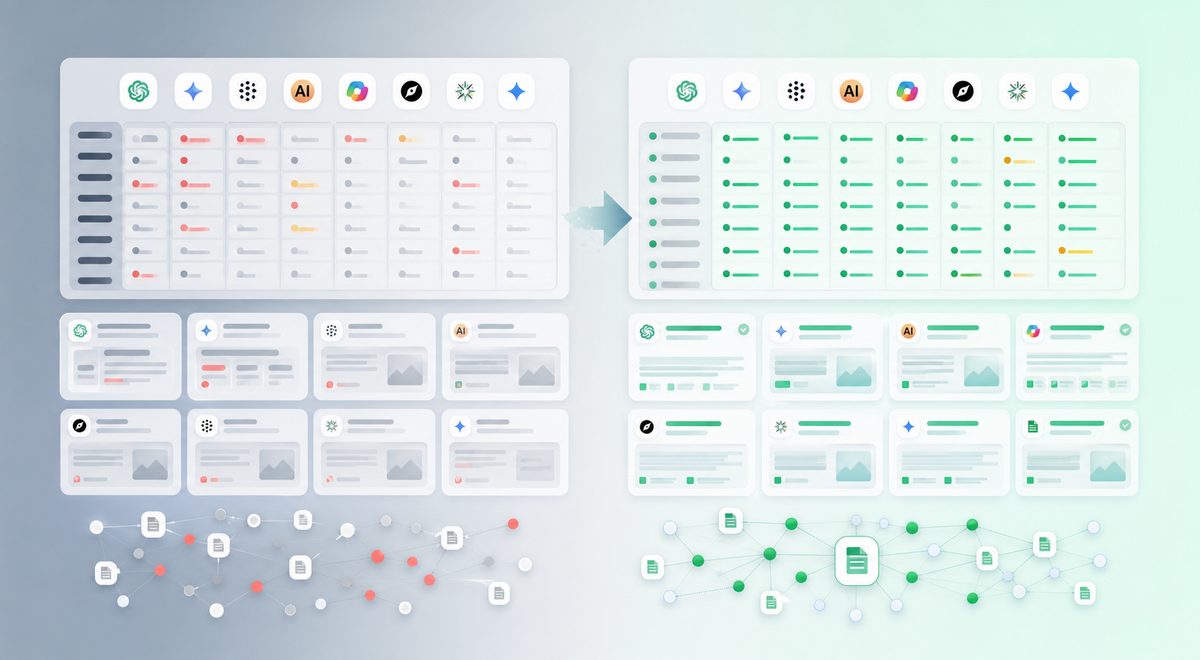
Use fixed prompts, a baseline, an indexing checkpoint, and a post-deployment observation period. A single answer or screenshot cannot establish impact.
A practical single-brand protocol is:
- Select four to six answer surfaces available to your team.
- Create eight fixed prompts covering stable identity facts.
- Capture one answer per prompt and surface daily for seven baseline days.
- Deploy the schema without changing unrelated page content.
- Verify that the markup is fetchable and monitor recrawling where possible.
- Capture the same prompts for 14 post-deployment days.
- Preserve answers, citations, dates, modes, locations, and account conditions.
- Compare identity attributes and cited sources—not only brand mentions.
With four surfaces and eight prompts, this protocol produces 672 captures:
Baseline: 4 surfaces × 8 prompts × 7 days = 224
Post-deployment: 4 surfaces × 8 prompts × 14 days = 448
Total: 672
This is a measurement design, not a performance benchmark.
Useful prompt families include:
- “What is the official website of [company]?”
- “What is the legal name of [company]?”
- “Is [former name] the same company as [current name]?”
- “Where is [company] headquartered?”
- “Who owns [brand or product]?”
- “Which profiles are officially associated with [company]?”
- “When was [company] founded?”
- “What does [company] do?”
Add subjective negative controls such as “Is [company] the most trusted provider?” Identity facts may plausibly respond to better entity reconciliation; unsupported superlatives should not.
How to score AI answer consistency
Score each requested attribute separately:
- 2 — Correct: The answer uses the current fact or an explicitly documented equivalent.
- 1 — Partially correct: The answer uses a recognized alternate name or gives an incomplete but compatible fact.
- 0 — Incorrect: The answer is wrong, outdated, or confused with another entity.
- N/A — Not answered: The system declines or does not address the attribute.
Calculate:
Attribute accuracy =
earned points ÷ maximum eligible points
Also record these metrics independently:
| Metric | What it reveals |
|---|---|
| Attribute accuracy | Whether stated identity facts are correct |
| Entity confusion rate | How often the company is merged with another entity |
| Citation coverage | How often answers supply sources |
| Owned-source citation rate | How often citations point to controlled pages |
| Recommendation rate | Whether the brand appears in relevant shortlists |
| Description drift | Whether company descriptions change over time |
Organization schema is most plausibly associated with changes in canonical name, domain, legal name, alternate names, and organizational relationships. Recommendation rate and sentiment depend on broader evidence.
Measure citations separately because a system may understand an entity without citing the company website. Conversely, it may cite an article without using the page’s Organization markup. The maxaeo guide to AI search citations explains how citation tracking differs from general mention tracking.
How to interpret the results
A credible change should be sustained, specific to declared facts, and traceable to a plausible source path. Treat short-lived movement on one system as an observation rather than proof of causation.
Use five checks:
- Persistence: Does the improvement last across several consecutive observations?
- Breadth: Does it appear on multiple surfaces or only one?
- Specificity: Did declared identity attributes improve while subjective controls remained stable?
- Source path: Did citations shift toward the corrected company page or another updated source?
- Change isolation: Were schema and identity corrections the only material changes during the test?
Different assistants may use different indexes, retrieval systems, and modes. The maxaeo analysis of which search indexes power AI engines explains why a correction may appear at different times across platforms.
Even a carefully designed before-and-after test is observational. Report the schema as a plausible contributor unless retrieval, crawling, model changes, and simultaneous publicity were controlled.
Why can an AI answer remain wrong after implementation?
The markup may be correct while another part of the discovery, retrieval, or evidence chain remains unresolved.
| Symptom | Likely cause | Next action |
|---|---|---|
| New name appears on Google but not another assistant | Different index or refresh cycle | Check the assistant’s cited sources and retest later |
| Answer uses an old domain | Authoritative profiles or articles still link to it | Redirect the domain and update controlled references |
| Company is confused with a namesake | Weak disambiguation or conflicting profiles | Add location, legal name, identifiers, and explicit entity copy |
| Legal name is mistaken for the brand | Relationship is not visibly explained | State “Brand is operated by Legal Entity” on the entity page |
| Parent and product are merged | Graph models them as one node | Define separate entities and connect them accurately |
| Correct answer has no citation | The system does not expose its source path | Track accuracy separately from citation coverage |
| Markup tests correctly but is absent when fetched | Rendering or consent scripts interfere | Put valid JSON-LD in reliably rendered HTML |
| Logo remains outdated | Old image is cached or referenced externally | Use a stable URL and update controlled profiles |
When citations are available, inspect them before changing the schema again. The wrong answer may be supported by an old article, directory listing, policy page, or former domain rather than by a technical markup error.
Common Organization schema mistakes
The most damaging errors are contradictions that create multiple plausible identities:
- Generating different
@idvalues for the same company - Using a schema
namethat does not match the visible brand - Publishing an unexplained legal name as the public brand
- Keeping former domains or abandoned profiles in
sameAs - Combining a parent company, subsidiary, brand, and product into one node
- Marking a software application as an Organization
- Using relative, blocked, or temporary logo URLs
- Adding claims that do not appear on the visible page
- Publishing stale addresses, phone numbers, or employee counts
- Creating duplicate publisher nodes in article templates
- Assuming validator approval means ranking or citation impact
- Adding every property exposed by a plugin without a maintenance plan
A sparse, consistent graph is more useful than a large graph full of unsupported or volatile data.
How to maintain Organization schema
Treat organization data as governed company information, not a one-time SEO task. Assign each fact an owner and review cadence.
| Fact group | Examples | Suggested review trigger |
|---|---|---|
| Core identity | Name, legal name, domain, @id |
Rebrand, incorporation change, or migration |
| Visual identity | Logo and brand assets | Brand refresh |
| Organizational relationships | Parent, subsidiary, owner | Acquisition, merger, or restructuring |
| Locations and contacts | Address, phone, email | Operational change and scheduled quarterly review |
| Official profiles | LinkedIn, GitHub, YouTube | Quarterly review or account migration |
| Public identifiers | LEI, tax or VAT identifier | Registration change |
| Publisher relationships | Website, articles, authors | Template or CMS changes |
After any material change:
- Update the entity home.
- Update the canonical Organization node.
- Update controlled profiles and policy pages.
- Redirect former URLs where appropriate.
- Verify dependent Article, WebSite, and product nodes.
- Revalidate rendered pages.
- Rerun identity prompts and inspect citations.
Organization schema checklist
Before launch, confirm that:
- The marked-up entity is clearly defined.
- One persistent
@ididentifies the organization. -
name,url, andlogomatch visible content. -
legalNameandalternateNamerelationships are explained. - Every
sameAsURL represents the identical organization. - Parent, subsidiary, brand, person, and product entities are separate where necessary.
- Optional values are public, accurate, and maintainable.
- The JSON-LD appears in rendered HTML.
- URLs and logo assets are absolute, canonical, and crawlable.
- Schema.org and Google validation tests pass.
- High-priority facts agree across controlled sources.
- Baseline prompts and measurement criteria are documented.
- Someone owns future updates.
Organization schema for AI search is successful when it makes the organization easier to identify without overstating what structured data can prove. The broader ranking and citation outcome still depends on useful content, external evidence, retrieval, and query relevance. For that wider context, see how AI search engines decide which brands to cite.
Frequently asked questions
Does Organization schema help ChatGPT understand a company?
It may help indirectly when ChatGPT retrieves a page or source system that has processed the markup. OpenAI does not guarantee that Organization JSON-LD will be used or that it will change an answer. Test factual prompts before and after implementation and record any cited sources.
Can Organization schema correct inaccurate AI answers?
It can publish a clear preferred fact on a company-controlled page, but it cannot force an assistant to reject contradictory evidence. Correct the visible website, controlled profiles, former domains, and significant third-party records alongside the markup.
How long does Organization schema for AI search take to work?
There is no universal timeline. Discovery depends on crawling, indexing, retrieval, and the system being tested. Confirm that the markup is fetchable, monitor recrawling where possible, and use a multi-day baseline and post-deployment observation period.
Should Organization markup appear on every page?
No. Google recommends placing the primary information on the homepage or one page describing the organization. Other structured-data nodes can reference the canonical Organization through its stable @id.
Is sameAs enough to establish a brand entity?
No. sameAs connects exact identity equivalents. A durable entity also needs consistent visible facts, clear relationships among the company, people and products, canonical URLs, and corroborating sources.
Should a product brand use Organization schema?
Only if the brand is itself an organization. A product or software application should normally have its own Product, Brand, or SoftwareApplication node and be connected to the company that owns, provides, or publishes it.
Does Organization schema improve Google rankings?
Google documents Organization structured data as a way to help it understand and distinguish organizations, not as a guaranteed ranking boost. Any ranking change should be evaluated alongside content quality, links, technical accessibility, query relevance, and other concurrent changes.
Can reviews, awards, or “best” claims be added to Organization schema?
Only use properties according to their defined meaning and support the content visibly. Self-declared awards, ratings, security claims, or superlatives do not become trustworthy because they appear in JSON-LD. Independent evidence and correct entity-specific markup are still required.