AI crawler log analysis is the process of verifying AI bot and fetcher requests in CDN, server, or WAF logs, grouping them by canonical URL and time window, and comparing those crawl windows with later AI answers, citations, brand mentions, and recommendation rankings. It diagnoses access, not causation.
That distinction matters. A page can be crawled, summarized, cited, used as background evidence, or ignored without sending a clean referral session to analytics. Logs show the access layer. AI search monitoring shows the answer layer. Ranking-worthy analysis connects both without pretending that one bot request proves one citation.
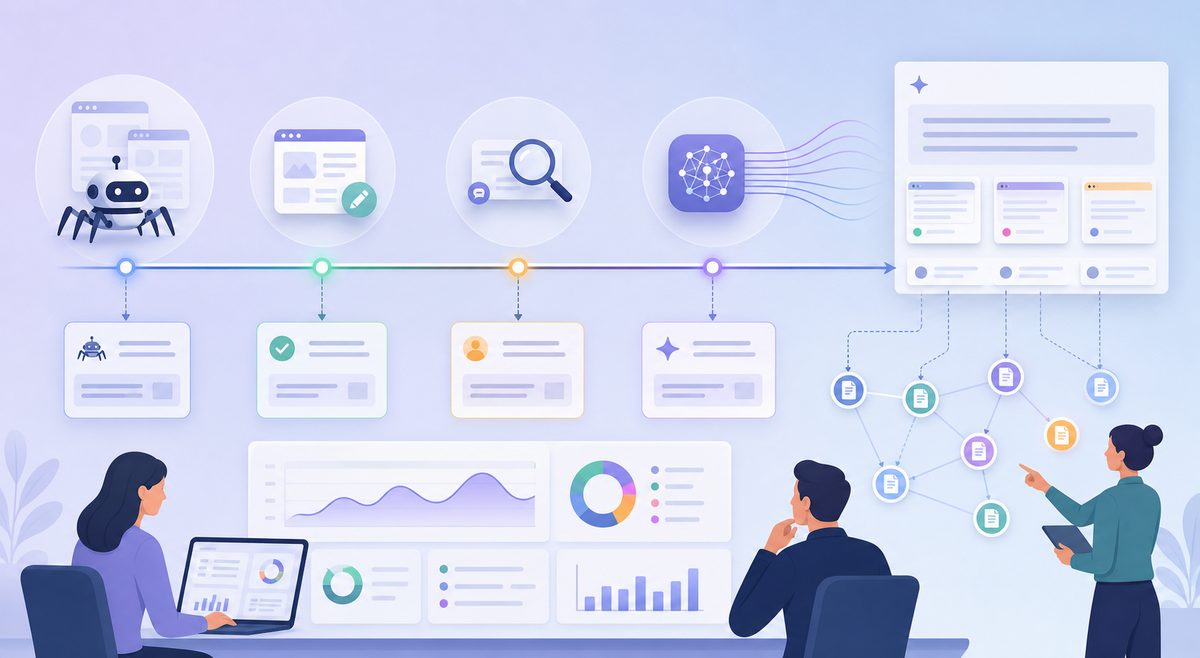
What AI Crawler Log Analysis Answers
AI crawler log analysis answers four operational questions:
- Can AI systems access priority URLs?
- Which bots or user-triggered fetchers visited which pages?
- Did crawled pages later gain citations, mentions, or better recommendation positions?
- When crawl access is clean but citations do not improve, what should be fixed next?
Traditional SEO log analysis focuses on search engine crawl budget, status codes, crawl waste, and indexation signals. AI crawler log analysis adds a second dataset: prompt-level visibility in ChatGPT, Gemini, Claude, Perplexity, Copilot, Google AI Overviews, and AI Mode.
The goal is a conservative decision system. You are not proving that OAI-SearchBot hit /compare/ at 09:14 UTC and therefore ChatGPT cited it three days later. You are building enough evidence to say: this URL was accessible, this content changed, this AI crawler saw it, and the answer layer moved within a plausible lag window.
Why Bot Hits Alone Are a Weak KPI
A raw AI bot hit means a request happened. It does not mean the page was indexed, trusted, retrieved, cited, or used in a recommendation.
The biggest reporting error is treating all AI crawler traffic as visibility. A better model separates three layers:
| Layer | What it proves | What it does not prove |
|---|---|---|
| Access | A bot or fetcher reached a URL and received a response | The content was understood or stored |
| Extractability | The important content was visible in HTML, not blocked, thin, or hidden behind scripts | The source is authoritative enough to cite |
| Answer impact | Mentions, citations, ranks, or facts changed in monitored AI answers | One crawl caused the change by itself |
This is why the core artifact should be a Crawl-to-Citation Ledger, not a chart of bot visits.
Which AI Crawlers and Fetchers Should You Track?
Track AI crawler hits when the bot identity, purpose, URL, response code, and timing are reliable enough to compare with later answer data. Do not mix training crawlers, search crawlers, and user-triggered fetchers in one bucket.
OpenAI documents separate agents for search, training, and user actions in its crawler documentation. Anthropic describes ClaudeBot, Claude-User, and Claude-SearchBot in its crawler guidance. Perplexity documents PerplexityBot and Perplexity-User in its crawler documentation.
| Bot or fetcher | Main purpose | How to use it in AI crawler log analysis |
|---|---|---|
OAI-SearchBot |
ChatGPT search features | High priority for ChatGPT citation tracking |
GPTBot |
OpenAI model training collection | Track for training policy, not direct search citation proof |
ChatGPT-User |
User-triggered page fetches | Treat as answer-time retrieval evidence |
Claude-SearchBot |
Claude search result quality | High priority for Claude visibility checks |
ClaudeBot |
Anthropic model development | Track separately from search visibility |
Claude-User |
User-triggered Claude retrieval | Useful for answer-time access diagnostics |
PerplexityBot |
Perplexity search results | High priority for Perplexity citation tracking |
Perplexity-User |
User-triggered Perplexity retrieval | Treat as answer-time retrieval evidence |
Googlebot |
Google Search crawling | Relevant for Google AI Overviews and AI Mode eligibility |
Google-Extended |
Robots.txt product token, not a crawler UA | A policy control for some Google AI uses, not a log user-agent |
The practical rule: search-oriented crawlers belong in crawl-to-citation reporting; training crawlers belong in governance reporting; user fetchers belong in answer-time retrieval reporting.
What Logs and Fields Do You Need?
Use CDN logs first when possible. Server logs can miss AI traffic served from cache, blocked at the edge, challenged by a WAF, or redirected before it reaches the origin.
Export at least 30 days for a first audit and 90 days for a useful baseline. Keep these fields:
| Field | Why it matters |
|---|---|
| Timestamp in UTC | Required for lag-window analysis |
| Host and path | Separates main site, docs, app, blog, and support subdomains |
| Query string | Helps remove tracking parameters and identify duplicate URLs |
| HTTP method | Separates normal GET from HEAD, OPTIONS, or odd probes |
| Status code | Shows access failures, redirects, and server errors |
| User-agent | Starts bot identification |
| Source IP | Required for IP validation or reverse DNS checks |
| Referrer | Helps identify user-triggered paths when present |
| Response bytes | Flags thin, blocked, or empty responses |
| Cache status | Shows whether the bot hit CDN cache or origin |
| WAF action | Explains blocks, challenges, rate limits, and managed rules |
| Country or ASN | Useful for anomaly review, not proof of identity |
| Final URL after redirect | Prevents splitting evidence across duplicate paths |
For multi-subdomain SaaS sites, keep content type as a derived field: homepage, product, docs, blog, comparison, pricing, customers, support, changelog, or glossary. AI systems often cite documentation and comparison pages for very different prompts.
How to Prepare Logs Before Analysis
Normalize logs before you compare them with AI citations. Raw exports are usually too noisy.
- Canonicalize URLs. Lowercase hosts, resolve trailing slashes, strip UTM and ad parameters, and map redirects to final canonical URLs.
- Filter non-content assets. Exclude images, fonts, CSS, JavaScript, health checks, and tracking pixels from citation analysis. Keep
robots.txthits in a separate access-policy table. - Group by URL and crawl window. Use 24-hour windows for active sites and 7-day windows for low-volume sites.
- Separate bot purposes. Keep
GPTBotseparate fromOAI-SearchBot; keepClaudeBotseparate fromClaude-SearchBot. - Mark page state. Record content update time, schema changes, internal link changes, robots rules, canonical tags, noindex status, and WAF changes.
- Create a clean URL inventory. Every log row should roll up to one canonical URL that also exists in your AI monitoring dataset.
A simple grouping query after bot verification might look like this:
SELECT
  canonical_url,
  content_type,
  bot_name,
  DATE_TRUNC(timestamp_utc, DAY) AS crawl_window,
  COUNT(*) AS verified_hits,
  MIN(timestamp_utc) AS first_hit_utc,
  MAX(timestamp_utc) AS last_hit_utc,
  COUNTIF(status_code BETWEEN 200 AND 299) AS ok_hits,
  COUNTIF(status_code IN (301, 302, 307, 308)) AS redirect_hits,
  COUNTIF(status_code IN (401, 403, 429)) AS blocked_hits,
  COUNTIF(status_code >= 500) AS server_error_hits,
  SUM(response_bytes) AS total_response_bytes
FROM verified_ai_crawler_logs
WHERE is_content_url = TRUE
GROUP BY 1, 2, 3, 4;
The query is intentionally boring. The value comes from verified identity, canonical URLs, and consistent crawl windows.
How to Verify AI Crawler Identity
Verification means proving that a request probably came from the bot operator, not just from a user-agent string that anyone can copy.
Use a three-level evidence model:
| Level | Requirement | Reporting label |
|---|---|---|
| Candidate | User-agent matches a known AI bot pattern | Discovery only |
| Verified | User-agent plus published IP range or reverse DNS validation | Safe for reporting |
| Disputed or unknown | Bot-like behavior, mismatched IP, generic browser UA, or failed validation | Investigate separately |
Google says its crawlers identify through user-agent, source IP, and reverse DNS hostname in its crawler overview. OpenAI and Perplexity publish IP JSON endpoints from their crawler docs. Use those endpoints as live sources, not pasted IP lists in a spreadsheet.
Verification is not theoretical. Cloudflare reported in 2025 that it observed Perplexity-related traffic using undeclared user agents and IPs outside the published ranges, including millions of requests per day across affected observations, in its Perplexity crawling investigation. Whether you allow or block a bot, keep verified and disputed traffic separate.
The Crawl-to-Citation Ledger
The Crawl-to-Citation Ledger is a URL-level table that joins page changes, verified AI crawler hits, prompt checks, and later answer outcomes. It turns AI crawler log analysis from a traffic report into a prioritization system.
Build one row per canonical URL per crawl window.
| Column | Example | Why it matters |
|---|---|---|
canonical_url |
/blog/ai-search-monitoring-methodology |
Joins logs to prompt outcomes |
content_type |
blog_explainer |
Shows which formats earn citations |
last_content_update_utc |
2026-07-03 16:20 |
Separates stale crawls from post-update crawls |
bot_name |
OAI-SearchBot |
Keeps crawler purpose clear |
verified_hits |
14 |
Measures real access, not spoofed traffic |
first_hit_utc and last_hit_utc |
2026-07-04 |
Defines the crawl window |
status_summary |
13x 200, 1x 304 |
Flags access quality |
indexability_state |
indexable, canonical self |
Explains Google AI eligibility issues |
render_state |
HTML answer visible |
Shows whether the answer can be extracted |
prompt_set_id |
b2b-saas-comparison-v3 |
Prevents measurement drift |
baseline_citations |
2 |
Pre-crawl answer state |
post_window_citations |
6 |
Post-crawl answer state |
baseline_rank |
not listed |
Recommendation position before |
post_window_rank |
#4 |
Recommendation position after |
answer_fact_change |
new pricing caveat included |
Tracks description accuracy |
confidence_label |
moderate |
Prevents overclaiming |
The ledger should produce backlog decisions. If documentation gets crawled and cited, expand technical pages. If pricing gets crawled but never cited, stop expecting pricing pages to answer informational prompts.
How to Connect Bot Hits to Later AI Citations
Use the same prompt set before and after crawl windows. Changing prompts, markets, language, or competitor lists will create false movement.
- Select 20 to 100 stable prompts across informational, comparison, category, problem-aware, and brand-aware intent.
- Record baseline mentions, citations, source URLs, recommendation rank, sentiment, and repeated facts.
- Export verified AI crawler hits for the same URLs and dates.
- Mark page changes that happened before the crawl: copy, schema, internal links, statistics, quotes, pricing, screenshots, or author updates.
- Re-run the same prompt set daily for 14 days, then weekly through day 45 for slower systems.
- Compare citation and mention changes inside defined lag windows.
- Flag URLs with clean crawl access but no answer improvement.
- Prioritize fixes by bottleneck: access, extractability, answer fit, authority, or third-party source quality.
For prompt design, use a controlled methodology rather than one-off manual searches. MaxAEO's guide to creating a prompt set for AI brand monitoring explains how to keep prompt samples stable enough for trend analysis.
What Lag Window Should You Use?
Use separate lag windows because AI systems crawl, retrieve, cache, index, and generate answers differently.
| Lag window | Best use | What to watch |
|---|---|---|
| 0-2 days | User-triggered fetches and fast retrieval systems | ChatGPT-User, Claude-User, Perplexity-User, sudden source changes |
| 3-14 days | Search-style crawling and refreshed answer sources | OAI-SearchBot, Claude-SearchBot, PerplexityBot, repeated citations |
| 15-45 days | Slower discovery, repeated crawls, competitor shifts | Topic authority, third-party pages, Google-oriented movement |
For Google AI Overviews and AI Mode, do not treat a bot hit as enough. Google's documentation says supporting links must be indexed and eligible to show a snippet, and that there are no extra technical requirements beyond Google Search eligibility. It also notes that AI Overviews and AI Mode can use query fan-out, so the cited source set may differ from classic rankings. See Google's AI features guidance and MaxAEO's guide on appearing in Google AI Overviews for the broader search context.
How to Score Evidence Without Overclaiming
AI crawler log analysis should use confidence labels. Causation language is usually too strong.
| Evidence level | Pattern | Interpretation |
|---|---|---|
| Weak | One verified bot hit followed by one mention change | Useful lead, not proof |
| Moderate | Verified crawl, unchanged prompt, citation gain within 14 days | Investigate page changes and competitors |
| Strong | Multiple verified crawls, repeated citation gains, stable prompt set, same URL cited | Prioritize similar content updates |
| Negative | Verified crawl, 2xx status, no citation gain after 30 days | Access is not the main bottleneck |
| Contradictory | Citation gain without visible crawl | Check search indexes, caches, third-party sources, and logging gaps |
A good executive report should say "strong correlation" or "likely bottleneck," not "the bot caused this citation."
A Worked Example of Crawl-to-Citation Yield
Here is an anonymized example structure using 2,481 verified AI crawler log rows, 42 canonical URLs, and 180 daily prompt checks across 30 days. The point is the method, not a universal benchmark.
| URL group | Verified AI crawler hits | Main bot | 14-day citation change | Crawl-to-citation yield | Interpretation |
|---|---|---|---|---|---|
/compare/ pages |
318 | OAI-SearchBot |
+9 citations | High | Comparison content has strong answer fit |
/docs/ pages |
1,044 | PerplexityBot |
+3 citations | Medium | Cited for technical prompts, not category prompts |
/blog/ explainers |
587 | Claude-SearchBot |
+7 mentions | Medium | Good mention lift, weak owned-source citation rate |
/pricing/ pages |
96 | Mixed | 0 citations | Low | Crawled but not useful for informational answers |
/customers/ pages |
211 | Googlebot |
+2 supporting links | Low-medium | Proof points help, but only for use-case prompts |
The useful insight is not "more crawls equals more citations." The useful insight is that comparison and explanatory pages converted crawl access into answer visibility better than pricing pages. That points the content team toward evidence-rich comparisons, definitions, and proof sections instead of generic bot chasing.
Use this simple formula:
Crawl-to-citation yield =
URLs with verified crawl and new citations inside the lag window
/
URLs with verified crawl inside the same window
Segment that yield by content type, bot, prompt intent, and page freshness. Aggregate numbers hide the bottleneck.
What to Fix When Bots Crawl but Citations Do Not Improve
If verified AI crawlers reach a page and citations do not improve, the bottleneck is usually answer fit, extractability, authority, or source reinforcement.
| Symptom | Likely bottleneck | Fix |
|---|---|---|
| Verified 200 responses, no citations | Page does not directly answer monitored prompts | Add answer-first definitions, steps, tables, and concrete examples |
| Bot receives 403, 429, CAPTCHA, or WAF challenge | Access blocked at the edge | Update WAF rules using verified IP sources and retest |
| Bot receives thin HTML shell | Important content depends on client-side rendering | Put core answers in server-rendered HTML |
| Page is crawled but a third-party page is cited | Third party is more authoritative or clearer | Improve owned source page and strengthen external references |
| Brand is mentioned but not cited | Mention-to-citation gap | Add original data, named proof points, and citable source sections |
| AI answer repeats stale facts | Old source still dominates | Update owned pages, partner pages, review profiles, docs, and comparison pages |
For the content layer, make the target answer visible in the first few paragraphs. Add concise definitions, comparison tables, named use cases, dates, limitations, and source-backed claims. For the broader GEO process, use MaxAEO's AI search optimization checklist to connect page-level fixes with entity and authority work.
What If Citations Improve Without Visible AI Crawler Hits?
Citation gains without visible AI crawler hits are normal. They do not automatically mean your logging is broken.
Common explanations include:
- The answer engine used a search index instead of fetching your page directly.
- The source was cached before your log window.
- The cited fact came from a third-party page, marketplace, review site, GitHub repo, analyst page, documentation mirror, or press article.
- The fetch happened through a user-triggered agent that you did not classify correctly.
- CDN, WAF, or sampling settings excluded the relevant request.
- The AI answer changed because competitors moved, not because your page was crawled.
Run a source attribution review. Capture the cited URLs, repeated facts, nearby competitors, and description accuracy. MaxAEO's AI search monitoring methodology is useful here because crawler analysis only works when prompt sampling and source capture are consistent.
How Robots.txt, WAF Rules, and llms.txt Fit In
Robots.txt is a crawl preference mechanism, not a visibility guarantee. The Robots Exclusion Protocol is standardized in RFC 9309, which also makes clear that robots.txt is not an access authorization system.
For AI visibility, treat access policy as a matrix:
| Control | What it can do | What it cannot do |
|---|---|---|
robots.txt |
Allow or disallow declared crawlers that honor the protocol | Force citation or stop all unauthorized access |
| WAF rules | Allow, challenge, rate-limit, or block traffic at the edge | Tell you whether a page deserves citation |
noindex and snippet controls |
Affect Google Search eligibility and preview behavior | Control every non-Google AI answer |
llms.txt |
Provide AI-oriented content guidance when systems choose to use it | Replace robots.txt, schema, or strong content |
| Published bot IP validation | Reduce spoofing risk in reports | Identify every stealth or third-party retrieval path |
Google's common crawler documentation says Google-Extended is a robots.txt product token and does not affect inclusion or ranking in Google Search. Use Google's common crawler documentation for that distinction.
If you are deciding whether to allow or block specific bots, start with MaxAEO's block or allow AI crawlers guide. If you are evaluating llms.txt, use it as a supplemental publishing signal and read MaxAEO's llms.txt guide before treating it as an operational control.
Metrics for an Executive AI Visibility Report
Executives do not need raw log exports. They need a short chain from access to visibility to action.
| Metric | What it answers |
|---|---|
| Verified AI crawler coverage | Can priority AI bots access priority URLs? |
| Clean crawl rate | What share of verified requests returned usable 2xx HTML? |
| Crawl-to-citation yield | Which crawled URLs later gained citations? |
| Mention-to-citation gap | Are AI systems naming the brand without sourcing it? |
| Prompt-level AI share of voice | How often does the brand appear versus competitors? |
| Recommendation rank movement | Did the brand move up or down in shortlist-style answers? |
| Source accuracy rate | Are cited facts current and correct? |
| Fix impact backlog | Which crawl, content, or authority changes are next? |
The strongest report has one page for leadership and one appendix for analysts. Leadership sees trend, risk, and next actions. Analysts see verified bots, URL groups, lag windows, prompt sets, and confidence labels.
Common Mistakes in AI Crawler Log Analysis
Mistake 1: Treating every AI bot hit as a win. A request is only access evidence.
Mistake 2: Mixing bot purposes. GPTBot is not OAI-SearchBot; ClaudeBot is not Claude-SearchBot; PerplexityBot is not Perplexity-User.
Mistake 3: Reporting unverified user-agent matches. User-agent strings are easy to spoof. Use IP validation, reverse DNS, or published ranges where available.
Mistake 4: Ignoring CDN and WAF data. Origin server logs can miss blocked, challenged, redirected, or cached AI traffic.
Mistake 5: Measuring answer changes too soon. Use 0-2, 3-14, and 15-45 day windows before judging impact.
Mistake 6: Forgetting third-party sources. AI answers often cite review sites, directories, analyst pages, GitHub repositories, or documentation mirrors instead of the brand site.
Mistake 7: Changing prompts mid-test. Prompt drift can look like visibility movement. Keep prompt sets stable and versioned.
Practical Checklist
Use this checklist for a first AI crawler log analysis project:
- Export 30 to 90 days of CDN, WAF, and origin logs.
- Build a canonical URL inventory for priority content.
- Classify AI bots by purpose: search, training, or user-triggered fetch.
- Verify bot identity with published IP ranges or reverse DNS where possible.
- Remove static assets and duplicate URL variants.
- Group verified hits by canonical URL and crawl window.
- Record page changes, indexability, robots rules, WAF actions, and render state.
- Run a stable prompt set before and after crawl windows.
- Build the Crawl-to-Citation Ledger.
- Score evidence as weak, moderate, strong, negative, or contradictory.
- Prioritize fixes by bottleneck, not by bot volume.
FAQ
What is AI crawler log analysis?
AI crawler log analysis is the process of verifying AI bot and fetcher visits in server, CDN, or WAF logs, then comparing those visits with later AI citations, brand mentions, recommendation rankings, and answer changes across monitored prompts.
Does AI crawler log analysis prove that a bot visit caused an AI citation?
No. It shows timing and access evidence. It can support a strong hypothesis when verified crawls, page changes, stable prompts, and citation gains align, but it should not be reported as one-to-one causation.
How many days of logs should a SaaS site analyze?
Use at least 30 days for an initial audit and 90 days for a stronger baseline. Smaller sites and slower-moving topics need longer windows because AI crawler visits and citation changes can be sparse.
Should GPTBot traffic be included in AI citation reports?
Track GPTBot, but do not treat it as direct ChatGPT search citation evidence. OpenAI separates GPTBot for model training from OAI-SearchBot for search features, so those bots should appear in different report sections.
Why did AI tools cite competitors after crawling our site?
A crawl only proves access. Competitors may have clearer definitions, better comparison pages, stronger third-party validation, fresher documentation, or more extractable proof points. The fix is usually content and authority work, not more crawler traffic.
What is the fastest way to start?
Pick 20 priority URLs, 20 high-intent prompts, and 30 days of logs. Verify AI crawler hits, build a small Crawl-to-Citation Ledger, and find pages with clean access but weak citation movement. That becomes the first AI visibility backlog.
Bottom Line
AI crawler log analysis turns bot traffic into a visibility diagnostic. It shows whether AI systems can access important pages, whether those pages later appear in AI answers, and which bottleneck should be fixed next.
The useful question is not "Did an AI bot visit us?" The useful question is: which verified crawl events, page changes, and prompt outcomes changed our AI search visibility? Answer that with clean logs, stable prompts, conservative lag windows, and a Crawl-to-Citation Ledger.